Within Health Habits
The cue that makes a habit easier
A habit plan works better when a clear daily cue tells the brain when to start the behaviour.
On this page
- Why repetition needs a recognisable cue
- Daily events, places, transitions, and objects
- How to choose a cue that survives real life
Page outline Jump by section
Introduction
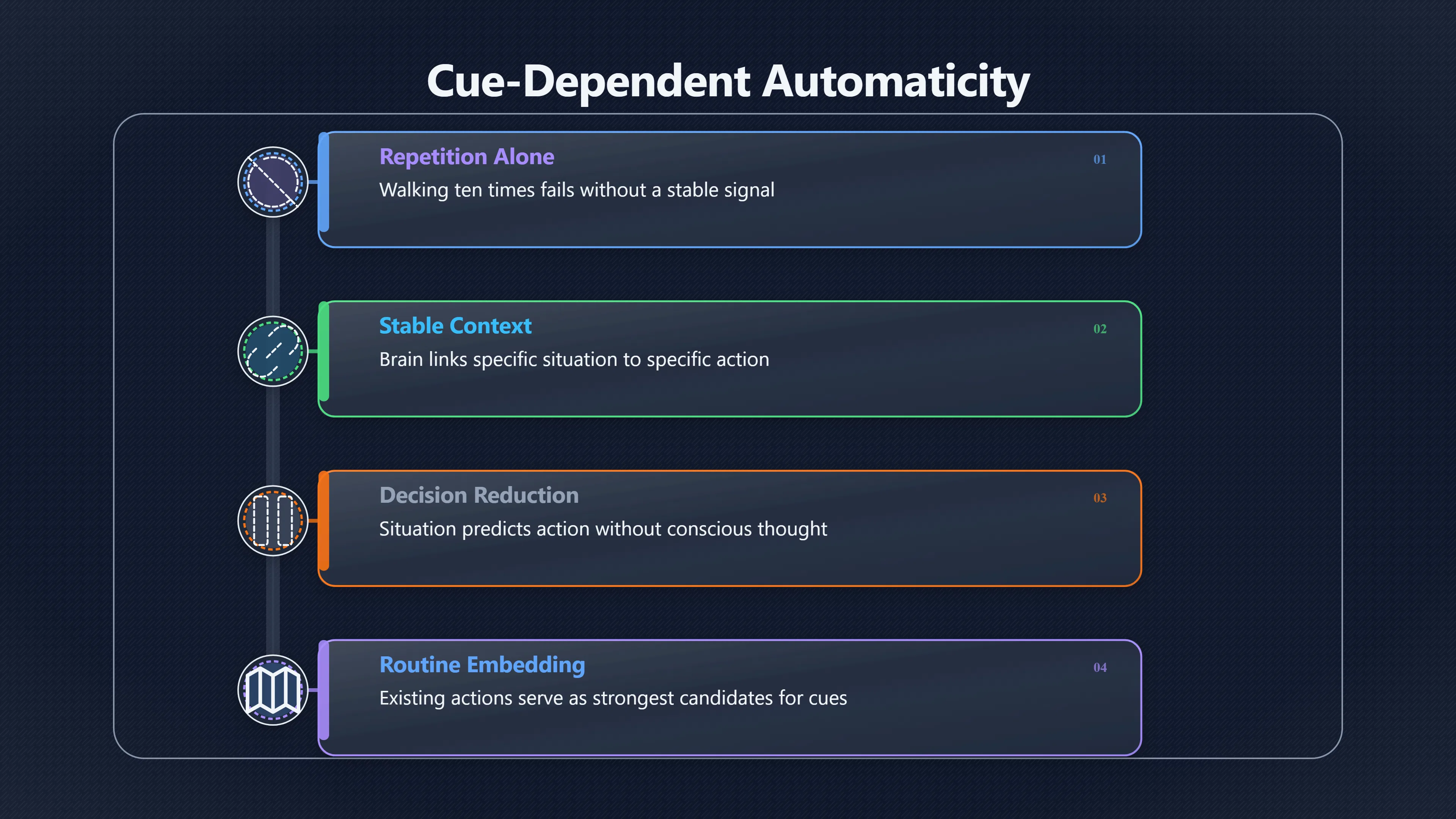
One of the strongest findings in health habit research is that repetition alone is not what makes a behaviour automatic. A habit becomes automatic when repetition happens in the presence of a stable cue that reliably signals when the behaviour should begin. In other words, the brain learns a link between a specific context and a specific action. Over time, encountering the cue starts to trigger the behaviour with less conscious effort, planning, or motivation. Research on health behaviours consistently describes habits as cue-dependent automatic responses rather than merely behaviours performed frequently.[Taylor & Francis Online]tandfonline.comTaylor & Francis OnlinePromoting habit formation: Health Psychology Reviewby P Lally · 2013 · Cited by 1243 — Habits are automatic behavi… ResearchGate For people interested in self-improvement that works[researchgate.net]researchgate.netThe Automatic Component of Habit in Health BehaviorObjective: Habit might be usefully characterized as a form of automaticity that involv…, this distinction matters. Many failed health plans rely on intentions such as “exercise more” or “eat healthier” without defining a stable cue. The evidence suggests that a recognisable cue is often the missing mechanism that turns effortful behaviour into something that feels increasingly natural. PubMed Central[Taylor & Francis Online]tandfonline.comTaylor & Francis OnlinePromoting habit formation: Health Psychology Reviewby P Lally · 2013 · Cited by 1243 — Habits are automatic behavi…

Why repetition needs a recognisable cue
Habit researchers define automaticity as behaviour that is triggered by a context with relatively little conscious deliberation. The cue is not an optional extra added to repetition; it is part of the mechanism through which repetition becomes automatic. Repeating a behaviour in the same context strengthens a cue–response association, making the behaviour easier to initiate when the cue reappears. PubMed Central[Taylor & Francis Online]tandfonline.comTaylor & Francis OnlinePromoting habit formation: Health Psychology Reviewby P Lally · 2013 · Cited by 1243 — Habits are automatic behavi…
This helps explain a common frustration. Someone may successfully walk for exercise ten times in a month yet still not feel that walking has become a habit. If those walks happened at unpredictable times and under changing circumstances, the brain had little opportunity to learn a reliable cue–response pattern. By contrast, a shorter walk performed after the same daily event may become automatic more quickly because the cue remains stable. PubMed Central[Taylor & Francis Online]tandfonline.comTaylor & Francis OnlinePromoting habit formation: Health Psychology Reviewby P Lally · 2013 · Cited by 1243 — Habits are automatic behavi…
Research reviews repeatedly emphasise that habits are not best understood as frequency alone. Frequency matters because it provides learning opportunities, but automaticity develops when behaviour is repeatedly enacted in a consistent context. PubMed Central[EHPS]ehps.netHabit as automaticity, not frequencyby B Gardner · 2012 · Cited by 257 — Empirical work has demonstrated that, because habits are trigger…
What context stability actually does
A stable context reduces the number of decisions required before action. Instead of asking, “Should I do this now?”, the brain learns that a particular situation predicts a particular behaviour.
Studies examining intentional habit building have found that greater context stability is associated with stronger automaticity. People who repeatedly perform a target behaviour under similar conditions tend to report that the behaviour becomes easier, faster to initiate, and less dependent on conscious motivation.[Frontiers]frontiersin.orgFrontiersContext Stability in Habit Building Increases Automaticity…by M Stojanovic · 2022 · Cited by 18 — In this paper, we investiga…[PubMed Central]pmc.ncbi.nlm.nih.govPubMed CentralA review and analysis of the use of 'habit' in understanding…by B Gardner · 2014 · Cited by 1340 — The mechanism that un…
The practical implication is simple: consistency of cue often matters more than intensity of commitment.
Daily events, places, transitions, and objects
Not all cues are equally useful. The most reliable cues are those that occur naturally and predictably in everyday life.
Researchers studying health habit formation frequently distinguish between cues tied to existing routines and cues tied to more variable circumstances. Effective cues tend to be encountered whether motivation is high or low.[Taylor & Francis Online]tandfonline.comTaylor & Francis OnlinePromoting habit formation: Health Psychology Reviewby P Lally · 2013 · Cited by 1243 — Habits are automatic behavi…[King's College London]kclpure.kcl.ac.ukexperiences of habit formation a qualitative studyKing's College LondonExperiences of habit formation: A qualitative studyby P Lally · 2011 · Cited by 365 — Results showed that behaviour…
Daily events
Existing actions are among the strongest candidates for habit cues because they already happen regularly.
Examples include:
- After brushing teeth, floss.
- After making morning tea, take a vitamin.
- After lunch, walk for ten minutes.
- After arriving home, prepare vegetables for dinner.
These cues benefit from being embedded within routines that already exist. The behaviour does not require remembering a new time slot; it is attached to something that is already part of daily life.[PubMed Central]pmc.ncbi.nlm.nih.govPubMed CentralA review and analysis of the use of 'habit' in understanding…by B Gardner · 2014 · Cited by 1340 — The mechanism that un…[King's College London]kclpure.kcl.ac.ukexperiences of habit formation a qualitative studyKing's College LondonExperiences of habit formation: A qualitative studyby P Lally · 2011 · Cited by 365 — Results showed that behaviour…
Places
Locations can also become powerful cues.
For example:
- Stretch immediately after entering the living room in the evening.
- Fill a water bottle when arriving at the office.
- Use stairs when reaching a specific building entrance.
Repeatedly performing the same action in the same place strengthens the contextual association. Place-based cues are especially useful because physical environments remain visible even when attention drifts.[cambridge]cambridge.orgAfter many repetitions, mental representations of habitual action are formed…Read more… University Press & Assessment[Taylor & Francis Online]tandfonline.comTaylor & Francis OnlinePromoting habit formation: Health Psychology Reviewby P Lally · 2013 · Cited by 1243 — Habits are automatic behavi…
Transitions
Behavioural transitions are often overlooked but highly reliable.
Transitions include:
- Finishing work.
- Leaving the house.
- Returning from school.
- Sitting down for breakfast.
- Getting into bed.
These moments naturally divide the day into segments. Because they occur repeatedly, they can serve as dependable signals for health behaviours. Habit researchers often describe previous actions and routine sequences as important contextual triggers.[Simply Psychology]simplypsychology.comSimply Psychology The Science of Habit FormationSimply PsychologyThe Science of Habit Formation - Simply Psychology6 days ago — Cue — A trigger that initiates the behavior (location, ti…[Taylor & Francis Online]tandfonline.comTaylor & Francis OnlinePromoting habit formation: Health Psychology Reviewby P Lally · 2013 · Cited by 1243 — Habits are automatic behavi…

Objects
Visible objects can act as environmental prompts.
Examples include:
- A water bottle placed on a desk.
- Walking shoes left beside the front door.
- Medication next to a toothbrush.
- A fruit bowl positioned on the kitchen counter.
The object itself is not magical. Its value comes from repeatedly appearing in the same context where the behaviour occurs. Over time, seeing the object can become part of the cue structure that prompts action.[Simply Psychology]simplypsychology.comSimply Psychology The Science of Habit FormationSimply PsychologyThe Science of Habit Formation - Simply Psychology6 days ago — Cue — A trigger that initiates the behavior (location, ti…[SOW]sow.knox.nsw.edu.auSOWForming positive habitspositive habits - SOW - Knox Science of WellbeingOnce habits are formed, context cues prompt automatic, unconscious activation of the beh…
How to choose a cue that survives real life
Many habit plans fail because the chosen cue sounds good in theory but disappears under real-world conditions.
The key question is not whether a cue is memorable on an ideal day. The key question is whether it still appears on busy days, stressful days, travel days, and ordinary days.
Prefer cues that already happen
A cue based on an existing routine is usually more robust than a cue that requires creating a new routine from scratch.
“After breakfast” is generally more stable than “at exactly 7:15 a.m.” because breakfast may happen even when schedules shift. Research comparing routine-based and time-based cue planning found that both approaches can support habit formation when enacted consistently, but the critical factor is repeated performance in response to the chosen cue. PubMed[Open Research Surrey]openresearch.surrey.ac.ukHabit formation following routine based versus time basedOpen Research SurreyHabit formation following routine-based versus time-based…by J Keller · 2021 · Cited by 148 — Group-level analyses…
Avoid cues that depend on motivation
“Whenever I feel energetic” is a weak cue.
“After I put down my lunch plate” is a stronger cue.
A useful cue is observable and specific. It should occur whether enthusiasm is present or absent. Habits become valuable precisely because they reduce dependence on fluctuating motivation.[Taylor & Francis Online]tandfonline.comTaylor & Francis OnlinePromoting habit formation: Health Psychology Reviewby P Lally · 2013 · Cited by 1243 — Habits are automatic behavi…[EHPS]ehps.netHabit as automaticity, not frequencyby B Gardner · 2012 · Cited by 257 — Empirical work has demonstrated that, because habits are trigger…

Match the cue to the behaviour
The cue should make practical sense for the action.
Examples:
- Taking medication after breakfast.
- Drinking water when sitting down at a desk.
- Stretching after a shower.
- Walking after lunch.
The closer the cue is to the desired behaviour in time and location, the fewer obstacles exist between cue and action. This increases the likelihood of repetition and therefore strengthens automaticity.[Taylor & Francis Online]tandfonline.comTaylor & Francis OnlinePromoting habit formation: Health Psychology Reviewby P Lally · 2013 · Cited by 1243 — Habits are automatic behavi…[Taylor & Francis Online]tandfonline.comTaylor & Francis OnlinePromoting habit formation: Health Psychology Reviewby P Lally · 2013 · Cited by 1243 — Habits are automatic behavi…
The most common cue-selection mistakes
One mistake is treating reminders as cues. A phone notification can prompt behaviour, but if the behaviour never becomes linked to a stable everyday context, it may remain dependent on external prompting.
A second mistake is using cues that occur inconsistently. A habit attached to an event that only happens twice a week will have fewer opportunities to strengthen than one attached to a daily routine. PubMed Central[Taylor & Francis Online]tandfonline.comTaylor & Francis OnlinePromoting habit formation: Health Psychology Reviewby P Lally · 2013 · Cited by 1243 — Habits are automatic behavi…
A third mistake is changing cues too often. If someone alternates between morning, afternoon, and evening depending on convenience, the brain receives mixed signals about when the behaviour belongs. Context stability research suggests that predictable contexts support stronger growth in automaticity than constantly changing ones.[Frontiers]frontiersin.orgFrontiersContext Stability in Habit Building Increases Automaticity…by M Stojanovic · 2022 · Cited by 18 — In this paper, we investiga…[PubMed Central]pmc.ncbi.nlm.nih.govPubMed CentralA review and analysis of the use of 'habit' in understanding…by B Gardner · 2014 · Cited by 1340 — The mechanism that un…
The central lesson from habit research
The cue is not merely a reminder; it is the mechanism that allows repetition to become automatic. Health habits develop when a recognisable part of everyday life consistently precedes the same behaviour. Whether the cue is a meal, a location, a transition, or a visible object, its job is to answer the question “when do I start?” before motivation has a chance to negotiate.
The evidence across habit-formation research points to the same conclusion: stable cues help transform health behaviours from repeated acts of effort into increasingly automatic responses to familiar situations.[ResearchGate]researchgate.netThe Automatic Component of Habit in Health BehaviorObjective: Habit might be usefully characterized as a form of automaticity that involv…[Taylor & Francis Online]tandfonline.comTaylor & Francis OnlinePromoting habit formation: Health Psychology Reviewby P Lally · 2013 · Cited by 1243 — Habits are automatic behavi…[PubMed Central]pmc.ncbi.nlm.nih.govPubMed CentralA review and analysis of the use of 'habit' in understanding…by B Gardner · 2014 · Cited by 1340 — The mechanism that un…
Amazon book picks
Further Reading
Books and field guides related to The cue that makes a habit easier. Use these as the next step if you want deeper reading beyond the article.
Atomic Habits
Rating: 3.5/5 from 7 Google Books ratings
Shows how environment and cues drive repeated actions.
eBay marketplace picks
Marketplace Samples
Example marketplace items related to this page. Use the search link to explore similar finds on eBay.


Endnotes
1.
Source: researchgate.net
Link:https://www.researchgate.net/profile/Bas-Verplanken/publication/45364462_The_Automatic_Component_of_Habit_in_Health_Behavior_Habit_as_Cue-Contingent_Automaticity/links/5535045b0cf2df9ea6a42a91/The-Automatic-Component-of-Habit-in-Health-Behavior-Habit-as-Cue-Contingent-Automaticity.pdf
Source snippet
The Automatic Component of Habit in Health BehaviorObjective: Habit might be usefully characterized as a form of automaticity that involv...
2.
Source: cambridge.org
Link:https://www.cambridge.org/core/books/handbook-of-behavior-change/changing-behavior-using-habit-theory/5F222BC3AF6ADD9A8307BBB726D43F5C
Source snippet
After many repetitions, mental representations of habitual action are formed...Read more...
3.
Source: ehps.net
Link:https://www.ehps.net/ehp/index.php/contents/article/download/ehp.v14.i2.p32/1012
Source snippet
Habit as automaticity, not frequencyby B Gardner · 2012 · Cited by 257 — Empirical work has demonstrated that, because habits are trigger...
4.
Source: researchgate.net
Link:https://www.researchgate.net/publication/348328187_Habit_formation_following_routine-based_versus_time-based_cue_planning_A_randomized_controlled_trial
Source snippet
Habit formation following routine‐based versus time‐based cue...To initiate habit formation, self‐regulation interventions can support i...
5.
Source: sow.knox.nsw.edu.au
Title: SOWForming positive habits
Link:https://sow.knox.nsw.edu.au/parents/forming-positive-habits/
Source snippet
positive habits - SOW - Knox Science of WellbeingOnce habits are formed, context cues prompt automatic, unconscious activation of the beh...
6.
Source: dictionary.cambridge.org
Link:https://dictionary.cambridge.org/dictionary/english-chinese-traditional/habit
Source snippet
in Traditional Chinese - Cambridge DictionaryHABIT translate: 重複的行爲, 習慣, 壞習慣,毛病, 毒癮, 衣服, (僧侶或修女穿的)衣服,長袍. Learn more in the Cambridge Engl...
7.
Source: researchgate.net
Title: 357418657 The review of habit forming theories and tools for well being
Link:https://www.researchgate.net/publication/357418657_The_review_of_habit-forming_theories_and_tools_for_well-being
Source snippet
Dual Process Theory, modern habit theory, and [Goal Setting]({{ 'goal-setting/' | relative_url }}) Theory.Read more...
8.
Source: researchgate.net
Link:https://www.researchgate.net/profile/Gonzalo_Marchant/post/Do-you-know-what-the-recommendation-is-for-physical-activity-and-sedentary-behavior-to-health/attachment/59d620af79197b807797f284/AS%3A291995114328067%401446628468694/download/Phillippa%2BLally%2C%2BJane%2BWardle%2Band%2BBenjamin%2BGardner.%2BExperiences%2Bof%2Bhabits%2Bformation%2B2011..pdf
Source snippet
Experiences of habit formation: A qualitative studyHabits are automatic responses to contextual cues, acquired through repetition of beha...
9.
Source: researchgate.net
Link:https://www.researchgate.net/publication/330406744_Habit_Formation_and_Behavior_Change
Source snippet
nge interventions, drawing on the most methodologically and...Read more...
10.
Source: researchgate.net
Title: How does habit form?
Link:https://www.researchgate.net/publication/358786633_How_does_habit_form_Guidelines_for_tracking_real-world_habit_formation
Source snippet
Guidelines for tracking real-world...Feb 7, 2022 — Habitual behaviors are automatic responses to specific cues, acquired through repetit...
11.
Source: researchgate.net
Link:https://www.researchgate.net/publication/45364462_The_Automatic_Component_of_Habit_in_Health_Behavior_Habit_as_Cue-Contingent_Automaticity
Source snippet
(PDF) The Automatic Component of Habit in Health Behavior20 Apr 2015 — Three studies examined habitual automaticity in regard to differen...
12.
Source: tandfonline.com
Link:https://www.tandfonline.com/doi/abs/10.1080/17437199.2011.603640
Source snippet
Taylor & Francis OnlinePromoting habit formation: Health Psychology Reviewby P Lally · 2013 · Cited by 1243 — Habits are automatic behavi...
13.
Source: pmc.ncbi.nlm.nih.gov
Link:https://pmc.ncbi.nlm.nih.gov/articles/PMC4566897/
Source snippet
PubMed CentralA review and analysis of the use of 'habit' in understanding...by B Gardner · 2014 · Cited by 1340 — The mechanism that un...
14.
Source: pmc.ncbi.nlm.nih.gov
Link:https://pmc.ncbi.nlm.nih.gov/articles/PMC3505409/
Source snippet
PubMed CentralMaking health habitual: the psychology of 'habit-formation' and...by B Gardner · 2012 · Cited by 851 — Automaticity develo...
15.
Source: tandfonline.com
Link:https://www.tandfonline.com/doi/full/10.1080/08870446.2021.2003362
Source snippet
Taylor & Francis OnlineDeveloping habit-based health [behaviour change]({{ 'behaviour-change/' | relative_url }})...by B Gardner · 2023 · Cited by 157 — Habits are inherently idios...
16.
Source: kclpure.kcl.ac.uk
Title: experiences of habit formation a qualitative study
Link:https://kclpure.kcl.ac.uk/portal/en/publications/experiences-of-habit-formation-a-qualitative-study
Source snippet
King's College LondonExperiences of habit formation: A qualitative studyby P Lally · 2011 · Cited by 365 — Results showed that behaviour...
17.
Source: tandfonline.com
Title: Taylor & Francis Online How does habit form?
Link:https://www.tandfonline.com/doi/full/10.1080/23311908.2022.2041277
Source snippet
Guidelines for tracking real-world...by B Gardner · 2022 · Cited by 100 — In sum, habit meaningfully develops in response to enhancement...
18.
Source: frontiersin.org
Link:https://www.frontiersin.org/journals/psychology/articles/10.3389/fpsyg.2022.883795/full
Source snippet
FrontiersContext Stability in Habit Building Increases Automaticity...by M Stojanovic · 2022 · Cited by 18 — In this paper, we investiga...
19.
Source: pmc.ncbi.nlm.nih.gov
Link:https://pmc.ncbi.nlm.nih.gov/articles/PMC9226889/
Source snippet
PubMed CentralContext Stability in Habit Building Increases Automaticity and...by M Stojanovic · 2022 · Cited by 18 — In this paper, we...
20.
Source: frontiersin.org
Link:https://www.frontiersin.org/journals/psychology/articles/10.3389/fpsyg.2019.01556/full
Source snippet
Habits, Quick and Easy: Perceived Complexity Moderates...by K McCloskey · 2019 · Cited by 68 — The results of this study confirm that be...
21.
Source: simplypsychology.com
Title: Simply Psychology The Science of Habit Formation
Link:https://www.simplypsychology.com/articles/science-of-habit-formation
Source snippet
Simply PsychologyThe Science of Habit Formation - Simply Psychology6 days ago — Cue — A trigger that initiates the behavior (location, ti...
22.
Source: openresearch.surrey.ac.uk
Title: Habit formation following routine based versus time based
Link:https://openresearch.surrey.ac.uk/esploro/outputs/journalArticle/Habit-formation-following-routine-based-versus-time-based/99783227002346
Source snippet
Open Research SurreyHabit formation following routine-based versus time-based...by J Keller · 2021 · Cited by 148 — Group-level analyses...
23.
Source: Wikipedia
Link:https://en.wikipedia.org/wiki/Habit
Source snippet
HabitThere are four main components to habit formation: the context cue, craving, behavioral repetition, and the reward. The context c...
24.
Source: medium.com
Title: The Psychology Behind Habits
Link:https://medium.com/%40eduklz2222/the-psychology-behind-habits-d07e694909c5
Source snippet
Introduction | by EduklzThe habit loop, as proposed by psychologist Charles Duhigg, consists of three key components: cue, routine, and r...
Additional References
25.
Source: merriam-webster.com
Link:https://www.merriam-webster.com/dictionary/habit
Source snippet
HABIT Definition & MeaningThe word habit most often refers to a usual way of behaving or a tendency that someone has settled into, as in...
26.
Source: therapyroute.com
Link:https://www.therapyroute.com/article/habit-formation-by-therapyroute
27.
Source: surrey.ac.uk
Title: does it really take [66 days]({{ ‘66-days/’ | relative_url }}) form habit we asked expert dr pippa lally
Link:https://www.surrey.ac.uk/news/does-it-really-take-66-days-form-habit-we-asked-expert-dr-pippa-lally
Source snippet
Does it really take 66 days to form a habit?21 Jan 2026 — In 2010, Dr Pippa Lally, with colleagues at UCL, published a study that found t...
28.
Source: globalrph.com
Link:https://globalrph.com/2026/04/the-science-of-habit-formation-how-to-rewire-your-brain-for-change/
Source snippet
lying habit formation and explores evidence-based strategies for behavioral change.Read more...
29.
Source: coachpedropinto.com
Link:https://coachpedropinto.com/habit-formation/
Source snippet
Habit Formation: Essential Strategies For Success4 Jun 2024 — Habits are behaviors that become automatic routines through repetitive action...
30.
Source: nature.com
Link:https://www.nature.com/nature-index/topics/l4/behavior-change-and-habit-formation-in-health-contexts
Source snippet
Behavior Change and Habit Formation in Health ContextsThe transition from deliberate, effortful action to habitual performance depends on...
31.
Source: mindspacex.com
Title: the science of habit formation full article
Link:https://www.mindspacex.com/post/the-science-of-habit-formation-full-article
Source snippet
The Science of Habit Formation (Full article)Apr 3, 2025 — The study conclusively showed that habit formation follows an asymptotic curve...
32.
Source: pubmed.ncbi.nlm.nih.gov
Link:https://pubmed.ncbi.nlm.nih.gov/21749245/
Source snippet
of habit formation: a qualitative studyby P Lally · 2011 · Cited by 369 — This study documented experiences of habit development in 10 pa...
33.
Source: pubmed.ncbi.nlm.nih.gov
Link:https://pubmed.ncbi.nlm.nih.gov/33405284/
Source snippet
Habit formation following routine-based versus time...by J Keller · 2021 · Cited by 148 — Linking one's nutrition behaviour to a d...
34.
Source: ebsco.com
Title: Habit (psychology) | Psychology | Research Starters
Link:https://www.ebsco.com/research-starters/psychology/habit-psychology
Source snippet
A habit is defined as an automatic behavior acquired through repetition, often occurring without conscious thought...
Topic Tree