Within Ego Depletion
Is Willpower Really a Tank?
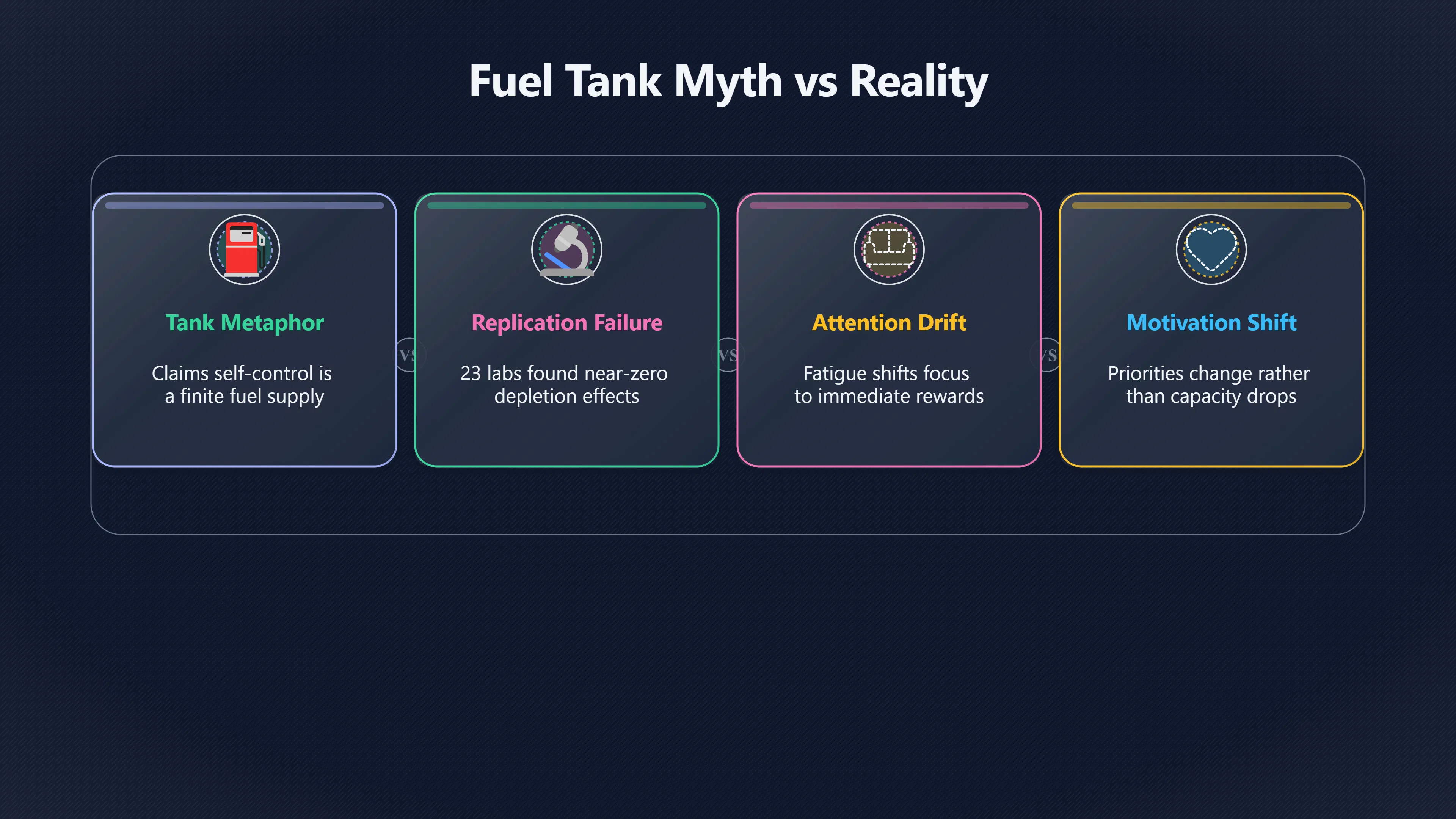
The fuel-tank metaphor feels intuitive, but it can turn ordinary fatigue and lapses into the wrong explanation for change failure.
On this page
- What the fuel tank metaphor claims
- Why the evidence is weaker than the metaphor
- Better explanations for tired day lapses
Page outline Jump by section
Introduction
Many self-help plans still assume that willpower works like a fuel tank: use too much self-control during the day and you will eventually run dry. The idea feels intuitive because people genuinely do feel worn down after effort, stress, decision-making and temptation. Yet the scientific debate around ego depletion has raised doubts about whether self-control failures are best explained by a simple “used up resource” model. Large replication projects have struggled to find the strong depletion effects that the fuel-tank metaphor would predict, and alternative explanations increasingly point towards motivation, attention, habits, expectations, stress and changing priorities. PubMed[Sage Journals]journals.sagepub.comSource details in endnotes.
 For people trying to improve their behaviour, this distinction matters. If tired-day lapses are automatically interpreted as proof that a finite stock of willpower has been exhausted, the real causes of failure can be missed. A misleading explanation can lead to ineffective solutions.
Is Willpower Really a Tank?
What the fuel-tank metaphor claims
The fuel-tank view treats self-control as a limited resource. According to this logic, every act of restraint—ignoring distractions, controlling emotions, resisting snacks, staying polite under pressure—withdraws from the same account. By evening, the account is supposedly low, making further self-control harder.
The attraction of the metaphor is obvious. It offers a simple story for difficult days:
- You skipped junk food at lunch, so you overate at night.
- You concentrated at work, so you procrastinated on personal goals.
- You managed stressful interactions all day, so you lost patience at home.
In everyday language, people often describe these experiences as “running out of willpower”. The metaphor turns a complex set of experiences into a single explanation.
The problem is that a compelling explanation is not necessarily a correct one. The scientific question is not whether people feel mentally tired—they clearly do. The question is whether a specific, depletable self-control resource is the primary reason those lapses occur.
Why the Evidence Is Weaker Than the Metaphor
The strongest challenge to the fuel-tank idea comes from replication research. A major preregistered replication involving 23 laboratories and more than 2,100 participants found an effect size close to zero, far smaller than earlier research had suggested. The results did not provide clear support for the classic ego-depletion prediction that an initial self-control task reliably harms later self-control performance. PubMed[Sage Journals]journals.sagepub.comSource details in endnotes.
At the same time, researchers examining the literature found evidence that publication bias may have inflated confidence in the effect. Positive findings are often more likely to be published than null findings, making a phenomenon appear stronger and more reliable than it really is. Analyses by Evan Carter and Michael McCullough argued that the published ego-depletion literature showed signs of exactly this problem.[Experts@Minnesota]experts.umn.eduEvan C. Carter;, Lilly M.Read moreExperts@MinnesotaA series of meta-analytic tests of the depletion effect: Self-…by EC Carter · 2015 · Cited by 813 — A series of meta…[Frontiers]frontiersin.orgEvan C. Carter.Read moreFrontiersPublication bias and the limited strength model of self-controlby EC Carter · 2014 · Cited by 557 — Publication bias and the lim…[PubMed]pubmed.ncbi.nlm.nih.govMultiple laboratories (k = 23, total N = 2,141)…Read more…
This does not prove that self-control never becomes harder after effort. Some later studies have found small effects under certain conditions, and researchers continue to debate the issue. However, the evidence is much less consistent than a literal fuel-tank model would suggest.[PMC]pmc.ncbi.nlm.nih.govPublication bias and the limited strength model of self-controlby EC Carter · 2014 · Cited by 557 — Publication bias and the limited s…[ScienceDirect]sciencedirect.comThe role of task similarity for ego depletion: A registered…by P Primoceri · 2021 · Cited by 16 — This registered report examined the…
For self-improvement, the practical implication is important: a person who fails to exercise after work may not be experiencing the exhaustion of a finite willpower substance. Something more specific may be happening.
Better Explanations for Tired-Day Lapses
Fatigue changes attention, not necessarily capacity
After a demanding day, people often become more sensitive to immediate rewards and less attentive to long-term goals. The issue may be that attention drifts towards comfort, convenience and relief rather than that self-control has literally run out.
A tired person may still possess the ability to act according to their plans, but maintaining focus on those plans becomes more difficult. The evening biscuit looks more salient. The sofa becomes more attractive. The benefits of tomorrow’s workout feel psychologically distant.
This explanation matters because it points towards different solutions. Environmental design, reminders, routines and reduced friction may help more than simply trying to summon extra determination.
Motivation shifts throughout the day
People often assume that behaviour reflects capacity when it may partly reflect changing motivation.
A worker who refuses distractions during office hours may later decide that rest, entertainment or social connection deserves higher priority. From the outside, this can look like depleted willpower. Internally, however, it may reflect a shift in what the person values in that moment.
Several modern accounts of self-control emphasise motivation and effort allocation rather than a draining resource. People do not merely lose the ability to exert effort; they become less willing to spend effort when alternatives become increasingly appealing.[Csom Assets]assets.csom.umn.eduCsom AssetsErratum to “Motivation, personal beliefs, and limited…October 15, 2012 — by KD Vohs · 2012 · Cited by 402 — Effect of willp…[Carlson School of Management]carlsonschool.umn.eduCarlson School of ManagementMisguided Effort With Elusive Implicationsby RF Baumeister · 2016 · Cited by 256 — When planning the Register…

Expectations can become self-fulfilling
One of the more interesting findings in the broader debate is that beliefs about willpower appear to influence behaviour.
Research associated with Veronika Job and colleagues found that people who strongly endorse the idea that willpower is easily exhausted are more likely to show performance declines after demanding tasks, whereas people who view willpower as less limited often show weaker depletion patterns. Subsequent work has continued to find links between willpower beliefs and responses to demanding days. ScienceDirect[PHBern]phrepo.phbern.ch28) found that only people with a limited resource theory performed more poorly on cognitive and self-control tasks as demands on self…[NCBI]ncbi.nlm.nih.govabout willpower moderate the effect of previous day…14 Oct 2015 — Research suggests that beliefs about willpower affect self-regulatio…
This does not mean beliefs create reality from nothing. Sleep deprivation, stress and overload are real. But it does suggest that repeatedly telling people they possess a tiny daily supply of willpower may unintentionally encourage them to interpret ordinary fatigue as a signal to disengage.
A person who thinks, “I’ve used up all my self-control today” may stop trying sooner than someone who thinks, “I’m tired, but I can still follow my plan if I make it easy.”
How the Tank Metaphor Can Create Practical Mistakes
The biggest risk is diagnostic error. When every lapse is explained by depleted willpower, other causes become harder to see.
Consider someone who repeatedly misses evening workouts. The fuel-tank explanation suggests that the problem is insufficient self-control. Yet the actual causes might include:
- Poor sleep reducing energy.
- An unrealistic workout schedule.
- Excessive decision-making before exercise.
- Lack of preparation.
- An environment full of competing cues.
- A habit that has not yet become automatic.
Calling all of these problems “low willpower” hides useful information.
The metaphor can also encourage passivity. If self-control is imagined as a tank that empties automatically, people may feel they have little influence once depletion begins. By contrast, explanations involving routines, planning, incentives and expectations highlight factors that can often be changed.
A Better Lens for Self-Improvement
For everyday behaviour change, the safest lesson from the ego-depletion debate is not that fatigue is imaginary. Fatigue is real. Long days, poor sleep, emotional strain and cognitive overload all affect behaviour.
The more useful lesson is that tired-day failures should not automatically be attributed to an invisible willpower reservoir running dry.
When a lapse occurs, better questions include:
- Was I physically exhausted?
- Did my environment make the tempting option too easy?
- Did I leave too many decisions until the moment of action?
- Had my motivation shifted towards immediate comfort?
- Did I interpret feeling tired as permission to quit?
- Could a habit, routine or cue reduce reliance on effort next time?
These questions produce actionable answers. The fuel-tank explanation often does not.
Within the broader ego-depletion debate, this is the main reason the metaphor can mislead tired people: it transforms a complex behavioural problem into a single-resource story that the evidence does not strongly support, while distracting attention from the practical factors that usually matter most for lasting change.[Replicability Index]replicationindex.comReplicability Index Is Ego Depletion Real?An Analysis of Argumentsby M Friese · 2018 · Cited by 474 — A reanalysis of the data investigated the presence of small study effects suc…[PubMed]pubmed.ncbi.nlm.nih.govMultiple laboratories (k = 23, total N = 2,141)…Read more…[Frontiers]frontiersin.orgEvan C. Carter.Read moreFrontiersPublication bias and the limited strength model of self-controlby EC Carter · 2014 · Cited by 557 — Publication bias and the lim…

Amazon book picks
Further Reading
Books and field guides related to Is Willpower Really a Tank?. Use these as the next step if you want deeper reading beyond the article.
Atomic Habits
Rating: 3.5/5 from 7 Google Books ratings
Promotes systems and environment design over heroic willpower.
eBay marketplace picks
Marketplace Samples
Example marketplace items related to this page. Use the search link to explore similar finds on eBay.






Endnotes
1.
Source: pmc.ncbi.nlm.nih.gov
Link:https://pmc.ncbi.nlm.nih.gov/articles/PMC4115664/
Source snippet
Publication bias and the limited strength model of self-controlby EC Carter · 2014 · Cited by 557 — Publication bias and the limited s...
2.
Source: sciencedirect.com
Link:https://www.sciencedirect.com/science/article/abs/pii/S0022103121000330
Source snippet
The role of task similarity for ego depletion: A registered...by P Primoceri · 2021 · Cited by 16 — This registered report examined the...
3.
Source: phrepo.phbern.ch
Link:https://phrepo.phbern.ch/7417/1/job-et-al-2013-beliefs-about-willpower-determine-the-impact-of-glucose-on-self-control__1_.pdf
Source snippet
(28) found that only people with a limited resource theory performed more poorly on cognitive and self-control tasks as demands on self...
4.
Source: ncbi.nlm.nih.gov
Link:https://www.ncbi.nlm.nih.gov/pmc/articles/PMC4604262/
Source snippet
about willpower moderate the effect of previous day...14 Oct 2015 — Research suggests that beliefs about willpower affect self-regulatio...
5.
Source: sciencedirect.com
Link:https://www.sciencedirect.com/science/article/pii/S0272494423000725
Source snippet
The role of lay beliefs about willpower and daily demands...by JM Jankowski · 2023 · Cited by 17 — People with a limited wi...
6.
Source: pubmed.ncbi.nlm.nih.gov
Link:https://pubmed.ncbi.nlm.nih.gov/27474142/
Source snippet
Multiple laboratories (k = 23, total N = 2,141)...Read more...
7.
Source: journals.sagepub.com
Link:https://journals.sagepub.com/doi/10.1177/1745691616652873
8.
Source: journals.sagepub.com
Link:https://journals.sagepub.com/doi/abs/10.1177/1745691616652873
Source snippet
S. Hagger... The analyses served as a catalyst for the current Registered Replication...
9.
Source: frontiersin.org
Title: Evan C. Carter.Read more
Link:https://www.frontiersin.org/journals/psychology/articles/10.3389/fpsyg.2014.00823/full
Source snippet
FrontiersPublication bias and the limited strength model of self-controlby EC Carter · 2014 · Cited by 557 — Publication bias and the lim...
10.
Source: pubmed.ncbi.nlm.nih.gov
Link:https://pubmed.ncbi.nlm.nih.gov/25126083/
Source snippet
bias and the limited strength model of self-control30 Jul 2014 — We argue that the evidence for the depletion effect is a useful case stu...
11.
Source: experts.umn.edu
Title: Evan C. Carter;, Lilly M.Read more
Link:https://experts.umn.edu/en/publications/a-series-of-meta-analytic-tests-of-the-depletion-effect-self-cont/
Source snippet
Experts@MinnesotaA series of meta-analytic tests of the depletion effect: Self-...by EC Carter · 2015 · Cited by 813 — A series of meta...
12.
Source: replicationindex.com
Title: Replicability Index Is Ego Depletion Real?
Link:https://replicationindex.com/wp-content/uploads/2018/12/e2e74-is-ego-depletion-real.pdf
Source snippet
An Analysis of Argumentsby M Friese · 2018 · Cited by 474 — A reanalysis of the data investigated the presence of small study effects suc...
13.
Source: assets.csom.umn.edu
Link:https://assets.csom.umn.edu/assets/lib/assets/AssetLibrary/2012/Vohs%20Baumeister%20Schmeichel%202012%20JESP%20this%20time%20for%20real.pdf
Source snippet
Csom AssetsErratum to “Motivation, personal beliefs, and limited...October 15, 2012 — by KD Vohs · 2012 · Cited by 402 — Effect of willp...
Published: October 15, 2012
14.
Source: carlsonschool.umn.edu
Link:https://carlsonschool.umn.edu/sites/carlsonschool.umn.edu/files/2019-04/baumeister_vohs_2016_perspectives_comment_on_hagger_rrr_misguided_effort_with_elusive_implications_2_0.pdf
Source snippet
Carlson School of ManagementMisguided Effort With Elusive Implicationsby RF Baumeister · 2016 · Cited by 256 — When planning the Register...
15.
Source: frontiersin.org
Link:https://www.frontiersin.org/journals/psychology/articles/10.3389/fpsyg.2016.01155/full
Source snippet
A Multilab Preregistered Replication of the Ego-Depletion...by J Dang · 2016 · Cited by 108 — The ego depletion effect has not been repl...
16.
Source: oamonitor.ireland.openaire.eu
Link:https://oamonitor.ireland.openaire.eu/national/search/publication?pid=10.3389%2Ffpsyg.2014.00823
Source snippet
bias and the limited strength model of self-controlEgo depletion and the strength model of self-control: A meta-analysis...
Additional References
17.
Source: psychologicalscience.org
Title: replication project investigates self control as limited resource 2
Link:https://www.psychologicalscience.org/observer/replication-project-investigates-self-control-as-limited-resource-2
Source snippet
Association for Psychological ScienceReplication Project Investigates Self-Control as Limited...31 Aug 2016 — The findings are published...
18.
Source: michael-inzlicht.squarespace.com
Link:https://michael-inzlicht.squarespace.com/s/Bias-correction-[techniques
Source snippet
squarespace.comBias-correction techniques alone cannot determine the...by M Inzlicht · Cited by 103 — Carter, Kofler, Forster, & McCullo...
19.
Source: researchgate.net
Title: 327979382 A Multilab Preregistered Replication of the Ego Depletion Effect
Link:https://www.researchgate.net/publication/327979382_A_Multilab_Preregistered_Replication_of_the_Ego-Depletion_Effect
Source snippet
(PDF) A Multilab Preregistered Replication of the Ego-...27 Feb 2026 — In line with the results from PET-PEESE, subsequent highlypowered...
20.
Source: pmc.ncbi.nlm.nih.gov
Link:https://pmc.ncbi.nlm.nih.gov/articles/PMC8186735/
Source snippet
A Multilab Replication of the Ego Depletion Effect - PMCby J Dang · 2020 · Cited by 202 — In the current research, we conducted a prer...
21.
Source: scribd.com
Title: Willpower Beliefs and Self-Regulation | PDFVeronika Job, Carol S
Link:https://www.scribd.com/document/917315643/Job-2010
Source snippet
Dweck, and Gregory M. Walton. Stanford University. Abstract Much recent research suggests that willpower—the capacity to exert self-...R...
22.
Source: researchgate.net
Title: Publication bias and the limited strength model of self-control
Link:https://www.researchgate.net/publication/263965097_Publication_bias_and_the_limited_strength_model_of_self-control_has_the_evidence_for_ego_depletion_been_overestimated
Source snippet
Carter EC and McCullough ME (2014) Publication bias and the limited. strength model of self-control: has the evidence for ego depletion b...
23.
Source: researchgate.net
Link:https://www.researchgate.net/publication/255986818_Beliefs_about_willpower_determine_the_impact_of_glucose_on_self-control
Source snippet
sensitivity to the depletion of self-control resources and their desire to preserve...Read more...
24.
Source: spsp.org
Title: when does belief willpower unlimited help motivation and when
Link:https://spsp.org/news-center/character-context-blog/when-does-belief-willpower-unlimited-help-motivation-and-when
Source snippet
When Does a Belief that Willpower is Unlimited Help...12 Dec 2016 — The findings consistently revealed that those who naturally endorse...
25.
Source: pages.ucsd.edu
Title: Ego Depletion Meta Analysis Text Revision for circulation
Link:https://pages.ucsd.edu/~memccullough/Papers/EgoDepletionMetaAnalysis_Text_Revision_for_circulation.pdf
Source snippet
Series of Meta-Analytic Tests of the Depletion Effectby EC Carter · Cited by 813 — We found compelling evi- dence that small-study effect...
26.
Source: michael-inzlicht.squarespace.com
Title: Paradigmatic test of the ego depletion effect
Link:https://michael-inzlicht.squarespace.com/s/Paradigmatic-test-of-the-ego-depletion-effect.pdf
Source snippet
by KD Vohs · 2021 · Cited by 295 — forms: meta-analytic analyses (Carter et al., 2015) and a multisite registered replication study (Hagg...
Topic Tree