What Actually Makes Self Improvement Work?
Self improvement that works is usually less dramatic than the self-help industry makes it sound. The strongest evidence points towards a practical pattern: choose a meaningful goal, make the next action specific, design the environment so the action is easier, track the behaviour, get feedback, and repeat it long enough for it to become less effortful.

Page outline Jump by section
Introduction
The useful promise of self improvement is not becoming a different person overnight. It is becoming more likely to do the thing you already have reason to value: study before scrolling, walk after lunch, save before spending, sleep before the next episode, apologise before resentment hardens. The evidence is clearest when self improvement is treated as behaviour design rather than identity theatre.
What “works” really means
A self-improvement method works when it reliably changes behaviour or wellbeing in the real world, not merely when it feels inspiring for a day. That distinction is important. Reading, watching or planning can create the feeling of progress while leaving daily conduct untouched. A stronger test is: did the method make the desired behaviour more likely this week, and can it survive a tired, busy, imperfect day?
Behaviour-change science has tried to make this more precise. The Behaviour Change Technique Taxonomy, developed through international consensus, identifies 93 distinct techniques used in interventions, such as goal setting, action planning, self-monitoring, feedback, prompts, social support and rewards. The point is not that every person needs all 93. It is that “self improvement” becomes more useful when broken into active ingredients that can be tested, combined and adjusted.[PubMed]pubmed.ncbi.nlm.nih.govThe behavior change technique taxonomy (v1) of 93…by S Michie · 2013 · Cited by 8923 — "BCT taxonomy v1," an extensive taxonomy…[OUP Academic]academic.oup.comSource details in endnotes.
A practical definition follows: self improvement works when it changes the conditions under which behaviour happens. That may mean changing the cue, the friction, the reward, the plan, the feedback loop, the social setting or the meaning of the goal. It rarely means relying on a permanent surge of motivation.
Start with behaviour, not personality
The weakest self-improvement plans begin with a self-judgement: “I need to be more disciplined”, “I am lazy”, “I have no willpower.” The stronger ones begin with a behaviour: “I will put my phone in another room at 9.30 pm”, “I will walk for ten minutes after lunch”, “I will write one paragraph before checking email.” Behaviour is easier to design, observe and improve than personality.
Goal-setting research gives a useful rule here. Specific and challenging goals tend to outperform vague “do your best” intentions, partly because they reduce ambiguity and direct attention. A goal such as “read more” leaves too many decisions until the moment of action; “read ten pages after brushing my teeth” gives the brain a clearer instruction.[Stanford Medicine]med.stanford.eduSource details in endnotes.
But specificity alone is not enough. A hard goal can backfire if it is disconnected from capacity, feedback or strategy. The best practical goal is demanding enough to matter, small enough to begin, and clear enough that you can tell whether it happened. For example, “get fit” is a wish; “cycle to work on Mondays and Thursdays” is a behaviour; “pack cycling clothes the night before” is the supporting action that makes the behaviour more likely.
The core tools that survive the evidence test
Self improvement works best when several modest techniques are combined. None is magical on its own; together, they close the gap between intention and action.
Set a specific target. A useful target names the behaviour, frequency and context. “Exercise three times a week” is better than “be healthier”, but “go to the gym after work on Monday, Wednesday and Friday” is better still. Specificity matters because it turns self improvement from a mood into a decision rule.[Stanford Medicine]med.stanford.eduSource details in endnotes.
Make an if-then plan. Implementation intentions turn goals into a cue-and-response format: “If situation X occurs, then I will do Y.” Research on implementation intentions has found that this kind of planning can improve goal attainment, and it is especially useful when a known obstacle or tempting alternative tends to appear. Sage Journals[Division of Cancer Control]cancercontrol.cancer.govSource details in endnotes.
Track the behaviour, not just the outcome. Self-monitoring works because it makes behaviour visible. A person trying to improve sleep may track bedtime rather than merely mood the next morning; a person trying to save money may track impulse purchases rather than only the monthly balance. Reviews of digital and health behaviour interventions repeatedly identify self-monitoring, feedback and goal setting as common useful components.[Wiley Online Library]onlinelibrary.wiley.comSource details in endnotes.[PMC]pmc.ncbi.nlm.nih.govOpen source on nih.gov.
Use prompts and cues. A cue reduces the need to remember. Running shoes by the door, a water bottle on the desk, an app blocker at 10 pm, or a calendar reminder before a weekly review can all act as prompts. In digital behaviour-change interventions, prompts and cues frequently appear alongside self-monitoring and goal setting.[PMC]pmc.ncbi.nlm.nih.govPMCDigital Behavior Change Intervention Designs for HabitPMCDigital Behavior Change Intervention Designs for Habit
Get feedback quickly. Feedback tells you whether the system is working. That may be a weekly review, a coach, a friend, a spreadsheet, a wearable device or a visible streak. Feedback is not only for praise; it helps you notice when the plan is unrealistic, the cue is weak or the reward is too delayed.[phwwhocc.co.uk]phwwhocc.co.ukIdentifying and Applying Behaviour Change TechniquesIdentifying and Applying Behaviour Change Techniques
Use social support carefully. Support works best when it helps the behaviour rather than turning change into performance anxiety. A walking partner, study group, therapist, coach or accountability friend can make a behaviour more regular. But social comparison can also discourage people if it creates shame rather than practical help.
Habits take longer than slogans suggest
The popular claim that a habit takes 21 days is not a good guide. A 2024 systematic review and meta-analysis of health habit formation found that reported median or mean times to habit formation varied widely, with median estimates around 59–66 days and mean estimates around 106–154 days in the studies that reported them. The same review found that habit strength is influenced by factors such as frequency, timing, type of habit, individual choice, affective judgements and behavioural regulation.[PMC]pmc.ncbi.nlm.nih.govOpen source on nih.gov.
That changes the emotional logic of self improvement. Missing a day in week three is not proof that the plan has failed; it is part of a longer learning process. A person building a morning walk habit may need to adjust shoes, weather plans, bedtime, route, breakfast timing and work start time before the behaviour becomes stable. The early phase is not just “discipline”; it is debugging.
Habit research also suggests that repetition in a stable context matters. When the same cue repeatedly leads to the same behaviour, the behaviour can become more automatic and less dependent on conscious intention. That is why “after I make coffee, I review my top task” is often stronger than “I will try to be productive tomorrow.”[PMC]pmc.ncbi.nlm.nih.govOpen source on nih.gov.
Motivation matters, but pressure is a poor fuel
Self improvement is not only mechanics. People are more likely to sustain change when the goal feels chosen, meaningful and compatible with their values. Self-determination theory, a major theory of motivation, argues that autonomy, competence and relatedness are central psychological needs: people are more likely to persist when they feel they have real choice, can make progress, and are connected to others.[Taylor & Francis Online]tandfonline.comSource details in endnotes.
This explains why two identical behaviours can feel different. Running because a doctor, partner or social-media feed has made you feel ashamed may produce a burst of effort, but it is fragile. Running because you want more energy, time outdoors or confidence in your body has a better chance of becoming part of your life. The behaviour is the same; the motivational quality is different.
The practical lesson is to ask two questions before adopting a plan: “Why does this matter to me?” and “How can I make the first version feel doable?” A plan that supports competence starts small enough to produce evidence of progress. A plan that supports autonomy leaves room for choice. A plan that supports relatedness uses other people for encouragement, learning and shared meaning, not humiliation.
Willpower is the wrong centre of gravity
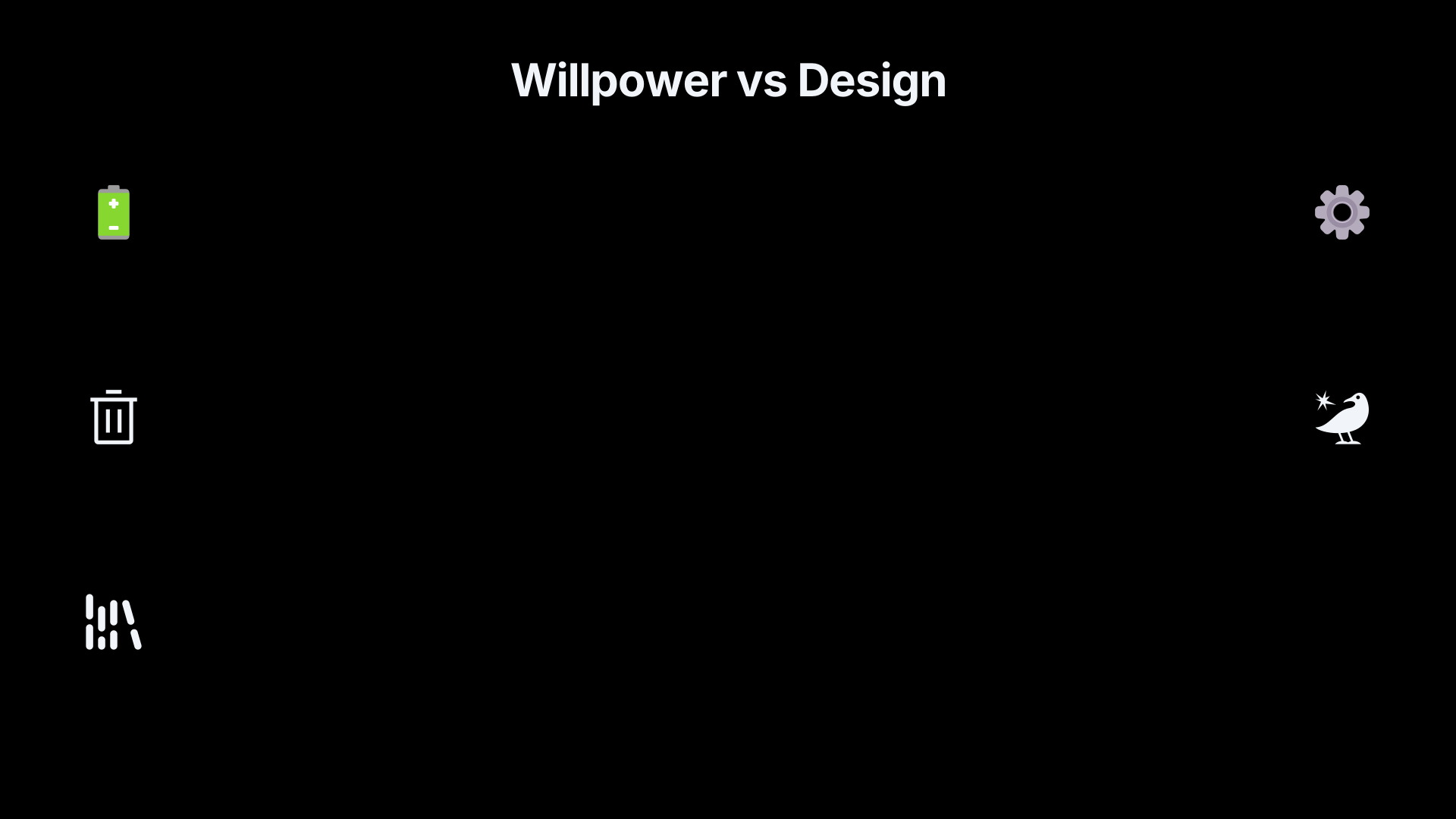
Willpower exists in ordinary language because people do experience effort, temptation and fatigue. But building a whole self-improvement system around willpower is unreliable. The influential “ego depletion” idea — that self-control draws from a limited inner resource that gets used up — has faced serious replication and conceptual challenges, and the literature remains controversial. PMC[Hogrefe eContent]econtent.hogrefe.comSource details in endnotes.
The safer conclusion for everyday self improvement is not “willpower is fake.” It is that willpower should be treated as a backup, not the main engine. A good system reduces the number of heroic choices required. It removes the snack from the desk, blocks the distracting site, books the class in advance, prepares the bag, sets the transfer to savings automatically, or creates a default bedtime routine.
This is why environment design often beats self-command. The person who says “I must stop looking at my phone in bed” is asking tired willpower to defeat a highly optimised device. The person who charges the phone outside the bedroom changes the contest.
The methods that look productive but often fail
Some self-improvement habits feel useful because they are tidy, aspirational or emotionally satisfying. They can still fail if they do not change behaviour.
Vague affirmations. Repeating “I am successful” may feel good briefly, but without a behaviour, cue or feedback loop it often remains detached from action. A better version is identity plus evidence: “I am becoming the sort of person who writes for twenty minutes after breakfast.”
Overloaded routines. A five-step morning routine may be inspiring on Sunday and impossible by Wednesday. When a plan collapses under ordinary life, the answer is usually to shrink it until it can survive stress.
Permanent tracking without learning. Tracking is useful when it changes decisions. It becomes performative when the person records data but never reviews patterns or adjusts the plan.
All-or-nothing streaks. Streaks can motivate, but they can also turn one missed day into a reason to quit. A more robust rule is “never miss twice” or “return to the smallest version tomorrow.”
Consuming advice as a substitute for action. Books, podcasts and videos can help when they lead to a specific experiment. They become avoidance when the next piece of advice replaces the next repetition.
A practical model for self improvement that works
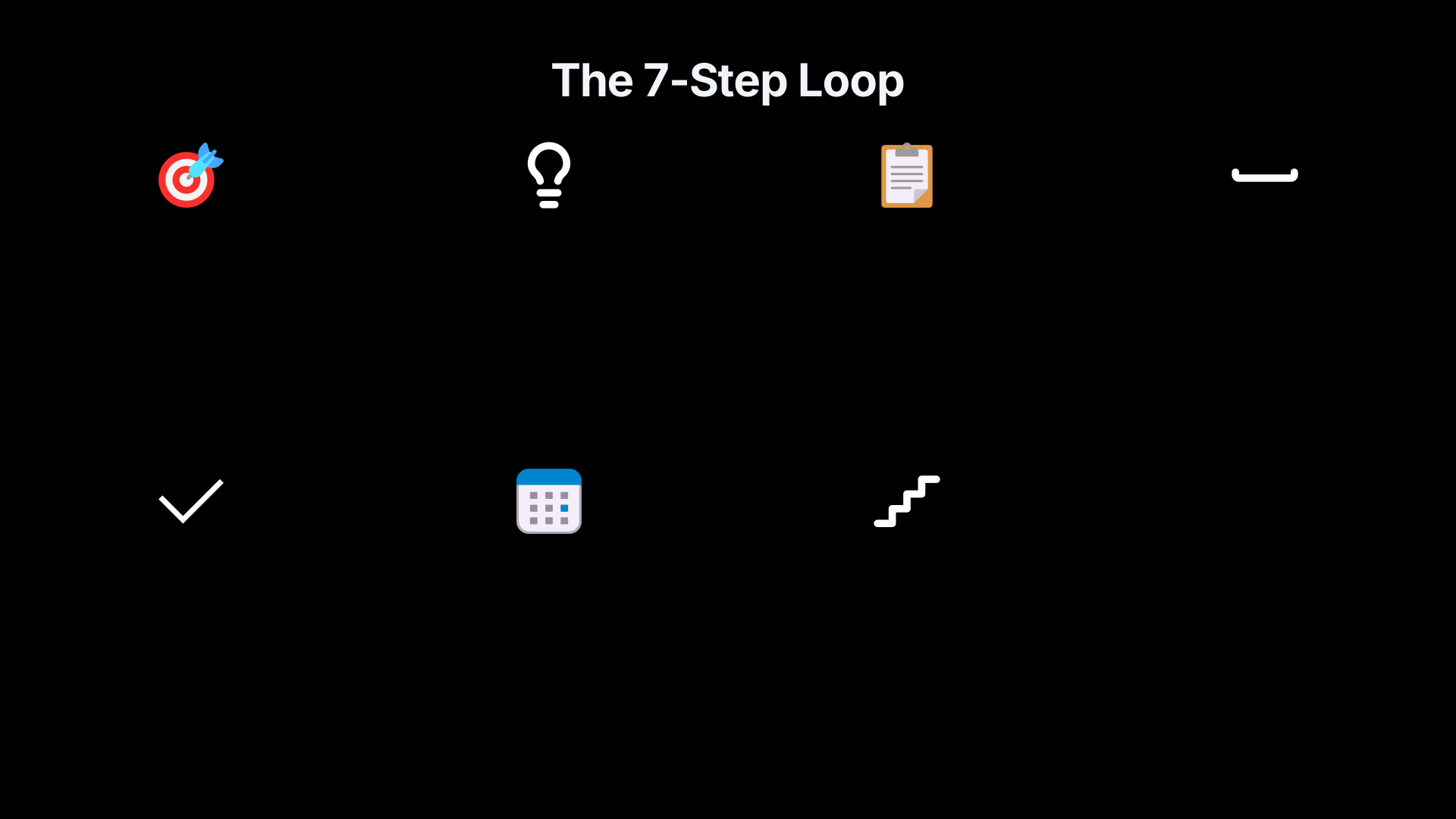
The simplest evidence-aligned model is a loop: choose, plan, reduce friction, act, track, review, adjust.
- Choose one behaviour. Pick a behaviour small enough to do this week. “Improve my health” becomes “walk for ten minutes after lunch.”
- Connect it to a real reason. Name the value behind it: energy, freedom, reliability, mood, strength, learning, family, dignity. This protects the goal from becoming mere self-punishment.
- Write an if-then plan. “If I finish lunch on a workday, then I will walk round the block before checking messages.”
- Make the environment cooperate. Put shoes by the door, block the first ten minutes in the calendar, and avoid scheduling calls immediately after lunch.
- Track the action. Record whether the walk happened, not whether you became “a healthy person.”
- Review weekly. Ask what made the behaviour easier, what blocked it, and what needs changing. If the plan failed three times, redesign the plan rather than attacking your character.
- Scale only after consistency. Once ten minutes is reliable, increase duration, frequency or intensity. Scaling too early is one of the most common ways good plans break.
This model is deliberately plain. Its strength is that each part corresponds to a known behaviour-change mechanism: goal setting, implementation planning, prompts, self-monitoring, feedback and adjustment. PMC[Frontiers]frontiersin.orgSource details in endnotes.
When apps help, and when they do not
Digital tools can support self improvement when they strengthen the behaviour loop: reminders, tracking, feedback, planning and social support. Reviews of digital behaviour-change interventions often find these components in effective designs, especially for physical activity and health behaviours. JMIR[Sage Journals]journals.sagepub.comSource details in endnotes.
But an app is not automatically an intervention. A habit tracker that becomes another thing to maintain can add burden without changing behaviour. Mental health and wellbeing apps are a special case: some show promise, but reviews also note problems such as limited evidence, high attrition, feasibility concerns and uneven quality across apps. BMJ Open[JMIR Mental Health]mental.jmir.orgSource details in endnotes.
A good self-improvement app should make the desired behaviour easier, not merely make self-optimisation more complicated. Useful questions include: does it help me act at the right moment, understand patterns, recover from lapses, protect my privacy, and reduce friction? If the app mainly increases guilt, comparison or compulsive checking, it is probably not helping.
The honest limits of self improvement
Self improvement works best when the problem is partly behavioural and the person has enough safety, time, health and support to act. It is less effective when it is asked to compensate for untreated illness, poverty, unsafe relationships, discrimination, overwhelming workload or lack of professional care. A better morning routine cannot replace medical treatment, secure housing, adequate sleep, fair pay or trauma support.
This matters because self-help culture often individualises every problem. Some changes are personal; others are structural; many are both. A person may genuinely benefit from better planning and still need childcare, therapy, medication, debt advice, workplace boundaries or community support. Self improvement is most humane when it increases agency without pretending that every obstacle is a mindset issue.
The right standard is therefore not perfection. It is a better fit between intention, environment and action. Self improvement that works makes good behaviour easier to repeat, mistakes easier to recover from, and progress easier to see. It does not require becoming superhuman; it requires building systems that respect being human.
Amazon book picks
Further Reading
Books and field guides related to What Actually Makes Self Improvement Work?. Use these as the next step if you want deeper reading beyond the article.
eBay marketplace picks
Marketplace Samples
Example marketplace items related to this page. Use the search link to explore similar finds on eBay.



Endnotes
1.
Source: academic.oup.com
Link:https://academic.oup.com/abm/article/46/1/81/4563254
2.
Source: pmc.ncbi.nlm.nih.gov
Link:https://pmc.ncbi.nlm.nih.gov/articles/PMC7429262/
3.
Source: med.stanford.edu
Link:https://med.stanford.edu/content/dam/sm/s-spire/documents/PD.locke-and-latham-retrospective_Paper.pdf
4.
Source: cancercontrol.cancer.gov
Link:https://cancercontrol.cancer.gov/brp/research/constructs/implementation-intentions
5.
Source: onlinelibrary.wiley.com
Link:https://onlinelibrary.wiley.com/doi/full/10.1111/obr.13306
6.
Source: jmir.org
Link:https://www.jmir.org/2024/1/e54375/
7.
Source: pmc.ncbi.nlm.nih.gov
Title: PMCDigital Behavior Change Intervention Designs for Habit
Link:https://pmc.ncbi.nlm.nih.gov/articles/PMC11161714/
8.
Source: phwwhocc.co.uk
Title: Identifying and Applying Behaviour Change Techniques
Link:https://phwwhocc.co.uk/wp-content/uploads/2024/02/Identifying-and-Applying-Behaviour-Change-Techniques-1.pdf
9.
Source: pmc.ncbi.nlm.nih.gov
Link:https://pmc.ncbi.nlm.nih.gov/articles/PMC11641623/
10.
Source: pmc.ncbi.nlm.nih.gov
Link:https://pmc.ncbi.nlm.nih.gov/articles/PMC12318445/
11.
Source: pmc.ncbi.nlm.nih.gov
Link:https://pmc.ncbi.nlm.nih.gov/articles/PMC5394171/
12.
Source: econtent.hogrefe.com
Link:https://econtent.hogrefe.com/doi/10.1027/1864-9335/a000398
13.
Source: pmc.ncbi.nlm.nih.gov
Link:https://pmc.ncbi.nlm.nih.gov/articles/PMC12259960/
14.
Source: bmjopen.bmj.com
Link:https://bmjopen.bmj.com/content/15/2/e093932
15.
Source: mental.jmir.org
Link:https://mental.jmir.org/2021/11/e31170
16.
Source: jmir.org
Link:https://www.jmir.org/2017/11/e397/
17.
Source: bjsm.bmj.com
Link:https://bjsm.bmj.com/content/56/23/1366
18.
Source: bmjopen.bmj.com
Link:https://bmjopen.bmj.com/content/12/8/e058229
19.
Source: academic.oup.com
Link:https://academic.oup.com/iwc/article/38/3/447/7760010
20.
Source: bpspsychub.onlinelibrary.wiley.com
Link:https://bpspsychub.onlinelibrary.wiley.com/doi/10.1111/joop.12540
21.
Source: onlinelibrary.wiley.com
Link:https://onlinelibrary.wiley.com/doi/10.1111/obr.13258
22.
Source: pubmed.ncbi.nlm.nih.gov
Link:https://pubmed.ncbi.nlm.nih.gov/23512568/
Source snippet
The behavior change technique taxonomy (v1) of 93...by S Michie · 2013 · Cited by 8923 — "BCT taxonomy v1," an extensive taxonomy...
23.
Source: journals.sagepub.com
Link:https://journals.sagepub.com/doi/10.1177/0146167211399102
24.
Source: frontiersin.org
Link:https://www.frontiersin.org/journals/psychology/articles/10.3389/fpsyg.2021.565202/full
25.
Source: pubmed.ncbi.nlm.nih.gov
Link:https://pubmed.ncbi.nlm.nih.gov/39685110/
26.
Source: tandfonline.com
Link:https://www.tandfonline.com/doi/full/10.1080/17437199.2020.1718529
27.
Source: journals.sagepub.com
Link:https://journals.sagepub.com/doi/10.1177/20552076251314904
28.
Source: sciencedirect.com
Title: Self-Determination Theory
Link:https://www.sciencedirect.com/topics/social-sciences/self-determination-theory
29.
Source: frontiersin.org
Link:https://www.frontiersin.org/journals/psychology/articles/10.3389/fpsyg.2021.626750/full
30.
Source: frontiersin.org
Link:https://www.frontiersin.org/journals/human-neuroscience/articles/10.3389/fnhum.2021.658890/full
Additional References
31.
Source: youtube.com
Title: The Science of Making & Breaking Habits: How to Change Your Life in 1 Month
Link:https://www.youtube.com/watch?v=8dHEG7WxR4c
Source snippet
What Behavioral Science Says About Changing Habits Around the New Year...
32.
Source: youtube.com
Title: Best Ways to Build Better Habits & Break Bad Ones | James Clear
Link:https://www.youtube.com/watch?v=bdsc3Spm6Sw
Source snippet
The Science of Making & Breaking Habits: How to Change Your Life in 1 Month...
33.
Source: youtube.com
Title: What Behavioral Science Says About Changing Habits Around the New Year
Link:https://www.youtube.com/watch?v=GmkzPcbFh8k
Source snippet
Part 13: Organizing support: Use self-monitoring of behavior...
34.
Source: youtube.com
Title: Part 13: Organizing support: Use self-monitoring of behavior
Link:https://www.youtube.com/watch?v=DbbE_METIGA
Source snippet
4 Steps to Building a Habit | James Clear & Dr. Andrew Huberman...
35.
Source: researchgate.net
Link:https://www.researchgate.net/publication/49832449_Breaking_Habits_With_Implementation_Intentions_A_Test_of_Underlying_Processes
36.
Source: researchgate.net
Link:https://www.researchgate.net/publication/236064731_The_Behavior_Change_Technique_Taxonomy_v1_of_93_Hierarchically_Clustered_Techniques_Building_an_International_Consensus_for_the_Reporting_of_Behavior_Change_Interventions
37.
Source: researchgate.net
Link:https://www.researchgate.net/publication/386593213_Time_to_Form_a_Habit_A_Systematic_Review_and_Meta-Analysis_of_Health_Behaviour_Habit_Formation_and_Its_Determinants
38.
Source: strongerbyscience.com
Link:https://www.strongerbyscience.com/goal-setting/
39.
Source: bct-taxonomy.com
Link:https://www.bct-taxonomy.com/about
40.
Source: instagram.com
Link:https://www.instagram.com/reel/DV4fBYdD0pm/
Topic Tree