Within The Idea That A Habit Forms In 21 Days
What 66 Days Really Means for Habits
The famous 66-day estimate is less useful as a deadline than as a warning that habit timelines vary widely.
On this page
- How the Lally study measured automaticity
- Why the range matters more than the average
- How to use 66 days without turning it into a rule
Page outline Jump by section
Introduction
The famous “66-day habit rule” is one of the most widely repeated findings in self-improvement, but it is also one of the most misunderstood. The original research did not discover a universal deadline after which a behaviour suddenly becomes automatic. Instead, it showed that habit formation is a gradual process and that the time required varies enormously between people and behaviours. The real lesson is not that habits take 66 days. It is that expecting every habit to become effortless within a fixed timeframe is unrealistic. For anyone interested in self improvement that works, that distinction matters because it changes how progress should be judged: by increasing automaticity over time, not by reaching a calendar milestone.[Wiley Online Library]onlinelibrary.wiley.comWiley Online LibraryHow are habits formed: Modelling habit formation in the…by P Lally · 2010 · Cited by 3630 — This research was cond…
How the Lally Study Measured Automaticity
The 66-day figure comes from research led by health psychologist Phillippa Lally and colleagues at University College London. Participants selected a simple health-related behaviour and repeated it daily in a consistent context. Examples included drinking water with lunch, eating fruit after breakfast, or performing a short exercise routine. Researchers then tracked how automatic the behaviour felt over time.[Wiley Online Library]onlinelibrary.wiley.comWiley Online LibraryHow are habits formed: Modelling habit formation in the…by P Lally · 2010 · Cited by 3630 — This research was cond…
This detail is important because the study was not measuring whether participants liked the behaviour, whether they never missed a day, or whether they had permanently changed their lives. It was measuring automaticity: the extent to which the behaviour began to feel natural, requiring less conscious effort and deliberation. Researchers used a habit measurement approach focused on automatic behaviour rather than simple repetition counts.[The Behavioral Scientist]thebehavioralscientist.comThe Behavioral Scientist How Long Does It Take to Form a Habit?What Lally et al…by J Hreha — The researchers used the Self-Report Habit Index to measure automaticity, a participant's subjective sen…[University of Surrey]youtube.comIt Takes 66 Days to Build a Habit — NOT 21 (Harvard Research ExplainedUniversity of Surrey…
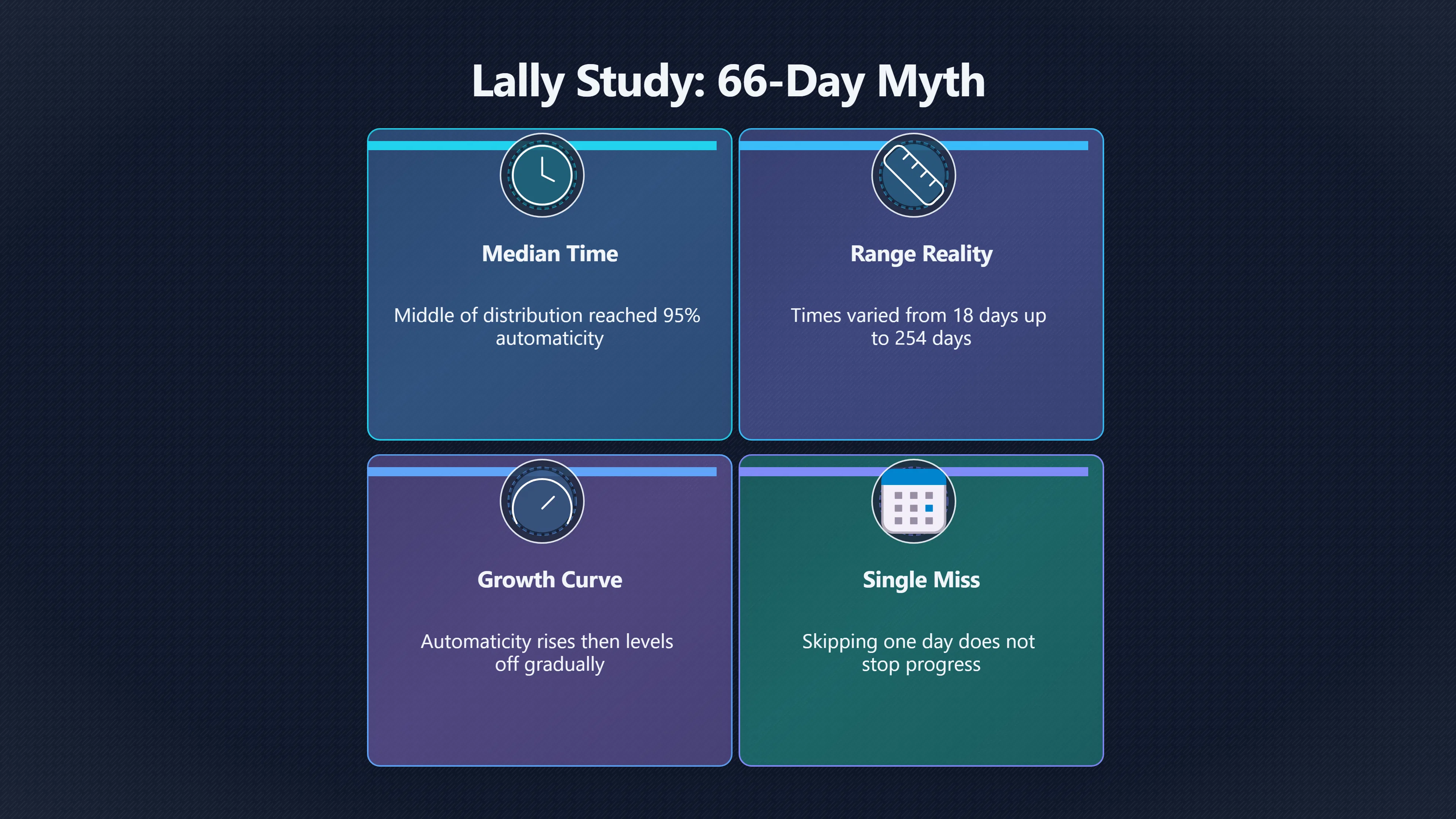
The resulting pattern was not a straight line. Automaticity increased rapidly at first and then gradually levelled off. In other words, habit formation resembled a curve approaching a plateau rather than a switch being flipped on a particular day.[CiNii Research]cir.nii.ac.jpCiNii ResearchHow are habits formed: Modelling habit formation in the real…by P Lally · 2009 · Cited by 3684 — How are habits formed…
One of the most cited statistics from the study was that the median time required to reach 95% of maximum automaticity was 66 days. Yet that number only describes the middle of a distribution. It does not describe everyone.[Studocu]studocu.vnModelling Habit Formation: Insights from EurJ. Soc….The median time to reach 95% of asymptote was 66 days, with a range from 18 to 254 days. There was substantial variation in cu…
Why the Range Matters More Than the Average
The most important finding in the study was not 66 days. It was the enormous variation between participants.
Some habits approached automaticity in as little as 18 days. Others were projected to require as long as 254 days. The researchers repeatedly highlighted this variability as a central result.[University of Surrey]youtube.comIt Takes 66 Days to Build a Habit — NOT 21 (Harvard Research ExplainedUniversity of Surrey… Studocu This range matters because it reveals several realities that fixed habit deadlines hide:[studocu.vn]studocu.vnModelling Habit Formation: Insights from EurJ. Soc….The median time to reach 95% of asymptote was 66 days, with a range from 18 to 254 days. There was substantial variation in cu…
- Different behaviours place different demands on attention, effort and motivation.
- Different people respond differently to the same behaviour.
- More complex actions generally take longer to become automatic than simple ones.
- Context stability influences how quickly automatic cues develop.[University of Surrey]youtube.comIt Takes 66 Days to Build a Habit — NOT 21 (Harvard Research ExplainedUniversity of Surrey…[PMC]pmc.ncbi.nlm.nih.govPMCTowards parsimony in habit measurementThis measure characterises…
A person trying to drink a glass of water at lunch is not facing the same challenge as someone trying to establish a daily exercise routine. Both may eventually become habitual, but their timelines are unlikely to match.
This is why treating 66 days as a deadline can be counterproductive. If someone expects a new behaviour to feel effortless by day 66 and it does not, they may assume they have failed. The study suggests the opposite interpretation may be correct. They may simply be following a normal habit-formation trajectory for that particular behaviour.[University of Surrey]youtube.comIt Takes 66 Days to Build a Habit — NOT 21 (Harvard Research ExplainedUniversity of Surrey…
What People Commonly Get Wrong About the Finding
Several misconceptions have emerged as the research spread through popular self-improvement culture.
The first mistake is turning an average or median into a rule. The study never claimed that every habit forms in 66 days. In fact, the researchers explicitly emphasised the wide range of outcomes.[University of Surrey]youtube.comIt Takes 66 Days to Build a Habit — NOT 21 (Harvard Research ExplainedUniversity of Surrey…[University]youtube.comIt Takes 66 Days to Build a Habit — NOT 21 (Harvard Research ExplainedUniversity of Surrey…
The second mistake is assuming habits suddenly “arrive”. The data showed gradual gains in automaticity rather than a dramatic transformation at a specific point. Habit strength increased progressively and then levelled off.[CiNii Research]cir.nii.ac.jpCiNii ResearchHow are habits formed: Modelling habit formation in the real…by P Lally · 2009 · Cited by 3684 — How are habits formed…
The third mistake is believing that one missed day destroys progress. The study found that missing a single opportunity to perform the behaviour did not significantly disrupt habit development. Consistency mattered, but perfection was not required. University College London[Wiley Online Library]onlinelibrary.wiley.comWiley Online LibraryHow are habits formed: Modelling habit formation in the…by P Lally · 2010 · Cited by 3630 — This research was cond…
These findings are often more useful than the headline number itself. They suggest that persistence after interruptions may matter more than maintaining an unbroken streak.
How to Use 66 Days Without Turning It Into a Rule
The practical value of the 66-day finding is as an expectation-setting tool rather than a target.
Instead of viewing 66 days as a finish line, it is better understood as evidence that meaningful habit change often takes longer than people expect. The study challenges the idea that a few weeks of repetition are enough for most behaviours.[University of Surrey]youtube.comIt Takes 66 Days to Build a Habit — NOT 21 (Harvard Research ExplainedUniversity of Surrey…
A more productive way to use the finding is to adopt three assumptions:
- Expect habit formation to be measured in months rather than weeks.
- Focus on whether the behaviour is becoming easier, not whether it feels fully automatic yet.
- Treat occasional misses as temporary disruptions rather than complete failures. University College London[PMC]pmc.ncbi.nlm.nih.govPMCTowards parsimony in habit measurementThis measure characterises…
The research points towards a patience-based model of behaviour change. Automaticity grows through repetition in a stable context, but it does not obey a universal timetable. The number 66 is therefore best viewed as a reminder that habits often take longer than the popular 21-day myth suggests, while still varying widely from one person and behaviour to another.[Wiley Online Library]onlinelibrary.wiley.comWiley Online LibraryHow are habits formed: Modelling habit formation in the…by P Lally · 2010 · Cited by 3630 — This research was cond…[University of Surrey]youtube.comIt Takes 66 Days to Build a Habit — NOT 21 (Harvard Research ExplainedUniversity of Surrey…
Amazon book picks
Further Reading
Books and field guides related to What 66 Days Really Means for Habits. Use these as the next step if you want deeper reading beyond the article.
Atomic Habits
Rating: 3.5/5 from 7 Google Books ratings
Frequently referenced in discussions of habit timelines and automaticity.
eBay marketplace picks
Marketplace Samples
Example marketplace items related to this page. Use the search link to explore similar finds on eBay.




Endnotes
1.
Source: onlinelibrary.wiley.com
Link:https://onlinelibrary.wiley.com/doi/abs/10.1002/ejsp.674
Source snippet
Wiley Online LibraryHow are habits formed: Modelling habit formation in the...by P Lally · 2010 · Cited by 3630 — This research was cond...
2.
Source: pmc.ncbi.nlm.nih.gov
Title: PMCTowards parsimony in habit measurement
Link:https://pmc.ncbi.nlm.nih.gov/articles/PMC3552971/
Source snippet
This measure characterises...
3.
Source: studocu.vn
Title: Modelling Habit Formation: Insights from Eur
Link:https://www.studocu.vn/vn/document/truong-dai-hoc-ngoai-ngu-dai-hoc-da-nang/ngon-ngu-anh/modelling-habit-formation-insights-from-eur-j-soc-psychol-40-2010/157504686
Source snippet
J. Soc....The median time to reach 95% of asymptote was 66 days, with a range from 18 to 254 days. There was substantial variation in cu...
4.
Source: onlinelibrary.wiley.com
Title: asymptote was 66 days, with a range from 18 to 254 days.Read more
Link:https://onlinelibrary.wiley.com/doi/10.1002/ejsp.674?538fcd4b_page=6&d2101103page=2&ref=b2b_cm_3p_cs_t_ww
Source snippet
Wiley Online LibraryHow are habits formed: Modelling habit formation in the...16 Jul 2009 — In this study, we consider how a single miss...
5.
Source: pmc.ncbi.nlm.nih.gov
Link:https://pmc.ncbi.nlm.nih.gov/articles/PMC3505409/
Source snippet
Making health habitual: the psychology of 'habit-formation' and...by B Gardner · 2012 · Cited by 871 — More relevant research found t...
6.
Source: studocu.vn
Title: Modelling Habit Formation: Insights from Eur
Link:https://www.studocu.vn/vn/document/hoc-vien-ngoai-giao-viet-nam/van-hoa-viet-nam-va-hoi-nhap-quoc-te/modelling-habit-formation-insights-from-eur-j-soc-psychol-40-2010/147722239
Source snippet
J. Soc....The time it took participants to reach 95% of their asymptote of automaticity ranged from 18 to 254 days; indicating considera...
7.
Source: iaap-journals.onlinelibrary.wiley.com
Link:https://iaap-journals.onlinelibrary.wiley.com/doi/abs/10.1111/aphw.12600
Source snippet
wiley.comCan—and should—automaticity be self‐reported using a...by B Gardner · 2024 · Cited by 14 — The most used measure, the Self-Repo...
8.
Source: youtube.com
Title: It Takes 66 Days to Build a Habit — NOT 21 (Harvard Research Explained)
Link:https://www.youtube.com/watch?v=DjPiyRZLgkY
Source snippet
University of Surrey...
9.
Source: surrey.ac.uk
Link:https://www.surrey.ac.uk/news/does-it-really-take-66-days-form-habit-we-asked-expert-dr-pippa-lally
Source snippet
University of SurreyDoes it really take 66 days to form a habit?Jan 21, 2026 — The average time it took for the participants in my study...
10.
Source: thebehavioralscientist.com
Title: The Behavioral Scientist How Long Does It Take to Form a Habit?
Link:https://www.thebehavioralscientist.com/articles/how-long-to-form-a-habit
Source snippet
What Lally et al...by J Hreha — The researchers used the Self-Report Habit Index to measure automaticity, a participant's subjective sen...
11.
Source: surrey.ac.uk
Title: theory and methods
Link:https://www.surrey.ac.uk/habitat-surrey-habit-application-and-theory-group/research/theory-and-methods
Source snippet
University of SurreyTheory and Methods(2012) Towards parsimony in habit measurement: Testing the convergent and predictive validity of an...
12.
Source: cir.nii.ac.jp
Link:https://cir.nii.ac.jp/crid/1361418518778992640
Source snippet
CiNii ResearchHow are habits formed: Modelling habit formation in the real...by P Lally · 2009 · Cited by 3684 — How are habits formed...
13.
Source: ucl.ac.uk
Title: how long does it take form habit
Link:https://www.ucl.ac.uk/news/2009/aug/how-long-does-it-take-form-habit
Source snippet
In our study we showed that missing one opportunity did not significantly impact the habit...Read more...
14.
Source: dictionary.cambridge.org
Link:https://dictionary.cambridge.org/dictionary/english/how
Source snippet
English [meaning]({{ 'meaning/' | relative_url }}) - Cambridge DictionaryHOW definition: 1. in what way, or by what methods: 2. used to ask about someone's physical or em...
15.
Source: Wikipedia
Link:https://en.wikipedia.org/wiki/How
Source snippet
How - WikipediaHow (greeting), an anglicization of the Lakota word háu; How, an interrogative word in English grammar. Contents. 1 Art...
Additional References
16.
Source: dictionary.com
Link:https://www.dictionary.com/browse/how
Source snippet
HOW Definition & Meaninga way or manner of doing something. to consider all the hows and wherefores. a word formerly used in communicatio...
17.
Source: langeek.co
Link:https://langeek.co/en/grammar/course/636/how
Source snippet
How to Use "How" in the English GrammarUse How as an interrogative adverb is used to ask questions about the way an action occurs. It als...
18.
Source: merriam-webster.com
Link:https://www.merriam-webster.com/dictionary/how
19.
Source: philpapers.org
Link:https://philpapers.org/rec/LALHAH
20.
Source: blog.theteamw.com
Link:https://www.blog.theteamw.com/2011/03/18/100-things-you-should-know-about-people-84-average-time-to-form-a-habit-is-66-days/
Source snippet
Time To Form A Habit Is 66 Days – The Team W, Inc.Mar 18, 2011 — The average amount of time it took for people to form a habit was 66 day...
21.
Source: collinsdictionary.com
Link:https://www.collinsdictionary.com/dictionary/english/how
Source snippet
in what way or manner; by what means? How did the accident happen? · 2. to what extent, degree, etc.? How damaged...Read more...
22.
Source: facebook.com
Link:https://www.facebook.com/100075645770251/posts/a-2009-study-of-phillippa-lally-et-al-showed-that-the-average-days-in-forming-a-/204505905414267/
Source snippet
A 2009 study of Phillippa Lally et al., showed that the...According to a 2009 study, it can take anywhere from 18 to 254 days to develop...
23.
Source: mentalzon.com
Title: 66 days to build a new habit why it’s not a myth but real habit psychology
Link:https://mentalzon.com/en/post/7770/66-days-to-build-a-new-habit-why-it%E2%80%99s-not-a-myth-but-real-habit-psychology
Source snippet
66 Days to Build a New Habit: Why It's Not a Myth, But Real...Nov 1, 2025 — The result: on average, it took 66 days for the new behavior...
24.
Source: researchgate.net
Title: Modeling habit formation in the real world | Request PDFLally et al
Link:https://www.researchgate.net/publication/32898894_How_are_habits_formed_Modeling_habit_formation_in_the_real_world
Source snippet
(2010) demonstrated that new behavioural patterns require between 18 and 254 days to reach automaticity, with a median of approximately 6...
25.
Source: openresearch.surrey.ac.uk
Title: Open Research Surrey Modelling habit formation in the real world
Link:https://openresearch.surrey.ac.uk/esploro/outputs/journalArticle/How-are-habits-formed-Modelling-habit/99783513802346
Source snippet
How are habits formed: Modelling habit formation in the real world; Publication Details. European journal of social psychology, Vol.40(6...
Topic Tree