Within Lunch Walks
Track the walk, not your worth
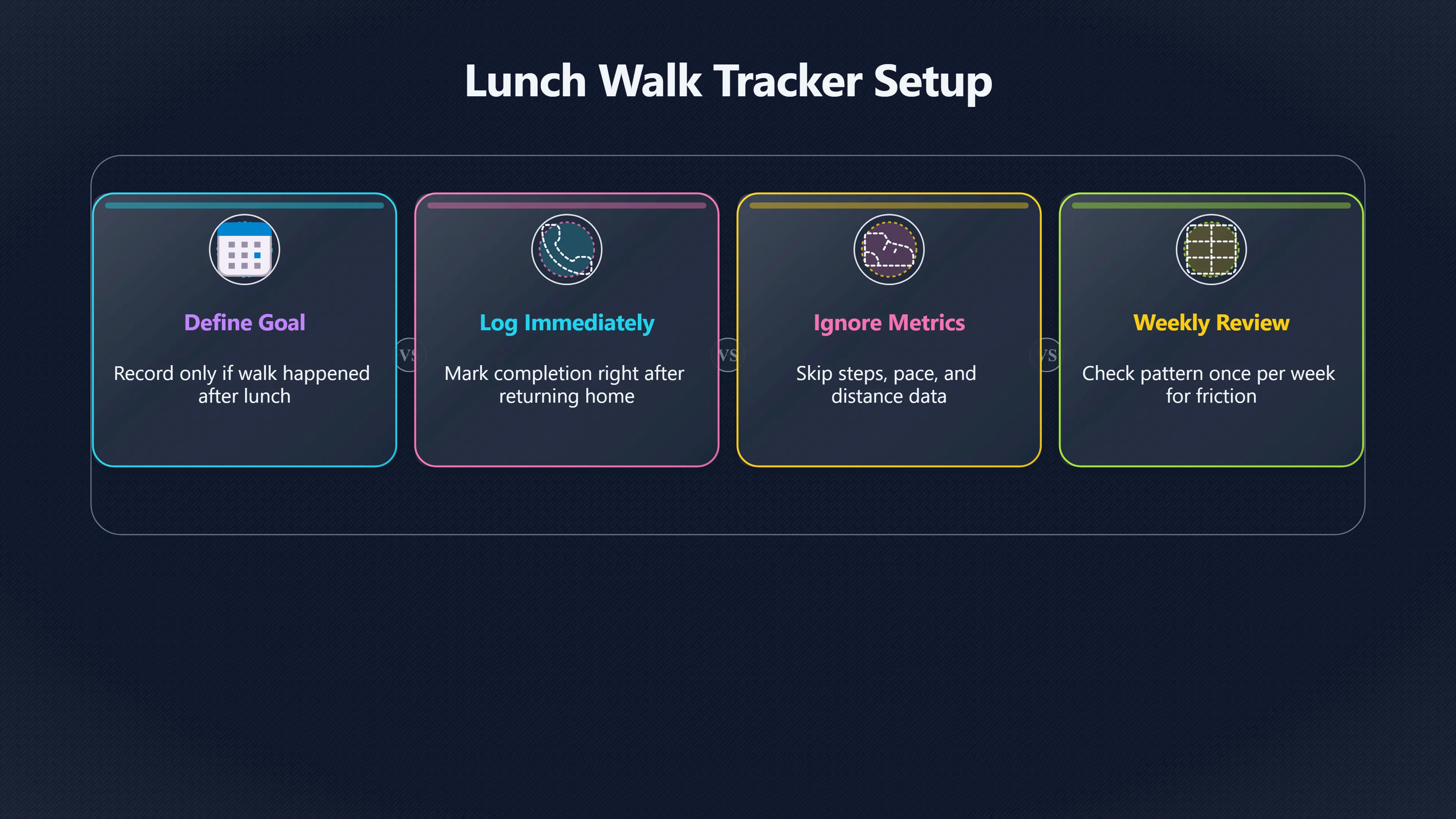
The best lunch-walk tracker answers one question first: did the walk happen after lunch today?
On this page
- Yes or no tracking for the first month
- Weekly reviews that remove friction
- Warning signs the tracker is becoming too much
Page outline Jump by section
Introduction
A lunch walk is deliberately small. The tracking system should be small as well. For most people, the best tracker answers one question before any other: Did the walk happen after lunch today?
 That approach follows a useful principle from behaviour-change research. Self-monitoring can help habits stick because it keeps behaviour visible, but habit formation depends primarily on repeating an action in a consistent context rather than collecting large amounts of data. Tracking works best when it supports repetition; it becomes less useful when the tracking itself turns into a second project.[PMC]pmc.ncbi.nlm.nih.govPMCDigital Behavior Change Intervention Designs for Habitby Y Zhu · 2024 · Cited by 80 — The results show that the most applied behavior change techniques were the self-monitoring of behavior…[PMC]pmc.ncbi.nlm.nih.govPMCDigital Behavior Change Intervention Designs for Habitby Y Zhu · 2024 · Cited by 80 — The results show that the most applied behavior change techniques were the self-monitoring of behavior…
For a lunch-walk habit, the goal is not to create a perfect record of steps, pace, distance, heart rate, route variation, weather conditions, or streak statistics. The goal is to make it slightly harder to forget the walk and slightly easier to notice that you are becoming the sort of person who takes one.
Track the walk, not your worth
Many self-improvement efforts fail because measurement quietly changes the objective. A person starts by wanting a ten-minute walk after lunch and ends up worrying about whether today’s walk was long enough, fast enough, or equal to yesterday’s.
A useful governance rule is simple:
The tracker exists to record compliance with the habit, not to judge the quality of the person.
That distinction matters because habit research emphasises consistency in response to a cue. For the lunch-walk habit, the critical event is completing the walk after lunch. Whether it was eight minutes or twelve minutes is usually a secondary concern during the early stages of habit formation.[PMC]pmc.ncbi.nlm.nih.govPMCDigital Behavior Change Intervention Designs for Habitby Y Zhu · 2024 · Cited by 80 — The results show that the most applied behavior change techniques were the self-monitoring of behavior…
A tracker should therefore answer a narrow operational question:
- Walk happened: yes.
- Walk did not happen: no.
Everything else is optional.
Yes-or-no tracking for the first month
The first month is usually about establishing repetition rather than optimisation. A yes-or-no system creates the lowest administrative burden while still providing the benefits of self-monitoring. Research reviews of behaviour-change interventions consistently identify self-monitoring as one of the most common and useful techniques for supporting behaviour change, but they do not require complex measurement to provide value.[PMC]pmc.ncbi.nlm.nih.govPMCDigital Behavior Change Intervention Designs for Habitby Y Zhu · 2024 · Cited by 80 — The results show that the most applied behavior change techniques were the self-monitoring of behavior…[JMIR]jmir.orgDigital Behavior Change Intervention Designs for Habit…by Y Zhu · 2024 · Cited by 82 — A systematic review was conducted to invest…
A practical first-month tracker might be:
DayWalk after lunch?Monday✓Tuesday✓Wednesday✗Thursday✓Friday✓
That is enough.
Some people prefer:
- A paper calendar with a tick.
- A notes app with one checkbox per day.
- A wall calendar and a pen.
- A simple habit-tracking app used only for completion.
The important feature is not technology. It is speed. Recording the walk should take a few seconds.
A useful policy is to log the walk immediately after returning. Delayed recording creates uncertainty and increases the chance that the tracking habit disappears before the walking habit is established.
Why minimal tracking often works better
People often assume that more information automatically produces better behaviour change. In practice, every additional metric creates another decision, another interpretation, and another opportunity to feel behind.
Behavioural research suggests that cues, repetition, and self-monitoring can support habit development. The simplest systems often succeed because they reduce cognitive load rather than increasing it.[PMC]pmc.ncbi.nlm.nih.govPMCDigital Behavior Change Intervention Designs for Habitby Y Zhu · 2024 · Cited by 80 — The results show that the most applied behavior change techniques were the self-monitoring of behavior…[Psychology Today]psychologytoday.comthe science behind habit tracking14 Dec 2025 — Tracking behavior increases goal success because self-monitoring itself drives change. Checkmarks trigger dopamine rewards…
Consider two lunch-walk trackers.
Tracker A
- Walk completed?
- Yes or no.
Tracker B
- Minutes walked.
- Steps.
- Distance.
- Average pace.
- Calories.
- Route.
- Mood.
- Weather.
- Energy level.
Tracker B may be appropriate for a dedicated fitness project. It is often excessive for a habit whose primary challenge is simply happening consistently.
When the objective is habit formation, the simplest measurement that preserves awareness is often the most sustainable.
Weekly reviews that remove friction
Daily tracking should be tiny. Weekly review is where thinking happens.
Once each week, spend one or two minutes looking at the pattern.
Ask only a few questions:
- How many lunch walks happened?
- Which days were missed?
- What got in the way?
- What would make next week easier?
This style of review treats tracking as a governance tool. The purpose is not self-criticism. The purpose is identifying friction.
For example:
- Three missed walks because lunch meetings ran long.
- Solution: take the walk before reopening email.
Or:
- Walks were skipped on rainy days.
- Solution: create a short indoor route.
Or:
- Walking shoes were upstairs.
- Solution: leave them near the lunch area.
This keeps attention on system design rather than motivation. Habit researchers repeatedly note the importance of stable contexts and cues. Removing practical barriers strengthens the link between lunch and walking.[PMC]pmc.ncbi.nlm.nih.govPMCDigital Behavior Change Intervention Designs for Habitby Y Zhu · 2024 · Cited by 80 — The results show that the most applied behavior change techniques were the self-monitoring of behavior…[ScienceDirect]sciencedirect.comHabit formation and changeby L Carden · 2018 · Cited by 355 — This review highlights emerging findings and new directions in research on…
What not to track yet
During the early stages, several measurements are usually better left alone.
Avoid tracking:
- Calories burned.
- Weight changes.
- Exact step counts.
- Average speed.
- Daily performance rankings.
- Multiple health metrics simultaneously.
None of these are inherently bad. The issue is timing.
A person trying to establish a lunch-walk habit is solving a behavioural problem first: remembering and repeating the walk. Adding numerous outcome measures can distract from that core objective.
A useful test is whether the metric changes today’s decision.
If it does not help answer “Will I take the walk after lunch?”, it may not deserve attention yet.
Warning signs the tracker is becoming too much
Tracking has crossed the line from support to burden when the measurement system starts demanding more attention than the behaviour itself.
Common warning signs include:
- Spending more time reviewing data than walking.
- Feeling that a short walk is “not worth logging”.
- Skipping records because they are incomplete.
- Repeatedly changing apps, spreadsheets, or methods.
- Feeling guilty about the tracker rather than curious about it.
- Treating a missed day as evidence of failure.
Another warning sign is perfectionism. If one missed walk causes a person to abandon the tracker entirely, the system has become fragile.
A more resilient rule is:
Missed walks are information, not verdicts.
The record should reveal reality, not punish it.
Research on self-monitoring highlights both benefits and costs. Tracking can increase awareness and support behaviour change, but excessive tracking can create burden and reduce long-term engagement if the process becomes cumbersome.[PMC]pmc.ncbi.nlm.nih.govPMCDigital Behavior Change Intervention Designs for Habitby Y Zhu · 2024 · Cited by 80 — The results show that the most applied behavior change techniques were the self-monitoring of behavior…
A simple default policy
For most people building a lunch-walk habit, a sensible default policy looks like this:
- Track only whether the walk happened.
- Record it immediately after the walk.
- Review once per week.
- Use missed days to identify friction.
- Avoid adding new metrics for at least a month.
- Keep the tracking method simple enough that it could continue for a year.
The strongest lunch-walk tracker is often the least impressive one. A row of quiet checkmarks may provide all the information needed: the habit happened, the routine is forming, and the system is doing its job.
Amazon book picks
Further Reading
Books and field guides related to Track the walk, not your worth. Use these as the next step if you want deeper reading beyond the article.
Atomic Habits
Rating: 3.5/5 from 7 Google Books ratings
Strong emphasis on tracking behaviors without obsession.
eBay marketplace picks
Marketplace Samples
Example marketplace items related to this page. Use the search link to explore similar finds on eBay.


Endnotes
1.
Source: pmc.ncbi.nlm.nih.gov
Title: PMCDigital Behavior Change Intervention Designs for Habit
Link:https://pmc.ncbi.nlm.nih.gov/articles/PMC11161714/
Source snippet
by Y Zhu · 2024 · Cited by 80 — The results show that the most applied behavior change techniques were the self-monitoring of behavior...
2.
Source: pmc.ncbi.nlm.nih.gov
Link:https://pmc.ncbi.nlm.nih.gov/articles/PMC3505409/
Source snippet
Making health habitual: the psychology of 'habit-formation' and...by B Gardner · 2012 · Cited by 879 — Psychological theory and evide...
3.
Source: pmc.ncbi.nlm.nih.gov
Link:https://pmc.ncbi.nlm.nih.gov/articles/PMC11641623/
Source snippet
to Form a Habit: A Systematic Review and Meta-Analysis...by B Singh · 2024 · Cited by 94 — Furthermore, the habit formation process thri...
4.
Source: jmir.org
Link:https://www.jmir.org/2024/1/e54375/
Source snippet
Digital Behavior Change Intervention Designs for Habit...by Y Zhu · 2024 · Cited by 82 — A systematic review was conducted to invest...
5.
Source: pmc.ncbi.nlm.nih.gov
Link:https://pmc.ncbi.nlm.nih.gov/articles/PMC6122239/
Source snippet
Self-monitoring often involves self-evaluation...Read more...
6.
Source: sciencedirect.com
Link:https://www.sciencedirect.com/science/article/abs/pii/S2352154617301602
Source snippet
Habit formation and changeby L Carden · 2018 · Cited by 355 — This review highlights emerging findings and new directions in research on...
7.
Source: sciencedirect.com
Link:https://www.sciencedirect.com/org/science/article/pii/S1438887124002619
Source snippet
Digital Behavior Change Intervention Designs for Habit...by Y Zhu · 2024 · Cited by 80 — The results show that the most applied behavior...
8.
Source: sciencedirect.com
Link:https://www.sciencedirect.com/science/article/abs/pii/S0747563215302946
Source snippet
Using [feedback]({{ 'feedback/' | relative_url }}) through digital technology to disrupt and...by S Hermsen · 2016 · Cited by 333 — This review shows that in the 72 studies...
9.
Source: sciencedirect.com
Link:https://www.sciencedirect.com/science/article/pii/S1364661324002663
Source snippet
Leveraging cognitive neuroscience for making and...by EK Buabang · 2025 · Cited by 46 — In real-life settings, habit formation typically...
10.
Source: sciencedirect.com
Link:https://www.sciencedirect.com/science/article/abs/pii/S002210310600028X
Source snippet
How do implementation intentions promote goal attainment...by TL Webb · 2007 · Cited by 560 — Implementation intentions are plans that s...
11.
Source: psychologytoday.com
Title: the science behind habit tracking
Link:https://www.psychologytoday.com/us/blog/parenting-from-a-neuroscience-perspective/202512/the-science-behind-habit-tracking
Source snippet
14 Dec 2025 — Tracking behavior increases goal success because self-monitoring itself drives change. Checkmarks trigger dopamine rewards...
12.
Source: psychologytoday.com
Title: the science behind habit tracking
Link:https://www.psychologytoday.com/sg/blog/parenting-from-a-neuroscience-perspective/202512/the-science-behind-habit-tracking
Source snippet
Simply tracking a behavior—whether it's...Read more...
13.
Source: psychologytoday.com
Title: the science behind habit tracking
Link:https://www.psychologytoday.com/za/blog/parenting-from-a-neuroscience-perspective/202512/the-science-behind-habit-tracking
Source snippet
14 Dec 2025 — Tracking behavior increases goal success because self-monitoring itself drives change. Checkmarks trigger dopamine rewards...
14.
Source: psychologytoday.com
Title: habit tracking a primer
Link:https://www.psychologytoday.com/sg/blog/parenting-from-a-neuroscience-perspective/202601/habit-tracking-a-primer
Source snippet
Habit Tracking: A Primer7 Jan 2026 — Tracking behavior increases goal success because self-monitoring itself drives change.Read more...
Additional References
15.
Source: cancercontrol.cancer.gov
Link:https://cancercontrol.cancer.gov/brp/research/constructs/implementation-intentions
Source snippet
Cancer ControlImplementation Intentionsby PM Gollwitzer — Implementation intentions are formed for the purpose of enhancing the translati...
16.
Source: researchgate.net
Link:https://www.researchgate.net/publication/336406914_The_Importance_of_Self-Monitoring_for_Behavior_Change_in_Youth_Findings_from_the_SWITCH_R_School_Wellness_Feasibility_Study
Source snippet
The Importance of Self-Monitoring for Behavior Change in...10 Oct 2019 — For example, self-monitoring-where individuals track and observ...
17.
Source: merriam-webster.com
Link:https://www.merriam-webster.com/dictionary/habit
Source snippet
HABIT Definition & Meaning7 days ago — The word habit most often refers to a usual way of behaving or a tendency that someone has settled...
18.
Source: nesslabs.com
Link:https://nesslabs.com/habit-trackers
Source snippet
Habit trackers: does tracking your habits actually work?They found that apps are most likely to successfully support habit formation if t...
19.
Source: fastercapital.com
Link:https://fastercapital.com/content/Self-management-Techniques–Habit-Tracking-Systems–Measure-Progress–The-Benefits-of-Habit-Tracking-Systems.html
Source snippet
Self management Techniques: Habit Tracking Systems3 Apr 2025 — Defining Habit Tracking: At its core, habit tracking is the systematic rec...
20.
Source: medium.com
Link:https://medium.com/personal-growth/the-scientific-argument-for-mastering-one-thing-at-a-time-d794a983dac1
Source snippet
The Scientific Argument for Mastering One Thing at a TimeFor example, implementation intentions have been found to increase the odds that...
21.
Source: theonlinegp.com
Link:https://www.theonlinegp.com/blog/transform-your-life-in-30-days-the-science-backed-guide-to-building-habits-that-actually-stick
Source snippet
Transform Your Life in 30 Days: The Science-Backed...Aug 12, 2025 — The optimal implementation intention formula states: "If [situation]...
22.
Source: researchportal.bath.ac.uk
Title: good intentions bad habits and effects of forming implementation
Link:https://researchportal.bath.ac.uk/en/publications/good-intentions-bad-habits-and-effects-of-forming-implementation-/
Source snippet
intentions, bad habits, and effects of forming...by B Verplanken · 1999 · Cited by 729 — A field experiment demonstrated that forming im...
23.
Source: wjarr.com
Link:https://wjarr.com/sites/default/files/fulltext_pdf/WJARR-2025-1333.pdf
Source snippet
g the basal ganglia, a group of nuclei in the brain associated with motor control...Read more...
24.
Source: jamesclear.com
Link:https://jamesclear.com/implementation-intentions
Source snippet
king to our goals, whether it's writing down the exact time and date of...Read more...
Topic Tree