Within Accountability
Make check ins specific enough to matter
A useful check-in asks what happened, what got in the way and what specific action comes next.
On this page
- Why 'how is it going' fails
- The five questions that make progress reviewable
- Ending with a concrete next action
Page outline Jump by section
Introduction
Weekly check-ins are one of the simplest tools in an accountability partnership or study group, yet they often fail because they ask the wrong question. “How is it going?” invites impressions, feelings and optimistic summaries. It does not reliably reveal what was done, what blocked progress, or what should happen next. Effective self-improvement depends on feedback loops that turn intentions into observable actions, and behaviour-change research consistently highlights goal review, self-monitoring, feedback, problem-solving and action planning as important ingredients in successful behaviour change.[digitalwellbeing.org]digitalwellbeing.orgi BCT Taxonomy (v1): 93 hierarchically-clustered techniquesweek1.5. Review behavior goal(s) Review behavior goal(s) jointly with the person and consider modifying goal(s) or behavior change strategy i… PubMed A useful weekly check-in therefore acts less like a conversation and more like a lightweight review system. It creates enough structure that[pubmed.ncbi.nlm.nih.gov]pubmed.ncbi.nlm.nih.gova model for providing human support to enhance adherence…by DC Mohr · 2011 · Cited by 1347 — We argue that human support increas… progress can be examined honestly without becoming bureaucratic. The goal is not to judge the past week but to produce a clearer next attempt.
Why “how is it going?” fails
The problem with a vague check-in is not that it is friendly. The problem is that it allows people to report intentions instead of behaviour.
Consider two answers:
- “Pretty well. I was busy but I stayed focused.”
- “I planned four study sessions, completed two, missed one because I worked late, and skipped one because I had not prepared the materials.”
The second answer is reviewable. The first is not.
Research on behaviour change repeatedly distinguishes between goals and the concrete actions needed to achieve them. Goal setting alone is often insufficient; progress improves when people specify actions, monitor behaviour and review outcomes against plans. PubMed Central[Cancer Control]cancercontrol.cancer.govCancer ControlImplementation Intentionsby PM Gollwitzer — Implementation intentions are formed for the purpose of enhancing the translati…
A vague check-in creates several common problems:
- Success becomes subjective. People judge effort, mood or intentions rather than completed actions.
- Obstacles stay hidden. The real cause of failure never appears because no one asks for specifics.
- Lessons are lost. A missed week becomes “I need more motivation” instead of “my study sessions were scheduled during my busiest work hours”.
- No next step emerges. The conversation ends with encouragement rather than a revised plan.
Accountability works best when expectations are clear and process-focused rather than vague. Research on supportive accountability emphasises that adherence improves when people know exactly what they are expected to report and when monitoring is regular and transparent.[PubMed]pubmed.ncbi.nlm.nih.gova model for providing human support to enhance adherence…by DC Mohr · 2011 · Cited by 1347 — We argue that human support increas…[ResearchGate]researchgate.netSupportive Accountability: A Model for Providing Human…We argue that human support increases adherence through accountabil…
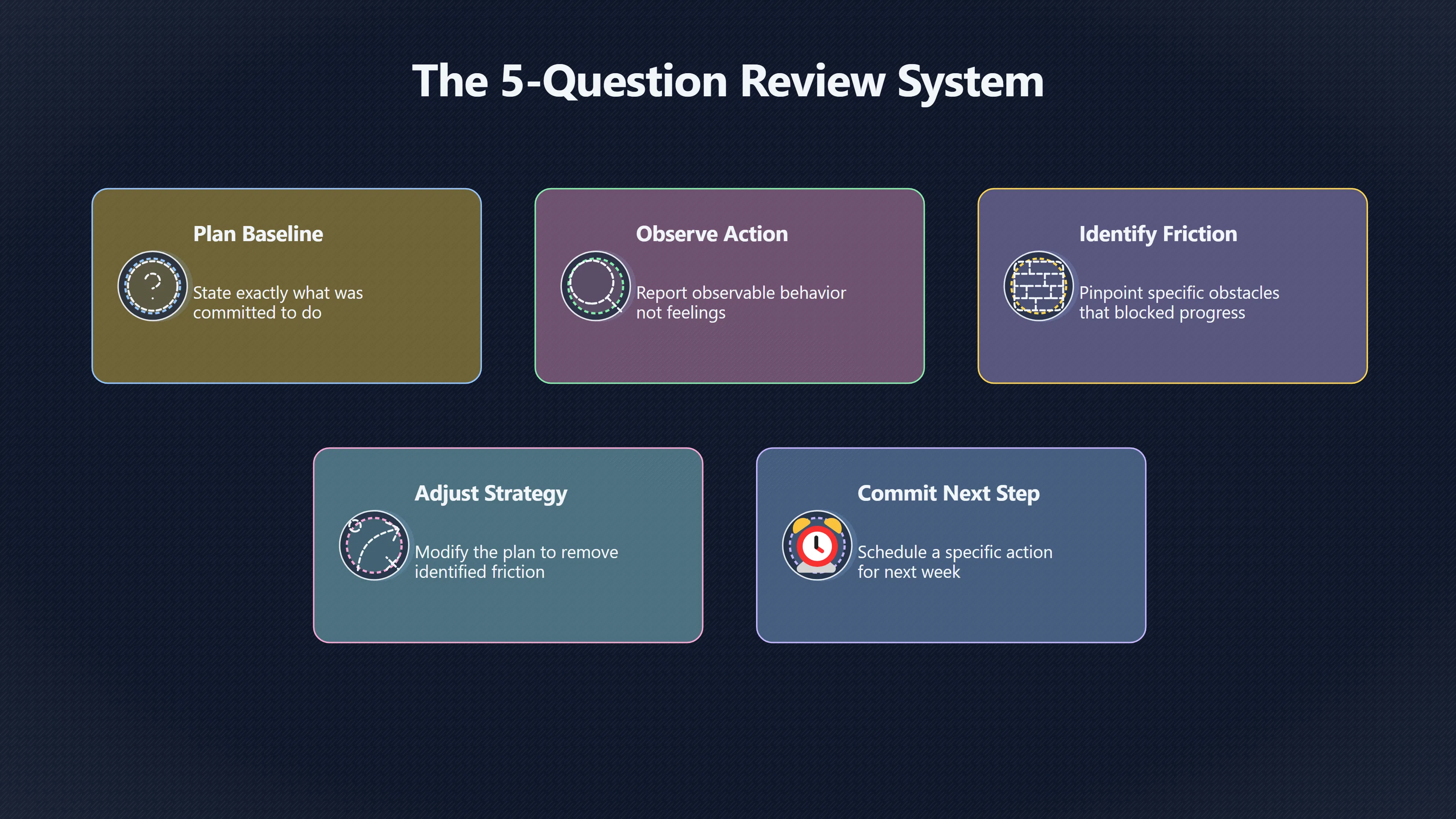
The five questions that make progress reviewable
A weekly check-in does not need to be long. In many cases, ten minutes is enough. What matters is that the discussion follows a sequence that exposes reality and guides adjustment.
1. What did you say you would do?
Start with the previous commitment.
Examples:
- “I planned three gym sessions.”
- “I planned to complete chapters four and five.”
- “I planned to write 1,500 words.”
This establishes the baseline. Without it, there is nothing to compare against.
2. What actually happened?
Focus on observable behaviour rather than effort or intention.
Examples:
- “I attended two sessions.”
- “I completed chapter four only.”
- “I wrote 900 words.”
Behaviour-change frameworks place substantial emphasis on self-monitoring and feedback because actions can be measured and reviewed.[WHO Collaborating Centre for Health]phwwhocc.co.ukEstablish a method for the person to monitor and record their behaviour(s) as part of a behaviour change strategy.Read more…[PubMed]pubmed.ncbi.nlm.nih.gova model for providing human support to enhance adherence…by DC Mohr · 2011 · Cited by 1347 — We argue that human support increas…
3. What got in the way?
This is often the most valuable question.
The purpose is not to excuse failure but to identify friction. Common answers include:
- Scheduling conflicts.
- Lack of preparation.
- Underestimating task duration.
- Fatigue.
- Environmental distractions.
- Unclear task definitions.
Many planning approaches distinguish between action planning and coping planning. Action planning specifies what to do, while coping planning anticipates obstacles and responses. Progress improves when people identify barriers rather than merely noticing that a goal was missed.[cambridge]cambridge.orgUniversity Press & Assessment39Cambridge University Press & Assessment39 - Planning and Implementation Intention InterventionsThis chapter provides resources and best-p… University Press & Assessment[ResearchGate]researchgate.netImplementation Intention and Action Planning Interventions…The purpose of this paper is to provide an overview of the lite…
4. What should change?
Once the obstacle is visible, the plan can be adjusted.
For example:
- Move study sessions from evenings to mornings.
- Reduce a target from five sessions to three.
- Prepare materials the night before.
- Block social media during writing periods.
This transforms failure into information. The review becomes a problem-solving exercise rather than a verdict.

5. What exactly happens next week?
The check-in should end with a commitment that can be verified.
Instead of:
- “I’ll try harder.”
- “I’ll stay more consistent.”
Use:
- “I will study from 7:00–8:00 a.m. on Monday, Wednesday and Friday.”
- “I will draft 500 words before lunch each weekday.”
- “I will complete practice questions 1–40 by Saturday.”
Research on implementation intentions and action planning shows that specifying when, where and how an action will occur helps bridge the gap between intention and behaviour.[Cancer Control]cancercontrol.cancer.govCancer ControlImplementation Intentionsby PM Gollwitzer — Implementation intentions are formed for the purpose of enhancing the translati…[Prospective Psychology]prospectivepsych.orgProspective PsychologyImplementation IntentionsHow good intentions can be implemented effectively has been analyzed in recent research on…
Turning obstacles into useful data
Many accountability systems fail because missed goals are treated as evidence of weak character.
A better approach is to treat them as data.
Imagine a student who reports three consecutive weeks of missed revision sessions. A poor accountability partner responds with pressure:
“You need to be more disciplined.”
A useful accountability partner becomes curious:
“What happened in the hour before the revision session each time?”
That question may reveal a recurring pattern: the sessions were scheduled immediately after a demanding commute. The obstacle is not motivation but timing.
This distinction matters because behaviour-change research frequently identifies problem-solving and barrier identification as key techniques. The objective is to uncover the mechanism behind the missed behaviour and modify the environment or plan accordingly.[PubMed Central]pmc.ncbi.nlm.nih.govPubMed CentralSelf-regulatory behavior change techniques in interventions to…by B Spring · 2020 · Cited by 115 — The most commonly rep…
The weekly check-in should therefore normalise discussion of failures. If people feel compelled to defend themselves, they will hide information. If they feel safe describing obstacles, the review becomes more accurate.
Ending with a concrete next action
The final minute of a check-in is often the most important.
A review that ends with analysis alone leaves the next week undefined. A review that ends with a specific commitment creates a new experiment.
Good next actions share three characteristics:
- Specific: exactly what will be done.
- Scheduled: attached to a time or trigger.
- Small enough to complete: ambitious enough to matter, realistic enough to happen.
For example:
Weak endingStrong ending“Exercise more.”“Walk for 30 minutes after work on Tuesday, Thursday and Saturday.”“Study harder.”“Complete two practice sets on Wednesday evening.”“Work on my project.”“Spend 45 minutes drafting the introduction on Monday morning.”
Implementation-intention research describes this as linking a behaviour to a clear situation through an if-then style plan. Such plans help translate goals into action because the decision has largely been made in advance.[Cancer Control]cancercontrol.cancer.govCancer ControlImplementation Intentionsby PM Gollwitzer — Implementation intentions are formed for the purpose of enhancing the translati…[Prospective Psychology]prospectivepsych.orgProspective PsychologyImplementation IntentionsHow good intentions can be implemented effectively has been analyzed in recent research on…
Within accountability partnerships and study groups, the final question can be phrased simply:
“What will I be asking you about next week?”
If the answer is concrete, the check-in has done its job. If the answer is vague, the next review will likely be vague as well.
A simple weekly check-in template
For most goals, the entire process can fit on one page:
- What did you plan to do?
- What did you actually do?
- What got in the way?
- What did you learn?
- What specific action will you take before the next check-in?
This structure aligns closely with established behaviour-change techniques such as self-monitoring, feedback, review of goals, problem-solving and action planning.[digitalwellbeing.org]digitalwellbeing.orgi BCT Taxonomy (v1): 93 hierarchically-clustered techniquesweek1.5. Review behavior goal(s) Review behavior goal(s) jointly with the person and consider modifying goal(s) or behavior change strategy i… PubMed The result is a check-in that produces evidence rather than impressions. Instead of repeatedly asking whether progress feels like it is happe[pubmed.ncbi.nlm.nih.gov]pubmed.ncbi.nlm.nih.gova model for providing human support to enhance adherence…by DC Mohr · 2011 · Cited by 1347 — We argue that human support increas… ning, it creates a weekly record of what happened, why it happened, and what will happen next. That is what makes accountability useful rather than merely social.
Amazon book picks
Further Reading
Books and field guides related to Make check ins specific enough to matter. Use these as the next step if you want deeper reading beyond the article.
eBay marketplace picks
Marketplace Samples
Example marketplace items related to this page. Use the search link to explore similar finds on eBay.







Endnotes
1.
Source: digitalwellbeing.org
Title: i BCT Taxonomy (v1): 93 hierarchically-clustered techniquesweek
Link:https://digitalwellbeing.org/wp-content/uploads/2016/11/BCTTv1_PDF_version.pdf
Source snippet
1.5. Review behavior goal(s) Review behavior goal(s) jointly with the person and consider modifying goal(s) or behavior change strategy i...
2.
Source: cancercontrol.cancer.gov
Link:https://cancercontrol.cancer.gov/brp/research/constructs/implementation-intentions
Source snippet
Cancer ControlImplementation Intentionsby PM Gollwitzer — Implementation intentions are formed for the purpose of enhancing the translati...
3.
Source: researchgate.net
Link:https://www.researchgate.net/publication/50363494_Supportive_Accountability_A_Model_for_Providing_Human_Support_to_Enhance_Adherence_to_eHealth_Interventions
Source snippet
Supportive Accountability: A Model for Providing Human...We argue that human [support]({{ 'support/' | relative_url }}) increases adherence through accountabil...
4.
Source: cambridge.org
Title: University Press & Assessment39
Link:https://www.cambridge.org/core/books/handbook-of-behavior-change/planning-and-implementation-intention-interventions/E1C8DA422E9BA21E7D2C4881A04898D0
Source snippet
Cambridge University Press & Assessment39 - Planning and Implementation Intention InterventionsThis chapter provides resources and best-p...
5.
Source: researchgate.net
Link:https://www.researchgate.net/publication/260486103_Implementation_Intention_and_Action_Planning_Interventions_in_Health_Contexts_State_of_the_Research_and_Proposals_for_the_Way_Forward
Source snippet
Implementation Intention and Action Planning Interventions...The purpose of this paper is to provide an overview of the lite...
6.
Source: pmc.ncbi.nlm.nih.gov
Link:https://pmc.ncbi.nlm.nih.gov/articles/PMC7429262/
Source snippet
PubMed CentralSelf-regulatory behavior change techniques in interventions to...by B Spring · 2020 · Cited by 115 — The most commonly rep...
7.
Source: pmc.ncbi.nlm.nih.gov
Link:https://pmc.ncbi.nlm.nih.gov/articles/PMC12649445/
Source snippet
PubMed CentralApplication of Behaviour Change Techniques in Promoting...by S Peng · 2025 · Cited by 2 — The most frequently applied BCTs...
8.
Source: pmc.ncbi.nlm.nih.gov
Link:https://pmc.ncbi.nlm.nih.gov/articles/PMC6796229/
Source snippet
PubMed CentralGoal Setting and Action Planning for Health Behavior Changeby RR Bailey · 2017 · Cited by 406 — Goal setting is one such st...
9.
Source: pubmed.ncbi.nlm.nih.gov
Link:https://pubmed.ncbi.nlm.nih.gov/21393123/
Source snippet
a model for providing human support to enhance adherence...by DC Mohr · 2011 · Cited by 1347 — We argue that human support increas...
10.
Source: phwwhocc.co.uk
Link:https://phwwhocc.co.uk/wp-content/uploads/2024/02/Identifying-and-Applying-Behaviour-Change-Techniques-1.pdf
Source snippet
Establish a method for the person to monitor and record their behaviour(s) as part of a behaviour change strategy.Read more...
11.
Source: prospectivepsych.org
Link:https://www.prospectivepsych.org/sites/default/files/pictures/Gollwitzer_Implementation-intentions-1999.pdf
Source snippet
Prospective PsychologyImplementation IntentionsHow good intentions can be implemented effectively has been analyzed in recent research on...
Additional References
12.
Source: theoryandtechniquetool.humanbehaviourchange.org
Link:https://theoryandtechniquetool.humanbehaviourchange.org/tool
Source snippet
Theory and Techniques ToolThe Theory and Techniques ToolExplore the links between 74 Behaviour Change Techniques (BCTs) and 26 Mechanisms...
13.
Source: research.vu.nl
Title: Vrije Universiteit Amsterdam Supportive Accountability
Link:https://research.vu.nl/ws/portalfiles/portal/2936910/2011%2BMohr%2C%2BAccountability%2C%2BJMIR.pdf
Source snippet
Vrije Universiteit AmsterdamSupportive Accountability - VU Research Portal10 Mar 2011 — Our model predicts that adherence to prescribed b...
14.
Source: nds.org.au
Link:https://nds.org.au/images/resources/wa-safer-services/Implementation-Intentions.pdf
Source snippet
to change their behaviour, and act in the way that is planned. It is...Read more...
15.
Source: link.springer.com
Link:https://link.springer.com/article/10.1007/s12144-024-06899-1
Source snippet
Springer Nature LinkAssessing and exploring self-enacted behavior change...by J Schüler · 2024 · Cited by 3 — Behavior change techniques...
16.
Source: youtube.com
Title: 5 Secrets to Running Effective Weekly Team Meetings
Link:https://www.youtube.com/watch?v=EG6muVcHNqM
Source snippet
From Chaos to Clarity: My 4-Step [Weekly Review]({{ 'weekly-review/' | relative_url }}) System...
17.
Source: youtube.com
Title: How to Do a Weekly Review
Link:https://www.youtube.com/watch?v=fQAxCmUYqeg
Source snippet
How to do an accountability check-in with your health coaching clients...
18.
Source: youtube.com
Title: How to Check-In Effectively
Link:https://www.youtube.com/watch?v=HrmK6mvQRlw
Source snippet
5 Secrets to Running Effective Weekly Team Meetings...
19.
Source: link.springer.com
Link:https://link.springer.com/article/10.1186/s12966-020-01001-x
Source snippet
However, it should be noted that the sample size in the...Read more...
20.
Source: youtube.com
Title: How to do an accountability check-in with your health coaching clients
Link:https://www.youtube.com/watch?v=x9pm3aciLRg
21.
Source: youtube.com
Title: From Chaos to Clarity: My 4-Step Weekly Review System
Link:https://www.youtube.com/watch?v=zjKUX7sHEGI
Source snippet
How to Do a Weekly Review...
Topic Tree