Within Health Habits
Does missing one day ruin a habit?
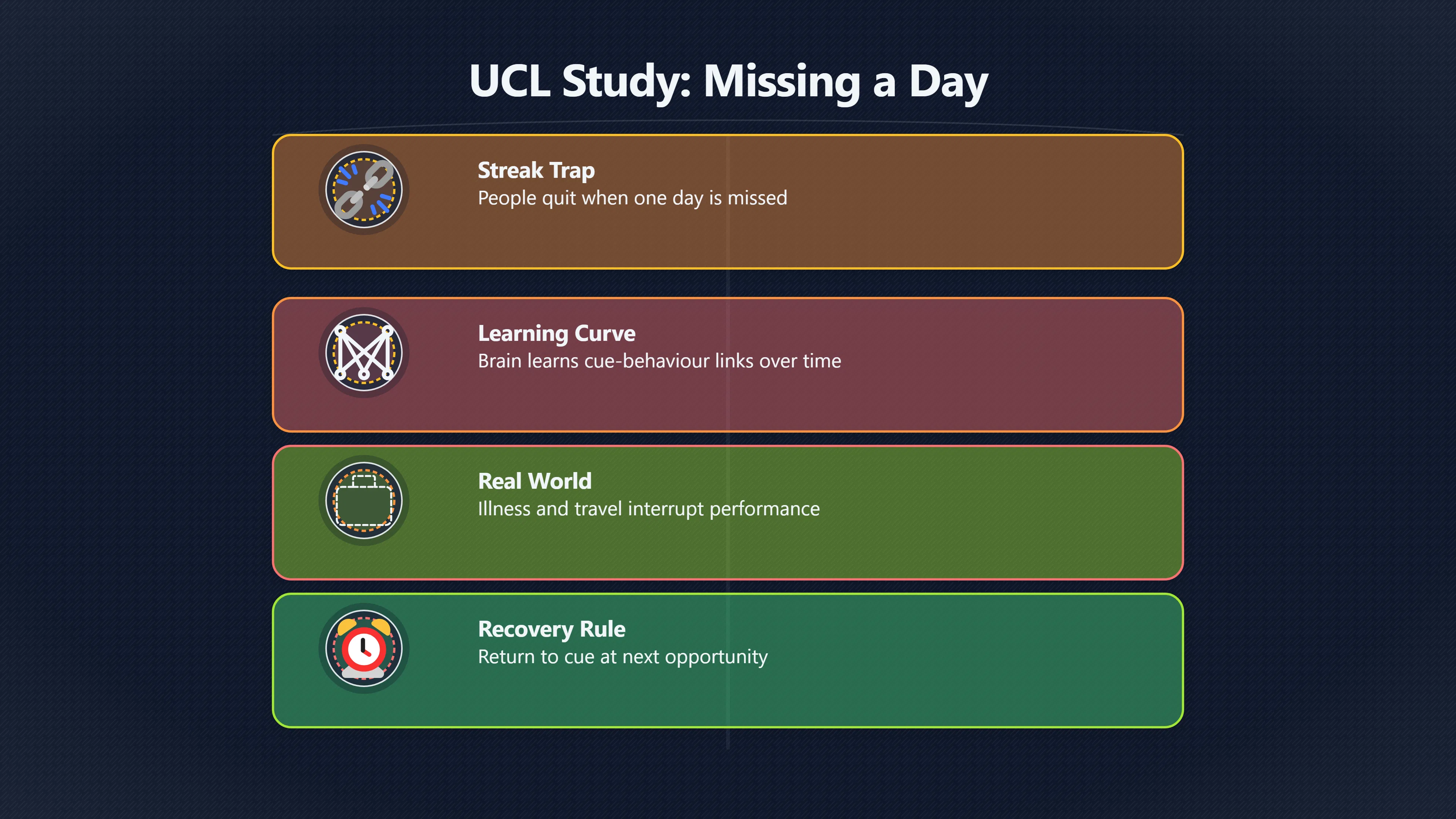
One missed day matters less than returning to the same cue often enough for the larger repetition pattern to continue.
On this page
- Why flawless streaks are a weak standard
- How stable repetition absorbs imperfect days
- Designing a restart plan before lapses happen
Page outline Jump by section
Introduction
Does missing one day ruin a habit? The evidence says no. One of the most persistent mistakes in self-improvement is treating a habit as a fragile streak that must remain unbroken. In reality, health habits are built through repeated returns to the same cue and behaviour over time, not through flawless execution. The research that helped popularise the modern understanding of habit formation found that missing a single opportunity to perform a behaviour did not significantly disrupt the habit-building process. What mattered was the larger pattern of repetition. PubMed Central[University College London]ucl.ac.ukUniversity College London How long does it take to form a habit?How long does it take to form a habit? | UCL News4 Aug 2009 — In our study we showed that missing one opportunity did not significantly i…
 This distinction matters because many people abandon habits not when they fail repeatedly, but when they fail once. A missed walk, skipped workout, or forgotten flossing session can trigger an all-or-nothing reaction: “the streak is broken, so I may as well stop”. The evidence points in the opposite direction. Effective health habit formation assumes imperfect weeks and focuses on recovery rather than perfection.[PubMed Central]pmc.ncbi.nlm.nih.govPubMed CentralMaking health habitual: the psychology of 'habit-formation' and…by B Gardner · 2012 · Cited by 894 — Missing the occasio…[PubMed Central]pmc.ncbi.nlm.nih.govPubMed CentralMaking health habitual: the psychology of 'habit-formation' and…by B Gardner · 2012 · Cited by 894 — Missing the occasio…
Why flawless streaks are a weak standard
Streaks are appealing because they provide a simple score. Consecutive days of success create visible progress, immediate feedback, and a sense of momentum. Many habit-tracking tools are built around this principle.[UCL Discovery]discovery.ucl.ac.ukThey are built when behavior is performed for a series of consecutive days - the number of days is the streak.Read more…
The problem is that streaks measure uninterrupted performance, while habit formation is about increasing automaticity—the extent to which a behaviour becomes easier to initiate in response to a cue. These are related but not identical goals. Someone can maintain a streak through intense effort and still not have a deeply established habit. Conversely, someone can miss an occasional day while steadily strengthening a cue-behaviour association.[PubMed Central]pmc.ncbi.nlm.nih.govPubMed CentralMaking health habitual: the psychology of 'habit-formation' and…by B Gardner · 2012 · Cited by 894 — Missing the occasio…
The streak mindset also creates a psychological cliff edge. Progress appears binary: either the streak survives or it is lost. When that happens, the emotional response is often disproportionate to the behavioural lapse. A single missed day becomes interpreted as evidence of failure rather than a normal interruption. Community discussions around habit tracking repeatedly show this pattern, with people reporting that motivation collapses after breaking a long streak even when their overall adherence remains high.[Reddit]reddit.comHabit trackers always work for me until I miss one day….I've been trying to build better habits for years (exercise, reading, jo…
For health habits, this is especially unhelpful because illness, travel, family obligations, poor sleep, work deadlines, and unexpected events are inevitable. A system that assumes uninterrupted performance is often less realistic than the life it is supposed to improve.
How stable repetition absorbs imperfect days
| The strongest evidence against the streak trap comes from habit formation research itself. In the influential real-world study led by Phillippa Lally and colleagues, participants repeated health-related behaviours in consistent contexts over time. The researchers observed that habit strength generally increased gradually and that missing one opportunity to perform the behaviour did not materially affect the overall trajectory of habit formation. Automaticity resumed increasing when the behaviour resumed.[Academia]academia.eduAcademia(PDF) How are habits formed: Modelling habit formation in…Missing one opportunity to perform the behavior did not significantl… 3PubMed Central 3University College London(#endnote-5 “Snippet: How long does it take[ucl.ac.uk]ucl.ac.ukUniversity College London How long does it take to form a habit?How long does it take to form a habit? | UCL News4 Aug 2009 — In our study we showed that missing one opportunity did not significantly i… to form a habit? | UCL News4 Aug 2009 — In our study we showed that missing one opportunity did not significantly i…”) |
This finding makes sense when viewed as a learning process rather than a scorekeeping exercise.
A habit develops because the brain repeatedly encounters a stable relationship:
- After breakfast → drink water.
- After brushing teeth → floss.
- After work → go for a walk.
The cue-behaviour link strengthens across many repetitions. One missing repetition does not erase the learning created by dozens of previous repetitions. Just as missing a single piano practice session does not remove months of learning, one skipped health behaviour does not reset habit development to zero.[PubMed Central]pmc.ncbi.nlm.nih.govPubMed CentralMaking health habitual: the psychology of 'habit-formation' and…by B Gardner · 2012 · Cited by 894 — Missing the occasio…
The larger systematic review literature supports this broader view. Habit formation is highly variable, often unfolding across months rather than weeks, with progress accumulating gradually through repeated performance. Within such long timelines, occasional missed days represent small deviations rather than catastrophic failures.[PubMed Central]pmc.ncbi.nlm.nih.govPubMed CentralMaking health habitual: the psychology of 'habit-formation' and…by B Gardner · 2012 · Cited by 894 — Missing the occasio…
The difference between one missed day and a new pattern
The practical risk is not a single lapse. The risk is allowing the lapse to become a new behavioural pattern.
A skipped workout on Tuesday is usually insignificant. Skipped workouts on Tuesday, Wednesday, Thursday and Friday may indicate that the original cue has weakened, circumstances have changed, or the routine no longer fits the person’s life.
The evidence suggests that habit strength grows through accumulated repetitions. Therefore, the relevant question after a missed day is not “Did I break my streak?” but “Am I returning to the cue often enough for the repetition pattern to continue?”[PubMed Central]pmc.ncbi.nlm.nih.govPubMed CentralMaking health habitual: the psychology of 'habit-formation' and…by B Gardner · 2012 · Cited by 894 — Missing the occasio…
This reframing shifts attention from preserving perfection to preserving continuity.
Designing a restart plan before lapses happen
Because missed days are normal, recovery should be planned rather than improvised.
A useful restart plan answers a simple question in advance: “What will I do when I inevitably miss a day?”
People often create detailed plans for performing a habit but no plan for recovering from interruption. As a result, the first lapse becomes a decision point filled with emotion, self-criticism and uncertainty.
A stronger approach is to define recovery rules before they are needed.
Examples include:
- Return at the next opportunity. If the morning walk is missed, take the next scheduled walk rather than trying to compensate immediately.
- Protect the cue. Even if the full behaviour cannot happen, maintain contact with the cue. Someone who normally stretches for fifteen minutes after work might perform one minute of stretching instead.
- Avoid debt thinking. Do not attempt to “make up” several missed sessions at once. Habit formation depends on repetition in context, not punishment through extra effort.
- Measure returns, not streaks. Track how quickly you resume after interruptions rather than counting only consecutive days.
These strategies keep attention on the behaviour that actually predicts habit formation: returning to the cue repeatedly enough that the association continues to strengthen. PubMed Central[Taylor & Francis Online]tandfonline.comTaylor & Francis Online How does habit form?Guidelines for tracking real-world…by B Gardner · 2022 · Cited by 106 — This paper proposes methodological criteria for studies tracki…
A better metric than streak length
For health habits, a more useful question than “How long is my streak?” is “How often do I recover?”
Consider two people trying to establish a daily walking habit:
- Person A walks for 40 days, misses one day, becomes discouraged and quits.
- Person B walks for 40 days, misses one day, walks again the next day and continues.
The second person has the stronger habit-building process despite having the shorter streak.
This illustrates a broader principle in evidence-based self-improvement: resilience of repetition matters more than perfection of repetition. Habit formation occurs in the real world, where interruptions are unavoidable. The individuals who succeed are often not those who never miss a day, but those who treat missed days as temporary deviations rather than evidence that the project has failed. PubMed Central[University College London]ucl.ac.ukUniversity College London How long does it take to form a habit?How long does it take to form a habit? | UCL News4 Aug 2009 — In our study we showed that missing one opportunity did not significantly i…

The practical takeaway
The habit streak trap confuses uninterrupted performance with successful habit formation. Research suggests that missing a single opportunity to perform a health behaviour does not significantly damage the habit-building process. What matters is returning to the same cue and behaviour often enough for the overall repetition pattern to continue. PubMed Central[University College London]ucl.ac.ukUniversity College London How long does it take to form a habit?How long does it take to form a habit? | UCL News4 Aug 2009 — In our study we showed that missing one opportunity did not significantly i…
For health habits, the most useful standard is not “never miss”. It is “never let one miss become the reason you stop”. In imperfect weeks, recovery is not a backup strategy. It is part of the habit itself.[PubMed Central]pmc.ncbi.nlm.nih.govPubMed CentralMaking health habitual: the psychology of 'habit-formation' and…by B Gardner · 2012 · Cited by 894 — Missing the occasio…
Amazon book picks
Further Reading
Books and field guides related to Does missing one day ruin a habit?. Use these as the next step if you want deeper reading beyond the article.
Atomic Habits
Rating: 3.5/5 from 7 Google Books ratings
Popularises the idea that missing once is less important than returning quickly.
The Power of Habit
Explains how habits persist through repeated cue-response learning.
eBay marketplace picks
Marketplace Samples
Example marketplace items related to this page. Use the search link to explore similar finds on eBay.


Endnotes
1.
Source: reddit.com
Link:https://www.reddit.com/r/getdisciplined/comments/1s0um3d/habit_trackers_always_work_for_me_until_i_miss/
Source snippet
Habit trackers always work for me until I miss one day....I've been trying to build better habits for years (exercise, reading, jo...
2.
Source: reddit.com
Link:https://www.reddit.com/r/Habits/comments/1tk5apf/habits_form_in_an_average_of_66_days_not_21_and/
Source snippet
and missing a day doesn't reset the clock (Lally et al., 2010)Habits form in an average of [66 days]({{ '66-days/' | relative_url }}), not 21 — and missing a day doesn't re...
3.
Source: academia.edu
Link:https://www.academia.edu/2475072/How_are_habits_formed_Modelling_habit_formation_in_the_real_world
Source snippet
Academia(PDF) How are habits formed: Modelling habit formation in...Missing one opportunity to perform the behavior did not significantl...
4.
Source: pmc.ncbi.nlm.nih.gov
Link:https://pmc.ncbi.nlm.nih.gov/articles/PMC3505409/
Source snippet
PubMed CentralMaking health habitual: the psychology of 'habit-formation' and...by B Gardner · 2012 · Cited by 894 — Missing the occasio...
5.
Source: ucl.ac.uk
Title: University College London How long does it take to form a habit?
Link:https://www.ucl.ac.uk/news/2009/aug/how-long-does-it-take-form-habit
Source snippet
How long does it take to form a habit? | UCL News4 Aug 2009 — In our study we showed that missing one opportunity did not significantly i...
6.
Source: pmc.ncbi.nlm.nih.gov
Link:https://pmc.ncbi.nlm.nih.gov/articles/PMC11641623/
Source snippet
PubMed CentralTime to Form a Habit: A Systematic Review and Meta-Analysis...by B Singh · 2024 · Cited by 97 — While habits can start for...
7.
Source: tandfonline.com
Title: Taylor & Francis Online How does habit form?
Link:https://www.tandfonline.com/doi/full/10.1080/23311908.2022.2041277
Source snippet
Guidelines for tracking real-world...by B Gardner · 2022 · Cited by 106 — This paper proposes methodological criteria for studies tracki...
8.
Source: discovery.ucl.ac.uk
Link:https://discovery.ucl.ac.uk/1477627/1/Chi%202016%20LBW%202.1%20camera%20ready.pdf
Source snippet
They are built when behavior is performed for a series of consecutive days - the number of days is the streak.Read more...
9.
Source: neuroregulation.org
Link:https://www.neuroregulation.org/article/view/23416
Source snippet
Habit Formation and Automaticity: Psychoneurobiological...by C Leaf · 2024 · Cited by 4 — The current pilot study seeks to contribute to...
10.
Source: frontiersin.org
Link:https://www.frontiersin.org/journals/psychology/articles/10.3389/fpsyg.2021.626750/full
Source snippet
A Systematic Review Examining the Relationship Between...by K Feil · 2021 · Cited by 98 — The aim of this review was to examine the rela...
Additional References
11.
Source: researchgate.net
Link:https://www.researchgate.net/publication/386593213_Time_to_Form_a_Habit_A_Systematic_Review_and_Meta-Analysis_of_Health_Behaviour_Habit_Formation_and_Its_Determinants
Source snippet
(PDF) Time to Form a Habit: A Systematic Review and...4 Dec 2024 — 21 Habit formation typically requires repeated exposure over time, wi...
12.
Source: researchgate.net
Link:https://www.researchgate.net/profile/Gonzalo_Marchant/post/Do-you-know-what-the-recommendation-is-for-physical-activity-and-sedentary-behavior-to-health/attachment/59d620af79197b807797f284/AS%3A291995114328067%401446628468694/download/Phillippa%2BLally%2C%2BJane%2BWardle%2Band%2BBenjamin%2BGardner.%2BExperiences%2Bof%2Bhabits%2Bformation%2B2011..pdf
13.
Source: repositorio.ispa.pt
Link:https://repositorio.ispa.pt/entities/publication/fae72a1c-b2b6-4991-9951-5d20b607f688
Source snippet
habit formation in the real worldMissing one opportunity to perform the behaviour did not materially affect the habit formation process...
14.
Source: surrey.ac.uk
Title: does it really take 66 days form habit we asked expert dr pippa lally
Link:https://www.surrey.ac.uk/news/does-it-really-take-66-days-form-habit-we-asked-expert-dr-pippa-lally
Source snippet
Does it really take 66 days to form a habit?Jan 21, 2026 — In 2010, Dr Pippa Lally, with colleagues at UCL, published a study that found...
15.
Source: jamesclear.com
Link:https://jamesclear.com/habit-tracker
Source snippet
The most basic format is to get a calendar and cross off each day you stick with your...Read more...
16.
Source: neenjames.com
Title: Notes from Neen: It takes 21 days to form a new habit?
Link:https://neenjames.com/notes-from-neen-it-takes-21-days-to-form-a-new-habit-thats-rubbish/
Source snippet
1 Apr 2024 — (The study also found that “missing one opportunity to perform the behavior did not materially affect the habit formation pr...
17.
Source: jamesclear.com
Title: James Clear How Long Does it Take to Form a Habit?
Link:https://jamesclear.com/new-habit
Source snippet
Backed by Science.Interestingly, the researchers also found that “missing one opportunity to perform the behavior did not materially affe...
18.
Source: scienceofselfhelp.org
Link:https://scienceofselfhelp.org/articles-1/phillippa-lally-and-the-number-of-days-to-form-a
Source snippet
Habit26 Jul 2013 — The study suggests that some tasks take less time and some tasks more time before they are considered a habit, but the...
19.
Source: instagram.com
Link:https://www.instagram.com/p/DRSmsDGgc_2/?__d=1%25252F
Source snippet
asurable effect. But two missed days starts a new trajectory.Read more...
20.
Source: facebook.com
Link:https://www.facebook.com/drinkAG1/posts/habits-dont-follow-a-perfect-timeline-the-research-shows-an-average-of-66-days-b/1428958322602697/
Source snippet
nd that it did not affect the habit formation process (2). 1.Read more...
Topic Tree