Within Digital Tools
Can apps know the right moment to help?
Adaptive interventions aim to offer support when a person is receptive or at risk, rather than sending the same advice every day.
On this page
- What just in time support means
- Signals phones and wearables can use
- Privacy and over intervention risks
Page outline Jump by section
Introduction
Just-in-time adaptive interventions (JITAIs) are one of the most ambitious ideas in digital behaviour change: instead of sending the same reminder every morning, they try to deliver the right support at the moment a person is most likely to need it or act on it. Modern smartphones and wearables can detect patterns in movement, location, sleep, heart rate, phone use and self-reported mood, allowing support to be tailored to changing circumstances throughout the day. The goal is not simply personalisation, but timing. A well-designed intervention aims to identify moments of vulnerability, opportunity or receptiveness and then provide a prompt, suggestion or coping strategy before a habit breaks down or a desired behaviour is missed. Research on JITAIs is still developing, but they have become a central concept in digital health and behaviour-change science because they address a long-standing problem: advice is only useful if it arrives when people can use it. PMC[PubMed]pubmed.ncbi.nlm.nih.govJust-in-Time Adaptive Interventions (JITAIs) in Mobile Healthby I Nahum-Shani · 2018 · Cited by 2542 — JITAI is an intervention des…

Can apps know the right moment to help?
The core idea behind a JITAI is often summarised as delivering the right type of support, in the right amount, at the right time. Rather than assuming that motivation and circumstances are stable, JITAIs treat behaviour as something that changes from hour to hour depending on context, stress, fatigue, social setting and opportunity. PMC[PubMed]pubmed.ncbi.nlm.nih.govJust-in-Time Adaptive Interventions (JITAIs) in Mobile Healthby I Nahum-Shani · 2018 · Cited by 2542 — JITAI is an intervention des…
Consider a walking programme. A traditional app might send a notification every day at 6 p.m. A JITAI might instead detect that the user has been sitting for several hours, has a gap in their schedule, is in a safe walking environment and has previously responded well to afternoon prompts. The intervention can then recommend a short walk at that specific moment. If the person is driving, asleep, in a meeting or repeatedly ignoring notifications, the system may stay silent. PMC[JMIR Research Protocols]researchprotocols.orgJMIR Research ProtocolsJust-in-Time Adaptive Intervention to Promote Walking…by CJ Firkin · 2026 · Cited by 1 — Background: A Just-in…
This distinction matters because behaviour-change support can fail for two opposite reasons:
- Support arrives too late, after a lapse has already happened.
- Support arrives too often, creating annoyance and notification fatigue.
JITAIs attempt to navigate between those extremes by making timing itself part of the intervention design.[PMC]pmc.ncbi.nlm.nih.govJust-in-Time Adaptive Interventions (JITAIs) in Mobile Healthby I Nahum-Shani · 2017 · Cited by 2547 — JITAI is an intervention design…[PMC]pmc.ncbi.nlm.nih.govPMCJust-in-Time Adaptive Intervention to Promote Walkingby CJ Firkin · 2026 · Cited by 1 — This paper outlines the application architecture and protocol for the pilot “Walking With Just-in-T…
What just-in-time support means in practice
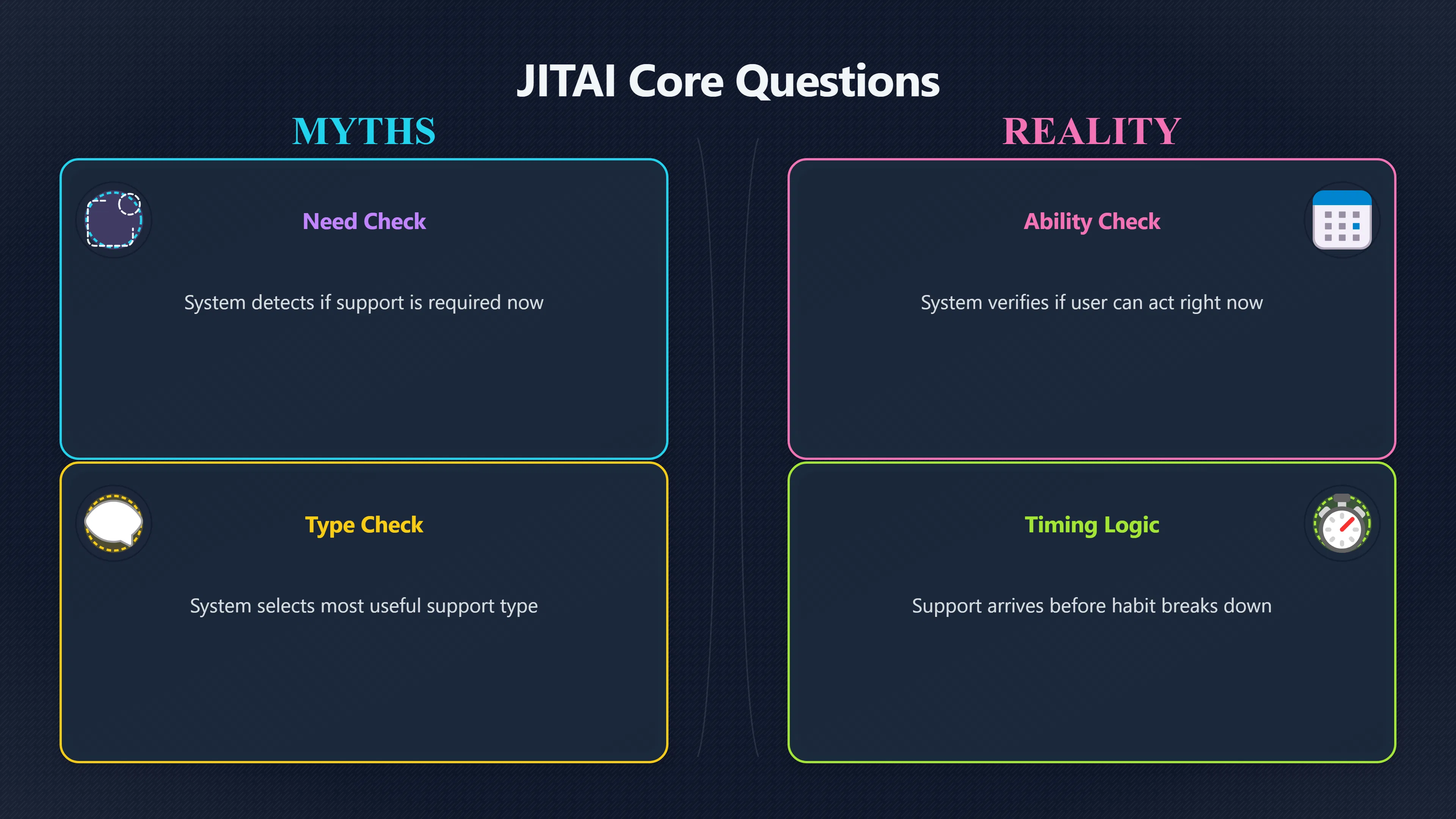
Most JITAIs operate around three questions:
- Is support needed right now?
- Is the person able to use support right now?
- What type of support is most useful right now?
To answer these questions, systems combine behavioural theory with real-time data. Someone trying to exercise more may receive encouragement when inactivity is detected. Someone trying to avoid emotional eating may receive coping suggestions when stress indicators rise. Someone working on sleep habits may receive reminders only when bedtime routines begin to drift.[PMC]pmc.ncbi.nlm.nih.govPMCReturn of the JITAI: Applying a Just-in-Time Adaptiveby SP Goldstein · 2017 · Cited by 131 — Just-in-time adaptive intervention (JITAI) is an intervention design framework that could be d…[PMC]pmc.ncbi.nlm.nih.govJust-in-Time Adaptive Interventions (JITAIs) in Mobile Healthby I Nahum-Shani · 2017 · Cited by 2547 — JITAI is an intervention design…
The intervention itself can take many forms:
- A notification or prompt.
- A brief coaching message.
- A suggestion for an alternative behaviour.
- A request for a quick self-check.
- Feedback based on recent behaviour.
- A reminder of a previously chosen goal or plan.
The key innovation is that these actions are triggered by changing circumstances rather than a fixed schedule. PMC[Harvard SEAS]people.seas.harvard.eduHarvard SEASjust-in-time adaptive interventions (JITAIs)Just-in-time adaptive interventions (JITAIs) are a special type of adaptive inter…
Signals phones and wearables can use
Modern smartphones and wearables act as collections of sensors. They can observe aspects of daily life that were difficult to measure continuously in earlier behaviour-change programmes.
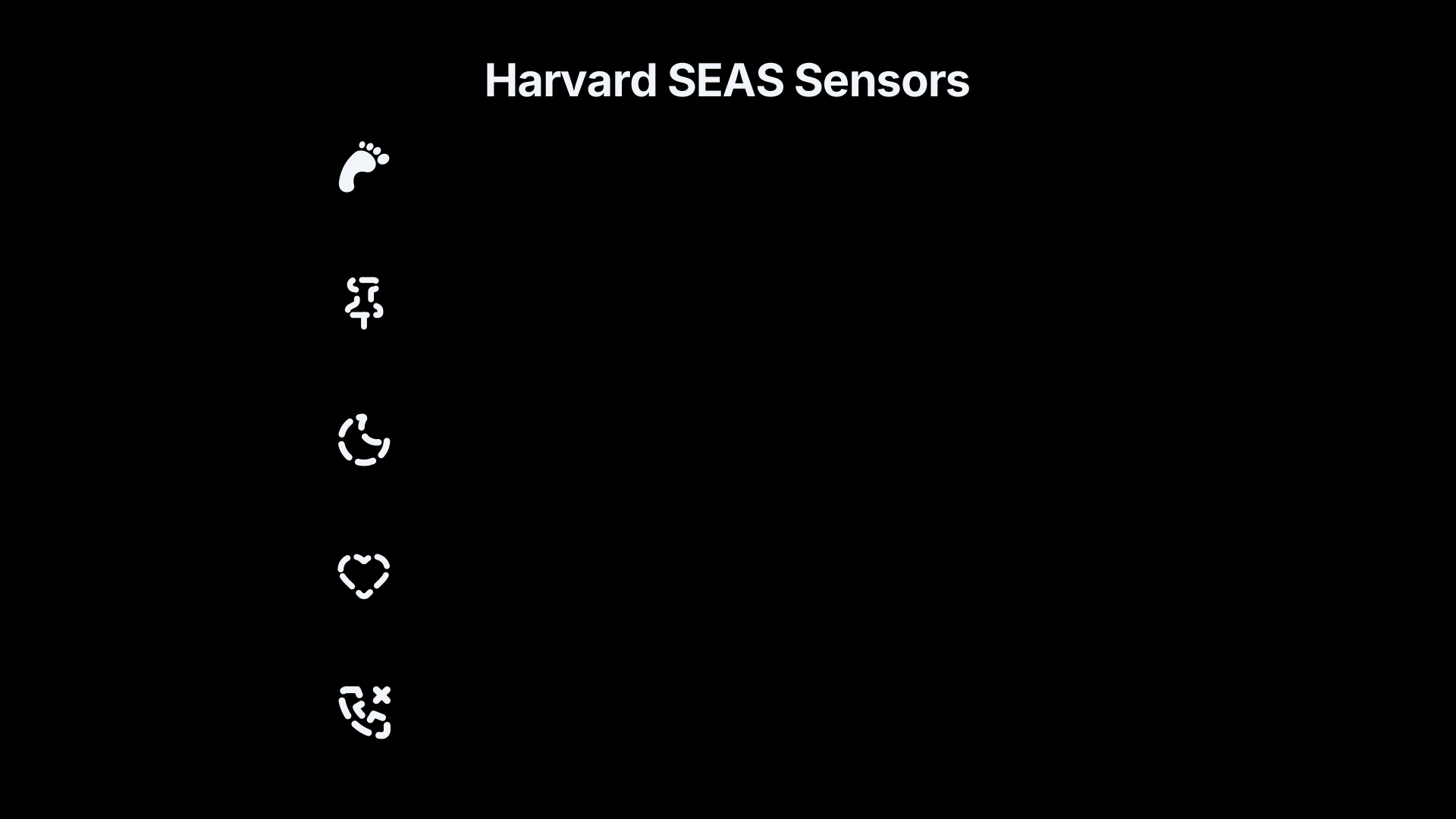
Common signals include:
Physical activity and movement[link.springer.com]link.springer.comConsistent use and a shared definition…Read more…
Accelerometers and step counters can identify walking, running, prolonged sitting and other movement patterns. These data are frequently used to trigger activity prompts or sedentary-behaviour interventions. PubMed[Springer]link.springer.comConsistent use and a shared definition…Read more…
Location and context
GPS and location services can identify whether a person is at home, commuting, at work or near a relevant place such as a gym or park. Context-aware interventions can use these patterns when deciding whether a prompt is practical.[PMC]pmc.ncbi.nlm.nih.govPMCJust-in-Time Adaptive Intervention to Promote Walkingby CJ Firkin · 2026 · Cited by 1 — This paper outlines the application architecture and protocol for the pilot “Walking With Just-in-T…
Time and routine
Behaviour is often tied to recurring routines. Systems can learn when someone typically exercises, studies, sleeps or experiences lapses and adjust support accordingly.[PMC]pmc.ncbi.nlm.nih.govPMCReturn of the JITAI: Applying a Just-in-Time Adaptiveby SP Goldstein · 2017 · Cited by 131 — Just-in-time adaptive intervention (JITAI) is an intervention design framework that could be d…
Sleep and fatigue indicators
Wearables increasingly estimate sleep duration, sleep timing and sleep regularity. These measures can help identify periods when users are unlikely to respond well to interventions or when recovery-related behaviours deserve attention.[PMC]pmc.ncbi.nlm.nih.govPMCReturn of the JITAI: Applying a Just-in-Time Adaptiveby SP Goldstein · 2017 · Cited by 131 — Just-in-time adaptive intervention (JITAI) is an intervention design framework that could be d…
Heart rate and physiological signals
Smartwatches can track heart rate and related indicators that may correlate with exertion, stress or arousal. Researchers are exploring how these measures can help identify moments when coping support might be useful.[JMIR]jmir.orgDigital Twins for Just-in-Time Adaptive Interventions (JITAIs)Mar 6, 2026 — In the context of digital health, just-in-time adaptive i…
Phone interaction patterns
Screen activity, app use and communication behaviour can provide clues about availability, attention and engagement. These signals are often used cautiously because they raise additional privacy concerns.[PMC]pmc.ncbi.nlm.nih.govPMCReturn of the JITAI: Applying a Just-in-Time Adaptiveby SP Goldstein · 2017 · Cited by 131 — Just-in-time adaptive intervention (JITAI) is an intervention design framework that could be d…
Self-reports
Many JITAIs still rely partly on user input. Short mood check-ins, stress ratings or confidence assessments can provide information that sensors cannot infer reliably. Researchers often combine self-reports with passive sensing rather than replacing them entirely.[PMC]pmc.ncbi.nlm.nih.govPMCReturn of the JITAI: Applying a Just-in-Time Adaptiveby SP Goldstein · 2017 · Cited by 131 — Just-in-time adaptive intervention (JITAI) is an intervention design framework that could be d…
Where the evidence is strongest
Research on JITAIs has expanded rapidly, particularly in physical activity, sedentary behaviour and mental health. Reviews generally find that users view these interventions as acceptable and that tailoring support to context is promising. However, the evidence base remains younger than many people assume. PubMed[springer]link.springer.comConsistent use and a shared definition…Read more… A systematic review of JITAIs for physical activity found widespread use of techniques such as prompts, feedback, goal setting and action planning. Participants generally accepted the interventions, but studies often faced practical challenges including sensor reliability, technical issues and imperfect timing of messages. Evidence for behaviour change was encouraging but mixed, partly because many studies were small and experimental.[PubMed]pubmed.ncbi.nlm.nih.govJust-in-Time Adaptive Interventions (JITAIs) in Mobile Healthby I Nahum-Shani · 2018 · Cited by 2542 — JITAI is an intervention des…
More recent reviews in mental health report modest positive effects for some outcomes while also highlighting considerable variation between interventions. The field increasingly recognises that simply collecting more data does not guarantee better support; success depends on identifying genuinely meaningful moments for intervention.[BMJ Mental Health]mentalhealth.bmj.comBMJ Mental HealthEffectiveness of just-in-time adaptive interventions for…by U von Lützow · 2025 · Cited by 6 — Our review advances pr…[Frontiers]frontiersin.orgFrontiersBeyond the current state of just-in-time adaptive…by CR van Genugten · 2025 · Cited by 36 — This review evaluates the current…
Why timing can matter more than message quality
A recurring finding in JITAI research is that relevance and timing often interact. Even a sensible recommendation may be ignored if it arrives when a person is busy, stressed or unable to act.
For example, a prompt encouraging movement may be effective during a free afternoon but pointless during a meeting. Likewise, a mindfulness exercise may be welcomed during rising stress but ignored when delivered randomly hours later. JITAI frameworks therefore distinguish between moments of need and moments of opportunity. Effective support often requires both.[PMC]pmc.ncbi.nlm.nih.govPMCReturn of the JITAI: Applying a Just-in-Time Adaptiveby SP Goldstein · 2017 · Cited by 131 — Just-in-time adaptive intervention (JITAI) is an intervention design framework that could be d…[PMC]pmc.ncbi.nlm.nih.govPMCReturn of the JITAI: Applying a Just-in-Time Adaptiveby SP Goldstein · 2017 · Cited by 131 — Just-in-time adaptive intervention (JITAI) is an intervention design framework that could be d…
This emphasis on timing reflects a broader lesson for self-improvement: behavioural success often depends less on knowing what to do than on receiving support when action is realistically possible.
Privacy and over-intervention risks
The same data that make JITAIs possible also create governance and privacy challenges.
Many systems rely on continuous or near-continuous monitoring of behaviour, movement and device use. Users may not fully understand which signals are being collected, how long they are stored, who can access them or how they are combined to generate predictions. The more personalised the intervention becomes, the greater the potential sensitivity of the underlying data.[PMC]pmc.ncbi.nlm.nih.govPMCReturn of the JITAI: Applying a Just-in-Time Adaptiveby SP Goldstein · 2017 · Cited by 131 — Just-in-time adaptive intervention (JITAI) is an intervention design framework that could be d…[Annual Reviews]annualreviews.orgJust-in-Time Adaptive Interventions: Where Are We Now…by I Nahum-Shani · Cited by 12 — The past decade has seen a surge in developing…
Another concern is over-intervention. A system that constantly reacts to behaviour can become intrusive. Excessive notifications may reduce engagement, encourage users to disable alerts or create a sense of surveillance. Researchers developing JITAIs increasingly treat user burden as a design problem in its own right. A useful intervention must know not only when to speak, but also when to remain silent. PMC[University of East Anglia]research-portal.uea.ac.uka systematic review of just in time adaptive interventions jitaisWe found mixed evidence for intervention effects on behaviour, but no study was sufficiently…Read more…
From a governance perspective, several questions become important:
- What data are collected and why?
- Can users inspect, control or delete those data?
- How transparent are the rules or algorithms triggering interventions?
- Are vulnerable users protected from manipulative or overly persuasive designs?
- How are false predictions handled?
These issues become more significant as wearable devices collect increasingly detailed behavioural and physiological information.[Frontiers]frontiersin.orgFrontiersBeyond the current state of just-in-time adaptive…by CR van Genugten · 2025 · Cited by 36 — This review evaluates the current…[JMIR]jmir.orgDigital Twins for Just-in-Time Adaptive Interventions (JITAIs)Mar 6, 2026 — In the context of digital health, just-in-time adaptive i…

The practical takeaway for self-improvement
Just-in-time support represents a shift from static advice to context-sensitive assistance. Instead of assuming that behaviour change happens through occasional bursts of motivation, JITAIs treat behaviour as a series of moment-by-moment decisions shaped by changing circumstances. Phones and wearables make this approach technically possible by continuously observing aspects of daily life and adapting support accordingly. PMC[nature]nature.comdelivers tailored assistance at moments of high need by adapting intervention…Read more… The promise is not that apps can perfectly predict human behaviour. Rather, they can sometimes recognise when a person is at greater risk of abandoning a goal or when an opportunity for action has appeared. When the timing is accurate, even a simple prompt can be more useful than a large amount of generic advice delivered at the wrong moment. At the same time, the effectiveness of these systems depends on careful design, reliable sensing, respect for privacy and restraint in how often they intervene.[PubMed]pubmed.ncbi.nlm.nih.govJust-in-Time Adaptive Interventions (JITAIs) in Mobile Healthby I Nahum-Shani · 2018 · Cited by 2542 — JITAI is an intervention des…[University of East Anglia]research-portal.uea.ac.uka systematic review of just in time adaptive interventions jitaisWe found mixed evidence for intervention effects on behaviour, but no study was sufficiently…Read more…
Amazon book picks
Further Reading
Books and field guides related to Can apps know the right moment to help?. Use these as the next step if you want deeper reading beyond the article.
Atomic Habits
Rating: 3.5/5 from 7 Google Books ratings
Explains how context and cues support behavior at the right moment.
Nudge
Provides a framework for delivering interventions when they can influence choices.
Hooked: How to Build Habit-Forming Products
Addresses timely triggers and user engagement, closely related to adaptive interventions.
eBay marketplace picks
Marketplace Samples
Example marketplace items related to this page. Use the search link to explore similar finds on eBay.



Endnotes
1.
Source: pmc.ncbi.nlm.nih.gov
Link:https://pmc.ncbi.nlm.nih.gov/articles/PMC5364076/
Source snippet
Just-in-Time Adaptive Interventions (JITAIs) in Mobile Healthby I Nahum-Shani · 2017 · Cited by 2547 — JITAI is an intervention design...
2.
Source: nature.com
Link:https://www.nature.com/nature-index/topics/l4/just-in-time-adaptive-interventions-in-health-behavior-change
Source snippet
delivers tailored assistance at moments of high need by adapting intervention...Read more...
3.
Source: pmc.ncbi.nlm.nih.gov
Title: PMCJust-in-Time Adaptive Intervention to Promote Walking
Link:https://pmc.ncbi.nlm.nih.gov/articles/PMC12824576/
Source snippet
by CJ Firkin · 2026 · Cited by 1 — This paper outlines the application architecture and protocol for the pilot “Walking With Just-in-T...
4.
Source: people.seas.harvard.edu
Link:https://people.seas.harvard.edu/~samurphy/JITAI_MRT/jitai.html
Source snippet
Harvard SEASjust-in-time adaptive interventions (JITAIs)Just-in-time adaptive interventions (JITAIs) are a special type of adaptive inter...
5.
Source: pmc.ncbi.nlm.nih.gov
Title: PMCReturn of the JITAI: Applying a Just-in-Time Adaptive
Link:https://pmc.ncbi.nlm.nih.gov/articles/PMC5870794/
Source snippet
by SP Goldstein · 2017 · Cited by 131 — Just-in-time adaptive intervention (JITAI) is an intervention design framework that could be d...
6.
Source: link.springer.com
Link:https://link.springer.com/article/10.1186/s12966
Source snippet
Consistent use and a shared definition...Read more...
7.
Source: jmir.org
Link:https://www.jmir.org/2026/1/e72830
Source snippet
Digital Twins for Just-in-Time Adaptive Interventions (JITAIs)Mar 6, 2026 — In the context of digital health, just-in-time adaptive i...
8.
Source: mentalhealth.bmj.com
Link:https://mentalhealth.bmj.com/content/28/1/e301641
Source snippet
BMJ Mental HealthEffectiveness of just-in-time adaptive interventions for...by U von Lützow · 2025 · Cited by 6 — Our review advances pr...
9.
Source: pubmed.ncbi.nlm.nih.gov
Link:https://pubmed.ncbi.nlm.nih.gov/27663578/
Source snippet
Just-in-Time Adaptive Interventions (JITAIs) in Mobile Healthby I Nahum-Shani · 2018 · Cited by 2542 — JITAI is an intervention des...
10.
Source: researchprotocols.org
Link:https://www.researchprotocols.org/2026/1/e79022
Source snippet
JMIR Research ProtocolsJust-in-Time Adaptive Intervention to Promote Walking...by CJ Firkin · 2026 · Cited by 1 — Background: A Just-in...
11.
Source: annualreviews.org
Link:https://www.annualreviews.org/content/journals/10.1146/annurev-psych-121024-044244
Source snippet
Just-in-Time Adaptive Interventions: Where Are We Now...by I Nahum-Shani · Cited by 12 — The past decade has seen a surge in developing...
12.
Source: pubmed.ncbi.nlm.nih.gov
Link:https://pubmed.ncbi.nlm.nih.gov/30943983/
Source snippet
A systematic review of just-in-time adaptive interventions...by W Hardeman · 2019 · Cited by 434 — We conducted a systematic revie...
13.
Source: annualreviews.org
Title: annurev publhealth 071723 103909
Link:https://www.annualreviews.org/content/journals/10.1146/annurev-publhealth-071723-103909
Source snippet
Advancing Public Health Through Just-in-Time Adaptive...by NH Zainal · 2025 · Cited by 41 — This review explores the transformative pote...
14.
Source: frontiersin.org
Link:https://www.frontiersin.org/journals/digital-health/articles/10.3389/fdgth.2025.1460167/full
Source snippet
FrontiersBeyond the current state of just-in-time adaptive...by CR van Genugten · 2025 · Cited by 36 — This review evaluates the current...
15.
Source: research-portal.uea.ac.uk
Title: a systematic review of just in time adaptive interventions jitais
Link:https://research-portal.uea.ac.uk/en/publications/a-systematic-review-of-just-in-time-adaptive-interventions-jitais/
Source snippet
We found mixed evidence for intervention effects on behaviour, but no study was sufficiently...Read more...
16.
Source: dictionary.cambridge.org
Link:https://dictionary.cambridge.org/dictionary/english/just
Source snippet
English [meaning]({{ 'meaning/' | relative_url }}) - Cambridge DictionaryJUST definition: 1. now, very soon, or very recently: 2. a very short time ago: 3. at the present...
Additional References
17.
Source: nimh.nih.gov
Link:https://www.nimh.nih.gov/funding/grant-writing-and-application-process/concept-clearances/2021/just-in-time-adaptive-interventions-to-optimize-adolescent-mental-health-treatments
Source snippet
National Institute of Mental HealthJust-in-Time Adaptive Interventions to Optimize Adolescent...May 18, 2021 — While JITAI augmentations...
Published: May 18, 2021
18.
Source: researchgate.net
Link:https://www.researchgate.net/publication/308535769_Just-in-Time_Adaptive_Interventions_JITAIs_in_Mobile_Health_Key_Components_and_Design_Principles_for_Ongoing_Health_Behavior_Support
Source snippet
Just-in-Time Adaptive Interventions (JITAIs) in Mobile Health12 Dec 2017 — Background The just-in-time adaptive intervention (JITAI) is a...
19.
Source: gojust.com
Link:https://www.gojust.com/about-justfx
Source snippet
Just Technologies AS | About JustJust creates software solutions to transform how corporate treasurers globally manage FX, connecting bus...
20.
Source: researchgate.net
Link:https://www.researchgate.net/publication/332205632_A_systematic_review_of_just-in-time_adaptive_interventions_JITAIs_to_promote_physical_activity
Source snippet
sical activity and other health behaviors when interventions are triggered at moments...Read more...
21.
Source: blogs.ucl.ac.uk
Title: just in time adaptive interventions jitais are not self help
Link:https://blogs.ucl.ac.uk/cbc-digi-hub-blog/2018/06/15/just-in-time-adaptive-interventions-jitais-are-not-self-help/
Source snippet
ucl.ac.ukJust-In-Time Adaptive Interventions (JITAIs) are not self-help15 Jun 2018 — The intervention aims to provide behavioural support...
22.
Source: ovid.com
Link:https://www.ovid.com/journals/anrp/fulltext/10.1146/annurev-psych-121024-044244~just-in-time-adaptive-interventions-where-are-we-now-and
Source snippet
Just-in-Time Adaptive Interventions: Where Are We...by I Nahum-Shani · 2026 · Cited by 12 — A JITAI is an intervention design that gu...
23.
Source: expiwell.com
Link:https://www.expiwell.com/post/cutting-edge-applications-of-just-in-time-adaptive-interventions
Source snippet
Just-in-Time Adaptive Interventions in EMA ResearchTimely Intervention Delivery: JITAI can deliver interventions precisely when they're n...
24.
Source: youtube.com
Link:https://www.youtube.com/watch?v=dxz7b5oMxWU
Source snippet
Develop Effective Just-in-Time Adaptive Interventions: From Proof-of-Concept to Optimization Studies...
25.
Source: merriam-webster.com
Title: JUS T Definition & Meaning5 days ago — 1
Link:https://www.merriam-webster.com/dictionary/just
Source snippet
a: having a basis in or conforming to fact or reason: reasonable had just reason to believe he was in danger b: conforming to a standa...
26.
Source: open.spotify.com
Title: 4mjdb GMiq ISKAgpsy F1Qv N
Link:https://open.spotify.com/track/4mjdbGMiqISKAgpsyF1QvN
Source snippet
song and lyrics by Just MusicLyrics. Yo truck music 난 고딩 때로 돌아왔네. 철없는 수준은 루피보다 더 용감하게. 이제 똥인지 된장인지는 분간 못하지. 나는 개념이 없이 너무 커버린 우량아이.Read more...
Topic Tree