Within Wearables
What Step Counts Can and Cannot Tell You
Step counts can prompt more daily movement, but they work best as practical signals rather than proof of health or discipline.
On this page
- Why steps are easy to track and act on
- Where step goals become misleading
- How to use step trends without worshipping the number
Page outline Jump by section
Introduction
Step counts are one of the most useful forms of visible feedback in self-improvement because they answer a simple question: “How much did I move today?” They are easy to measure, easy to understand and easy to influence. That makes them valuable behavioural tools. What they do not provide is a complete verdict on health, fitness, effort or personal discipline.
 The most important lesson from recent research is that step counts work best as feedback, not as proof. More daily movement is generally associated with better health outcomes, and wearable trackers can help people walk more. But a single number cannot capture strength, cardiovascular fitness, mobility, recovery, sleep quality, stress, nutrition or overall wellbeing. Treating steps as a practical signal encourages useful behaviour. Treating them as a score of personal worth often leads to confusion and unnecessary pressure.[The Lancet]thelancet.comThe LancetEffectiveness of wearable activity trackers to increase…by T Ferguson · 2022 · Cited by 589 — Together, the results from thi…
Why Steps Are Easy to Track and Act On
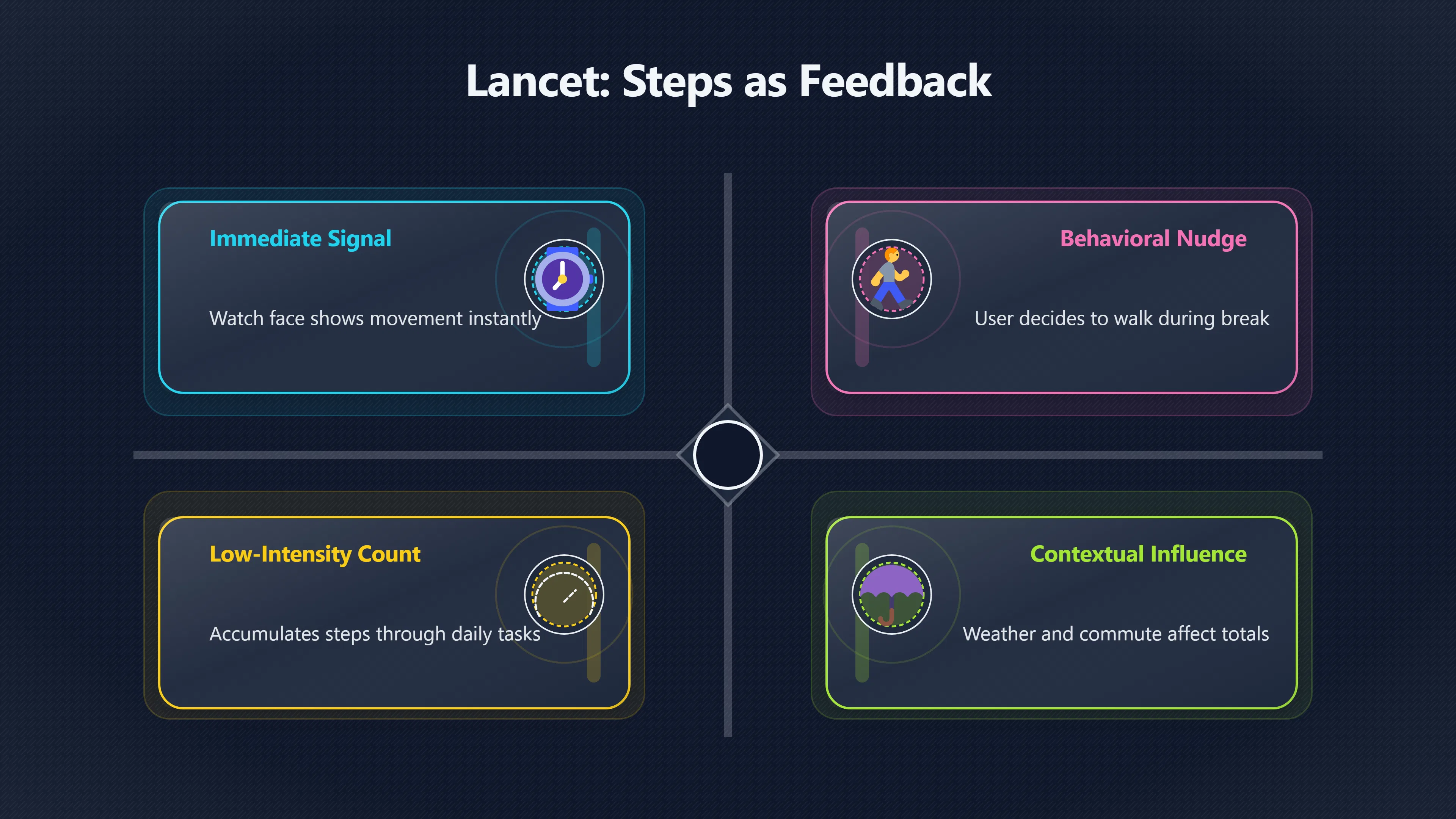
Many health behaviours are difficult to observe directly. Cardiovascular health improves slowly. Weight fluctuates for many reasons. Fitness gains can take weeks to notice. Step counts are different because they provide immediate feedback.
A person can see that they have taken 2,000 steps by lunchtime and decide to walk during a break. They can notice a low-movement day and take a short evening walk. The metric creates a clear link between behaviour and information.
This simplicity is one reason wearable trackers have attracted so much attention. A major umbrella review published in The Lancet Digital Health found consistent evidence that activity trackers increase physical activity across many populations, with average gains equivalent to roughly 1,800 additional steps and around 40 extra minutes of walking per day. The trackers did not magically improve health on their own; they helped people notice and adjust their behaviour.[The Lancet]thelancet.comThe LancetEffectiveness of wearable activity trackers to increase…by T Ferguson · 2022 · Cited by 589 — Together, the results from thi…[PubMed]pubmed.ncbi.nlm.nih.govEffectiveness of wearable activity trackers to increase…by T Ferguson · 2022 · Cited by 589 — This systematic review of systemat…
For self-improvement, that distinction matters. The useful question is not whether a watch proves someone is healthy. The useful question is whether the feedback helps them move more often than they otherwise would.
Where Step Goals Become Misleading
The most common misunderstanding is treating a step target as a boundary between success and failure.
The famous 10,000-step goal is a good example. Although widely adopted, it was not originally established as a scientifically proven threshold for health. Research consistently shows benefits from increasing daily steps even when people remain below 10,000. In fact, several large analyses have found meaningful reductions in mortality risk beginning at much lower levels of activity.[The Lancet]thelancet.comThe LancetEffectiveness of wearable activity trackers to increase…by T Ferguson · 2022 · Cited by 589 — Together, the results from thi…[PubMed Central]pmc.ncbi.nlm.nih.govPubMed CentralDaily steps and all-cause mortality: a meta-analysis of 15…by AE Paluch · 2022 · Cited by 641 — Although 10 000 steps pe…
This creates a paradox. Someone who increases their daily movement from 2,500 to 6,000 steps may achieve a substantial health improvement yet feel like they are failing because they did not reach an arbitrary target. The number has become a judgement rather than feedback.
Research increasingly suggests that health benefits occur along a continuum. Large reviews have found lower risks of mortality, cardiovascular disease and other outcomes as daily steps increase, with gains often appearing well below 10,000 steps per day. More movement is generally better than less movement, but the relationship is gradual rather than all-or-nothing.[Science Media Centre]sciencemediacentre.orgexpert reaction to systematic review and meta-analysis of…23 Jul 2025 — “This study suggested that 5000-7000 steps per day can signifi…[The Lancet]thelancet.comThe LancetEffectiveness of wearable activity trackers to increase…by T Ferguson · 2022 · Cited by 589 — Together, the results from thi…[OUP Academic]academic.oup.comOUP AcademicThe association between daily step count and all-cause and…by M Banach · 2023 · Cited by 302 — This meta-analysis demonstr…
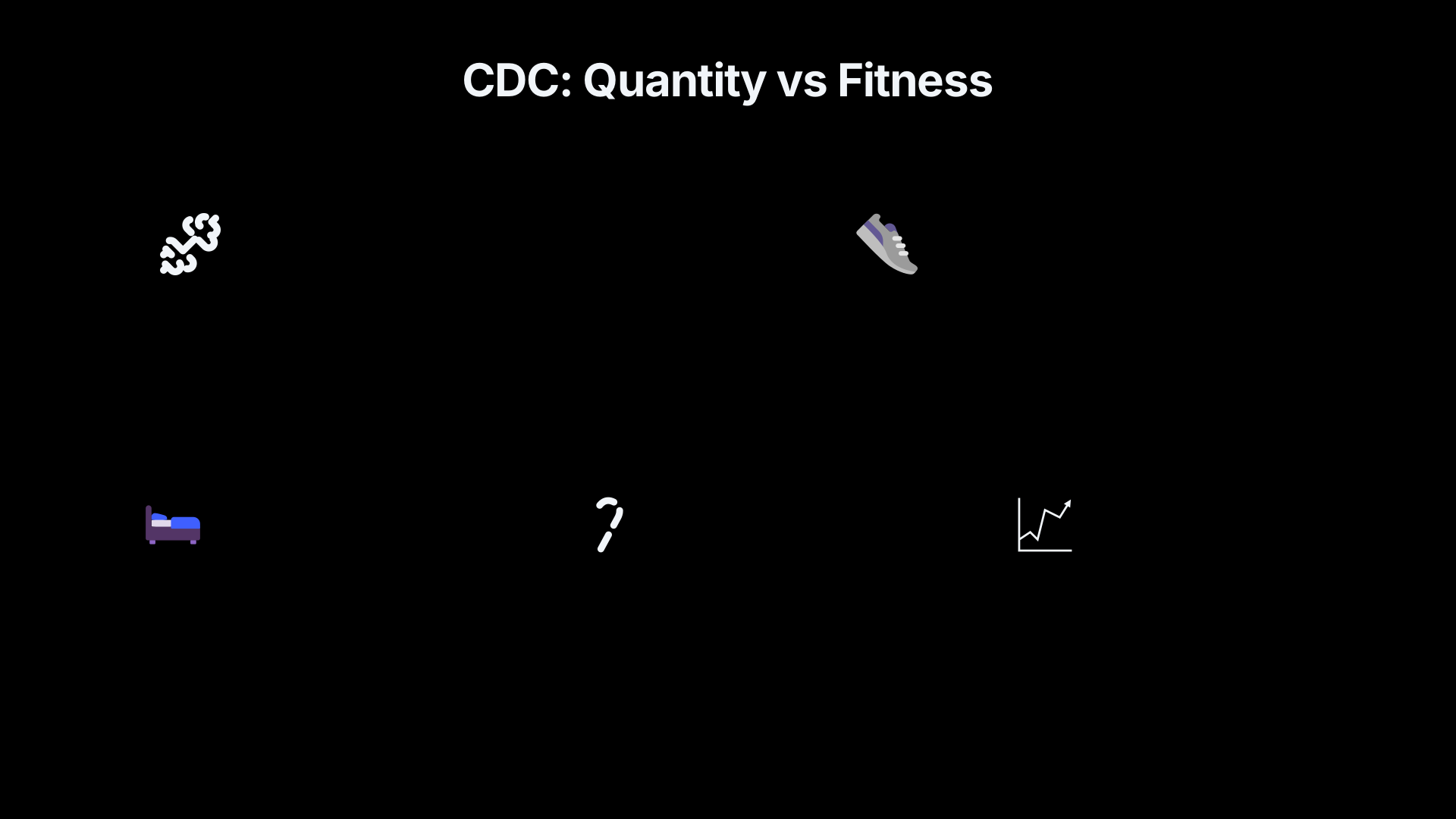
Another problem is that step counts measure quantity of movement, not the whole picture of physical fitness.
A person may:
- Reach a step target but never perform strength training.
- Accumulate steps through low-intensity activity while neglecting cardiovascular conditioning.
- Walk extensively while sleeping poorly or recovering inadequately.
- Have mobility limitations that make step-based comparisons unfair.
Public-health guidance reflects this broader reality. Physical activity recommendations include both aerobic activity and muscle-strengthening activity. A daily step count captures only part of that picture.[CDC]cdc.govAdult Activity: An Overview | Physical Activity Basics20 Dec 2023 — Adults need at least 150 minutes of moderate-intensity physical ac…
Why More Steps Do Not Equal More Discipline
Visible metrics often attract moral interpretations. People begin to see high numbers as evidence of virtue and low numbers as evidence of laziness.
Step counts are particularly vulnerable to this because they are displayed constantly. A watch face can make movement feel like a public scorecard even when nobody else sees it.
Yet daily step totals are influenced by many factors unrelated to commitment:
- Occupation and commuting patterns.
- Family responsibilities.
- Illness or injury.
- Weather and environment.
- Travel schedules.
- Age and mobility constraints.
A nurse working long shifts may accumulate far more steps than an office worker who performs intense gym sessions. A parent caring for a newborn may experience a temporary collapse in daily movement despite making sensible health decisions elsewhere.
The number therefore reflects context as much as character. Using it as a measure of discipline invites inaccurate conclusions.
What Research Actually Suggests About Step Targets
Recent evidence has moved the discussion away from finding a single perfect number.
A 2025 systematic review and dose-response meta-analysis found that higher step counts were consistently associated with better health outcomes, while suggesting that around 7,000 daily steps may provide substantial benefits for many adults. Importantly, the evidence did not imply that benefits suddenly begin at one threshold or disappear below it.[The Lancet]thelancet.comThe LancetEffectiveness of wearable activity trackers to increase…by T Ferguson · 2022 · Cited by 589 — Together, the results from thi…
Other studies have reached similar conclusions. Mortality risk appears to decline substantially as people move from very low activity levels toward moderate step counts, with diminishing returns as counts become higher. Even modest increases from a low baseline can matter.[JAMA Network]jamanetwork.comSteps per Day and All-Cause Mortality in Middle-aged Adultsby AE Paluch · 2021 · Cited by 200 — Adults taking at least 7000 steps/d, comp…[PubMed Central]pmc.ncbi.nlm.nih.govPubMed CentralDaily steps and all-cause mortality: a meta-analysis of 15…by AE Paluch · 2022 · Cited by 641 — Although 10 000 steps pe…[OUP Academic]academic.oup.comOUP AcademicThe association between daily step count and all-cause and…by M Banach · 2023 · Cited by 302 — This meta-analysis demonstr…
The practical implication is simple: for most people, the most meaningful comparison is not with an idealised target but with their own recent baseline.
Going from 3,000 to 5,000 daily steps is often a more important behavioural achievement than going from 10,000 to 12,000.
How to Use Step Trends Without Worshipping the Number
The most productive use of step counts is as a trend indicator.
Instead of asking whether today’s number is good or bad, ask questions such as:
- Am I moving more than I was last month?
- Are long sedentary periods becoming less common?
- Does my activity collapse during stressful weeks?
- What habits reliably increase movement?
Looking at weekly or monthly averages usually provides more useful information than obsessing over individual days. A single low-step day may reflect recovery, illness or competing priorities. A long-term decline in movement is more informative.
Many people also benefit from using flexible targets. Rather than one rigid daily goal, they might have:
- A minimum target for difficult days.
- A standard target for ordinary days.
- A stretch target for highly active days.
This approach preserves the motivational value of feedback while reducing the all-or-nothing thinking that often accompanies streaks and fixed quotas.
The Most Useful Interpretation
Step counts are among the best examples of visible feedback in self-improvement because they are actionable. They tell you something you can change today.
Their value comes from helping you notice behaviour, not from proving fitness, health or personal worth. A higher number usually means more movement. It does not automatically mean better health, greater effort or stronger character.
The healthiest relationship with the metric is therefore practical rather than symbolic. Use the count to spot patterns, encourage movement and guide decisions. Let it answer the question “What should I do next?” rather than “What kind of person am I?” The first use supports improvement. The second asks far more of a number than it can ever deliver.
Amazon book picks
Further Reading
Books and field guides related to What Step Counts Can and Cannot Tell You. Use these as the next step if you want deeper reading beyond the article.
Atomic Habits
Rating: 3.5/5 from 7 Google Books ratings
Explains how feedback and tracking influence behaviour.
eBay marketplace picks
Marketplace Samples
Example marketplace items related to this page. Use the search link to explore similar finds on eBay.





Endnotes
1.
Source: academic.oup.com
Link:https://academic.oup.com/eurjpc/article/30/18/1975/7226309
Source snippet
OUP AcademicThe association between daily step count and all-cause and...by M Banach · 2023 · Cited by 302 — This meta-analysis demonstr...
2.
Source: cdc.gov
Link:https://www.cdc.gov/physical-activity-basics/guidelines/adults.html
Source snippet
Adult Activity: An Overview | Physical Activity Basics20 Dec 2023 — Adults need at least 150 minutes of moderate-intensity physical ac...
3.
Source: cdc.gov
Link:https://www.cdc.gov/physical-activity-basics/benefits/index.html
Source snippet
Benefits of Physical Activity4 Dec 2025 — For adults 60 and older, the risk of premature death leveled off at about 6,000 to 8,000 steps...
4.
Source: cdc.gov
Title: getting started
Link:https://www.cdc.gov/healthy-weight-growth/physical-activity/getting-started.html
Source snippet
Steps for Getting Started With Physical Activity4 Dec 2025 — Here are ways to get started: Federal guidelines for adults recommend at lea...
5.
Source: cdc.gov
Title: older adults
Link:https://www.cdc.gov/physical-activity-basics/guidelines/older-adults.html
Source snippet
Older Adult Activity: An Overview | Physical Activity Basics4 Dec 2025 — Moderate-intensity aerobic activity such as brisk walking for 15...
6.
Source: archive.cdc.gov
Link:https://archive.cdc.gov/www_cdc_gov/media/releases/2020/p0324-daily-step-count.html
Source snippet
Daily Step Count Linked with Lower All-cause...Mar 24, 2020 — Taking 12,000 steps per day was associated with a 65% lower risk compared...
7.
Source: cdc.gov
Title: what counts
Link:https://www.cdc.gov/physical-activity-basics/adding-older-adults/what-counts.html
Source snippet
as Physical Activity for Older AdultsDec 4, 2025 — Older adults need 150 minutes of moderate-intensity aerobic physical activity each wee...
8.
Source: who.int
Link:https://www.who.int/initiatives/behealthy/physical-activity
Source snippet
Physical activityShould do at least 60 minutes of moderate to vigorous-intensity physical activity daily. · Should do at least 150 minute...
9.
Source: thelancet.com
Link:https://www.thelancet.com/journals/landig/article/PIIS2589-7500%2822%2900111-X/fulltext
Source snippet
The LancetEffectiveness of wearable activity trackers to increase...by T Ferguson · 2022 · Cited by 589 — Together, the results from thi...
10.
Source: thelancet.com
Link:https://www.thelancet.com/journals/lanpub/article/PIIS2468-2667%2825%2900164-1/fulltext
Source snippet
The LancetDaily steps and health outcomes in adults: a systematic...by D Ding · 2025 · Cited by 113 — All consistently found that higher...
11.
Source: pubmed.ncbi.nlm.nih.gov
Link:https://pubmed.ncbi.nlm.nih.gov/35868813/
Source snippet
Effectiveness of wearable activity trackers to increase...by T Ferguson · 2022 · Cited by 589 — This systematic review of systemat...
12.
Source: thelancet.com
Link:https://www.thelancet.com/journals/lanpub/article/PIIS2468-2667%2821%2900302-9/fulltext
Source snippet
The LancetDaily steps and all-cause mortality: a meta-analysis of 15...by AE Paluch · 2022 · Cited by 604 — Although 10 000 steps per da...
13.
Source: pmc.ncbi.nlm.nih.gov
Link:https://pmc.ncbi.nlm.nih.gov/articles/PMC9289978/
Source snippet
PubMed CentralDaily steps and all-cause mortality: a meta-analysis of 15...by AE Paluch · 2022 · Cited by 641 — Although 10 000 steps pe...
14.
Source: sciencemediacentre.org
Link:https://www.sciencemediacentre.org/expert-reaction-to-systematic-review-and-meta-analysis-of-daily-step-count-and-risk-of-chronic-diseases-cognitive-decline-and-death/
Source snippet
expert reaction to systematic review and meta-analysis of...23 Jul 2025 — “This study suggested that 5000-7000 steps per day can signifi...
15.
Source: jamanetwork.com
Link:https://jamanetwork.com/journals/jamanetworkopen/fullarticle/2783711
Source snippet
Steps per Day and All-Cause Mortality in Middle-aged Adultsby AE Paluch · 2021 · Cited by 200 — Adults taking at least 7000 steps/d, comp...
16.
Source: pubmed.ncbi.nlm.nih.gov
Link:https://pubmed.ncbi.nlm.nih.gov/37555441/
Source snippet
association between daily step count and all-cause...by M Banach · 2023 · Cited by 297 — This meta-analysis demonstrates a significant i...
17.
Source: jamanetwork.com
Link:https://jamanetwork.com/journals/jamanetworkopen/fullarticle/2802810
Source snippet
Association of Daily Step Patterns With Mortality in US Adultsby K Inoue · 2023 · Cited by 100 — Recently, a meta-analysis suggested that...
18.
Source: henryford.com
Title: 10000 Steps Per Day
Link:https://www.henryford.com/Blog/2026/03/10000-Steps-Per-Day
Source snippet
Do You Really Need 10000 Steps A Day?7 days ago — Start slow: Instead of aiming for 7,000 steps right at the beginning, start with a few...
Additional References
19.
Source: researchgate.net
Link:https://www.researchgate.net/publication/371001917_The_effectiveness_of_wearable_activity_trackers_for_increasing_physical_activity_and_reducing_sedentary_time_in_older_adults_A_systematic_review_and_meta-analysis
Source snippet
(PDF) The effectiveness of wearable activity trackers for...Apr 30, 2026 — This review showed that wearable activity trackers are an eff...
20.
Source: ouci.dntb.gov.ua
Link:https://ouci.dntb.gov.ua/en/works/9JNGEJ19/
Source snippet
dntb.gov.uaSelf-tracking of daily physical activity using a fitness tracker...Results of mixed-effect multilevel analyses suggest that a...
21.
Source: acsm.org
Link:https://acsm.org/education-resources/trending-topics-resources/physical-activity-guidelines/
22.
Source: ouci.dntb.gov.ua
Link:https://ouci.dntb.gov.ua/en/works/4LRnV0q9/
Source snippet
Devices to Improve Physical Activity and Reduce...Effectiveness of wearable activity trackers to increase physical activity and improve...
23.
Source: newswise.com
Link:https://www.newswise.com/pdf_docs/165828208454252_PIIS258975002200111X.pdf
Source snippet
d meta-analyses (umbrella review) aimed to examine the effectiveness of activity trackers for.Read more...
24.
Source: theguardian.com
Title: 7000 steps a day could be enough to improve health say researchers
Link:https://www.theguardian.com/science/2025/jul/23/7000-steps-a-day-could-be-enough-to-improve-health-say-researchers
Source snippet
7000 steps a day could be enough to improve health, say...23 Jul 2025 — Compared with those who walked 2,000 steps a day, the researcher...
25.
Source: nih.gov
Link:https://www.nih.gov/news-events/nih-research-matters/number-steps-day-more-important-step-intensity
Source snippet
Number of steps per day more important than step intensity31 Mar 2020 — Taking 4,000 or fewer steps a day is considered a low level of ph...
26.
Source: dtnext.in
Title: fitness trackers do not appear to improve health lancet report
Link:https://www.dtnext.in/lifestyle/wellbeing/fitness-trackers-do-not-appear-to-improve-health-lancet-report
Source snippet
Fitness trackers do not appear to improve health: Lancet...Oct 5, 2016 — “However, we found no evidence that the device promoted weight...
27.
Source: dr.ntu.edu.sg
Title: ntu.edu.sg Wearable activity trackers for promoting physical
Link:https://dr.ntu.edu.sg/server/api/core/bitstreams/a214eb20-98d2-4410-9d81-0c3a31bca745/content
Source snippet
NTUby C Li · Cited by 88 — Conclusions: The use of wearable activity trackers effectively improves conscious exercise behavior, includ...
28.
Source: uptonneurophysio.com
Title: wearable activity trackers recommended for everyone
Link:https://www.uptonneurophysio.com/beccas-blog/wearable-activity-trackers-recommended-for-everyone
Source snippet
Wearable Activity Trackers-recommended for everyoneNov 20, 2025 — Effectiveness of wearable activity trackers to increase physical activi...
Topic Tree