Within Self Help Myths
Why Motivation Fades by Tuesday Afternoon
Motivational highs can help people start, but lasting change usually depends on plans, cues and routines that survive ordinary stress.
On this page
- How high energy self help creates a short term lift
- Why emotional readiness is not a behaviour system
- What planning adds when motivation drops
Page outline Jump by section
Introduction
A familiar pattern runs through much of the self-help industry. You attend a seminar, watch a powerful talk, or finish an inspiring book feeling different. You are energised, optimistic and convinced that change will be easy this time. Then ordinary life returns. Work becomes busy, routines reassert themselves, unexpected problems appear, and by Tuesday afternoon the new commitment is fading.
 This does not necessarily mean the event failed or that the participant lacked commitment. The deeper problem is that motivation and behaviour are not the same thing. High-energy experiences can create genuine intention, but intention alone rarely produces lasting change. Research on behaviour change repeatedly finds that people often form strong intentions without consistently translating them into action, a phenomenon known as the intention–behaviour gap.[PubMed Central]pmc.ncbi.nlm.nih.govPub Med Central Why We Don't “Just Do It”: Understanding the Intentionby MD Faries · 2016 · Cited by 264 — This review introduces 5 factors that could help the practitioner understand the patient intentio…[White Rose Research Online]eprints.whiterose.ac.ukWhite Rose Research OnlineThe Intention–Behavior Gapby P Sheeran · 2016 · Cited by 2982 — This analysis revealed that it is people who in…
Within the broader mythology of self-help, this matters because many programmes implicitly sell emotional readiness as if it were a complete change system. In reality, motivation is often the spark rather than the engine.
How High-Energy Self-Help Creates a Short-Term Lift
Motivational events are not usually ineffective because they fail to move people. Their strength is precisely that they create movement.
Large seminars, workshops and inspirational talks often combine emotionally charged stories, social reinforcement, public commitments, music, group participation and vivid future-oriented imagery. These elements can temporarily increase confidence, attention and willingness to act. People leave feeling unusually certain that they are about to change.
There is good reason this feels powerful. Motivation is a real psychological force. Emotional arousal can increase perceived possibility, reduce hesitation and create a stronger desire to pursue a goal. Contemporary research on motivation and reward systems suggests that positive emotional states can help initiate behaviour change efforts.[ResearchGate]researchgate.netResearch Gate Motivation and reward mechanisms in health behaviorMotivation and reward mechanisms in health behavior…January 29, 2021 — 10 Feb 2021 — In this integrative review, we presen…
The problem is timing. The emotional conditions inside a seminar hall are often very different from the conditions that exist three days later. During the event:
- Distractions are reduced.
- The goal feels vivid and immediate.
- Social pressure supports action.
- Attention is focused on improvement.
- Obstacles are psychologically distant.
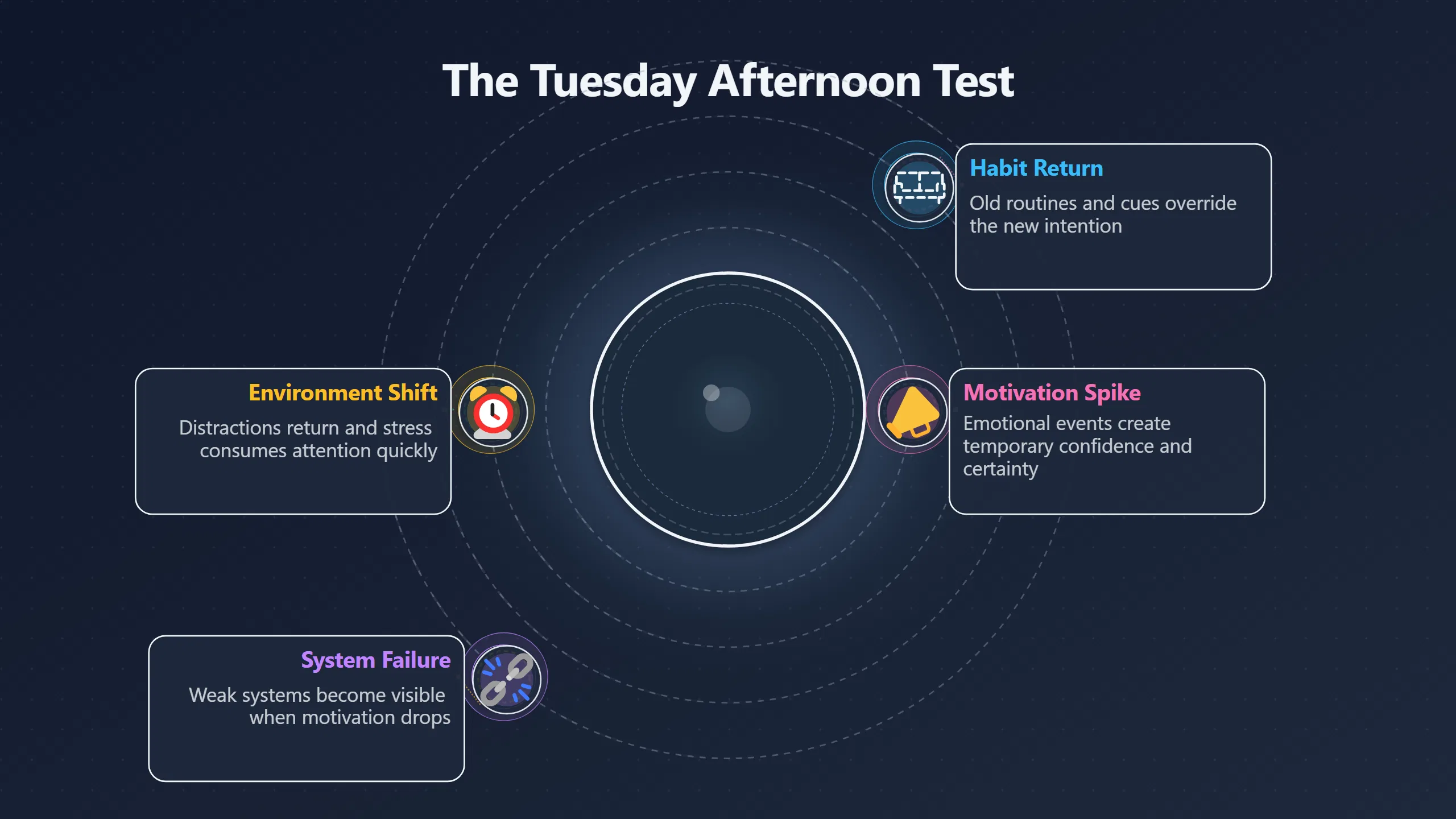
After the event:
- Competing priorities return.
- Existing habits reappear.[washingtonpost.com]washingtonpost.comPopularized by authors BJ Fogg and James Clear, and widely used by behavioral therapists, habit-stacking involves "stacking" small, speci…
- Stress consumes attention.
- The environment remains largely unchanged.
The result is a predictable decline in the emotional intensity that originally fuelled the commitment. The feeling was real, but the circumstances that produced it were temporary.
Why Emotional Readiness Is Not a Behaviour System
One of the most persistent self-help myths is that people fail because they were not motivated enough. Behavioural science points to a more complicated picture.
Research on the intention–behaviour gap shows that many people genuinely intend to change and still fail to act consistently. The gap is not primarily explained by a lack of desire. It often emerges because intention must compete with habits, environmental cues, limited attention and practical obstacles.[PubMed Central]pmc.ncbi.nlm.nih.govPub Med Central Why We Don't “Just Do It”: Understanding the Intentionby MD Faries · 2016 · Cited by 264 — This review introduces 5 factors that could help the practitioner understand the patient intentio…[White Rose Research Online]eprints.whiterose.ac.ukWhite Rose Research OnlineThe Intention–Behavior Gapby P Sheeran · 2016 · Cited by 2982 — This analysis revealed that it is people who in…
This distinction helps explain why motivational highs fade so quickly. A seminar can strengthen intention, but intention is only one component of behaviour.
Behaviour scientist B. J. Fogg’s behaviour model argues that behaviour occurs when motivation, ability and a prompt converge at the same moment. If one element is missing, the behaviour is less likely to happen. High motivation can temporarily compensate for weak systems, but when motivation falls, the weaknesses become visible.[Fogg Behavior Model]behaviormodel.orgFogg Behavior ModelFogg Behavior Model - BJ FoggThe Fogg Behavior Model shows that three elements must converge at the same moment for a…[Behavior Design Lab]behaviordesign.stanford.eduBehavior Design LabFogg Behavior ModelThe Fogg Behavior Model shows that three elements must converge at the same moment for a behavior t…
Consider someone who leaves a self-help event determined to exercise every morning.
The motivational explanation says:
“I will exercise because I am committed.”
The behavioural explanation asks:
- When exactly?
- Where?
- What will trigger the action?
- What happens if it rains?
- What happens after a poor night’s sleep?
- How easy is the first step?
Those questions sound less inspiring, but they are often more predictive of what actually happens.
The self-help industry frequently markets emotional certainty as evidence that change has already begun. Behaviour research suggests that certainty is often only the beginning of the process.[PubMed Central]pmc.ncbi.nlm.nih.govPub Med Central Why We Don't “Just Do It”: Understanding the Intentionby MD Faries · 2016 · Cited by 264 — This review introduces 5 factors that could help the practitioner understand the patient intentio…

The Hidden Power of Existing Habits
Another reason motivation fades is that most self-help events focus attention on future behaviour while underestimating current behaviour.
People do not start from a blank slate. They already have routines, schedules, habits and environmental triggers operating every day. These existing patterns continue functioning after the motivational event ends.
For example, a person may leave a seminar determined to read every evening. Yet each evening already contains established cues: television, social media, household tasks, family obligations or simple fatigue. The new intention enters an environment that has been training the old behaviour for months or years.
Research on behaviour maintenance consistently finds that lasting change depends heavily on creating stable routines and habits that reduce dependence on ongoing motivation. Behaviour change interventions often succeed in creating temporary improvement but struggle to maintain results unless the new behaviour becomes integrated into everyday life.[PubMed Central]pmc.ncbi.nlm.nih.govPub Med Central Why We Don't “Just Do It”: Understanding the Intentionby MD Faries · 2016 · Cited by 264 — This review introduces 5 factors that could help the practitioner understand the patient intentio…
This is one reason tiny, repeatable actions often outperform dramatic resolutions. Small actions are easier to repeat under ordinary conditions, including stressful ones.[Tiny Habits]tinyhabits.comTiny HabitsTiny Habits: BJ FoggCreate any habit you want in your life using Tiny Habits: A breakthrough method created by Stanford behavi…[Stanford Graduate School of Business]gsb.stanford.edubuilding habits key lasting behavior changeStanford Graduate School of BusinessBuilding Habits: The Key to Lasting Behavior Change18 Apr 2023 — In this episode, BJ Fogg reveals the…

What Planning Adds When Motivation Drops
The strongest critique of motivation-centred self-help is not that motivation is useless. It is that motivation is unreliable.
People naturally experience fluctuations in energy, mood, confidence and attention. A change strategy that only works when motivation is high is fragile by design.
Planning helps because it transfers some of the burden from emotion to structure.
Researchers studying the intention–behaviour gap have repeatedly found that detailed action planning, implementation intentions and self-regulatory strategies help translate intentions into behaviour. Instead of relying on a general desire to improve, people specify when, where and how the action will occur.[ResearchGate]researchgate.netResearch Gate Motivation and reward mechanisms in health behaviorMotivation and reward mechanisms in health behavior…January 29, 2021 — 10 Feb 2021 — In this integrative review, we presen…[2D-NB]d-nb.infoBridging the intention–behaviour gap: Planning, self-…by FF Sniehotta · Cited by 2066 — Intentions are explicit decisions to act in a…
A motivational commitment sounds like:
“I will meditate more.”
An implementation plan sounds like:
“After I make coffee at 7 a.m., I will meditate for two minutes at the kitchen table.”
The second statement is less emotionally exciting but more behaviourally useful because it creates a cue, a context and a concrete action.
Recent reporting on habit formation has highlighted similar principles. Techniques such as habit stacking work by attaching a new behaviour to an existing routine, reducing dependence on momentary enthusiasm and increasing the likelihood that the behaviour occurs automatically.[The Washington Post]washingtonpost.comPopularized by authors BJ Fogg and James Clear, and widely used by behavioral therapists, habit-stacking involves "stacking" small, speci…
In practical terms, planning contributes three things that motivation alone cannot reliably provide:
- Consistency: the action has a defined place in daily life.
- Resilience: the behaviour can survive low-motivation days.
- Repeatability: success depends less on inspiration and more on execution.
Why the Tuesday Afternoon Test Matters
The true value of a self-help event is not how someone feels while attending it. It is what remains when the emotional surge disappears.
A useful motivational experience can help people clarify goals, increase optimism and begin taking action. Those benefits are real. The problem arises when the emotional lift is mistaken for durable change itself.
The most reliable behaviour-change theories suggest that maintenance depends on factors such as routines, environmental support, prompts, self-regulation and habit formation rather than on permanently elevated motivation.[PubMed Central]pmc.ncbi.nlm.nih.govPub Med Central Why We Don't “Just Do It”: Understanding the Intentionby MD Faries · 2016 · Cited by 264 — This review introduces 5 factors that could help the practitioner understand the patient intentio…[Taylor & Francis Online]tandfonline.comTaylor & Francis OnlineDeveloping habit-based health behaviour change…by B Gardner · 2023 · Cited by 156 — Theory suggests that making…
That is why so many people feel transformed on Sunday and unchanged by the following week. The seminar may have successfully increased motivation, but motivation was never the main challenge. The challenge was building a system capable of functioning after the excitement ended.
The uncomfortable lesson is also the practical one: lasting self-improvement usually begins when inspiration is translated into schedules, cues, plans and routines that continue working during ordinary, unremarkable days. The test is not whether a message feels powerful in the moment. The test is whether the behaviour still happens when the moment has passed.
Amazon book picks
Further Reading
Books and field guides related to Why Motivation Fades by Tuesday Afternoon. Use these as the next step if you want deeper reading beyond the article.
eBay marketplace picks
Marketplace Samples
Example marketplace items related to this page. Use the search link to explore similar finds on eBay.




Endnotes
1.
Source: researchgate.net
Title: Research Gate Motivation and reward mechanisms in health behavior
Link:https://www.researchgate.net/publication/348891109_Motivation_and_reward_mechanisms_in_health_behavior_change_processes
Source snippet
Motivation and reward mechanisms in health behavior...January 29, 2021 — 10 Feb 2021 — In this integrative review, we presen...
Published: January 29, 2021
2.
Source: behaviordesign.stanford.edu
Link:https://behaviordesign.stanford.edu/resources/fogg-behavior-model
Source snippet
Behavior Design LabFogg Behavior ModelThe Fogg Behavior Model shows that three elements must converge at the same moment for a behavior t...
3.
Source: gsb.stanford.edu
Title: building habits key lasting behavior change
Link:https://www.gsb.stanford.edu/insights/building-habits-key-lasting-behavior-change
Source snippet
Stanford Graduate School of BusinessBuilding Habits: The Key to Lasting Behavior Change18 Apr 2023 — In this episode, BJ Fogg reveals the...
4.
Source: researchgate.net
Title: Research Gate(PDF) Bridging the Intention-Behaviour Gap: Planning, Self
Link:https://www.researchgate.net/publication/233052718_Bridging_the_Intention-Behaviour_Gap_Planning_Self-Efficacy_and_Action_Control_in_the_Adoption_and_Maintenance_of_Physical_Exercise
Source snippet
ResearchGate(PDF) Bridging the Intention-Behaviour Gap: Planning, Self...April 1, 2005 — Detailed action planning, perceived self-effica...
Published: April 1, 2005
5.
Source: d-nb.info
Link:https://d-nb.info/1102164860/34
Source snippet
Bridging the intention–behaviour gap: Planning, self-...by FF Sniehotta · Cited by 2066 — Intentions are explicit decisions to act in a...
6.
Source: pmc.ncbi.nlm.nih.gov
Title: Pub Med Central Why We Don’t “Just Do It”: Understanding the Intention
Link:https://pmc.ncbi.nlm.nih.gov/articles/PMC6125069/
Source snippet
by MD Faries · 2016 · Cited by 264 — This review introduces 5 factors that could help the practitioner understand the patient intentio...
7.
Source: eprints.whiterose.ac.uk
Link:https://eprints.whiterose.ac.uk/id/eprint/107519/3/The
Source snippet
White Rose Research OnlineThe Intention–Behavior Gapby P Sheeran · 2016 · Cited by 2982 — This analysis revealed that it is people who in...
8.
Source: behaviormodel.org
Link:https://www.behaviormodel.org/
Source snippet
Fogg Behavior ModelFogg Behavior Model - BJ FoggThe Fogg Behavior Model shows that three elements must converge at the same moment for a...
9.
Source: pmc.ncbi.nlm.nih.gov
Link:https://pmc.ncbi.nlm.nih.gov/articles/PMC4975085/
Source snippet
Background: Behaviour change interventions are effective in supporting individuals in achieving temporary behaviour change.Read more...
10.
Source: tandfonline.com
Link:https://www.tandfonline.com/doi/full/10.1080/08870446.2021.2003362
Source snippet
Taylor & Francis OnlineDeveloping habit-based health behaviour change...by B Gardner · 2023 · Cited by 156 — Theory suggests that making...
11.
Source: tinyhabits.com
Link:https://tinyhabits.com/
Source snippet
Tiny HabitsTiny Habits: BJ FoggCreate any habit you want in your life using Tiny Habits: A breakthrough method created by Stanford behavi...
12.
Source: washingtonpost.com
Link:https://www.washingtonpost.com/wellness/2026/04/26/habit-stacking/
Source snippet
Popularized by authors BJ Fogg and James Clear, and widely used by behavioral therapists, habit-stacking involves "stacking" small, speci...
13.
Source: drpaulmccarthy.com
Title: tiny habits the breakthrough method for building life changing behaviors
Link:https://www.drpaulmccarthy.com/post/tiny-habits-the-breakthrough-method-for-building-life-changing-behaviors
Source snippet
Tiny Habits: The Breakthrough Method for Building Life-...10 Feb 2026 — Use the B=MAP formula: Every behavior needs Motivation, Ability...
14.
Source: northbeam.io
Title: fogg behavior model motivation ability and prompts
Link:https://www.northbeam.io/blog/fogg-behavior-model-motivation-ability-and-prompts
Source snippet
Fogg Behavior Model: Motivation, Ability, and Prompts29 Oct 2025 — The Fogg Behavior Model explains that behavior occurs when Motivation...
15.
Source: youtube.com
Title: B J Fogg
Link:https://www.youtube.com/watch?v=l3KNiPHhB9s
Source snippet
BJ Fogg - How To Think Clearly About Behavior Change...Forget big change, start with a tiny habit: BJ Fogg at TEDxFremont · Rory...
16.
Source: thedecisionlab.com
Link:https://thedecisionlab.com/reference-guide/psychology/fogg-behavior-model
Source snippet
Fogg Behavior ModelIt involves manipulating motivation, ability, and prompts to encourage desired actions and facilitate positive behavio...
17.
Source: nehrlich.com
Title: tiny habits by bj fogg
Link:https://www.nehrlich.com/blog/2020/03/03/tiny-habits-by-bj-fogg/
Source snippet
Tiny Habits, by BJ Fogg3 Mar 2020 — Fogg suggests troubleshooting first the prompt, then ability, then motivation. If the prompt isn't cl...
Additional References
18.
Source: linkedin.com
Link:https://www.linkedin.com/pulse/episode-71-bj-fogg-phd-behavioural-doyen-author-tiny-nouye
Source snippet
BJ Fogg PhD, behavioural expert and author of Tiny Habits...BJ explains the Fogg Behaviour Model, the coming together of motivation, abi...
19.
Source: rsisinternational.org
Link:https://rsisinternational.org/journals/ijriss/articles/bridging-intention-behavior-gap-through-implementation-intention-conceptual-insight/
Source snippet
Bridging Intention-Behavior Gap through Implementation...And this study explains how entrepreneurs can use implementation intention to c...
20.
Source: realsimple.com
Link:https://www.realsimple.com/work-life/life-strategies/inspiration-motivation/habit-stacking
Source snippet
This technique capitalizes on the brain's established neural pathways, making new habits easier to adopt by tying them to familiar routin...
21.
Source: bluerhoon.nl
Link:https://bluerhoon.nl/wp-content/uploads/2023/04/Situating-interventions-to-bridge-the-intention-behaviour-gap-A-framework-for.pdf
Source snippet
Situating interventions to bridge the intention–behaviour gapby EK Papies · 2017 · Cited by 127 — This paper presents a situated cognitio...
22.
Source: mariashriver.com
Link:https://mariashriver.com/stanford-researcher-bj-fogg-on-the-tiny-habits-that-lead-to-big-breakthroughs/
Source snippet
Stanford Researcher BJ Fogg on the 'Tiny Habits' That Lead to...There's Motivation to do the behavior, Ability to do the behavior, and a...
23.
Source: lifeintelligence.io
Title: breaking habits psychology of lasting behavior change
Link:https://www.lifeintelligence.io/blog/breaking-habits-psychology-of-lasting-behavior-change
Source snippet
Breaking Habits: Psychology of Lasting Behavior Change6 Mar 2021 — In both personal and professional realms, we often experience desires...
24.
Source: sweetinstitute.com
Title: [social support]({{ ‘social-support/’ | relative_url }}) and behavioral change and motivation
Link:https://sweetinstitute.com/social-support-and-behavioral-change-and-motivation/
Source snippet
23 Jan 2025 — Social support is a vital component of the behavior change process, significantly influencing motivation and engagement.Rea...
25.
Source: dexterzhuang.com
Title: the ultimate guide to lasting behavior change
Link:https://www.dexterzhuang.com/2019/09/18/the-ultimate-guide-to-lasting-behavior-change/
Source snippet
18 Sept 2019 — In this evidence-based guide, I want to show you that changing behavior —whether it's related to your career, wellness, or...
26.
Source: ui-patterns.com
Title: making the fogg behavior model actionable
Link:https://ui-patterns.com/blog/making-the-fogg-behavior-model-actionable
Source snippet
8 Apr 2019 — Fogg suggests three things need to converge at the same moment in time for behavior to happen: Motivation, Ability, and a Pr...
27.
Source: behaviourworksaustralia.org
Link:https://www.behaviourworksaustralia.org/blog/the-intention-behaviour-gap-what-is-it-and-how-can-you-avoid-it
Source snippet
when people don't do what they want to do, basically.Read more...
Topic Tree