Within False Progress
Are You Planning or Avoiding the Real Task?
Planning can feel responsible while quietly protecting you from the task that would prove whether change is happening.
On this page
- Why useful planning turns into delay
- Mood repair and the safer substitute task
- A two minute reality test for any plan
Page outline Jump by section
Introduction
Planning is one of the most respected activities in self-improvement. It looks responsible, organised and forward-looking. Yet planning can quietly become a form of productive procrastination: work that feels useful because it is related to the goal, while delaying the action that would reveal whether progress is actually happening.
 This is a common trap within self-improvement theatre. The person is not doing nothing. They may be researching, outlining, scheduling, tracking and refining. The problem is that these activities can provide many of the emotional rewards of progress without requiring the discomfort of performance. A study timetable avoids the struggle of studying. A business strategy avoids the risk of selling. A detailed fitness programme avoids the effort of training. The plan grows while the behaviour remains unchanged.
The distinction is not that planning is bad. Effective planning is one of the most studied and useful behaviour-change tools available. The question is whether planning is serving action or replacing it. Research on procrastination increasingly suggests that delay is often driven by emotion regulation rather than poor time management. In that context, planning can become a sophisticated way of avoiding uncomfortable feelings while preserving the impression of productivity.[PMC]pmc.ncbi.nlm.nih.govPMCPromoting the translation of intentions into action byby F Wieber · 2015 · Cited by 215 — It has been proposed that implementation intentions render the mental representation of the situat…[White Rose Research Online]eprints.whiterose.ac.ukCompass Paper revision FINALWhite Rose Research OnlineProcrastination and the Priority of Short-Term Mood…This is the peer reviewed version of the following artic…
Are You Planning or Avoiding the Real Task?
The easiest way to recognise productive procrastination is to ask what the plan protects you from.
Every meaningful goal eventually reaches a point where uncertainty disappears and exposure begins. The writer must write. The runner must run. The student must attempt the difficult problem. The entrepreneur must contact a potential customer. At that point, progress becomes measurable.
Planning remains useful when it reduces friction before that moment. It becomes avoidance when it repeatedly postpones that moment.
A common pattern looks like this:
- The task creates anxiety, boredom, confusion or self-doubt.
- Planning feels more comfortable than confronting those emotions.
- The person shifts into preparation mode.
- Preparation creates relief and a sense of control.
- Relief is mistaken for progress.
- The original task remains untouched.
The result is a cycle where planning solves the emotional problem of facing the task while leaving the practical problem unsolved. Researchers studying procrastination consistently find that aversive tasks and negative emotions are major triggers for delay. People often avoid not because they lack knowledge, but because avoidance temporarily feels better than engagement.[PMC]pmc.ncbi.nlm.nih.govPMCPromoting the translation of intentions into action byby F Wieber · 2015 · Cited by 215 — It has been proposed that implementation intentions render the mental representation of the situat…[White Rose Research Online]eprints.whiterose.ac.ukCompass Paper revision FINALWhite Rose Research OnlineProcrastination and the Priority of Short-Term Mood…This is the peer reviewed version of the following artic…
The more intelligent and conscientious a person is, the easier this trap can become. Sophisticated plans can create an equally sophisticated illusion of movement.
Why Useful Planning Turns Into Delay
Planning is not automatically procrastination. In many cases it genuinely improves performance. Research on implementation intentions—specific plans that define when, where and how an action will occur—shows that planning can significantly improve the translation of intentions into behaviour. ScienceDirect[Cancer Control]cancercontrol.cancer.govCancer ControlImplementation Intentionsby PM Gollwitzer — Implementation intentions are formed for the purpose of enhancing the translati…
The problem emerges when planning crosses a subtle boundary.
Planning that reduces friction
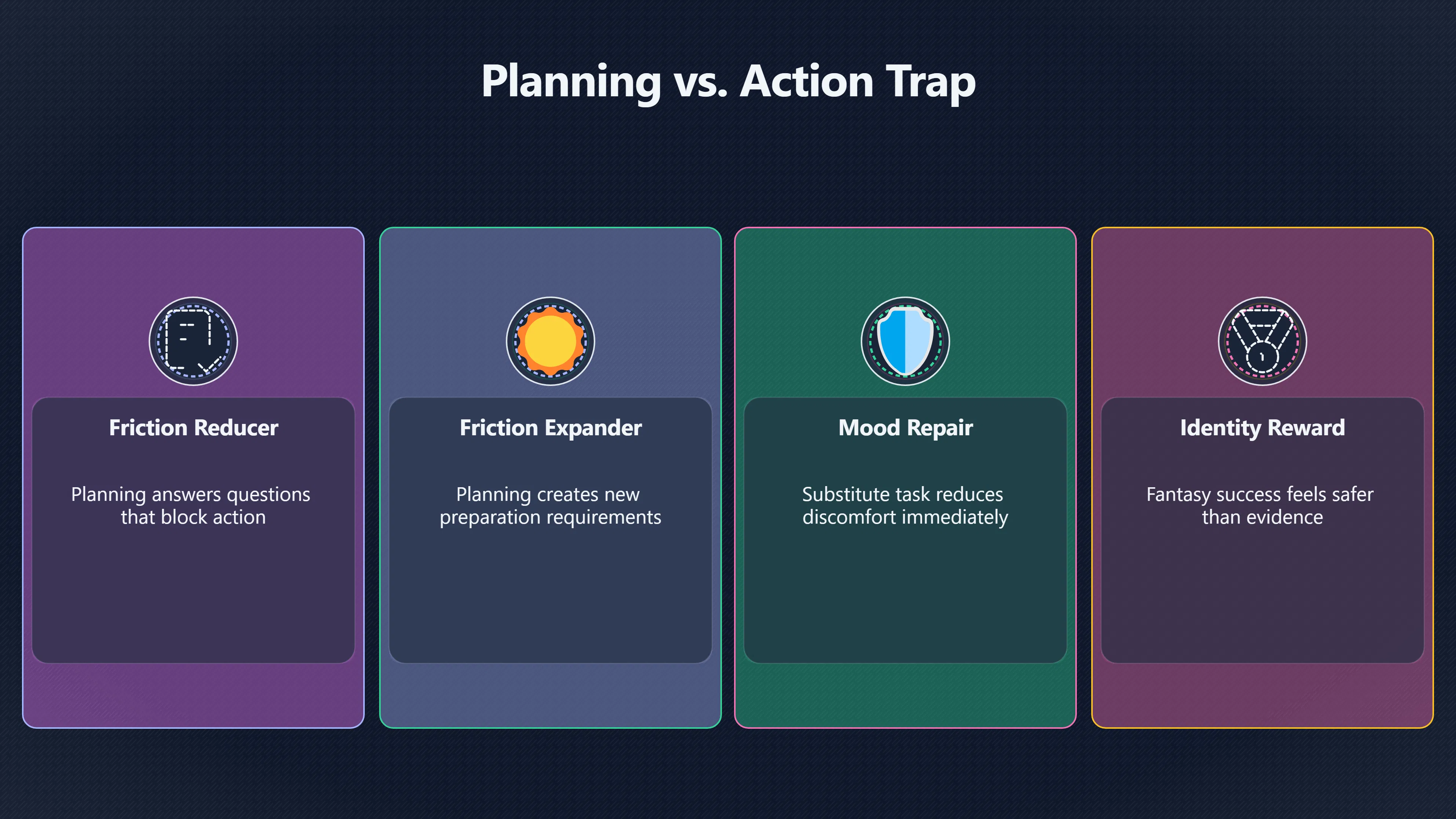
Useful planning answers questions that would otherwise block action:
- When will I do this?
- Where will I do it?
- What is the first step?
- What obstacle is most likely?
- What will I do if that obstacle appears?
This type of planning shortens the distance between intention and action. It simplifies execution.[PubMed]pubmed.ncbi.nlm.nih.govstate of the research and proposals for the way forwardby MS Hagger · 2014 · Cited by 717 — Overall, evidence supports the effectiv…[PMC]pmc.ncbi.nlm.nih.govPMCPromoting the translation of intentions into action byby F Wieber · 2015 · Cited by 215 — It has been proposed that implementation intentions render the mental representation of the situat…
Planning that expands friction
Avoidant planning does the opposite.
Instead of reducing uncertainty enough to begin, it continually creates new preparation requirements:
- One more productivity system.
- One more book.
- One more comparison.
- One more framework.
- One more revision of the schedule.
The goal gradually shifts from doing the thing to perfecting readiness for the thing.
A useful question is whether each additional planning session makes action easier today or merely makes the plan feel more complete. If the answer is the latter, planning has started serving itself.
Mood Repair and the Safer Substitute Task
One reason productive procrastination is so persuasive is that it genuinely improves mood.
Modern procrastination research increasingly describes delay as a form of short-term mood repair. When a task triggers anxiety, uncertainty, frustration or boredom, people often choose an alternative activity that reduces those feelings. The activity does not need to be enjoyable. It only needs to feel less unpleasant than the original task. Carleton University[White Rose Research Online]eprints.whiterose.ac.ukCompass Paper revision FINALWhite Rose Research OnlineProcrastination and the Priority of Short-Term Mood…This is the peer reviewed version of the following artic… ScienceDirect Planning is almost uniquely suited to this role.[sciencedirect.com]sciencedirect.comImplementation Intentions and Goal Achievement: A Meta‐…by PM Gollwitzer · 2006 · Cited by 5020 — This review analyzes wh…
Unlike obvious distractions, planning still appears connected to the goal. It preserves a positive self-image. A person who spends an hour reorganising their writing workflow can still feel committed to becoming a writer. A person redesigning a study system can still feel academically serious.
This is what makes planning a safer substitute task.
The emotional exchange is attractive:
Real taskPlanning substituteRisk of failureSense of competenceUncertaintyFeeling of controlExposure to judgmentPrivate preparationImmediate effortImmediate reliefFeedback about abilityFeedback about organisation
The substitute task reduces discomfort now. The cost arrives later when deadlines approach and real progress is missing.
Research on emotion regulation and procrastination repeatedly finds that avoiding difficult emotions can create temporary relief while increasing future stress. The mood benefit is real but short-lived.[PMC]pmc.ncbi.nlm.nih.govPMCPromoting the translation of intentions into action byby F Wieber · 2015 · Cited by 215 — It has been proposed that implementation intentions render the mental representation of the situat…[PMC]pmc.ncbi.nlm.nih.govPMCPromoting the translation of intentions into action byby F Wieber · 2015 · Cited by 215 — It has been proposed that implementation intentions render the mental representation of the situat…

The Hidden Reward of Endless Preparation
Many people assume procrastination means choosing pleasure over responsibility. Productive procrastination reveals a different reality.
The reward is often not entertainment but identity.
Planning allows someone to feel like:
- A future athlete.
- A future entrepreneur.
- A future author.
- A future disciplined person.
The identity becomes emotionally rewarding before the behaviour exists.
This is why preparation can continue for months. The planner keeps receiving psychological rewards despite limited behavioural evidence. The fantasy version of success remains intact because reality has not yet tested it.
Direct action is different. It produces information. Information can be encouraging, but it can also reveal weaknesses, slow progress and unexpected difficulties.
A detailed plan can survive indefinitely. A first attempt cannot.
For someone protecting a desired self-image, planning may therefore feel safer than evidence.
A Two-Minute Reality Test for Any Plan
A simple test can reveal whether planning is helping or hiding.
Take any plan and ask three questions.
What action happens next?
The answer must be behavioural and observable.
Good answers:
- Write 200 words.
- Walk for ten minutes.
- Call one prospect.
- Solve one practice problem.
Weak answers:
- Refine the strategy.
- Research more options.[researchgate.net]researchgate.netSource details in endnotes.
- Improve the workflow.
- Revisit the framework.
If the next step is another planning activity, caution is warranted.
Could I start within two minutes?
If the answer is no, the plan may still be too abstract.
Effective plans create a clear bridge into behaviour. Research on implementation intentions suggests that specifying concrete action cues increases the likelihood of initiation. ScienceDirect[Cancer Control]cancercontrol.cancer.govCancer ControlImplementation Intentionsby PM Gollwitzer — Implementation intentions are formed for the purpose of enhancing the translati…
What uncomfortable feeling am I avoiding?
This is often the decisive question.
Possible answers include:
- Fear of producing poor work.
- Fear of rejection.
- Fear of looking inexperienced.
- Frustration with slow progress.
- Boredom.
- Uncertainty about what happens next.
Once the emotion is identified, the purpose of the planning session often becomes obvious. Many plans are not solving logistical problems at all. They are attempting to solve emotional ones.
The Small Shift That Breaks the Planning Trap
The goal is not to eliminate planning. The goal is to restore its proper role.
A useful rule is that planning should end with a commitment that creates immediate contact with reality.
For example:
- After planning a workout, perform five minutes of movement.
- After planning a writing project, write one paragraph.
- After planning a business launch, send one message.
- After planning a study schedule, complete one question.
This changes planning from a destination into a bridge.
Research on goal achievement consistently finds that intentions alone are weaker than intentions connected to concrete action plans and immediate execution. Planning has value when it reduces the gap between intention and behaviour. Its value declines sharply when it becomes an alternative to behaviour.[National Elf Service]nationalelfservice.netNational Elf ServiceImplementation intentions: helping people achieve their…by A Underwood — This review focuses on a specific element…[PubMed]pubmed.ncbi.nlm.nih.govstate of the research and proposals for the way forwardby MS Hagger · 2014 · Cited by 717 — Overall, evidence supports the effectiv…[Cancer Control]cancercontrol.cancer.govCancer ControlImplementation Intentionsby PM Gollwitzer — Implementation intentions are formed for the purpose of enhancing the translati…
Within self-improvement theatre, productive procrastination is one of the most convincing forms of false progress because it resembles genuine effort. The key distinction is simple: useful planning leaves you closer to action. Avoidant planning leaves you feeling prepared. Only one of those reliably changes what you do tomorrow.
Amazon book picks
Further Reading
Books and field guides related to Are You Planning or Avoiding the Real Task?. Use these as the next step if you want deeper reading beyond the article.
The Now Habit
Directly addresses productive procrastination and avoidance disguised as planning.
Eat That Frog!
Rating: 3.5/5 from 7 Google Books ratings
Focused on tackling difficult tasks rather than avoiding them.
Atomic Habits
Rating: 3.5/5 from 7 Google Books ratings
Encourages small concrete actions instead of elaborate planning systems.
eBay marketplace picks
Marketplace Samples
Example marketplace items related to this page. Use the search link to explore similar finds on eBay.



Endnotes
1.
Source: pmc.ncbi.nlm.nih.gov
Link:https://pmc.ncbi.nlm.nih.gov/articles/PMC10049005/
Source snippet
Procrastination and Stress: A Conceptual Review of Why...by FM Sirois · 2023 · Cited by 208 — Indeed, research confirms that encounte...
2.
Source: sciencedirect.com
Link:https://www.sciencedirect.com/science/chapter/bookseries/pii/S0065260106380021
Source snippet
Implementation Intentions and Goal Achievement: A Meta‐...by PM Gollwitzer · 2006 · Cited by 5020 — This review analyzes wh...
3.
Source: cancercontrol.cancer.gov
Link:https://cancercontrol.cancer.gov/brp/research/constructs/implementation-intentions
Source snippet
Cancer ControlImplementation Intentionsby PM Gollwitzer — Implementation intentions are formed for the purpose of enhancing the translati...
4.
Source: pmc.ncbi.nlm.nih.gov
Title: PMCPromoting the translation of intentions into action by
Link:https://pmc.ncbi.nlm.nih.gov/articles/PMC4500900/
Source snippet
by F Wieber · 2015 · Cited by 215 — It has been proposed that implementation intentions render the mental representation of the situat...
5.
Source: sciencedirect.com
Link:https://www.sciencedirect.com/science/article/abs/pii/S002210310600028X
Source snippet
How do implementation intentions promote goal attainment...by TL Webb · 2007 · Cited by 564 — Implementation intentions are plans that s...
6.
Source: sciencedirect.com
Link:https://www.sciencedirect.com/science/article/abs/pii/B9780128028629000086
Source snippet
Procrastination, Emotion Regulation, and Well-Beingby TA Pychyl · 2016 · Cited by 256 — In this chapter, we explore how procrastination f...
7.
Source: carleton.ca
Title: University Procrastination Problem?
Link:https://carleton.ca/news/story/procrastination-problem-tim-pychyl/
Source snippet
Tim Pychyl Knows Why“Procrastination is an emotion-regulation problem,” Pychyl says. “It's not a time management problem.... Pychyl sees...
8.
Source: pmc.ncbi.nlm.nih.gov
Link:https://pmc.ncbi.nlm.nih.gov/articles/PMC7671960/
Source snippet
Emotion Regulation Difficulties and Academic Procrastinationby JM Bytamar · 2020 · Cited by 200 — However, the effect of procrastinati...
9.
Source: sciencedirect.com
Link:https://www.sciencedirect.com/science/article/pii/S1041608016302187
Source snippet
Enhancing emotion regulation skills reduce procrastinationby M Eckert · 2016 · Cited by 388 — Results indicated that systematic training...
10.
Source: cancercontrol.cancer.gov
Title: Control Implementation Intentions Peter M
Link:https://cancercontrol.cancer.gov/sites/default/files/2020-06/goal_intent_attain.pdf
Source snippet
Gollwitzer New York...by PM Gollwitzer · Cited by 131 — Gollwitzer and Sheeran (2006) found that implementation intention formation had...
11.
Source: sciencedirect.com
Link:https://www.sciencedirect.com/science/article/abs/pii/S0001879104001149
Source snippet
Implementation intentions, action control, and procrastinationby EAJ van Hooft · 2005 · Cited by 240 — The main focus of the current stud...
12.
Source: sciencedirect.com
Link:https://www.sciencedirect.com/science/article/abs/pii/S0001691816304048
Source snippet
Implementation intention effects in non-planned situationsby M Bieleke · 2018 · Cited by 44 — Forming implementation intentions (i.e., if...
13.
Source: sciencedirect.com
Link:https://www.sciencedirect.com/science/article/abs/pii/S0278262624001179
Source snippet
Functional connectivity in procrastination and emotion...by K Li · 2024 · Cited by 8 — The short-term emotion repair theory proposes tha...
14.
Source: sciencedirect.com
Link:https://www.sciencedirect.com/science/article/abs/pii/S0191886925000121
Source snippet
Academic procrastination and emotion regulationby WL Chen · 2025 · Cited by 11 — This study investigated the developmental trajectories a...
15.
Source: youtube.com
Title: Why I Keep Avoiding the Things That Could Change My Life
Link:https://www.youtube.com/watch?v=jwiM-s44hE8
Source snippet
Productive Procrastination...
16.
Source: youtube.com
Title: Productive Procrastination
Link:https://www.youtube.com/watch?v=NLQ0cczBU40
Source snippet
Planning as a Form of Procrastination...
17.
Source: eprints.whiterose.ac.uk
Title: Compass Paper revision FINAL
Link:https://eprints.whiterose.ac.uk/id/eprint/91793/1/Compass%20Paper%20revision%20FINAL
Source snippet
White Rose Research OnlineProcrastination and the Priority of Short-Term Mood...This is the peer reviewed version of the following artic...
18.
Source: eprints.whiterose.ac.uk
Title: Compass Paper revision FINAL
Link:https://eprints.whiterose.ac.uk/id/eprint/91793/1/Compass%20Paper%20revision%20FINAL.pdf
Source snippet
White Rose Research OnlineProcrastination and the Priority of Short-Term Mood...by F Sirois · 2013 · Cited by 1135 — In terms of procras...
19.
Source: pubmed.ncbi.nlm.nih.gov
Link:https://pubmed.ncbi.nlm.nih.gov/24591064/
Source snippet
state of the research and proposals for the way forwardby MS Hagger · 2014 · Cited by 717 — Overall, evidence supports the effectiv...
20.
Source: nationalelfservice.net
Link:https://www.nationalelfservice.net/social-care/[support
Source snippet
National Elf ServiceImplementation intentions: helping people achieve their...by A Underwood — This review focuses on a specific element...
21.
Source: pmc.ncbi.nlm.nih.gov
Link:https://pmc.ncbi.nlm.nih.gov/articles/PMC9669985/
Source snippet
ABC of academic procrastination: Functional analysis of a...by F Svartdal · 2022 · Cited by 60 — In academic procrastination, behavioral...
22.
Source: Wikipedia
Link:https://en.wikipedia.org/wiki/Implementation
Source snippet
ImplementationImplementation is the realization of an application, execution of a plan, idea, model, design, specification, standard...
23.
Source: durmonski.com
Title: implementation intentions
Link:https://durmonski.com/psychology/implementation-intentions/
Source snippet
Defining Implementation Intentions and How to Make Them...23 Dec 2022 — Implementation Intentions are proven strategies helping you achi...
Additional References
24.
Source: apa.org
Link:https://www.apa.org/news/podcasts/speaking-of-psychology/procrastinate
Source snippet
American Psychological AssociationWhy we procrastinate and what to do about it, with Fuschia...Fuschia Sirois, PhD, of Durham University...
25.
Source: vbpsychology.com
Link:https://www.vbpsychology.com/how-to-stop-procrastinating-mood-regulation-strategies/
Source snippet
How To Stop Procrastinating: Mood Regulation StrategiesMood regulation, as the article suggests, can help overcome procrastination. One o...
26.
Source: solvingprocrastination.com
Link:https://solvingprocrastination.com/procrastination-theories/
Source snippet
The Psychological Frameworks for Explaining ProcrastinationEmotion-regulation theory, which states that procrastination occurs when peopl...
27.
Source: allard.ubc.ca
Link:https://allard.ubc.ca/sites/default/files/2021-10/Implementation%20Intentions.pdf
Source snippet
IntentionsImplementation Intentions ('If-then' planning) are an effective strategy for turning goals into action. Whereas goal intentions...
28.
Source: researchgate.net
Link:https://www.researchgate.net/publication/232586066_Implementation_Intentions
29.
Source: d-nb.info
Link:https://d-nb.info/1097212408/34
Source snippet
plementation intentions is sensitive to the activation and strength of partici- pants' underlying goal intentions...Read m...
30.
Source: youtube.com
Link:https://www.youtube.com/shorts/ROfGVBCw_uc
Source snippet
Why Academics Procrastinate: The Emotional Truth | PhD...procrastination isn't about laziness, it's about emotions. This short reveals t...
31.
Source: cannelevate.com.au
Title: Discover why we delay tasks and the emotion regulation mechanisms at play
Link:https://www.cannelevate.com.au/article/understanding-procrastination-psychological-perspectives/
Source snippet
Why We Procrastinate: Psychological PerspectivesOct 24, 2025 — Explore the psychology of procrastination beyond time management...
32.
Source: research.tue.nl
Link:https://research.tue.nl/en/publications/procrastination-self-regulation-in-initiating-aversive-goals/
Source snippet
Eindhoven Research PortalProcrastination: self-regulation in initiating aversive goalsby W van Eerde · 2000 · Cited by 467 — In this pap...
33.
Source: researchgate.net
Link:https://www.researchgate.net/publication/227630625_Procrastination_Self-regulation_in_Initiating_Aversive_Goals
Source snippet
Procrastination: Self‐regulation in Initiating Aversive GoalsIn this paper, procrastination is defined as the avoidance of the implementa...
Topic Tree