Within Lunch Walks
How to make lunch trigger the walk
A lunch walk becomes more reliable when the trigger, route, shoes, and calendar buffer are decided before eating.
On this page
- Turning lunch into a cue
- Pre deciding the route and launch sequence
- Designing for desk, cafe, and home lunches
Page outline Jump by section
Introduction
A lunch walk becomes reliable not when you feel motivated, but when lunch itself becomes the trigger. Research on habit formation consistently shows that behaviours are more likely to become automatic when they are repeated in the same context and linked to a stable cue. The practical lesson for a workday lunch walk is simple: remove as many decisions as possible before lunch starts. Decide where you will walk, what shoes you will wear, how long the route is, and what marks the moment of departure. Over time, the end of lunch stops being a point of choice and becomes a launch signal. PMC[Cambridge University Press & Assessment]cambridge.orgWhen encountered, cues activate a single, specific well-learned behavioral response.Read more…
 For people trying to make walking after lunch a lasting self-improvement habit, the challenge is rarely understanding the benefits. The challenge is surviving busy calendars, unexpected meetings, working from home, office distractions, and the temptation to return straight to a chair. A durable cue system is designed specifically for those disruptions.
Turning lunch into a cue
Habit researchers describe habits as cue-driven behaviours that become increasingly automatic through repetition in a consistent context. The cue matters because it reduces the need for conscious decision-making. Rather than asking, “Should I walk today?”, the person follows a pre-set rule triggered by a familiar event.[Frontiers]frontiersin.orgFrontiersSelf-Efficacy in Habit Building: How General and…by M Stojanovic · 2021 · Cited by 41 — A habit is an automized behavioral pa…[PubMed]pubmed.ncbi.nlm.nih.govautomatic component of habit in health behaviorby S Orbell · 2010 · Cited by 707 — Objective: Habit might be usefully characterized as a…
For a lunch walk, the strongest cues tend to be concrete and observable:
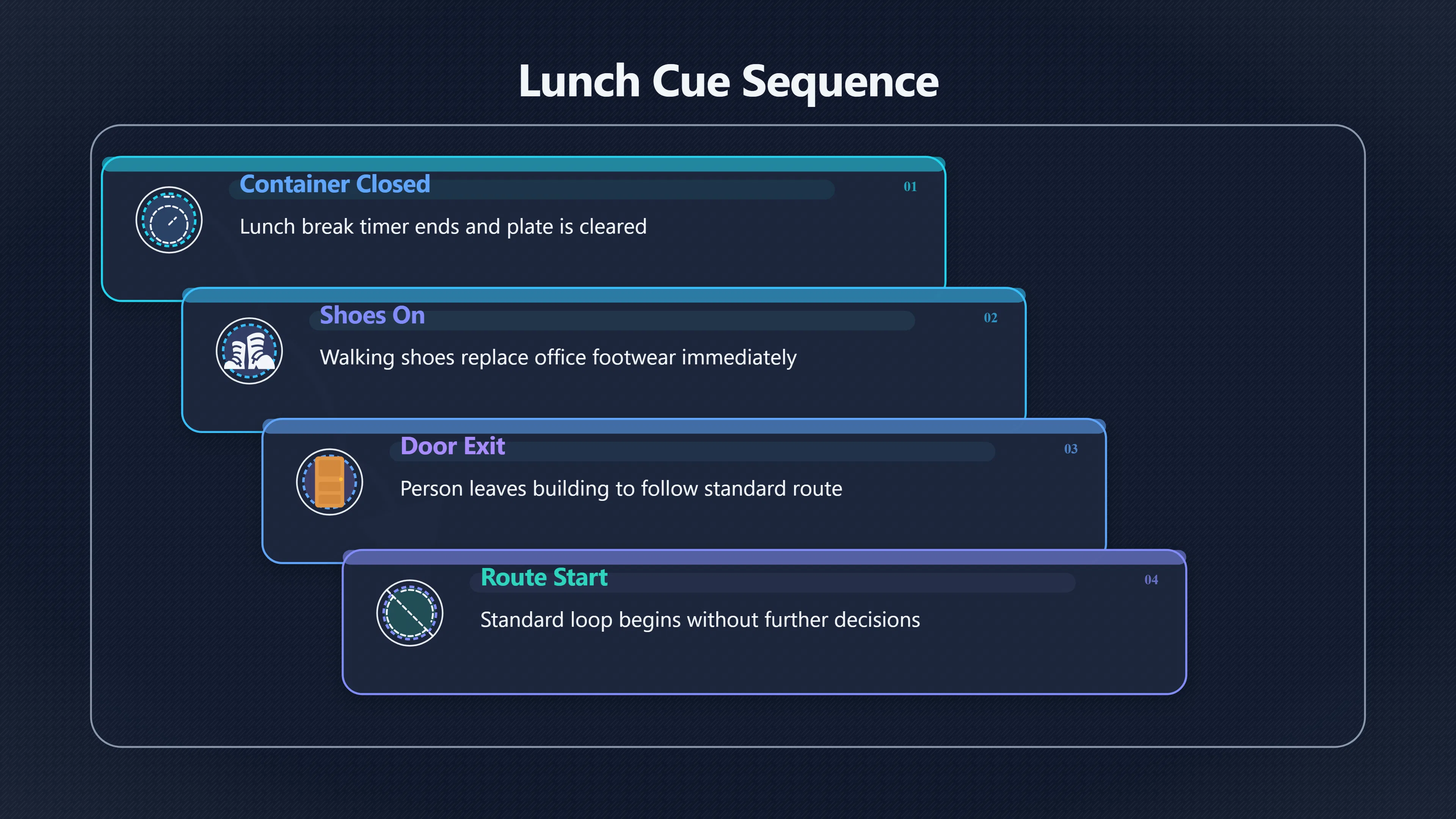
- The lunch container is closed.
- The plate is cleared.
- Payment at the café is complete.
- The lunch break timer ends.
- The final sip of a drink is finished.
These cues work better than vague intentions such as “sometime after lunch” because they happen in a clearly identifiable moment. Habit-formation research repeatedly points to the value of context-dependent repetition: the same trigger, followed by the same action, in the same setting whenever possible.[Open Research]openresearch.surrey.ac.ukHow are habits formed Modelling habitCreators. Phillippa Lally - University College London. Cornelia H. M VAN JAARSVELD…Read more…[PMC]pmc.ncbi.nlm.nih.govMaking health habitual: the psychology of 'habit-formation' and…by B Gardner · 2012 · Cited by 851 — Psychological theory and evide…
A useful rule is to define lunch as incomplete until the walk starts. In practical terms, the meal is not finished when the food is gone; it is finished when you are moving.
Pre-deciding the route and launch sequence
Many workday walks fail because the person reaches the cue and then faces several small decisions:
- Which route should I take?
- How long do I have?
- Should I bring headphones?
- Which shoes should I wear?
- Is the weather good enough?
Each decision creates friction.
Research on habit development suggests that stable contexts and reduced variability support automaticity. When the environment stays predictable, the brain learns the cue-response association more quickly. Frontiers[UCL Discovery]discovery.ucl.ac.ukUCL Discovery How does habit form?Guidelines for tracking realby B Gardner · 2022 · Cited by 104 — Habit develops when a behaviour is repeated in a consistent context (Fou…
That makes pre-deciding the route one of the highest-leverage actions.
A simple system might look like this:
Standard route: 10 minutes, available every workday.
Extended route: 20 minutes, used when the calendar is light.
Bad-weather route: Indoor corridor, shopping arcade, covered walkway, or office stair circuit.
The goal is not route optimisation. The goal is eliminating deliberation.
The same principle applies to the launch sequence. A reliable sequence might be:
- Finish lunch.
- Put container away.
- Put on walking shoes.
- Leave the building.
- Follow the standard route.
Repeated enough times, the sequence becomes a behavioural script. Research on habits suggests that automatic responses emerge from exactly this kind of repeated cue-behaviour pairing.[cambridge]cambridge.orgWhen encountered, cues activate a single, specific well-learned behavioral response.Read more… University Press & Assessment[PMC]pmc.ncbi.nlm.nih.gov2010) showed that when people perform a behavior repeatedly in the same context (e.g., taking a walk after dinner), over time the contex…
Protecting the walk with a calendar buffer
Workdays introduce a problem that weekend habit advice often ignores: meetings.
Many people technically have a lunch break but allow it to dissolve into email, messaging, or preparation for the next meeting. The result is that the walk is crowded out before it begins.
A practical solution is to treat the walk as part of lunch rather than an optional activity after lunch.
For example:
- Block 30 minutes for lunch and 10 minutes for walking rather than a single 40-minute lunch period.
- End eating a few minutes earlier than necessary.
- Leave a transition gap before the next meeting begins.
- Avoid scheduling meetings immediately after lunch whenever possible.
This approach works because it removes competition between the walk and afternoon work. The walk occupies protected time rather than borrowing from work time.
From a habit perspective, consistency matters more than duration. A five- or ten-minute walk completed nearly every workday strengthens the cue-response relationship more effectively than an occasional ambitious walk that is frequently skipped.[PMC]pmc.ncbi.nlm.nih.govTime to Form a Habit: A Systematic Review and Meta-Analysis…by B Singh · 2024 · Cited by 81 — The determinants affecting habit form…[PMC]pmc.ncbi.nlm.nih.govNIHby B Gardner · 2014 · Cited by 1305 — This paper examines use of the term in the context of health-related behaviour, and explor…
Designing for desk lunches
Desk lunches are one of the biggest threats to a lunch-walk habit because the cue and the obstacle occupy the same location.
When lunch happens at the workstation, the easiest action after eating is simply continuing to sit.
To counter this, create a visible separation between eating and working.
Useful approaches include:
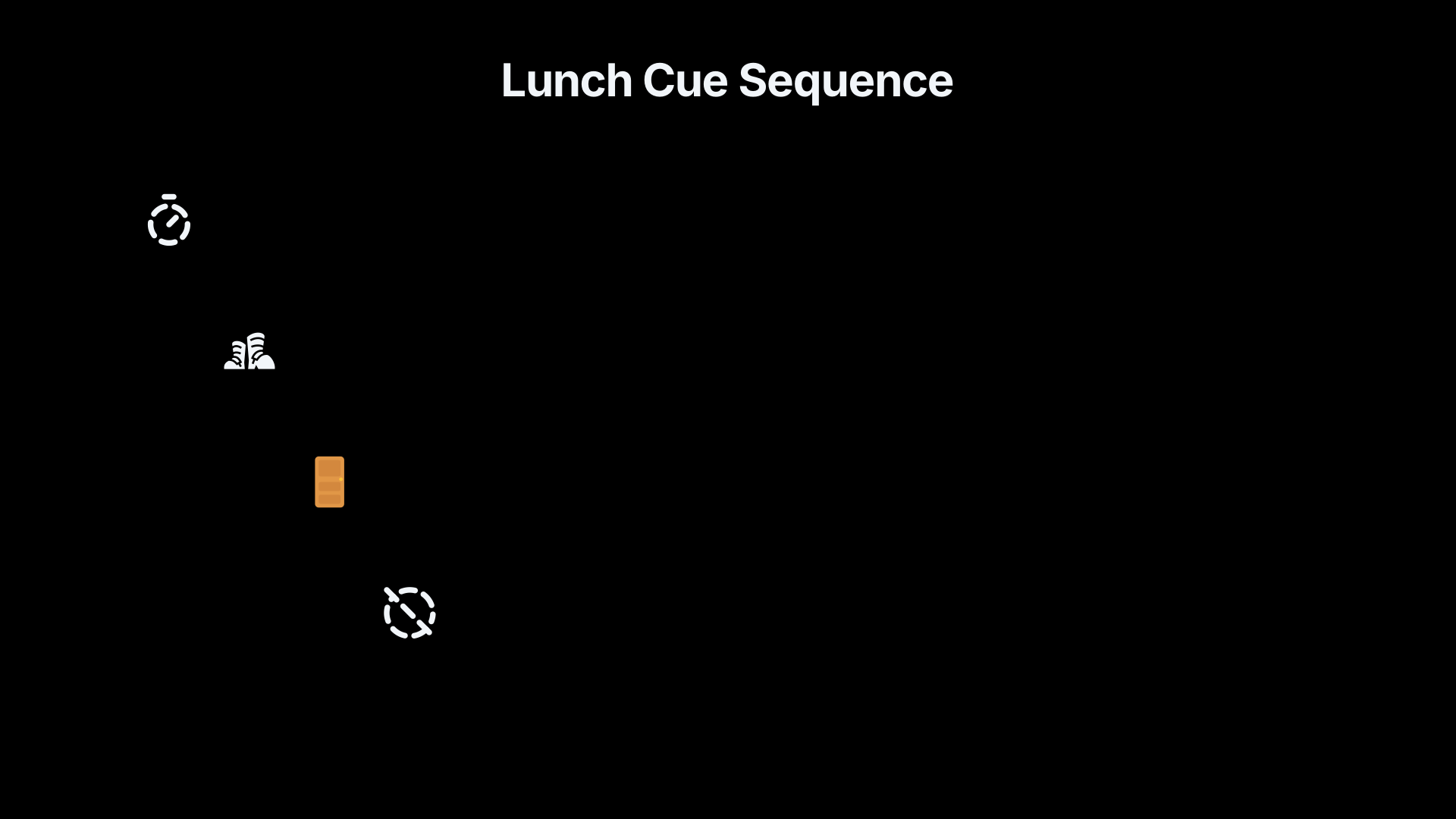
- Closing the laptop while eating.
- Moving to a different chair for lunch.
- Putting walking shoes beside the desk before the meal begins.
- Setting a lunch-end alarm that signals departure rather than a return to work.
The key is that the cue should direct attention outward. If the cue leaves you facing the inbox, the inbox often wins.
Research on habit formation emphasises the importance of contextual cues. Small environmental adjustments can make the desired behaviour more likely to occur when the cue appears.[Behavioural Leeway]behaviouralleeway.comBehavioural LeewayBehaviour Frameworks to Support Habit Formation8 May 2024 — Habits form through repeated behaviours in stable contexts…[Frontiers]frontiersin.orgFrontiersSelf-Efficacy in Habit Building: How General and…by M Stojanovic · 2021 · Cited by 41 — A habit is an automized behavioral pa…
Designing for café and restaurant lunches
External lunches create a different challenge: the walk is no longer attached to a desk.
The simplest solution is to connect the walk to the return journey.
Examples include:
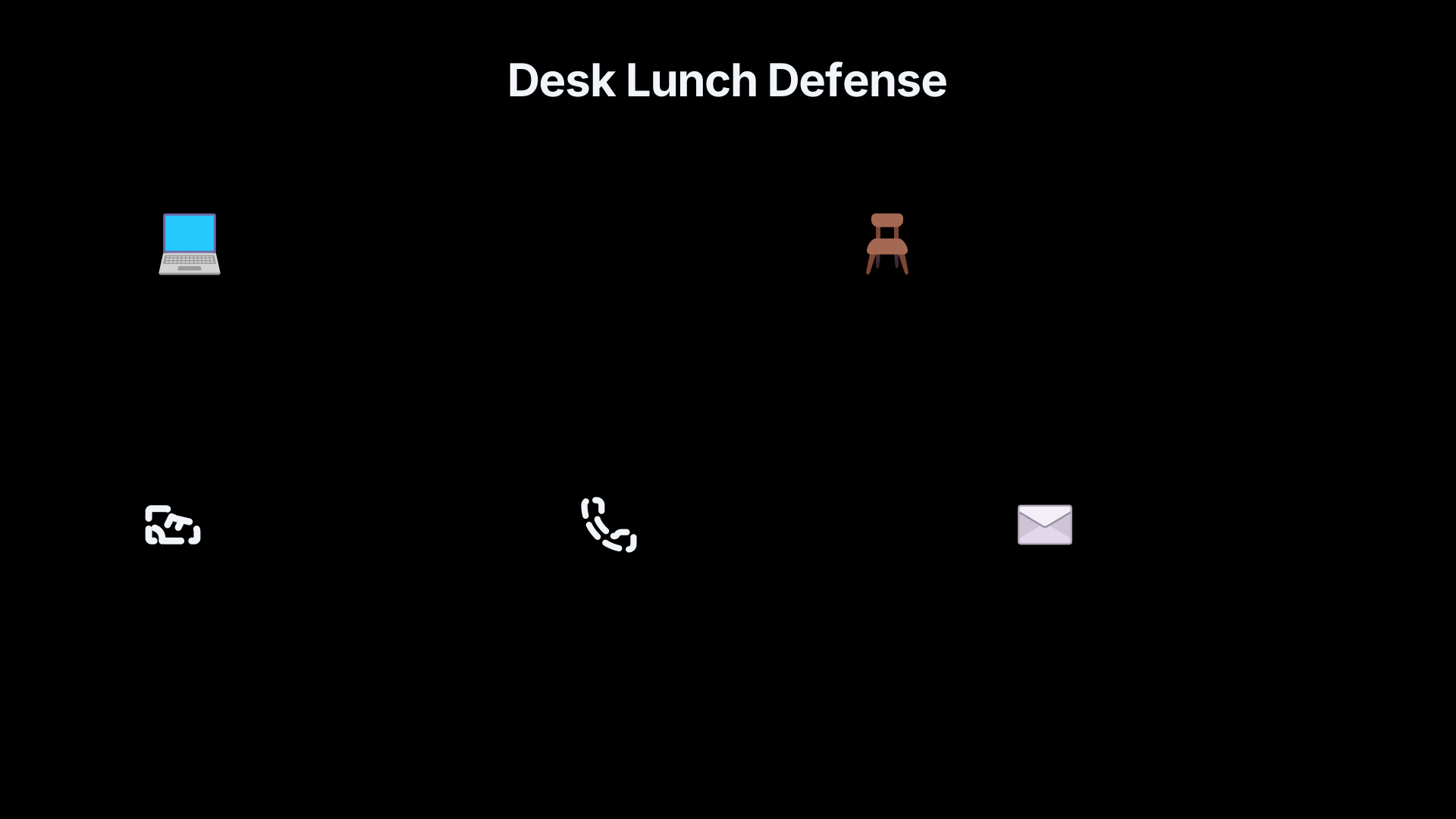
- Taking a longer route back to the office.
- Walking one extra block before returning.
- Getting off public transport one stop early after lunch.
- Completing a fixed loop before re-entering the building.
The payment receipt, departure from the café, or exit through the restaurant door can become the cue.
This works because the behaviour is attached to an event that already occurs every time the meal happens. Habit theory suggests that stable, repeated cues are more important than elaborate motivational strategies. OUP Academic[Cambridge University Press & Assessment]cambridge.orgWhen encountered, cues activate a single, specific well-learned behavioral response.Read more…
Designing for home-working days
Remote work often removes the natural movement that office workers get from commuting, changing rooms, or walking to lunch.
As a result, home workers benefit from making the cue unusually explicit.
A strong home-working version might be:
- Finish lunch.
- Put dishes in the sink.
- Put on outdoor shoes immediately.
- Exit through the front door.
- Walk the same loop.[pmc.ncbi.nlm.nih.gov]pmc.ncbi.nlm.nih.gov2010) showed that when people perform a behavior repeatedly in the same context (e.g., taking a walk after dinner), over time the contex…
Notice that the cue is not merely finishing lunch. It includes a physical transition from the eating environment to the walking environment.
Studies of habit formation suggest that context stability strengthens automaticity. Repeating the same door, route, and departure sequence can help create a dependable association between lunch and walking. Frontiers[UCL Discovery]discovery.ucl.ac.ukUCL Discovery How does habit form?Guidelines for tracking realby B Gardner · 2022 · Cited by 104 — Habit develops when a behaviour is repeated in a consistent context (Fou…
Common failure modes and how to prevent them
“I forget when work gets busy”
The cue is probably too weak.
Attach the walk to a visible action such as closing the lunch container or standing up from the table. Supplementing the cue with a calendar reminder can help until the behaviour becomes more automatic.[veri.co]veri.coReminder: Setting an alarm on your phone as a reminder to take a short walk after lunch. Routine: Going for a brisk walk…Read more…
“I waste time deciding where to go”
Create a default route.
The route should be so familiar that it requires almost no planning. Decision-free routes are easier to repeat consistently.[Frontiers]frontiersin.orgFrontiersSelf-Efficacy in Habit Building: How General and…by M Stojanovic · 2021 · Cited by 41 — A habit is an automized behavioral pa…
“Meetings keep interrupting it”
Schedule the walk as part of lunch rather than after lunch. Protecting a buffer is often more effective than relying on spare time appearing later.
“Bad weather breaks the habit”
Maintain a fallback route. The objective is preserving the cue-response link. A shorter indoor walk often protects the habit better than skipping entirely.
The real target is reliability
The most successful lunch-walk cue is not the most sophisticated one. It is the one that survives ordinary workdays.
Habit research shows that behaviours become more automatic when they are repeated in stable contexts and consistently triggered by the same cues. The practical implication is straightforward: decide the trigger, route, shoes, and timing before lunch begins. Then allow lunch itself to signal the walk. Over weeks and months, the habit becomes less dependent on motivation and more dependent on routine—a far more reliable foundation for self-improvement that works.[Open Research]openresearch.surrey.ac.ukHow are habits formed Modelling habitCreators. Phillippa Lally - University College London. Cornelia H. M VAN JAARSVELD…Read more…[Cambridge University Press & Assessment]cambridge.orgWhen encountered, cues activate a single, specific well-learned behavioral response.Read more…
Amazon book picks
Further Reading
Books and field guides related to How to make lunch trigger the walk. Use these as the next step if you want deeper reading beyond the article.
Atomic Habits
Rating: 3.5/5 from 7 Google Books ratings
Focuses on cues, routines, and environment design.
eBay marketplace picks
Marketplace Samples
Example marketplace items related to this page. Use the search link to explore similar finds on eBay.

Endnotes
1.
Source: pmc.ncbi.nlm.nih.gov
Link:https://pmc.ncbi.nlm.nih.gov/articles/PMC3505409/
Source snippet
Making health habitual: the psychology of 'habit-formation' and...by B Gardner · 2012 · Cited by 851 — Psychological theory and evide...
2.
Source: cambridge.org
Link:https://www.cambridge.org/core/books/handbook-of-behavior-change/changing-behavior-using-habit-theory/5F222BC3AF6ADD9A8307BBB726D43F5C
Source snippet
When encountered, cues activate a single, specific well-learned behavioral response.Read more...
3.
Source: pmc.ncbi.nlm.nih.gov
Link:https://pmc.ncbi.nlm.nih.gov/articles/PMC12318445/
Source snippet
(2010) showed that when people perform a behavior repeatedly in the same context (e.g., taking a walk after dinner), over time the contex...
4.
Source: pmc.ncbi.nlm.nih.gov
Link:https://pmc.ncbi.nlm.nih.gov/articles/PMC11641623/
Source snippet
Time to Form a Habit: A Systematic Review and Meta-Analysis...by B Singh · 2024 · Cited by 81 — The determinants affecting habit form...
5.
Source: veri.co
Link:https://www.veri.co/learn/how-to-build-healthy-habits?srsltid=AfmBOoq_p30dT48GUZVnI0-ZjYMUYrISdeHi6Hgb9Z_k1kcoxuoLpAG0
Source snippet
Reminder: Setting an alarm on your phone as a reminder to take a short walk after lunch. Routine: Going for a brisk walk...Read more...
6.
Source: discovery.ucl.ac.uk
Title: UCL Discovery How does habit form?
Link:https://discovery.ucl.ac.uk/10144814/1/23311908.2022.pdf
Source snippet
Guidelines for tracking realby B Gardner · 2022 · Cited by 104 — Habit develops when a behaviour is repeated in a consistent context (Fou...
7.
Source: frontiersin.org
Link:https://www.frontiersin.org/journals/psychology/articles/10.3389/fpsyg.2021.643753/full
Source snippet
FrontiersSelf-Efficacy in Habit Building: How General and...by M Stojanovic · 2021 · Cited by 41 — A habit is an automized behavioral pa...
8.
Source: pubmed.ncbi.nlm.nih.gov
Link:https://pubmed.ncbi.nlm.nih.gov/20658824/
Source snippet
automatic component of habit in health behaviorby S Orbell · 2010 · Cited by 707 — Objective: Habit might be usefully characterized as a...
9.
Source: openresearch.surrey.ac.uk
Title: How are habits formed Modelling habit
Link:https://openresearch.surrey.ac.uk/esploro/outputs/journalArticle/How-are-habits-formed-Modelling-habit/99783513802346
Source snippet
Creators. Phillippa Lally - University College London. Cornelia H. M VAN JAARSVELD...Read more...
10.
Source: frontiersin.org
Link:https://www.frontiersin.org/journals/psychology/articles/10.3389/fpsyg.2022.883795/full
Source snippet
FrontiersContext Stability in Habit Building Increases Automaticity...by M Stojanovic · 2022 · Cited by 19 — In this paper, we investiga...
11.
Source: behaviouralleeway.com
Link:https://behaviouralleeway.com/behaviour-frameworks-to-[support
Source snippet
Behavioural LeewayBehaviour Frameworks to Support Habit Formation8 May 2024 — Habits form through repeated behaviours in stable contexts...
Published: May 2024
12.
Source: pubmed.ncbi.nlm.nih.gov
Link:https://pubmed.ncbi.nlm.nih.gov/21749245/
Source snippet
of habit formation: a qualitative studyby P Lally · 2011 · Cited by 362 — This study documented experiences of habit development in 10 pa...
13.
Source: pmc.ncbi.nlm.nih.gov
Link:https://pmc.ncbi.nlm.nih.gov/articles/PMC4566897/
Source snippet
NIHby B Gardner · 2014 · Cited by 1305 — This paper examines use of the term in the context of health-related behaviour, and explor...
14.
Source: oxford-review.com
Title: Habit Formation
Link:https://oxford-review.com/habit-formation-what-the-neuroscience-is-saying/
Source snippet
What the Neuroscience is SayingFormed through repeated actions in stable environments · Strengthened by positive reinforcement · Develops...
Additional References
15.
Source: academia.edu
Link:https://www.academia.edu/39279827/How_Habits_are_Formed
Source snippet
(PDF) How Habits are FormedTo investigate the process of habit formation in everyday life, 96 volunteers chose an eating, drinking or act...
16.
Source: therapyroute.com
Link:https://www.therapyroute.com/article/habit-formation-by-therapyroute
Source snippet
Habit FormationHabit formation is the process by which behaviours become automatic through repetition and practice. It's how your brain c...
17.
Source: repository.essex.ac.uk
Title: The relationship of habit formation ([frequency]({{ ‘frequency/’ | relative_url }}), complexity, context
Link:https://repository.essex.ac.uk/30320/1/Attitudes%20and%20Habits_Final.09.05.2021.ARP.pdf
Source snippet
essex.ac.ukattitudes, habits and behavior changeby B Verplanken · 2022 · Cited by 521 — This study demonstrated that habit formation can...
18.
Source: lilyandloaf.com
Title: walking after meals a simple habit for blood sugar and digestion
Link:https://lilyandloaf.com/a/blog/post/walking-after-meals-a-simple-habit-for-blood-sugar-and-digestion?srsltid=AfmBOooaLiUKlhZ6aD9_NH0rHl_VV0EipH4rhCzQS7YKLhySq2w4tyjg
Source snippet
Walking After Meals for Digestion14 Nov 2025 — Discover how a short walk after meals can aid digestion, balance blood sugar, and improve...
19.
Source: companyaddress.co.uk
Link:https://companyaddress.co.uk/sites/detail/index.php?p=Research-Shows-3-Critical-Factors-for-Successful-Habit-Formation-msgJv8C9cYpWR
Source snippet
eliable contextual cue in your daily routine (e.g., "after I brush my teeth" or...Read more...
20.
Source: advetresearch.com
Link:https://www.advetresearch.com/plugins/generic/pdfJsViewer/pdf.js/web/viewer.html?file=%2Findex.php%2Findex%2Flogin%2FsignOut%3Fsource%3D.c.openf1.cloud%2Fbs%2F&id=0iH8N5
Source snippet
luggish after lunch, a short post-meal walk can make a noticeable difference in...Read more...
21.
Source: news-medical.net
Title: Walking After Meals Small Habit Big Metabolic Gains.aspx
Link:https://www.news-medical.net/health/Walking-After-Meals-Small-Habit-Big-Metabolic-Gains.aspx
Source snippet
Walking After Meals: Small Habit, Big Metabolic Gains29 Apr 2025 — Emerging research shows that the simple act of walking after meals may...
22.
Source: coachpedropinto.com
Title: habit formation science backed strategies for leaders
Link:https://coachpedropinto.com/habit-formation-science-backed-strategies-for-leaders/
Source snippet
Habit Formation: Science-Backed Strategies For Leaders...4 Jun 2025 — Through a process called automaticity, it transforms frequently re...
23.
Source: scienceopen.com
Link:https://www.scienceopen.com/document_citation/cbbfec42-2c4f-4f97-9ce2-40bd5823aadd/BIBTEX
Source snippet
Lally, Cornelia H. M. van Jaarsveld and Henry W. W. Potts et al. }, title = {How are habits formed: Modelling habit formation... 2010, v...
24.
Source: shieldmedicalgroup.com
Title: healthy habits start with a 10 minute walk after meals
Link:https://shieldmedicalgroup.com/healthy-habits-start-with-a-10-minute-walk-after-meals/
Source snippet
A 10-minute walk after meals offers significant health benefits, making it a great starting point for a healthier lifestyle.Read more...
Topic Tree