Within The Idea That A Habit Forms In 21 Days
Why Small Habits Settle In Faster
Small low-friction actions often stabilize sooner because they need fewer decisions, less energy and fewer supporting conditions.
On this page
- Effort and complexity in habit timelines
- Why low friction actions repeat more easily
- How to shrink a demanding routine without losing the goal
Page outline Jump by section
Introduction
One reason habit formation timelines vary so widely is that not all habits demand the same amount of effort. A behaviour such as drinking a glass of water after lunch, putting a vitamin beside a toothbrush, or writing a single sentence in a journal asks very little from a person. A habit such as running five kilometres every morning, preparing healthy meals from scratch, or studying for an hour each evening requires far more decisions, energy, time and preparation.
 This difference helps explain why some habits feel automatic within weeks while others may take months. Research on habit formation consistently shows that automaticity develops through repetition in stable contexts, but simple behaviours are easier to repeat consistently because there are fewer barriers between intention and action. As a result, the cue-to-action link can strengthen more quickly.[Wiley Online Library]onlinelibrary.wiley.comOnline Library Modelling habit formation in the real worldWiley Online LibraryModelling habit formation in the real world - Lally - 2010by P Lally · 2010 · Cited by 3493 — To investigate the proc…[PMC]pmc.ncbi.nlm.nih.govReinforcement motivates and strengthens repetition. With ongoing repetition, the stable context cue…
Effort and Complexity in Habit Timelines
Habit researchers define a habit not as a behaviour that happens often, but as a behaviour that becomes automatically triggered by a familiar situation. Repetition in the same context gradually creates a mental association between the cue and the action. Eventually, the cue itself starts prompting the behaviour with little conscious effort.[Open Research Surrey]openresearch.surrey.ac.ukHabit Formation and Behavior ChangeOpen Research SurreyHabit Formation and Behavior Changeby AL Rebar · 2019 · Cited by 409 — Within psychology, the term habit refers to a…[PMC]pmc.ncbi.nlm.nih.govhealth habitual: the psychology of 'habit-formation' and…by B Gardner · 2012 · Cited by 871 — Participants in one study repeated a sel…
Simple habits usually reach this stage sooner because they place fewer demands on the systems that support behaviour. Consider the difference between:
- Drinking water after lunch.
- Completing a 45-minute workout before work.
The first requires almost no planning, equipment, scheduling or motivation. The second depends on sleep, time availability, physical energy, suitable clothing, weather conditions in some cases, and the ability to overcome discomfort.
Every additional requirement creates another point where the routine can fail. When a behaviour fails to occur, the cue-action connection is not reinforced. Fewer successful repetitions generally mean slower growth in automaticity.[Wiley Online Library]onlinelibrary.wiley.comOnline Library Modelling habit formation in the real worldWiley Online LibraryModelling habit formation in the real world - Lally - 2010by P Lally · 2010 · Cited by 3493 — To investigate the proc…[PMC]pmc.ncbi.nlm.nih.govHabits, Quick and Easy: Perceived Complexity Moderates the…by K McCloskey · 2019 · Cited by 65 — The present study examines how eac…
Research examining behavioural complexity has found that perceived complexity influences how easily automaticity develops. More complex behaviours often depend more heavily on supportive conditions and stable environments than simpler actions do.[PMC]pmc.ncbi.nlm.nih.govStability in Habit Building Increases Automaticity and…by M Stojanovic · 2022 · Cited by 18 — In this paper, we investigate the effect…
Why Low-Friction Actions Repeat More Easily
The key mechanism is friction. Friction refers to anything that makes a behaviour harder to start.
Low-friction habits have several advantages.
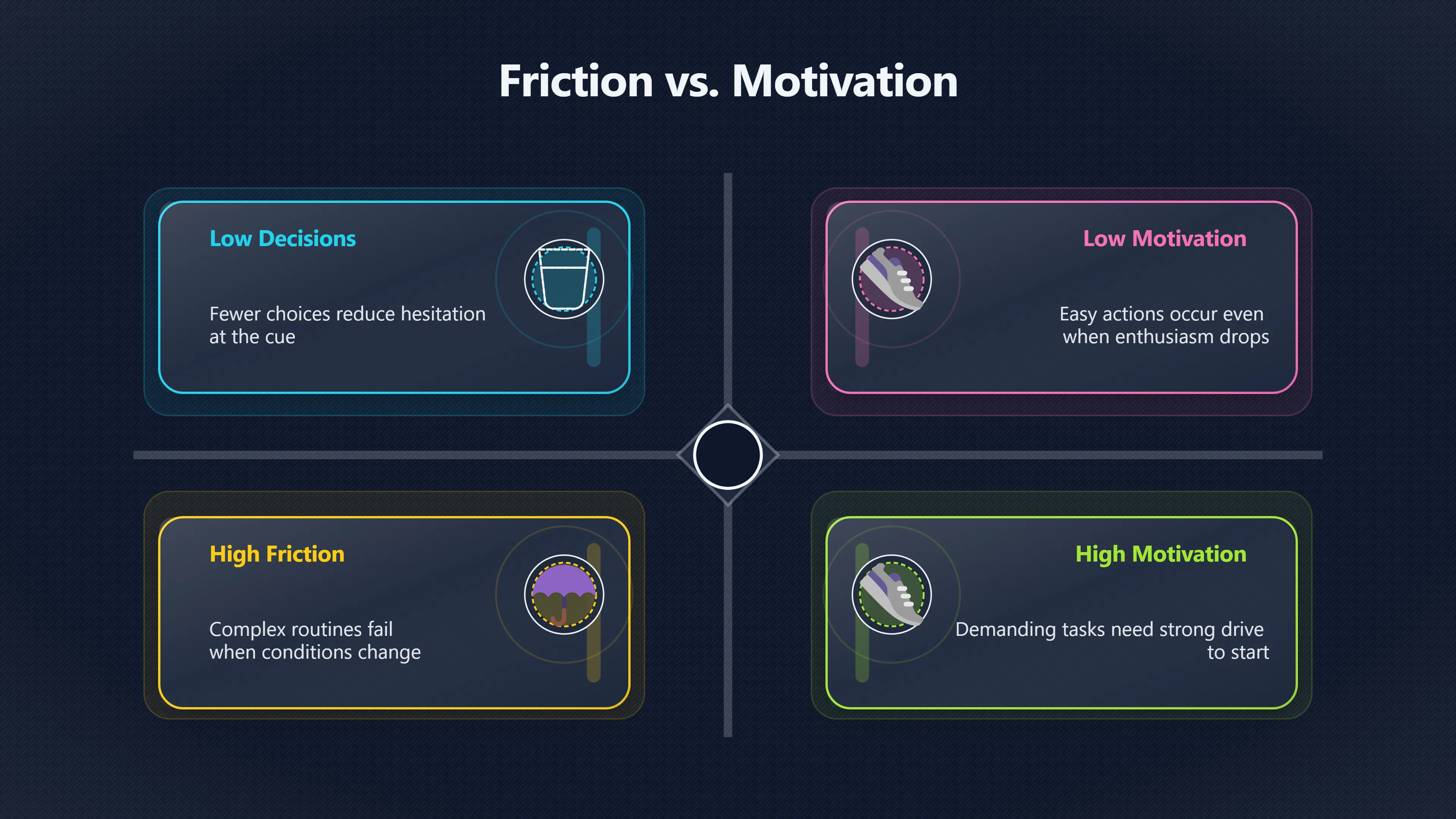
They require fewer decisions.
Decision-making consumes mental resources. A habit that can be completed immediately when a cue appears has fewer opportunities for hesitation. If a person decides to do one push-up after brushing their teeth, there is almost no decision left to make when the cue occurs.
They require less motivation.
The Fogg Behavior Model argues that behaviour depends on motivation, ability and a prompt occurring together. When a behaviour is very easy, less motivation is needed for it to happen. This means the action can still occur on days when enthusiasm is low.[Fogg Behavior Model]behaviormodel.orgFogg Behavior ModelFogg Behavior Model - BJ FoggThe Fogg Behavior Model shows that three elements must converge at the same moment for a…[Behavior Design Lab]behaviordesign.stanford.eduBehavior Design LabFogg Behavior ModelThe Fogg Behavior Model shows that three elements must converge at the same moment for a behavior t…
They fit more situations.
A two-minute action can often be performed despite travel, stress, busy schedules or mild illness. A demanding routine may be disrupted whenever circumstances change.
They produce more repetitions.[cambridge.org]cambridge.orgAfter many repetitions, mental representations of habitual action are formed…Read more…
Habit formation depends heavily on repeated performance. A tiny behaviour that succeeds nearly every day accumulates repetitions faster than a larger behaviour that is completed inconsistently. PMC[Cambridge University Press & Assessment]cambridge.orgAfter many repetitions, mental representations of habitual action are formed…Read more…
These advantages create a reinforcing cycle. Easy behaviours are performed more often, frequent performance strengthens automaticity, and growing automaticity makes future performance easier.
The Hidden Power of Context Stability
Simple habits are often easier to attach to a stable cue.
A person can decide:
- After I pour my morning coffee, I will drink a glass of water.
- After I sit at my desk, I will write one sentence.
- After I brush my teeth, I will floss one tooth.
The cue is clear, frequent and predictable.
More complex routines often depend on contexts that are less stable. A full workout might require free time, access to equipment, suitable clothing and sufficient energy. When the context changes, the cue becomes less reliable.
Studies of habit building show that context stability helps automaticity grow. Consistent environments make it easier for the brain to learn the association between a situation and an action. Simple habits frequently benefit because they can be linked to everyday events that rarely change.[Frontiers]frontiersin.orgFrontiersContext Stability in Habit Building Increases Automaticity…by M Stojanovic · 2022 · Cited by 18 — In this paper, we investiga…[PMC]pmc.ncbi.nlm.nih.govSome habits are more work than others: Deliberate self…by B Saunders · 2024 · Cited by 26 — We tested the hypothesis that complex b…
Why Bigger Habits Often Need Extra Support
An important misconception is that complex habits cannot become automatic. They can. The difference is that they often require additional layers of support.
Research suggests that complex behaviours frequently rely on planning, self-regulation and environmental design even when habit strength is high. Someone who exercises regularly may still schedule sessions, prepare equipment in advance and protect time in their calendar.[PMC]pmc.ncbi.nlm.nih.govReinforcement motivates and strengthens repetition. With ongoing repetition, the stable context cue…
In practice, the automatic part may be the decision to begin rather than every detail of execution.
For example:
- The habit becomes changing into running clothes after work.
- The habit becomes opening a study notebook at 7 p.m.
- The habit becomes entering the gym on the way home.
Once the starting action occurs, conscious effort can carry the person through the rest of the routine.
This distinction helps explain why large routines often feel partly automatic rather than completely effortless.
How to Shrink a Demanding Routine Without Losing the Goal
When a habit repeatedly fails to stick, the problem is often not commitment but scale.
A useful strategy is to reduce the behaviour until it becomes difficult to avoid.
Instead of:
- Read for 30 minutes.
- Meditate for 20 minutes.
- Run 5 kilometres.
- Write 1,000 words.
Try:
- Read one page.
- Meditate for one minute.
- Put on running shoes and walk outside.
- Write one sentence.
This approach preserves the identity and direction of the habit while reducing friction. The goal is not that the tiny version delivers the entire benefit. The goal is to establish a reliable cue-action relationship that can later support larger amounts of behaviour. This principle sits behind several habit-building frameworks that emphasise starting with actions small enough to be repeated consistently.[Tiny Habits]tinyhabits.comTiny HabitsTiny Habits: BJ FoggCreate any habit you want in your life using Tiny Habits: A breakthrough method created by Stanford behavi…[Fogg Behavior Model]behaviormodel.orgFogg Behavior ModelFogg Behavior Model - BJ FoggThe Fogg Behavior Model shows that three elements must converge at the same moment for a…
What This Means for Real Habit Formation
The lesson from habit research is not that some people have stronger willpower than others. It is that behaviours differ in complexity.
Simple habits become automatic faster because they require fewer decisions, less motivation, fewer resources and fewer supporting conditions. They can be repeated more consistently, attached to stable cues more easily and practised across a wider range of circumstances. Those repeated successful performances strengthen the cue-action link that lies at the heart of habit formation.[Wiley Online Library]onlinelibrary.wiley.comOnline Library Modelling habit formation in the real worldWiley Online LibraryModelling habit formation in the real world - Lally - 2010by P Lally · 2010 · Cited by 3493 — To investigate the proc…[PMC]pmc.ncbi.nlm.nih.govhealth habitual: the psychology of 'habit-formation' and…by B Gardner · 2012 · Cited by 871 — Participants in one study repeated a sel…
Within the broader discussion of habit timelines beyond 21 days, this helps explain why one person may automate a daily glass of water in a relatively short period while another spends months making exercise feel routine. The difference is often not determination. It is the amount of behavioural complexity that must be turned into something automatic. University College London[2surrey.ac.uk]surrey.ac.ukdoes it really take 66 days form habit we asked expert dr pippa lallyDoes it really take 66 days to form a habit?21 Jan 2026 — In 2010, Dr Pippa Lally, with colleagues at UCL, published a study that found t…
Amazon book picks
Further Reading
Books and field guides related to Why Small Habits Settle In Faster. Use these as the next step if you want deeper reading beyond the article.
Atomic Habits
Rating: 3.5/5 from 7 Google Books ratings
Promotes reducing friction and starting small.
eBay marketplace picks
Marketplace Samples
Example marketplace items related to this page. Use the search link to explore similar finds on eBay.






Endnotes
1.
Source: onlinelibrary.wiley.com
Title: Online Library Modelling habit formation in the real world
Link:https://onlinelibrary.wiley.com/doi/10.1002/ejsp.674
Source snippet
Wiley Online LibraryModelling habit formation in the real world - Lally - 2010by P Lally · 2010 · Cited by 3493 — To investigate the proc...
2.
Source: pmc.ncbi.nlm.nih.gov
Link:https://pmc.ncbi.nlm.nih.gov/articles/PMC12318445/
Source snippet
Reinforcement motivates and strengthens repetition. With ongoing repetition, the stable context cue...
3.
Source: cambridge.org
Link:https://www.cambridge.org/core/books/handbook-of-behavior-change/changing-behavior-using-habit-theory/5F222BC3AF6ADD9A8307BBB726D43F5C
Source snippet
After many repetitions, mental representations of habitual action are formed...Read more...
4.
Source: pmc.ncbi.nlm.nih.gov
Link:https://pmc.ncbi.nlm.nih.gov/articles/PMC3505409/
Source snippet
health habitual: the psychology of 'habit-formation' and...by B Gardner · 2012 · Cited by 871 — Participants in one study repeated a sel...
5.
Source: pmc.ncbi.nlm.nih.gov
Link:https://pmc.ncbi.nlm.nih.gov/articles/PMC6667662/
Source snippet
Habits, Quick and Easy: Perceived Complexity Moderates the...by K McCloskey · 2019 · Cited by 65 — The present study examines how eac...
6.
Source: pmc.ncbi.nlm.nih.gov
Link:https://pmc.ncbi.nlm.nih.gov/articles/PMC9226889/
Source snippet
Stability in Habit Building Increases Automaticity and...by M Stojanovic · 2022 · Cited by 18 — In this paper, we investigate the effect...
7.
Source: pmc.ncbi.nlm.nih.gov
Link:https://pmc.ncbi.nlm.nih.gov/articles/PMC11891988/
Source snippet
Some habits are more work than others: Deliberate self...by B Saunders · 2024 · Cited by 26 — We tested the hypothesis that complex b...
8.
Source: surrey.ac.uk
Title: does it really take [66 days]({{ ‘66-days/’ | relative_url }}) form habit we asked expert dr pippa lally
Link:https://www.surrey.ac.uk/news/does-it-really-take-66-days-form-habit-we-asked-expert-dr-pippa-lally
Source snippet
Does it really take 66 days to form a habit?21 Jan 2026 — In 2010, Dr Pippa Lally, with colleagues at UCL, published a study that found t...
9.
Source: compass.onlinelibrary.wiley.com
Link:https://compass.onlinelibrary.wiley.com/doi/10.1111/spc3.12975
Source snippet
is habit and how can it be used to change real‐world...by B Gardner · 2024 · Cited by 70 — Habit formation approaches need not seek to f...
10.
Source: openresearch.surrey.ac.uk
Title: Habit Formation and Behavior Change
Link:https://openresearch.surrey.ac.uk/esploro/outputs/bookChapter/Habit-Formation-and-Behavior-Change/99648862902346
Source snippet
Open Research SurreyHabit Formation and Behavior Changeby AL Rebar · 2019 · Cited by 409 — Within psychology, the term habit refers to a...
11.
Source: behaviormodel.org
Link:https://www.behaviormodel.org/
Source snippet
Fogg Behavior ModelFogg Behavior Model - BJ FoggThe Fogg Behavior Model shows that three elements must converge at the same moment for a...
12.
Source: behaviordesign.stanford.edu
Link:https://behaviordesign.stanford.edu/resources/fogg-behavior-model
Source snippet
Behavior Design LabFogg Behavior ModelThe Fogg Behavior Model shows that three elements must converge at the same moment for a behavior t...
13.
Source: behaviormodel.org
Link:https://www.behaviormodel.org/prompts
Source snippet
Fogg Behavior ModelPrompts in the Fogg Behavior ModelLearn how prompts activate behavior in the Fogg Behavior Model and how to design eff...
14.
Source: frontiersin.org
Link:https://www.frontiersin.org/journals/psychology/articles/10.3389/fpsyg.2022.883795/full
Source snippet
FrontiersContext Stability in Habit Building Increases Automaticity...by M Stojanovic · 2022 · Cited by 18 — In this paper, we investiga...
15.
Source: tinyhabits.com
Link:https://tinyhabits.com/
Source snippet
Tiny HabitsTiny Habits: BJ FoggCreate any habit you want in your life using Tiny Habits: A breakthrough method created by Stanford behavi...
16.
Source: northbeam.io
Title: fogg behavior model motivation ability and prompts
Link:https://www.northbeam.io/blog/fogg-behavior-model-motivation-ability-and-prompts
Source snippet
Fogg Behavior Model: Motivation, Ability, and Prompts29 Oct 2025 — The Fogg Behavior Model explains that behavior occurs when Motivation...
17.
Source: frontiersin.org
Link:https://www.frontiersin.org/journals/psychology/articles/10.3389/fpsyg.2019.01556/full
Source snippet
Habits, Quick and Easy: Perceived Complexity Moderates...by K McCloskey · 2019 · Cited by 65 — Both contextual stability and [rewards]({{ 'rewards/' | relative_url }}) wer...
18.
Source: drpaulmccarthy.com
Title: Specific and clearly defined.Read more
Link:https://www.drpaulmccarthy.com/post/tiny-habits-the-breakthrough-method-for-building-life-changing-behaviors
Source snippet
Tiny Habits: The Breakthrough Method for Building Life-...10 Feb 2026 — BJ Fogg's tiny habits approach suggests picking behaviors that a...
19.
Source: nehrlich.com
Title: tiny habits by bj fogg
Link:https://www.nehrlich.com/blog/2020/03/03/tiny-habits-by-bj-fogg/
Source snippet
Tiny Habits, by BJ Fogg3 Mar 2020 — Fogg suggests troubleshooting first the prompt, then ability, then motivation. If the prompt isn't cl...
20.
Source: thedecisionlab.com
Link:https://thedecisionlab.com/reference-guide/psychology/fogg-behavior-model
Source snippet
Fogg Behavior ModelCommercial exploitation: The goal of the Fogg Behavior Model is to strike a balance between motivation, ability, and p...
Additional References
21.
Source: pubmed.ncbi.nlm.nih.gov
Link:https://pubmed.ncbi.nlm.nih.gov/31396122/
Source snippet
nih.govHabits, Quick and Easy: Perceived Complexity Moderates the...The present study examines how each of these factors are associated...
22.
Source: linkedin.com
Link:https://www.linkedin.com/posts/ali-abdaal_the-secret-to-building-lifelong-habits-fits-activity-7372615066644320256-ADl2
Source snippet
Ali Abdaal's PostLove how simple BJ Fogg makes it with MAP, most people overcomplicate habits. The reminder that ability (removing fricti...
23.
Source: filippa-k.com
Link:https://www.filippa-k.com/
Source snippet
FILIPPA K | Effortless Scandinavian MinimalismAt FILIPPA K, we stand for effortless style, simplicity, and quality, crafting timeless, hi...
24.
Source: triagemethod.com
Link:https://triagemethod.com/understanding-the-basics-of-behaviour-change-and-habit-formation/
Source snippet
Understanding The Basics of [Behaviour Change]({{ 'behaviour-change/' | relative_url }}) and Habit...The habit loop (cue, routine, reward) governs every behaviour, and successful c...
25.
Source: oneyoufeed.net
Link:https://www.oneyoufeed.net/why-willpower-isnt-enough-the-tiny-habits-method-explained-with-dr-bj-foggwhy-willpower-isnt-enough/
Source snippet
Fogg shares practical strategies for designing habits that fit individual contexts, explains his behavior model, and discusses how positi...
26.
Source: merriam-webster.com
Link:https://www.merriam-webster.com/dictionary/habit
Source snippet
HABIT Definition & MeaningThe word habit most often refers to a usual way of behaving or a tendency that someone has settled into, as in...
27.
Source: peterhbrownpsych.com
Link:https://peterhbrownpsych.com/2009/10/08/it-takes-how-long-to-form-a-habit-research-shows-a-curved-relationship-between-practice-and-automaticity/
Source snippet
It Takes HOW Long to Form a Habit?: Research Shows a...8 Oct 2009 — Although the average was 66 days, there was marked variation in how...
28.
Source: researchgate.net
Link:https://www.researchgate.net/publication/361222550_Context_Stability_in_Habit_Building_Increases_Automaticity_and_Goal_Attainment
Source snippet
Context Stability in Habit Building Increases Automaticity...Jun 10, 2022 — In this paper, we investigate the effects of context stabili...
29.
Source: researchgate.net
Title: 32898894 How are habits formed Modeling habit formation in the real world
Link:https://www.researchgate.net/publication/32898894_How_are_habits_formed_Modeling_habit_formation_in_the_real_world
Source snippet
Modeling habit formation in the real world | Request PDFThese students reached their peak automaticity after about 56 days (or 8 weeks)...
30.
Source: philippalondon.com
Link:https://www.philippalondon.com/
Topic Tree