Within Identity
Build the proof before claiming the identity
A new self-image becomes more believable when small visible actions create proof a person can repeat.
On this page
- Why premature identity claims can backfire
- How small actions become self evidence
- What counts as enough proof to continue
Page outline Jump by section
Introduction
In the debate between identity change and behaviour design, one principle repeatedly emerges from psychology and habit research: self-image becomes more believable when it is supported by evidence. Rather than starting with a declaration such as “I am disciplined” or “I am a runner”, lasting change is often built by accumulating small actions that make those statements increasingly true. Behaviour comes first; identity becomes a summary of repeated behaviour later. Research on self-perception, habits and identity formation suggests that people frequently learn who they are by observing what they consistently do, not merely by deciding what they wish to be.[The Decision Lab]thedecisionlab.comThe Decision LabSelf Perception TheorySelf perception theory argues that people become aware of certain attitudes by observing their own…[EBSCO]ebsco.comSelf-perception theory (SPT) | Health and MedicineSelf-perception theory (SPT) is a concept in social psychology introduced by Daryl Bem… This does not mean identity is unimportant. It means that identity claims are strongest when they rest on observable proof. A new self-imagegains credibility when it can survive contact with ordinary days, competing priorities and imperfect motivation.

Why premature identity claims can backfire
The attraction of identity language is obvious. It feels deeper than a checklist. A person would rather become “a healthy person” than merely complete a workout. The problem appears when the identity claim arrives before enough behaviour exists to support it.
When people make broad statements about who they are becoming, they create a standard that reality can immediately test. If the evidence is thin, each failure becomes psychologically expensive. Missing one run feels less like a missed activity and more like proof that the new identity was never real.
Research on self-perception theory helps explain why. When attitudes or self-beliefs are uncertain, people often infer them by observing their own actions. In effect, they ask: “What does my behaviour suggest about me?” If the behavioural record is inconsistent, the identity claim remains fragile.[The Decision Lab]thedecisionlab.comThe Decision LabSelf Perception TheorySelf perception theory argues that people become aware of certain attitudes by observing their own… ScienceDirect This creates a common self-improvement cycle:[sciencedirect.com]sciencedirect.comScienceDirect From attitude to identity?A field experiment on…by L Randers · 2023 · Cited by 25 — Self-perception theory suggests that a person's behavioural history matters…
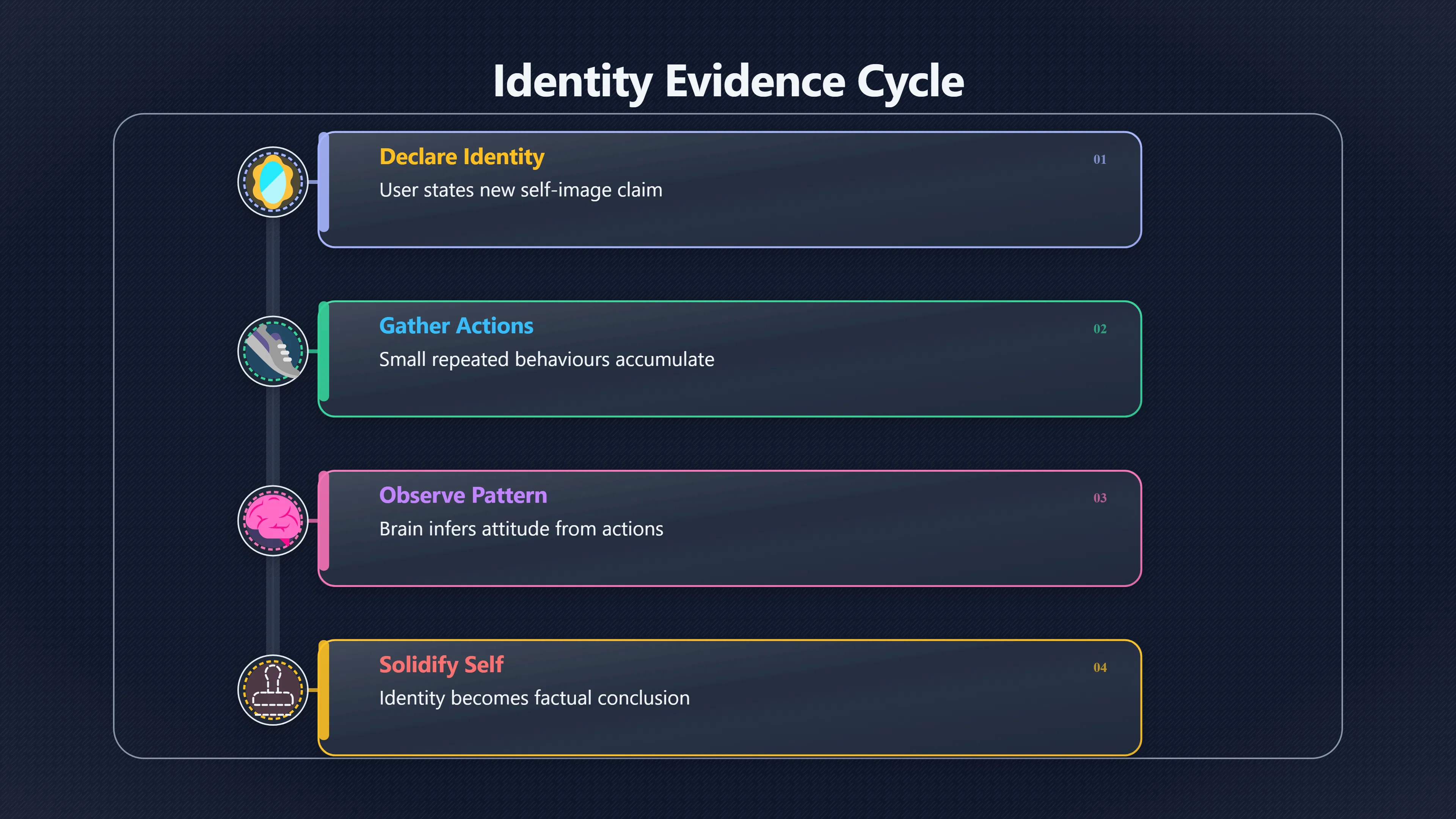
- Declare a new identity.
- Feel motivated by the declaration.
- Fail to produce enough supporting behaviour.
- Interpret the gap as personal inadequacy.
- Abandon the identity claim.
The failure is not necessarily a lack of commitment. Often there was simply not enough evidence yet.
How small actions become self-evidence
A useful way to think about behaviour is as evidence rather than achievement.
One completed workout does not make someone an athlete. One page of writing does not make someone a writer. Yet each action becomes a data point that can be observed and remembered. Over time, these data points accumulate into a believable pattern.
Popular habit literature often describes actions as “votes” for a particular identity. The metaphor resonates because it reflects a broader psychological reality: repeated behaviour provides information about the self.[James Clear]jamesclear.comJames ClearHow to Change Your Beliefs and Stick to Your Goals for…The best way to stick to your goals is to build identity-based habit…
Evidence is stronger than intention
People often overestimate the importance of intentions because intentions are emotionally vivid. Behavioural evidence is less dramatic but more reliable.
Consider two people:[pmc.ncbi.nlm.nih.gov]pmc.ncbi.nlm.nih.govby B Verplanken · 2019 · Cited by 150 — Two studies investigated associations between habits and identity, in particular what people c…
- Person A says they are committed to fitness and talks about it frequently.
- Person B quietly walks for twenty minutes every weekday.
After three months, Person B possesses a stronger factual basis for a fitness-related identity. The repeated action provides visible proof that can be observed by both the individual and others.
This distinction matters because habits are not merely behaviours that happen often. Strong habits become integrated into a person’s sense of self. Research examining habit and identity found that habits can become connected to what people regard as their “true self”, particularly when behaviours are repeated and personally meaningful.[PubMed]pubmed.ncbi.nlm.nih.govHabit and Identity: Behavioral, Cognitive, Affective…by B Verplanken · 2019 · Cited by 150 — When habits relate to feelings of i…[PMC]pmc.ncbi.nlm.nih.govby B Verplanken · 2019 · Cited by 150 — Two studies investigated associations between habits and identity, in particular what people c…
Small actions reduce the credibility gap
Large identity claims often fail because the distance between current behaviour and desired identity is too wide.
A person who rarely exercises may struggle to believe “I am an athlete”. However, “I have completed a ten-minute walk every day for the past two weeks” is concrete and verifiable.
Small actions narrow the gap between aspiration and reality. They provide evidence that the brain can accept without requiring self-deception.
This is one reason behaviour-focused interventions often outperform approaches that rely mainly on attitude change. Habit researchers note that behaviour is heavily influenced by repeated routines and contextual cues, meaning that sustained action can reshape future behaviour more effectively than belief alone.[Annual Reviews]annualreviews.organnurev psych 020821 011744Annual ReviewsAttitudes, Habits, and Behavior Changeby B Verplanken · 2022 · Cited by 547 — Efforts to guide peoples' behavior toward env…
What counts as enough proof to continue?
There is no universal threshold at which a new identity becomes justified. However, the evidence becomes more persuasive when it meets three conditions.
It is observable
The behaviour should be visible enough that a neutral observer could confirm it.
Examples include:
- Reading ten pages each night.
- Preparing meals at home five days per week.
- Writing every morning before work.
- Tracking spending weekly.
Statements such as “I feel more motivated” or “I think differently now” may be valuable experiences, but they are weaker forms of evidence because they are harder to verify.
It is repeated
A single action proves almost nothing.
Identity grows from patterns rather than isolated events. Research on habits consistently emphasises repetition because recurring behaviour is what gradually becomes automatic and integrated into self-concept.[PubMed]pubmed.ncbi.nlm.nih.govHabit and Identity: Behavioral, Cognitive, Affective…by B Verplanken · 2019 · Cited by 150 — When habits relate to feelings of i…[IAAP Journals]iaap-journals.onlinelibrary.wiley.comIAAP JournalsThe relationship between habit and identity in health…19 Mar 2025 — In sum, this meta-analytic review provides evidence t…
The critical question is not whether a behaviour happened once but whether it continues under ordinary conditions.
It survives inconvenience
The strongest proof appears when behaviour persists despite minor obstacles.
A person who writes only when inspired has evidence of occasional writing. A person who writes when tired, busy or uninspired has evidence of a writing practice.
The difference is important because identity becomes believable when behaviour remains stable across different situations. Evidence gathered only under ideal conditions is weaker than evidence gathered under real-life constraints.
Proof first, identity second
A practical mistake in self-improvement is treating identity as a starting point rather than an emerging conclusion.
Instead of asking, “How can I convince myself that I am disciplined?”, the more useful question is often, “What behaviour would make that statement increasingly difficult to deny?”
This shifts attention from self-description to evidence gathering.
For example:
- Rather than claiming to be organised, consistently maintain a calendar.
- Rather than claiming to be healthy, repeatedly perform health-supporting behaviours.
- Rather than claiming to be focused, create regular periods of uninterrupted work.
Over time, identity becomes less of a motivational slogan and more of a factual observation.
Interestingly, research on behaviour and identity formation suggests that behavioural history may influence future attitudes and identity gradually rather than instantly. New behaviours do not automatically create a new self-image, but repeated identity-consistent actions can strengthen positive attitudes and eventually support a more durable sense of identity.[ScienceDirect]sciencedirect.comScienceDirect From attitude to identity?A field experiment on…by L Randers · 2023 · Cited by 25 — Self-perception theory suggests that a person's behavioural history matters…
The practical standard: act before you announce
Within self-improvement that works, the most reliable approach is often to treat identity as something earned through evidence rather than granted through declaration.
The person who has exercised fifty times possesses stronger grounds for seeing themselves as active than the person who merely adopted the label. The person who has written regularly for months has more reason to identify as a writer than the person who has only imagined becoming one.
Identity is not irrelevant. It can provide direction, meaning and persistence. But behaviour supplies the proof. When small actions are repeated long enough to form a visible pattern, self-image stops being a hopeful claim and starts becoming a reasonable conclusion.[ScienceDirect]sciencedirect.comScienceDirect From attitude to identity?A field experiment on…by L Randers · 2023 · Cited by 25 — Self-perception theory suggests that a person's behavioural history matters…[PubMed]pubmed.ncbi.nlm.nih.govHabit and Identity: Behavioral, Cognitive, Affective…by B Verplanken · 2019 · Cited by 150 — When habits relate to feelings of i…[PMC]pmc.ncbi.nlm.nih.govby B Verplanken · 2019 · Cited by 150 — Two studies investigated associations between habits and identity, in particular what people c…
Amazon book picks
Further Reading
Books and field guides related to Build the proof before claiming the identity. Use these as the next step if you want deeper reading beyond the article.
Atomic Habits
Rating: 3.5/5 from 7 Google Books ratings
Frames repeated actions as votes for the type of person you become.
eBay marketplace picks
Marketplace Samples
Example marketplace items related to this page. Use the search link to explore similar finds on eBay.







Endnotes
1.
Source: ebsco.com
Link:https://www.ebsco.com/research-starters/health-and-medicine/self-perception-theory-spt
2.
Source: sciencedirect.com
Title: ScienceDirect From attitude to identity?
Link:https://www.sciencedirect.com/science/article/pii/S0272494423000440
Source snippet
A field experiment on...by L Randers · 2023 · Cited by 25 — Self-perception theory suggests that a person's behavioural history matters...
3.
Source: sciencedirect.com
Link:https://www.sciencedirect.com/science/chapter/bookseries/pii/S0065260108600246
Source snippet
It discusses some...Read more...
4.
Source: pmc.ncbi.nlm.nih.gov
Link:https://pmc.ncbi.nlm.nih.gov/articles/PMC6635880/
Source snippet
by B Verplanken · 2019 · Cited by 150 — Two studies investigated associations between habits and identity, in particular what people c...
5.
Source: psychology.town
Title: self perception theory attitudes understanding
Link:https://psychology.town/social/self-perception-theory-attitudes-understanding/
Source snippet
Understanding Attitudes Through Self-Perception Theory9 Oct 2025 — Self-perception theory proposes that individuals learn about their own...
6.
Source: psychology.town
Title: self understanding social comparison self perception
Link:https://psychology.town/advanced-social/self-understanding-social-comparison-self-perception/
Source snippet
Self-Understanding Through Social Comparison and...24 Sept 2025 — Explore how social comparison, self-perception, and cognitive dissonan...
7.
Source: thedecisionlab.com
Link:https://thedecisionlab.com/reference-guide/psychology/self-perception-theory
Source snippet
The Decision LabSelf Perception TheorySelf perception theory argues that people become aware of certain attitudes by observing their own...
8.
Source: jamesclear.com
Link:https://jamesclear.com/identity-votes
Source snippet
James ClearHow to Change Your Beliefs and Stick to Your Goals for...The best way to stick to your goals is to build identity-based habit...
9.
Source: pubmed.ncbi.nlm.nih.gov
Link:https://pubmed.ncbi.nlm.nih.gov/31354563/
Source snippet
Habit and Identity: Behavioral, Cognitive, Affective...by B Verplanken · 2019 · Cited by 150 — When habits relate to feelings of i...
10.
Source: annualreviews.org
Title: annurev psych 020821 011744
Link:https://www.annualreviews.org/content/journals/10.1146/annurev-psych-020821-011744
Source snippet
Annual ReviewsAttitudes, Habits, and Behavior Changeby B Verplanken · 2022 · Cited by 547 — Efforts to guide peoples' behavior toward env...
11.
Source: annualreviews.org
Title: annurev psych 020821 011744
Link:https://www.annualreviews.org/docserver/fulltext/psych/73/1/annurev-psych-020821-011744.pdf?accname=guest&checksum=25BC0568471D2B3B1729FC0D8A37C3FC&expires=1734081569&id=id
Source snippet
Attitudes, Habits, and Behavior Change4 Jan 2022 — Attitudes, Habits, and Behavior Change. Bas Verplanken1 and Sheina Orbell2. View Affil...
12.
Source: iaap-journals.onlinelibrary.wiley.com
Link:https://iaap-journals.onlinelibrary.wiley.com/doi/10.1111/aphw.70017
Source snippet
IAAP JournalsThe relationship between habit and identity in health...19 Mar 2025 — In sum, this meta-analytic review provides evidence t...
13.
Source: jamesclear.com
Link:https://jamesclear.com/identity-based-habits
Source snippet
Identity-Based Habits: How to Actually Stick to Your Goals...The key to building lasting habits is focusing on creating a new identity f...
14.
Source: study.com
Title: Self-Perception Theory | Definition & Examples
Link:https://study.com/academy/lesson/self-perception-theory-definition-and-examples.html
Source snippet
LessonSelf-perception theory says that people learn about their own attitudes and character traits by observing their own behavior.Read more...
Additional References
15.
Source: researchgate.net
Link:https://www.researchgate.net/publication/334372119_Habit_and_Identity_Behavioral_Cognitive_Affective_and_Motivational_Facets_of_an_Integrated_Self
Source snippet
(PDF) Habit and Identity: Behavioral, Cognitive, Affective...10 Jul 2019 — Two studies investigated associations between habits and iden...
16.
Source: goodlifeproject.com
Link:https://www.goodlifeproject.com/podcast/atomic-habits-identity-habits-behavior-change-james-clear/
Source snippet
How to Build Habits That Stick | James Clear [Best of]You know, I talk about this in chapter two of the book about this idea of like iden...
17.
Source: tumcso.com
Link:https://www.tumcso.com/teaching/courses/courses/work-and-life-skills-ss-23/work-life-skills-23/habits-page-by-eva-schroeder/drive-change/identity-based-habits
Source snippet
Identity-Based HabitsA helpful framework by James Clear helps you to quickly define an identity-based habit, by defining the person you w...
18.
Source: litcharts.com
Link:https://www.litcharts.com/lit/atomic-habits/themes/identity-based-habits
Source snippet
Identity-Based Habits Theme in Atomic HabitsClear contends that lasting behavioral change depends not on what you want to achieve, but on...
19.
Source: itsacademic.co.uk
Link:https://itsacademic.co.uk/self-perception-theory-1
Source snippet
Self-Perception TheorySELF-PERCEPTION THEORY · Behavioural Cues: The theory asserts that people infer their attitudes from observing thei...
20.
Source: researchgate.net
Link:https://www.researchgate.net/publication/277682193_Self-Perception_Theory
21.
Source: linkedin.com
Link:https://www.linkedin.com/pulse/identity-based-habits-secret-lasting-change-eric-michiels-bwndf
22.
Source: spiegeloog.amsterdam
Title: identity fractures the impact of manipulation on morality and self perception
Link:https://www.spiegeloog.amsterdam/identity-fractures-the-impact-of-manipulation-on-morality-and-self-perception/
Source snippet
Identity Fractures: The Impact of Manipulation on Morality...3 Jan 2025 — Manipulative behaviour profoundly affects an individual's perc...
23.
Source: strongbodygreenplanet.com
Link:https://strongbodygreenplanet.com/james-clear-and-atomic-habits-true-behaviour-change-is-identity-change/
Source snippet
It can be this simple. It gives you a sense of clarity, control and confidence.Read more...
24.
Source: renascence.io
Title: self perception theory inferring attitudes from behavior
Link:https://www.renascence.io/journal/self-perception-theory-inferring-attitudes-from-behavior
Source snippet
Self-Perception Theory: Inferring Attitudes from Behavior8 Aug 2024 — Self-Perception Theory is a cognitive bias where individuals infer...
Topic Tree