Within Health Habits
Is morning really the best habit time?
Mornings often protect repetition from interruptions, but the best cue is the one a person can repeat reliably.
On this page
- Why mornings may help repetition
- When routine cues beat clock times
- How to match timing to the behaviour
Page outline Jump by section
Introduction
Morning is not automatically the best time for every health habit. The strongest evidence suggests a more nuanced rule: habits are easier to maintain when they are attached to a reliable cue and repeated consistently. Morning routines often provide that stability because they face fewer interruptions, competing demands and decision points. However, evening habits can work just as well when they fit a person’s natural schedule, energy patterns and existing routines. The practical question is not “What is the optimal hour?” but “When can this behaviour happen repeatedly under real-life conditions?” Research on habit formation, exercise adherence and routine stability points towards consistency and cue quality as the main drivers of automaticity, with clock time playing a supporting role.[PubMed Central]pmc.ncbi.nlm.nih.govPubMed CentralMaking health habitual: the psychology of 'habit-formation' and…by B Gardner · 2012 · Cited by 851 — Automaticity develo…[Frontiers]frontiersin.orgContext Stability in Habit Building Increases Automaticity…by M Stojanovic · 2022 · Cited by 18 — In this paper, we investigate the ef…
Why mornings may help repetition
Morning habits have a structural advantage: the day has not yet had a chance to interfere.
Many health behaviours fail not because people reject them, but because work demands, family responsibilities, fatigue and unexpected events crowd them out. A morning walk, stretching session or medication routine is often completed before those competing pressures appear. Researchers studying exercise adherence have argued that consistent morning exercise may support habit formation because morning routines already contain stable cues that can trigger behaviour repeatedly.[Lippincott Journals]journals.lww.comLippincott JournalsConsistent Morning Exercise May Be Beneficial for…This review explores the hypothesis that a consistent exercise tim…[2exerciseismedicine.gr]exerciseismedicine.grAgain, consistent morning exercise may be…
This advantage is behavioural rather than magical. The benefit comes from predictability:
- Fewer schedule disruptions.
- Less need to negotiate with oneself later in the day.
- More stable environmental cues.
- Reduced exposure to competing priorities.
Studies of long-term exercisers have found that consistent early-morning activity is associated with stronger exercise automaticity and more stable routines. Importantly, the proposed mechanism is not that morning exercise changes motivation directly; it is that regular timing helps create cue-behaviour associations.[PubMed Central]pmc.ncbi.nlm.nih.govPubMed CentralMaking health habitual: the psychology of 'habit-formation' and…by B Gardner · 2012 · Cited by 851 — Automaticity develo…[2exerciseismedicine.gr]exerciseismedicine.grAgain, consistent morning exercise may be…
For behaviours that are easy to perform soon after waking—such as taking medication, drinking water, brief mobility work or preparing a healthy breakfast—the morning often offers a naturally protected slot.
When routine cues beat clock times
The strongest habit-formation evidence points towards context stability rather than a universal ideal time.
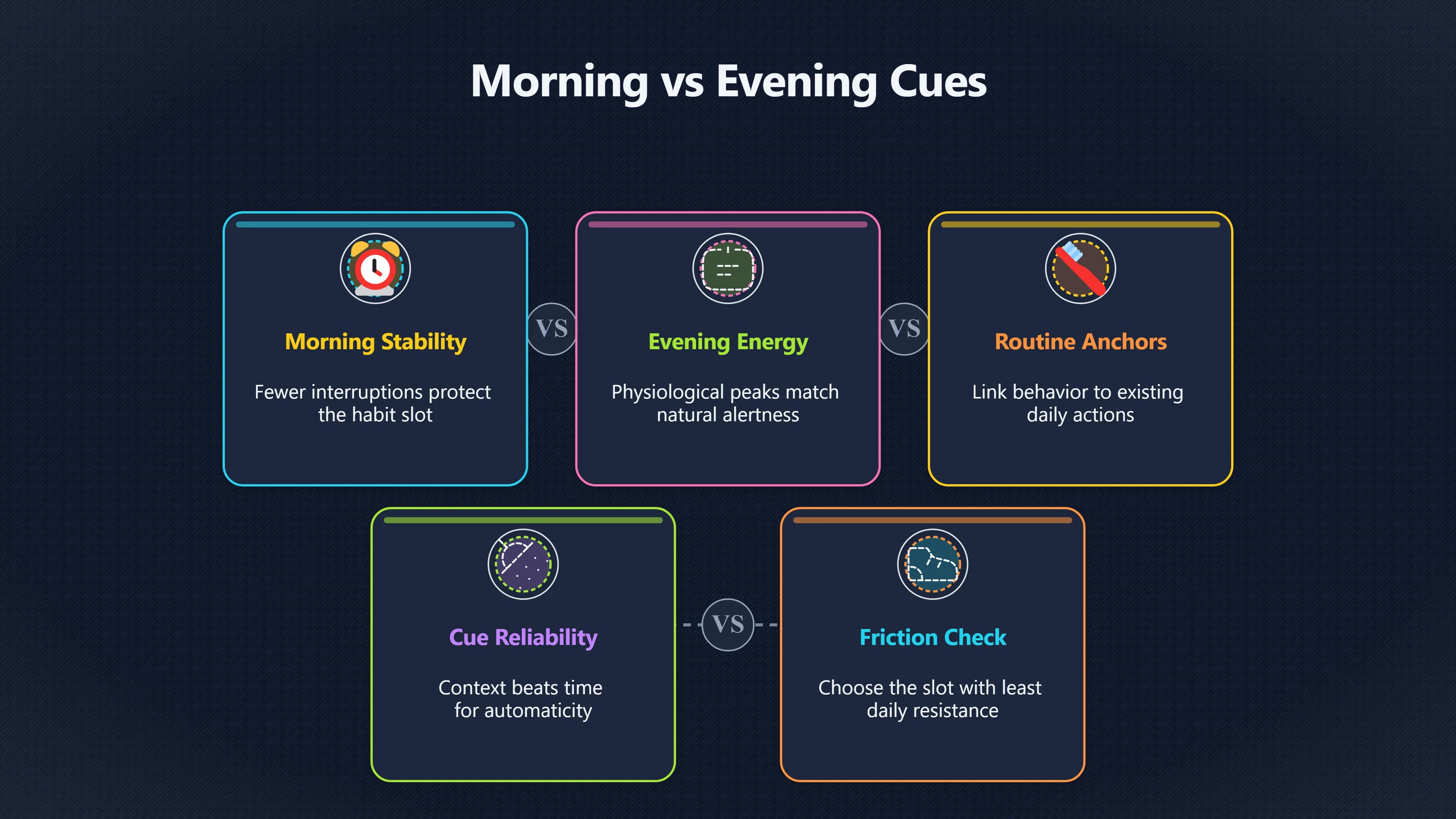
Habit researchers describe automaticity as developing when a behaviour is repeated in a consistent context. The cue might be a time of day, but it can also be another routine: after brushing teeth, after arriving at work, after lunch, or after putting children to bed. Stable contexts help the brain learn when a behaviour belongs.[PubMed Central]pmc.ncbi.nlm.nih.govPubMed CentralMaking health habitual: the psychology of 'habit-formation' and…by B Gardner · 2012 · Cited by 851 — Automaticity develo…[Frontiers]frontiersin.orgContext Stability in Habit Building Increases Automaticity…by M Stojanovic · 2022 · Cited by 18 — In this paper, we investigate the ef…
This distinction matters because people often mistake “6:00 a.m.” for the cue when the real cue is “after getting out of bed”. The latter is usually more robust because it survives weekends, travel and schedule shifts.
A randomised trial examining nutrition habits found that linking behaviour to a daily routine was about as effective as linking it to a specific clock time. The key factor was not whether the cue was temporal or routine-based, but whether people repeatedly acted when the cue occurred.[Tilburg University Research Portal]research.tilburguniversity.eduhabit formation following routine based versus time based cue plaInterventions should encourage…Read more…
In practice, this means:
- “After my morning coffee, I take my vitamins” is often stronger than “I take vitamins at 8:00.”
- “After dinner, I go for a ten-minute walk” may be easier to maintain than “I walk at 7:15 p.m.”
- “When I brush my teeth, I floss” is generally more reliable than relying on a particular clock time.
The best cue is frequently the one that already happens every day.
Why evenings sometimes work better
The common self-improvement message that everything important should happen before breakfast ignores major differences between people.
Some individuals have later chronotypes—the biological tendency to feel more alert and energetic later in the day. Research on chronotypes consistently finds meaningful variation in when people perform best physically and mentally. More recent evidence suggests that matching activity timing to one’s chronotype may improve adherence, sleep quality and health outcomes more effectively than forcing everyone into the same schedule.[The Times]thetimes.comThe Times Lark or owl?Here's when you should exercise - and what you should doA recent study published in the journal Open Heart suggests that aligning your…[PubMed Central]pmc.ncbi.nlm.nih.govPubMed CentralMaking health habitual: the psychology of 'habit-formation' and…by B Gardner · 2012 · Cited by 851 — Automaticity develo…[PubMed Central]pmc.ncbi.nlm.nih.govPubMed CentralMaking health habitual: the psychology of 'habit-formation' and…by B Gardner · 2012 · Cited by 851 — Automaticity develo…
Evening timing may be particularly useful when:
- The habit requires substantial energy or concentration.
- Morning schedules are chaotic.
- Family or caregiving duties dominate the early hours.
- The behaviour naturally fits an evening transition.
For example, a post-dinner walk has a built-in cue, occurs after a predictable daily event and can become part of a household routine. Similarly, evening meal preparation, stretching or planning for the next day may fit naturally into an established shutdown ritual.
Exercise research also complicates the simple “earlier is better” story. Physiological performance measures such as strength, power and some cardiovascular responses often peak later in the day. While that does not automatically improve habit formation, it can make the activity feel easier or more rewarding for some people, which may indirectly support consistency.[PubMed Central]pmc.ncbi.nlm.nih.govPubMed CentralMaking health habitual: the psychology of 'habit-formation' and…by B Gardner · 2012 · Cited by 851 — Automaticity develo…[PubMed Central]pmc.ncbi.nlm.nih.govPubMed CentralMaking health habitual: the psychology of 'habit-formation' and…by B Gardner · 2012 · Cited by 851 — Automaticity develo…

How to match timing to the behaviour
Different health habits face different obstacles, so the best timing depends on what must be overcome.
Behaviours that benefit from morning placement
Morning is often useful when the main challenge is remembering or protecting time.
Examples include:
- Taking medication.
- Drinking water.
- Brief mobility routines.
- Short walks.
- Preparing a healthy breakfast.
- Packing healthy food before leaving home.
These habits are generally simple, benefit from stable cues and can be completed before the day becomes complicated.[PubMed Central]pmc.ncbi.nlm.nih.govPubMed CentralMaking health habitual: the psychology of 'habit-formation' and…by B Gardner · 2012 · Cited by 851 — Automaticity develo…
Behaviours that may fit evening placement
Evening can be effective when the challenge is finding enough uninterrupted time.
Examples include:
- Longer exercise sessions.
- Meal preparation for the next day.
- Stretching or recovery work.
- Reflective practices such as journalling.
- Post-meal walks.
These behaviours often benefit from a transition cue such as finishing work, eating dinner or beginning a bedtime routine.
Behaviours that should follow an existing routine
Some habits gain little from being forced into either morning or evening.
Flossing, taking supplements, applying sunscreen before leaving home, or completing a rehabilitation exercise may be easiest when attached to a behaviour that already occurs daily. In these cases, cue reliability usually matters more than the hour on the clock.[Tilburg University Research Portal]research.tilburguniversity.eduhabit formation following routine based versus time based cue plaInterventions should encourage…Read more…[UCL Discovery]discovery.ucl.ac.ukJan paperRoutine cues are linked to higher behavioural automaticity in…
The practical decision rule
For self-improvement, the most useful question is not whether morning or evening is theoretically superior. It is whether the chosen time consistently survives ordinary life.
Morning timing often wins because it reduces exposure to interruptions and provides stable cues. Evening timing can win when it aligns better with energy levels, chronotype or household routines. The evidence on habit formation repeatedly points in the same direction: automaticity grows when behaviours occur in a stable context that repeats often enough for the cue and action to become linked.[PubMed Central]pmc.ncbi.nlm.nih.govPubMed CentralMaking health habitual: the psychology of 'habit-formation' and…by B Gardner · 2012 · Cited by 851 — Automaticity develo…[Frontiers]frontiersin.orgContext Stability in Habit Building Increases Automaticity…by M Stojanovic · 2022 · Cited by 18 — In this paper, we investigate the ef…
A reliable evening cue is usually more valuable than an aspirational morning schedule that repeatedly fails. The best habit time is therefore not the earliest available slot but the one that a person can repeat with the least friction for months rather than days. MDPI[PubMed Central]pmc.ncbi.nlm.nih.govPubMed CentralMaking health habitual: the psychology of 'habit-formation' and…by B Gardner · 2012 · Cited by 851 — Automaticity develo…
Amazon book picks
Further Reading
Books and field guides related to Is morning really the best habit time?. Use these as the next step if you want deeper reading beyond the article.
Atomic Habits
Rating: 3.5/5 from 7 Google Books ratings
Explains habit cues, consistency, and fitting behaviours into existing routines rather than chasing ideal times.
The Power of Habit
Focuses on cue-routine-reward loops and how stable contexts support repetition.
The Miracle Morning
Directly addresses morning routines and their advantages for consistency.
eBay marketplace picks
Marketplace Samples
Example marketplace items related to this page. Use the search link to explore similar finds on eBay.


Endnotes
1.
Source: exerciseismedicine.gr
Link:https://exerciseismedicine.gr/wp-content/uploads/2020/09/Consistent_Morning_Exercise_May_Be_Beneficial_for.7.pdf
Source snippet
Again, consistent morning exercise may be...
2.
Source: mdpi.com
Link:https://www.mdpi.com/2227-9032/12/23/2488
Source snippet
Time to Form a Habit: A Systematic Review and Meta-...by B Singh · 2024 · Cited by 97 — Conclusions: Emerging evidence on health-rel...
3.
Source: mdpi.com
Link:https://www.mdpi.com/1660-4601/20/3/2083
Source snippet
Time of Day and Chronotype-Dependent Synchrony Effects...by EM Malek · 2023 · Cited by 11 — Our data suggests that exercise timing has l...
4.
Source: pmc.ncbi.nlm.nih.gov
Link:https://pmc.ncbi.nlm.nih.gov/articles/PMC3505409/
Source snippet
PubMed CentralMaking health habitual: the psychology of 'habit-formation' and...by B Gardner · 2012 · Cited by 851 — Automaticity develo...
5.
Source: frontiersin.org
Link:https://www.frontiersin.org/journals/psychology/articles/10.3389/fpsyg.2022.883795/full
Source snippet
Context Stability in Habit Building Increases Automaticity...by M Stojanovic · 2022 · Cited by 18 — In this paper, we investigate the ef...
6.
Source: journals.lww.com
Link:https://journals.lww.com/acsm-essr/fulltext/2020/10000/consistent_morning_exercise_may_be_beneficial_for.7.aspx
Source snippet
Lippincott JournalsConsistent Morning Exercise May Be Beneficial for...This review explores the hypothesis that a consistent exercise tim...
7.
Source: pmc.ncbi.nlm.nih.gov
Link:https://pmc.ncbi.nlm.nih.gov/articles/PMC8764567/
Source snippet
Consistent early morning exercise was most strongly related to exercise automaticity and...Read more...
8.
Source: research.tilburguniversity.edu
Title: habit formation following routine based versus time based cue pla
Link:https://research.tilburguniversity.edu/en/publications/habit-formation-following-routine-based-versus-time-based-cue-pla/
Source snippet
Interventions should encourage...Read more...
9.
Source: discovery.ucl.ac.uk
Title: Jan paper
Link:https://discovery.ucl.ac.uk/id/eprint/10118622/1/Jan%20paper.pdf
Source snippet
Routine cues are linked to higher behavioural automaticity in...
10.
Source: pmc.ncbi.nlm.nih.gov
Link:https://pmc.ncbi.nlm.nih.gov/articles/PMC9367887/
Source snippet
by N Sempere-Rubio · 2022 · Cited by 91 — This systematic review includes 23 studies fulfilling the selection criteria that analyses t...
11.
Source: pmc.ncbi.nlm.nih.gov
Title: Pub Med Central The effects of time of day and chronotype on cognitive
Link:https://pmc.ncbi.nlm.nih.gov/articles/PMC6200828/
Source snippet
by ER Facer-Childs · 2018 · Cited by 240 — This study aimed to investigate the impact of chronotype on indices of cognitive and physic...
12.
Source: thetimes.com
Title: The Times Lark or owl?
Link:https://www.thetimes.com/life-style/health-fitness/article/body-clock-when-should-you-exercise-morning-or-evening-cldvpmvhp
Source snippet
Here's when you should exercise - and what you should doA recent study published in the journal *Open Heart* suggests that aligning your...
13.
Source: pmc.ncbi.nlm.nih.gov
Title: Pub Med Central Morning and evening exercise
Link:https://pmc.ncbi.nlm.nih.gov/articles/PMC5481716/
Source snippet
PubMed CentralMorning and evening exercise - PMCby DY Seo · 2013 · Cited by 60 — In the present review, we confirm that the diurnal or ho...
14.
Source: pmc.ncbi.nlm.nih.gov
Link:https://pmc.ncbi.nlm.nih.gov/articles/PMC10214902/
Source snippet
by LC Brito · 2022 · Cited by 41 — Indeed, different research groups have consistently found greater CV benefits when exercise is cond...
15.
Source: sleepfoundation.org
Link:https://www.sleepfoundation.org/how-sleep-works/chronotypes
Source snippet
Definition, Types, & Effect on Sleep10 Jul 2025 — Chronotype is the natural inclination of your body to sleep at a certain time, or what...
16.
Source: oxford-review.com
Title: Habit Formation
Link:https://oxford-review.com/habit-formation-what-the-neuroscience-is-saying/
Source snippet
What the Neuroscience is SayingThe neuroscience of habit formation reveals why some behaviours become automatic and how organisations can...
Additional References
17.
Source: researchgate.net
Link:https://www.researchgate.net/publication/316882937_Chronotype_Physical_Activity_and_Sport_Performance_A_Systematic_Review
Source snippet
(PDF) Chronotype, Physical Activity, and Sport PerformanceThe objective of the present review was to study the effect of chronotype on at...
18.
Source: researchgate.net
Link:https://www.researchgate.net/publication/365790456_Habit_formation_in_context_Context-specific_and_context-free_measures_for_tracking_fruit_consumption_habit_formation_and_behaviour
Source snippet
(PDF) Habit formation in context: Context‐specific and...28 Nov 2022 — Objectives Interventions promoting habitual fruit consumption hav...
19.
Source: researchgate.net
Link:https://www.researchgate.net/publication/386593213_Time_to_Form_a_Habit_A_Systematic_Review_and_Meta-Analysis_of_Health_Behaviour_Habit_Formation_and_Its_Determinants
Source snippet
(PDF) Time to Form a Habit: A Systematic Review and...4 Dec 2024 — Habit formation typically takes 2 to 6 months, and up to a year for s...
20.
Source: researchgate.net
Link:https://www.researchgate.net/profile/Bas-Verplanken/publication/45364462_The_Automatic_Component_of_Habit_in_Health_Behavior_Habit_as_Cue-Contingent_Automaticity/links/5535045b0cf2df9ea6a42a91/The-Automatic-Component-of-Habit-in-Health-Behavior-Habit-as-Cue-Contingent-Automaticity.pdf
Source snippet
The Automatic Component of Habit in Health BehaviorObjective: Habit might be usefully characterized as a form of automaticity that involv...
21.
Source: tomsguide.com
Link:https://www.tomsguide.com/wellness/sleep/new-study-reveals-that-timing-exercise-to-match-your-body-clock-chronotype-may-lower-cardiovascular-disease-and-improve-sleep-quality-heres-how
Source snippet
Conducted over 12 weeks with 134 previously sedentary adults who had at least one cardiovascular risk factor, the study divided participa...
22.
Source: diabetologia-journal.org
Link:https://diabetologia-journal.org/2023/09/21/study-shows-morning-and-afternoon-slightly-better-than-evening-physical-activity-for-diabetes-prevention/
Source snippet
Study shows morning and afternoon slightly better than...21 Sept 2023 — Morning and afternoon physical activity are associated with a lo...
23.
Source: news-medical.net
Title: Matching exercise timing to body clock chronotype improves heart health.aspx
Link:https://www.news-medical.net/news/20260415/Matching-exercise-timing-to-body-clock-chronotype-improves-heart-health.aspx
Source snippet
Matching exercise timing to body clock chronotype...15 Apr 2026 — Chronotype alignment boosted sleep quality and lowered risk factors, s...
24.
Source: arxiv.org
Link:https://arxiv.org/html/2501.01779v2
Source snippet
approach to exercise, which is particularly important for older adults who...
25.
Source: youtube.com
Link:https://www.youtube.com/watch?v=pLm_mopCMek
26.
Source: nature.com
Title: Differential benefits of 12-week morning vs
Link:https://www.nature.com/articles/s41598-025-02659-8
Source snippet
B Shen · 2025 · Cited by 12 — This study aims to investigate the effects of a 12-week timed exercise program on sleep, lipi...
Topic Tree