Within Tracking
When tracking starts running your life
Tracking becomes harmful when checking, shame or device targets start overriding the behaviour the system was meant to support.
On this page
- Checking without changing anything
- When untracked actions stop feeling real
- How to reset the system around signals, not scores
Page outline Jump by section
Introduction
Self-monitoring is supposed to support behaviour change. It helps you notice patterns, stay honest about what you are doing and make adjustments when something is not working. The problem begins when the tracking system becomes more important than the behaviour it was designed to support. Instead of creating clarity, it creates anxiety. Instead of informing decisions, it demands constant attention.
 Research on self-tracking consistently finds benefits when monitoring increases awareness and supports action. At the same time, researchers and clinicians have identified downsides when tracking becomes a source of stress, obligation, compulsive checking or self-judgement. The warning signs are often subtle at first: more checking, more rules, more emotional dependence on the numbers, and less attention to real-world behaviour and outcomes.[PMC]pmc.ncbi.nlm.nih.govPMCAdherence to self‐monitoring and behavioral goals isby LE Burke · 2025 · Cited by 11 — Providing proximal feedback (FB) to self‐monitoring (SM) can improve adherence, as well as adherenc…[Taylor & Francis Online]tandfonline.comTaylor & Francis Online The ethics of self-trackingA comprehensive review…by M Wieczorek · 2023 · Cited by 52 — This paper presents a literature review on the ethics of self-tracking te…
The key question is not whether you track. It is whether the tracking still serves you.
Checking without changing anything
One of the clearest signs that tracking has become obsessive is when the act of checking starts replacing the act of improving.
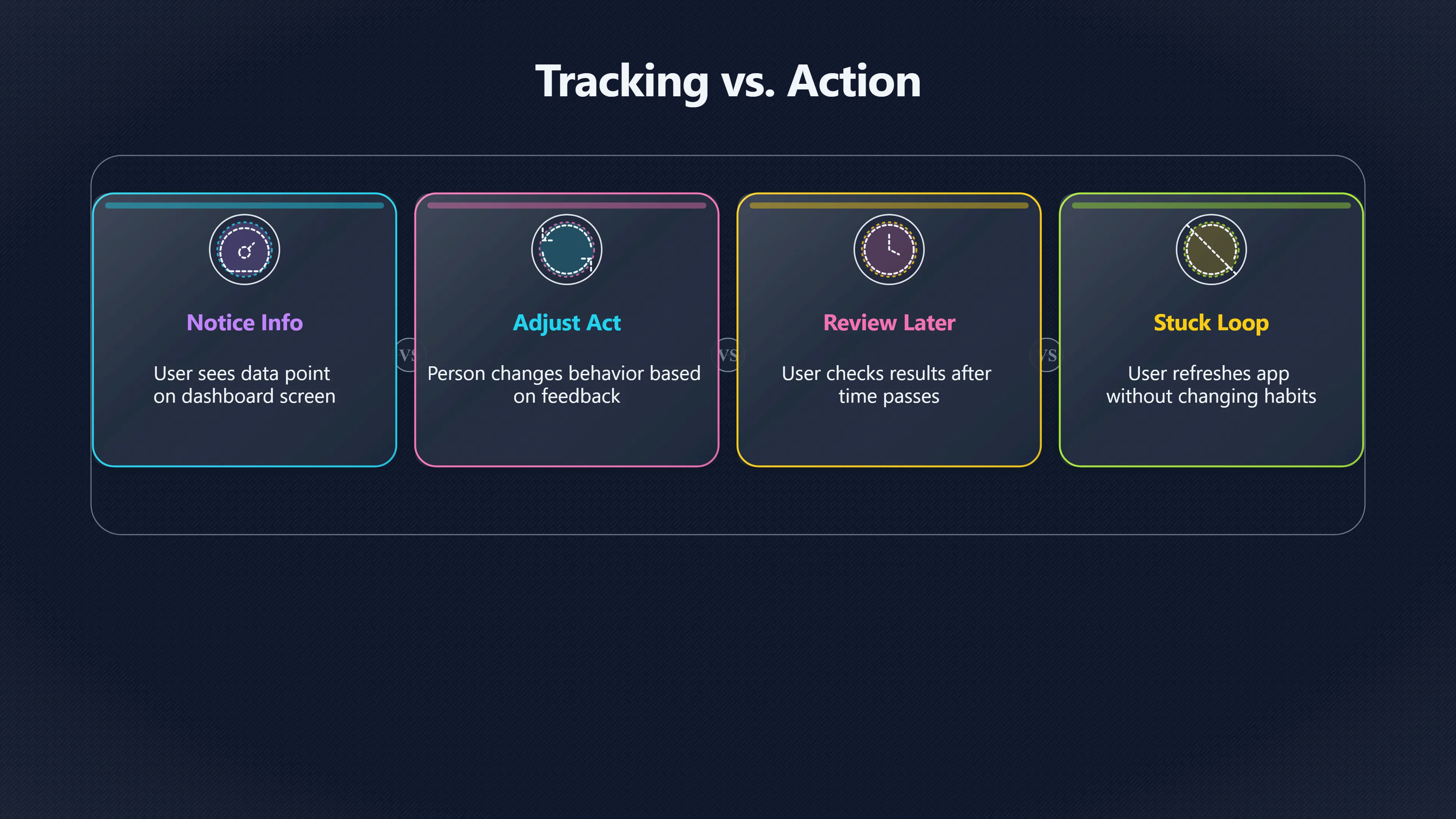
A useful tracking system creates a loop:
- Notice information.
- Adjust behaviour.
- Review results later.
An obsessive system often gets stuck at step one. The person repeatedly checks a dashboard, app, scale, sleep score or productivity chart without making any meaningful change. The checking itself becomes the activity.
This pattern resembles a broader psychological phenomenon seen in compulsive checking behaviours. Checking produces a brief feeling of certainty or control, but the relief fades quickly, creating pressure to check again. The result is more monitoring but not necessarily more progress.[PMC]pmc.ncbi.nlm.nih.govPMCAdherence to self‐monitoring and behavioral goals isby LE Burke · 2025 · Cited by 11 — Providing proximal feedback (FB) to self‐monitoring (SM) can improve adherence, as well as adherenc…
Common examples include:
- Looking at step counts dozens of times per day despite already knowing the trend.
- Refreshing productivity statistics without starting the next task.
- Repeatedly checking sleep data after waking, even though the night’s sleep cannot be changed.
- Weighing yourself multiple times a day and reacting emotionally to normal fluctuations.
The warning sign is not frequency alone. It is frequency without action. If checking has become disconnected from decision-making, the monitoring system may be consuming attention without creating value.
When the numbers control your mood
Another signal is emotional dependence on the metric.
A useful metric provides information. An obsessive metric provides a verdict. A good score creates relief or pride. A bad score creates shame, guilt or panic. The person’s emotional state starts moving with the graph.
Researchers studying self-tracking have noted that numerical feedback can increase awareness and motivation, but poorly interpreted or highly salient data can also create distress, demotivation and feelings of obligation. Young adults using mental-health tracking tools have reported that increased awareness can become uncomfortable when they are dissatisfied with what they see.[ScienceDirect]sciencedirect.comMental Health Self-Tracking Preferences of Young Adults…by ML Beltzer · 2023 · Cited by 8 — The act of self-tracking brin…
A practical test is to ask: “If this number is worse than expected today, can I still follow my plan?” If the answer is no, the score may have become psychologically oversized.
When untracked actions stop feeling real
Healthy tracking supports reality. Obsessive tracking can gradually replace it.
One warning sign is the feeling that an activity only “counts” if it is recorded. A walk without a fitness tracker seems wasted. Reading without logging pages feels less valuable. A workout that fails to sync with an app feels as though it never happened.
This shift changes the purpose of behaviour. Instead of exercising to become fitter, the person exercises to produce data. Instead of writing to improve skill, they write to maintain a streak.
Researchers studying self-quantification have observed that self-tracking can shape identity and influence how people interpret their experiences. In some cases, attention shifts from the activity itself towards the measurement process.[Springer]link.springer.comSelf-Tracking for Health and the Quantified Self: Reby T Sharon · 2017 · Cited by 643 — Self-tracking devices point to a future in which individuals will be more involved in the man…
Several warning signs tend to appear together:
- Untracked behaviour feels meaningless.
- You avoid useful activities because they are difficult to measure.
- Missing data feels more upsetting than missing the behaviour itself.
- Device failures cause disproportionate frustration.
- You remember the score more clearly than the experience.
When this happens, the metric has stopped being a tool and started becoming a substitute for judgement.

Rigid rules are replacing adaptation
Behaviour change requires flexibility. Life changes, environments change and goals change.
Obsessive tracking often produces the opposite effect. The system becomes increasingly rigid. Rules that began as helpful reminders become requirements. Exceptions become failures.
Examples include:
- Refusing to take a recovery day because it would break a streak.
- Exercising while ill to maintain a target.
- Logging food with perfect accuracy but ignoring hunger, energy or social circumstances.
- Continuing a metric long after it has stopped providing useful information.
Research on the “dark side” of health and fitness technologies has highlighted concerns about pressure, surveillance, unhealthy perfectionism and problematic engagement with metrics. Reviews of self-quantification similarly find that while tracking can improve wellbeing, it can also create negative effects under certain conditions.[Sage Journals]journals.sagepub.comSage JournalsThe “Dark Side” of General Health and Fitness-Related…Dec 25, 2023 — The authors identify current research gaps concernin…
The practical warning sign is simple: the system becomes harder to bend than the behaviour it is supposed to support.
When the cost of tracking exceeds the value
Every tracking system carries a cost.
It takes time to enter data, review information, maintain devices and interpret results. Normally those costs are justified because the information improves decisions. Problems arise when the administrative burden keeps growing while the behavioural benefit remains unchanged.
People engaged in long-term self-tracking frequently report burden, emotional effort and fatigue associated with maintaining records and interpreting data. Some studies describe self-tracking as requiring substantial ongoing cognitive and emotional work.[PMC]pmc.ncbi.nlm.nih.govPMCAdherence to self‐monitoring and behavioral goals isby LE Burke · 2025 · Cited by 11 — Providing proximal feedback (FB) to self‐monitoring (SM) can improve adherence, as well as adherenc…
Warning signs include:
- Spending more time recording behaviour than performing it.
- Creating increasingly detailed categories that never influence decisions.
- Tracking variables “just in case” rather than for a specific purpose.
- Feeling anxious when data collection is interrupted.
- Continuing to collect information that no longer answers an important question.
A useful metric earns its place. If removing a metric would not change any decisions, it may no longer deserve attention.

How to reset the system around signals, not scores
When tracking becomes obsessive, the solution is usually not to abandon self-monitoring entirely. It is to simplify it.
The goal is to return to signals rather than scores. A signal helps you notice something important. A score invites constant evaluation.
Several practical resets are effective:
Reduce review frequency. If a metric changes slowly, review it weekly or monthly rather than hourly or daily.
Track fewer variables. Keep only measurements that lead to clear decisions.
Focus on behaviour metrics. Record actions under your control more often than outcomes outside your direct control.
Create action triggers. Every metric should answer the question: “What will I do differently if this number changes?”
Schedule checking. Deliberately separate data review from everyday activity to prevent constant monitoring.
Research on self-monitoring repeatedly shows that tracking works best as part of a broader self-regulation process involving feedback, goals and behavioural adjustment. Monitoring alone is not the objective. The objective is better action.[PMC]pmc.ncbi.nlm.nih.govPMCAdherence to self‐monitoring and behavioral goals isby LE Burke · 2025 · Cited by 11 — Providing proximal feedback (FB) to self‐monitoring (SM) can improve adherence, as well as adherenc…[JMIR]mhealth.jmir.orgJMIR mHealth and uHealthCross-Cutting mHealth Behavior Change Techniques to…by CK Eaton · 2024 · Cited by 18 — This study aimed to ide… mHealth and uHealth
A simple rule captures the difference between healthy and obsessive tracking:
If removing the tracker would stop the behaviour, the tracker has become too important. If removing the tracker would merely reduce your awareness, the tracker is probably still serving its intended role.
Amazon book picks
Further Reading
Books and field guides related to When tracking starts running your life. Use these as the next step if you want deeper reading beyond the article.
Atomic Habits
Rating: 3.5/5 from 7 Google Books ratings
Encourages tracking that serves behaviour rather than replacing it.
eBay marketplace picks
Marketplace Samples
Example marketplace items related to this page. Use the search link to explore similar finds on eBay.




Endnotes
1.
Source: pmc.ncbi.nlm.nih.gov
Link:https://pmc.ncbi.nlm.nih.gov/articles/PMC8493454/
Source snippet
How Self-tracking and the Quantified Self Promote Health and...by S Feng · 2021 · Cited by 247 — We have undertaken a systematic lite...
2.
Source: pmc.ncbi.nlm.nih.gov
Link:https://pmc.ncbi.nlm.nih.gov/articles/PMC12126976/
Source snippet
The Etiology, Assessment and Treatment of Compulsive...by S Guo · 2025 · Cited by 3 — In this theory, behaviors such as compulsive ch...
3.
Source: sciencedirect.com
Link:https://www.sciencedirect.com/org/science/article/pii/S2561326X23004699
Source snippet
Mental Health Self-Tracking Preferences of Young Adults...by ML Beltzer · 2023 · Cited by 8 — The act of self-tracking brin...
4.
Source: link.springer.com
Title: Self-Tracking for Health and the Quantified Self: Re
Link:https://link.springer.com/article/10.1007/s13347
Source snippet
by T Sharon · 2017 · Cited by 643 — Self-tracking devices point to a future in which individuals will be more involved in the man...
5.
Source: pmc.ncbi.nlm.nih.gov
Link:https://pmc.ncbi.nlm.nih.gov/articles/PMC12489404/
Source snippet
Patient-Reported Experiences With Long-Term Lifestyle Self...by M Goevaerts · 2025 · Cited by 2 — We explored facilitators of and bar...
6.
Source: pmc.ncbi.nlm.nih.gov
Title: PMCAdherence to self‐monitoring and behavioral goals is
Link:https://pmc.ncbi.nlm.nih.gov/articles/PMC11897847/
Source snippet
by LE Burke · 2025 · Cited by 11 — Providing proximal feedback (FB) to self‐monitoring (SM) can improve adherence, as well as adherenc...
7.
Source: mhealth.jmir.org
Link:https://mhealth.jmir.org/2024/1/e49024/
Source snippet
JMIR mHealth and uHealthCross-Cutting mHealth Behavior Change [Techniques]({{ 'techniques/' | relative_url }}) to...by CK Eaton · 2024 · Cited by 18 — This study aimed to ide...
8.
Source: link.springer.com
Link:https://link.springer.com/article/10.1186/s13063-023-07549-w
Source snippet
In this aspect, a participant may be asked “Did you remember...Read more...
9.
Source: sciencedirect.com
Link:https://www.sciencedirect.com/science/article/pii/S0167811625000321
Source snippet
The diverse impact of self-quantification: How narcissism...by ELE De Vries · 2025 · Cited by 1 — Self-quantification increases self-ind...
10.
Source: mental.jmir.org
Link:https://mental.jmir.org/2023/1/e45572
Source snippet
and Mobile Technologies for the Evaluation and...by AC Frank · 2023 · Cited by 21 — These efforts highlight the potential therapeutic be...
11.
Source: tandfonline.com
Title: Taylor & Francis Online The ethics of self-tracking
Link:https://www.tandfonline.com/doi/full/10.1080/10508422.2022.2082969
Source snippet
A comprehensive review...by M Wieczorek · 2023 · Cited by 52 — This paper presents a literature review on the ethics of self-tracking te...
12.
Source: journals.sagepub.com
Link:https://journals.sagepub.com/doi/10.1177/07439156231224731
Source snippet
Sage JournalsThe “Dark Side” of General Health and Fitness-Related...Dec 25, 2023 — The authors identify current research gaps concernin...
Additional References
13.
Source: researchgate.net
Link:https://www.researchgate.net/publication/353303143_How_Self-tracking_and_the_Quantified_Self_Promote_Health_and_Well-being_A_Systematic_Literature_Review
Source snippet
(PDF) How Self-tracking and the Quantified Self Promote...21 Sept 2021 — We have undertaken a systematic literature review on self-track...
14.
Source: researchgate.net
Link:https://www.researchgate.net/figure/The-weaknesses-of-the-self-monitoring-strategy_tbl3_327407975
Source snippet
The weaknesses of the self-monitoring strategyIn this study, we investigated why the self-monitoring strategy might work in some contexts...
15.
Source: cavuhb.nhs.wales
Link:https://cavuhb.nhs.wales/files/mental-health/obsessive-compulsive-disorder-a-self-help-guide/
Source snippet
Compulsive Disorder: A Self Help GuideCompulsions are repetitive behaviours or mental acts that a person feels driven to perform in respo...
16.
Source: onlinelibrary.wiley.com
Link:https://onlinelibrary.wiley.com/doi/full/10.1002/mar.22141
Source snippet
Wiley Online LibrarySelf‐quantification and consumer well‐being: A meta‐...by A Jain · 2025 · Cited by 27 — Our findings reveal that sel...
17.
Source: youtube.com
Link:https://www.youtube.com/watch?v=B-kaXpCSfQA
Source snippet
ACT for OCD: Behavior Tracking and the Self-Monitoring FormYou can simply track the way that they are responding to their thoughts and th...
18.
Source: blogs.ucl.ac.uk
Title: the costs and benefits of [self monitoring]({{ ‘tracking/’ | relative_url }}) for health and wellness
Link:https://blogs.ucl.ac.uk/cbc-digi-hub-blog/2018/09/21/the-costs-and-benefits-of-self-monitoring-for-health-and-wellness/
Source snippet
costs and benefits of self-monitoring for health and wellness21 Sept 2018 — One of the major strengths of self-monitoring is that it incr...
19.
Source: arno.uvt.nl
Link:https://arno.uvt.nl/show.cgi?fid=162593
Source snippet
ng for longer than two years, users might see self-tracking as part of their identity (...Read more...
20.
Source: repository.cam.ac.uk
Title: cam.ac.uk Checking responses of goal- and sign-trackers are
Link:https://www.repository.cam.ac.uk/items/57080a0f-3f41-4211-882e-a2fdddbb00e2
Source snippet
Apolloby GH Vousden · 2020 · Cited by 15 — Checking responses of goal- and sign-trackers are differentially affected by threat in a roden...
21.
Source: dovepress.com
Link:https://www.dovepress.com/deficiency-in-self-control-unraveling-psychological-and-behavioral-ris-peer-reviewed-fulltext-article-PRBM
Source snippet
It provides new insights into the psychological and behavioral factors that...Read more...
22.
Source: eprints.soton.ac.uk
Title: soton.ac.uka dimensional approach to OCD
Link:https://eprints.soton.ac.uk/492715/1/using-event-related-potentials-to-characterize-inhibitory-control-and-self-monitoring-across-impulsive-and-compulsive-phenotypes-a-dimensional-approach-to-ocd.pdf
Source snippet
ePrints Sotonby S Dhir · 2023 · Cited by 8 — The current findings provide evidence for differential, ERP-indexed inhibitory control and s...
Topic Tree