Within Weekly Review
Why the Habit Never Even Started
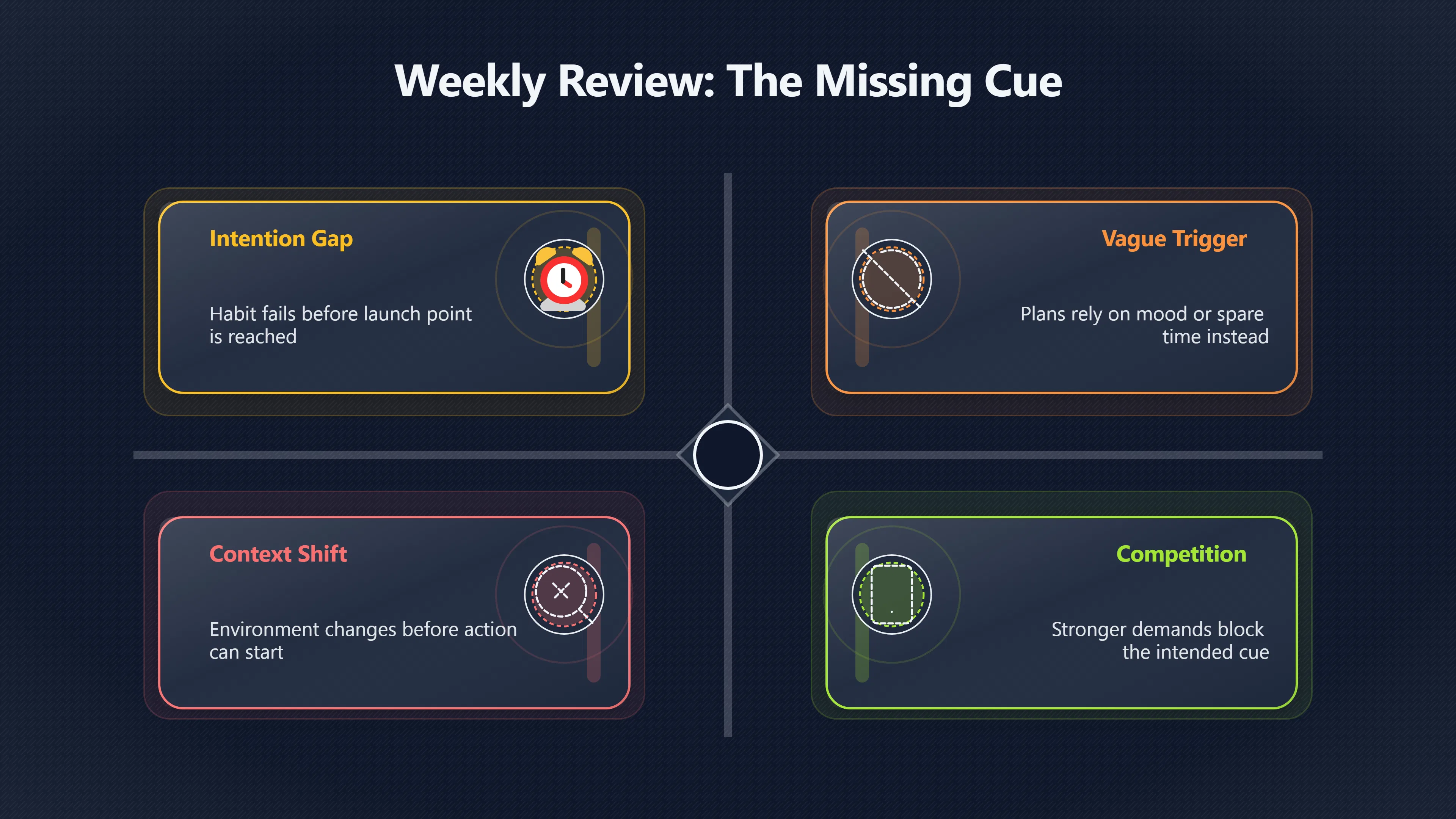
Many habits fail before effort begins because the planned prompt is missing, weak, badly timed, or buried in the wrong context.
On this page
- How to spot a missing or weak cue
- Why timing and location change the prompt
- Simple cue repairs for the next seven days
Page outline Jump by section
Introduction
A weekly review often reveals a surprising pattern: the habit did not fail halfway through. It never started. The person intended to read, exercise, write, stretch or practise a skill, but the behaviour never reached the launch point.
 When this happens repeatedly, the problem is often not motivation. It is the cue. A cue is the reminder, situation or trigger that makes a behaviour easy to begin at the right moment. Habit research consistently shows that behaviours become linked to recurring contexts and prompts. When the cue is absent, unclear, badly timed or buried among competing demands, the intended action may never even enter awareness.[PubMed]pubmed.ncbi.nlm.nih.govPsychology of Habitby W Wood · 2016 · Cited by 1896 — As the proverbial creatures of habit, people tend to repeat the same behavior…
During a weekly review, one of the most useful questions is therefore: “What was supposed to remind me to start?” If the answer is vague, missing or unreliable, the review has likely identified the real bottleneck.
How to Spot a Missing or Weak Cue
Many habit plans contain a goal but no reliable starting signal.
A person may decide to meditate every day, exercise more often or study regularly. Yet when asked exactly what should trigger the behaviour, the answer is often something like “when I have time”, “after work”, or “sometime in the evening”. These are intentions, not cues.
Research on habits describes them as responses that become associated with specific recurring contexts. Repetition in a stable situation helps create a cue–behaviour link. Without a recognisable cue, there is nothing consistent for the brain to connect with the desired action.[PubMed Central]pmc.ncbi.nlm.nih.govPubMed CentralMaking health habitual: the psychology of 'habit-formation' and…by B Gardner · 2012 · Cited by 894 — Habit-formation adv…[Taylor & Francis Online]tandfonline.comTaylor & Francis OnlineDeveloping habit-based health behaviour change…by B Gardner · 2023 · Cited by 157 — Habits are inherently idios…
During a weekly review, look for these warning signs:
- The habit was forgotten rather than consciously skipped.
- The start time varied wildly from day to day.
- The behaviour happened only when remembered by chance.
- The cue depended on mood, spare time or motivation.
- The intended trigger occurred, but attention was elsewhere.
- Different days produced different prompts.
A useful test is simple: if someone asked what exact event should occur immediately before the habit, could you answer in one sentence?
“After I brush my teeth, I will do five press-ups” is clear.
“Exercise more in the morning” is not.
Implementation-intention research repeatedly finds that specifying the exact situation in which an action will occur helps bridge the gap between intention and behaviour. The more clearly the cue is defined, the easier it becomes to recognise the moment for action.[Cancer Control]cancercontrol.cancer.govCancer ControlImplementation Intentionsby PM Gollwitzer — Implementation intentions are formed for the purpose of enhancing the translati…[PubMed Central]pmc.ncbi.nlm.nih.govPubMed CentralMaking health habitual: the psychology of 'habit-formation' and…by B Gardner · 2012 · Cited by 894 — Habit-formation adv…
Why Timing and Location Change the Prompt
A cue is not only about what happens before the behaviour. It is also about where and when that cue appears.
Many habits fail because the cue arrives during a moment of conflict.
Consider someone who plans to stretch after arriving home from work. On paper, the cue seems obvious. In reality, arriving home may coincide with hunger, children needing attention, messages waiting to be answered and the desire to sit down. The cue exists, but it competes with stronger behaviours.
Research on habit formation repeatedly highlights the importance of stable contexts. Consistent environments make cue recognition easier and increase automaticity over time. When context changes constantly, the cue becomes weaker and less reliable. PubMed Central[Frontiers]frontiersin.orgContext Stability in Habit Building Increases Automaticity…by M Stojanovic · 2022 · Cited by 25 — In this paper, we investigate the ef…
During a review, examine the actual conditions surrounding the cue:
- Was the person busy when the cue appeared?
- Did multiple demands compete for attention?
- Did the cue occur in a location associated with other habits?
- Was the cue encountered while tired, rushed or distracted?
- Did the environment make the next action obvious?
A common example is a reading habit linked to bedtime. If the book remains in another room while the phone is on the bedside table, the environment is already promoting a competing behaviour. The cue for reading is weak while the cue for scrolling is strong.
The lesson is that cue quality depends on context. The same reminder can succeed in one location and fail in another.
When the Cue Exists but Still Does Not Work
Not every failed habit suffers from a missing cue. Sometimes the cue is present but ineffective.
The Fogg Behaviour Model argues that behaviour occurs when motivation, ability and a prompt converge at the same moment. If the prompt appears but the behaviour still does not happen, the action may be too difficult or inconvenient to perform in that context.[Fogg Behavior Model]productmindset.substack.comBehavior Model - Product Mindset's Newsletter - SubstackFogg's behavior model is made up of three elements that predict behavior: motivat…
For example:
- An alarm reminds someone to run, but running requires finding clothes, locating shoes and travelling to a park.
- A calendar reminder prompts language practice, but the learning materials are buried in several applications.
- A reminder to journal appears just as the person begins an important meeting.
In these cases, the prompt is technically present. The real problem is that the prompt is attached to a difficult starting sequence.
This is why weekly reviews should distinguish between:
No cue: “I completely forgot.”
Weak cue: “I noticed it, but not at the right moment.”
Blocked cue: “I saw the reminder, but starting felt inconvenient.”
These are different problems and require different fixes.

Simple Cue Repairs for the Next Seven Days
The purpose of a weekly review is not to analyse endlessly. It is to improve the next week.
When a habit never starts, test one cue repair at a time.
Attach the Habit to an Existing Routine
One of the strongest options is to use a stable daily action as the cue.
Examples include:
- After making morning coffee.
- After brushing teeth.
- After shutting down a work computer.
- After sitting at a desk.
Research on habit formation shows that linking behaviour to recurring contexts supports the development of cue–response associations. Studies have found that connecting behaviours to routines or specific times can effectively support habit formation when repeated consistently.[PubMed]pubmed.ncbi.nlm.nih.govPsychology of Habitby W Wood · 2016 · Cited by 1896 — As the proverbial creatures of habit, people tend to repeat the same behavior…
Make the Cue Visible
Many intended cues remain invisible.
Move the trigger into the environment:
- Put the book on the pillow.
- Place walking shoes by the door.
- Leave the guitar on a stand instead of in a case.
- Put a water bottle on the desk.
The goal is not decoration. It is increasing the likelihood that the cue is noticed at the right moment.
Convert Vague Plans into If–Then Plans
Instead of:
“I will stretch more.”
Use:
“If I finish lunch, then I will stretch for two minutes.”
Implementation-intention research consistently shows benefits from specifying the exact cue and response pair.[Cancer Control]cancercontrol.cancer.govCancer ControlImplementation Intentionsby PM Gollwitzer — Implementation intentions are formed for the purpose of enhancing the translati…[Cambridge University Press & Assessment]cambridge.orgEvidence shows that established habits are cue-contingent, share…Read more…
Move the Cue Earlier
Sometimes the cue arrives after decision fatigue has already accumulated.
A review might reveal that a workout reminder appears at 8 p.m., when energy is low and distractions are high. Testing the same behaviour at lunchtime or immediately after waking may produce very different results.
The habit itself may not need changing. Only the timing of the cue does.
Reduce Cue Competition
If several prompts arrive simultaneously, weaker behaviours lose.
For the next week, ask:
- What other behaviours occur immediately after this cue?
- Which behaviour usually wins?[effectiveselfhelp.org]effectiveselfhelp.orgBehaviour change: a guide to forming habits you'll keepImplementation intentions involve 'specifying the behaviour one will perform in th…
- Can the cue be moved to a quieter moment?
A cue works best when it points to a single obvious action.
The Weekly Review Question That Matters Most
When a habit repeatedly records zero completions, avoid asking whether commitment was strong enough.
Instead ask:
“What exactly was supposed to make me start?”
That question shifts attention from willpower to mechanism.
Habits grow through repeated cue–behaviour pairings in stable contexts. When the cue is absent, hidden, mistimed or overwhelmed by competing demands, the behaviour may never leave the planning stage. When the cue becomes clear, visible and reliably connected to a specific moment, the odds of starting improve dramatically. [Cambridge University Press & Assessment+3Cambridge University Press & Assessment+3Taylor & Francis Online]
For many stalled habits, the weekly review does not reveal a motivation problem at all. It reveals that the starting signal was never strong enough to be noticed.
Amazon book picks
Further Reading
Books and field guides related to Why the Habit Never Even Started. Use these as the next step if you want deeper reading beyond the article.
Atomic Habits
Rating: 3.5/5 from 7 Google Books ratings
Strong coverage of cues, triggers and environment design.
eBay marketplace picks
Marketplace Samples
Example marketplace items related to this page. Use the search link to explore similar finds on eBay.

Endnotes
1.
Source: cambridge.org
Link:https://www.cambridge.org/core/books/handbook-of-behavior-change/changing-behavior-using-habit-theory/5F222BC3AF6ADD9A8307BBB726D43F5C
Source snippet
Evidence shows that established habits are cue-contingent, share...Read more...
2.
Source: cambridge.org
Title: University Press & Assessment Habit Interventions (Chapter 41)
Link:https://www.cambridge.org/core/books/handbook-of-behavior-change/habit-interventions/420CFDC7EE75036CC4D08EE137108E45
Source snippet
Cambridge University Press & AssessmentHabit Interventions (Chapter 41) - The Handbook of...The central BCT involved in habit formation...
3.
Source: cancercontrol.cancer.gov
Link:https://cancercontrol.cancer.gov/brp/research/constructs/implementation-intentions
Source snippet
Cancer ControlImplementation Intentionsby PM Gollwitzer — Implementation intentions are formed for the purpose of enhancing the translati...
4.
Source: cambridge.org
Title: University Press & Assessment39
Link:https://www.cambridge.org/core/books/handbook-of-behavior-change/planning-and-implementation-intention-interventions/E1C8DA422E9BA21E7D2C4881A04898D0
Source snippet
Cambridge University Press & Assessment39 - Planning and Implementation Intention InterventionsThus, implementation intentions may be use...
5.
Source: youtube.com
Title: Tiny Habits | My Thoughts as a Behavior Change Expert
Link:http://www.youtube.com/watch?v=vfVQWCh1rTk
Source snippet
Fogg behavior model in 2 minutes and 30 seconds...
6.
Source: youtube.com
Title: Fogg behavior model in 2 minutes and 30 seconds
Link:http://www.youtube.com/watch?v=jsbF9z6adAo
Source snippet
How Does Habit Formation Impact UX Design Choices...
7.
Source: pubmed.ncbi.nlm.nih.gov
Link:https://pubmed.ncbi.nlm.nih.gov/26361052/
Source snippet
Psychology of Habitby W Wood · 2016 · Cited by 1896 — As the proverbial creatures of habit, people tend to repeat the same behavior...
8.
Source: pmc.ncbi.nlm.nih.gov
Link:https://pmc.ncbi.nlm.nih.gov/articles/PMC3505409/
Source snippet
PubMed CentralMaking health habitual: the psychology of 'habit-formation' and...by B Gardner · 2012 · Cited by 894 — Habit-formation adv...
9.
Source: tandfonline.com
Link:https://www.tandfonline.com/doi/full/10.1080/08870446.2021.2003362
Source snippet
Taylor & Francis OnlineDeveloping habit-based health [behaviour change]({{ 'behaviour-change/' | relative_url }})...by B Gardner · 2023 · Cited by 157 — Habits are inherently idios...
10.
Source: pmc.ncbi.nlm.nih.gov
Link:https://pmc.ncbi.nlm.nih.gov/articles/PMC10585941/
Source snippet
PubMed CentralInstant habits versus flexible tenacity: Do implementation...by T van Timmeren · 2022 · Cited by 11 — Implementation inten...
11.
Source: pubmed.ncbi.nlm.nih.gov
Link:https://pubmed.ncbi.nlm.nih.gov/29191800/
Source snippet
Intention and Reminder Effects on...30 Nov 2017 — The aim of this experiment was to manipulate the effects of implementation intentions...
12.
Source: pmc.ncbi.nlm.nih.gov
Link:https://pmc.ncbi.nlm.nih.gov/articles/PMC9226889/
Source snippet
PubMed CentralContext Stability in Habit Building Increases Automaticity and...by M Stojanovic · 2022 · Cited by 21 — In this paper, we...
13.
Source: frontiersin.org
Link:https://www.frontiersin.org/journals/psychology/articles/10.3389/fpsyg.2022.883795/full
Source snippet
Context Stability in Habit Building Increases Automaticity...by M Stojanovic · 2022 · Cited by 25 — In this paper, we investigate the ef...
14.
Source: pmc.ncbi.nlm.nih.gov
Link:https://pmc.ncbi.nlm.nih.gov/articles/PMC12318445/
Source snippet
the Science of Habit Formation to Evidence-Based...by AG Harvey · 2021 · Cited by 55 — Also, implementation intentions to perform altern...
15.
Source: behaviormodel.org
Link:https://www.behaviormodel.org/
Source snippet
Fogg Behavior ModelFogg Behavior Model - BJ FoggThe Fogg Behavior Model shows that three elements must converge at the same moment for a...
16.
Source: pubmed.ncbi.nlm.nih.gov
Link:https://pubmed.ncbi.nlm.nih.gov/33405284/
Source snippet
Habit formation following routine-based versus time...by J Keller · 2021 · Cited by 153 — Conclusions: Linking one's nutrition beh...
17.
Source: pubmed.ncbi.nlm.nih.gov
Link:https://pubmed.ncbi.nlm.nih.gov/39387277/
Source snippet
micro-randomized trial to understand and promote habit...by D Baretta · 2025 · Cited by 13 — We examined the habit formation trajectory...
18.
Source: northbeam.io
Title: fogg behavior model motivation ability and prompts
Link:https://www.northbeam.io/blog/fogg-behavior-model-motivation-ability-and-prompts
Source snippet
Fogg Behavior Model: Motivation, Ability, and Prompts29 Oct 2025 — The Fogg Behavior Model explains that behavior occurs when Motivation...
19.
Source: vocus.cc
Link:https://vocus.cc/article/63a096c8fd89780001022028
Source snippet
法格行為模型(Fogg Behavior Model)Dec 19, 2022 — 法格行為模型是用來拆解人類行為的一個公式,任何行為都可以拆解成三要素:動機(Motivation)、能力(Ability)、觸發點(Trigger)。 · 可以簡化為公式:行為(...Re...
20.
Source: productmindset.substack.com
Title: fogg behavior model
Link:https://productmindset.substack.com/p/fogg-behavior-model
Source snippet
Behavior Model - Product Mindset's Newsletter - SubstackFogg's behavior model is made up of three elements that predict behavior: motivat...
21.
Source: thedecisionlab.com
Link:https://thedecisionlab.com/reference-guide/psychology/fogg-behavior-model
Source snippet
Fogg Behavior ModelIt involves manipulating motivation, ability, and prompts to encourage desired actions and facilitate positive behavio...
22.
Source: oxford-review.com
Title: Habit Formation
Link:https://oxford-review.com/habit-formation-what-the-neuroscience-is-saying/
Source snippet
What the Neuroscience is SayingStress and fatigue increase habitual behaviour; Context changes can disrupt existing habits; Working memor...
Additional References
23.
Source: researchgate.net
Link:https://www.researchgate.net/publication/49832449_Breaking_Habits_With_Implementation_Intentions_A_Test_of_Underlying_Processes
Source snippet
(PDF) Breaking Habits With Implementation IntentionsImplementation intentions specifying the replacement of a habitual response with an a...
24.
Source: researchgate.net
Link:https://www.researchgate.net/publication/322222649_Habit_Formation_and_Change
Source snippet
(PDF) Habit Formation and ChangeThis review highlights emerging findings, topics, and new directions in research on habitual behavior.Rea...
25.
Source: researchgate.net
Link:https://www.researchgate.net/publication/37367761_Implementation_Intentions_and_Health_Behaviour
Source snippet
(PDF) Implementation Intentions and Health BehaviourIntentions are the culmination of the decision making process; they signal the end of...
26.
Source: researchgate.net
Link:https://www.researchgate.net/publication/365790456_Habit_formation_in_context_Context-specific_and_context-free_measures_for_tracking_fruit_consumption_habit_formation_and_behaviour
Source snippet
(PDF) Habit formation in context: Context‐specific and...28 Nov 2022 — This study compared context‐specific and context‐free measures of...
27.
Source: medium.com
Link:https://medium.com/design-bootcamp/designing-with-intention-applying-bj-foggs-behavioral-model-in-ai-experiences-05ea6dca3069
Source snippet
Applying BJ Fogg's Behavioral Model in AI ExperiencesHow Understanding Motivation, Ability, and Prompts Can Enhance User Engagement and D...
28.
Source: behaviordesign.stanford.edu
Link:https://behaviordesign.stanford.edu/resources/fogg-behavior-model
Source snippet
Behavior Design LabFogg Behavior ModelThe Fogg Behavior Model shows that three elements must converge at the same moment for a behavior t...
29.
Source: effectiveselfhelp.org
Link:https://effectiveselfhelp.org/research/a-guide-to-forming-habits-you-ll-keep/
Source snippet
Behaviour change: a guide to forming habits you'll keepImplementation intentions involve 'specifying the behaviour one will perform in th...
30.
Source: behaviormodel.org
Link:https://www.behaviormodel.org/prompts
Source snippet
Prompts in the Fogg Behavior ModelLearn how prompts activate behavior in the Fogg Behavior Model and how to design effective triggers tha...
31.
Source: digitalcharitylab.org
Link:https://digitalcharitylab.org/2019/06/behavior-motivation-ability-prompt-the-fogg-behaviorial-model-and-digital-charities/
Source snippet
Behavior = Motivation + Ability + Prompt: The Fogg...27 Jun 2019 — Three elements must converge at the same moment for a behavior to occ...
32.
Source: osf.io
Link:https://osf.io/download/dc39t/
Source snippet
support for the notion that implementation intentions enhance automaticity by transferring control of behaviour...Read...
Topic Tree