Within Bedroom Phone
Why the Bedside Phone Keeps Winning
Keeping the phone within reach turns tired moments into repeated decisions that make sleep harder to protect.
On this page
- Why proximity beats good intentions
- Clock checking, notifications and one more swipe loops
- How distance changes the bedtime decision
Page outline Jump by section
Introduction
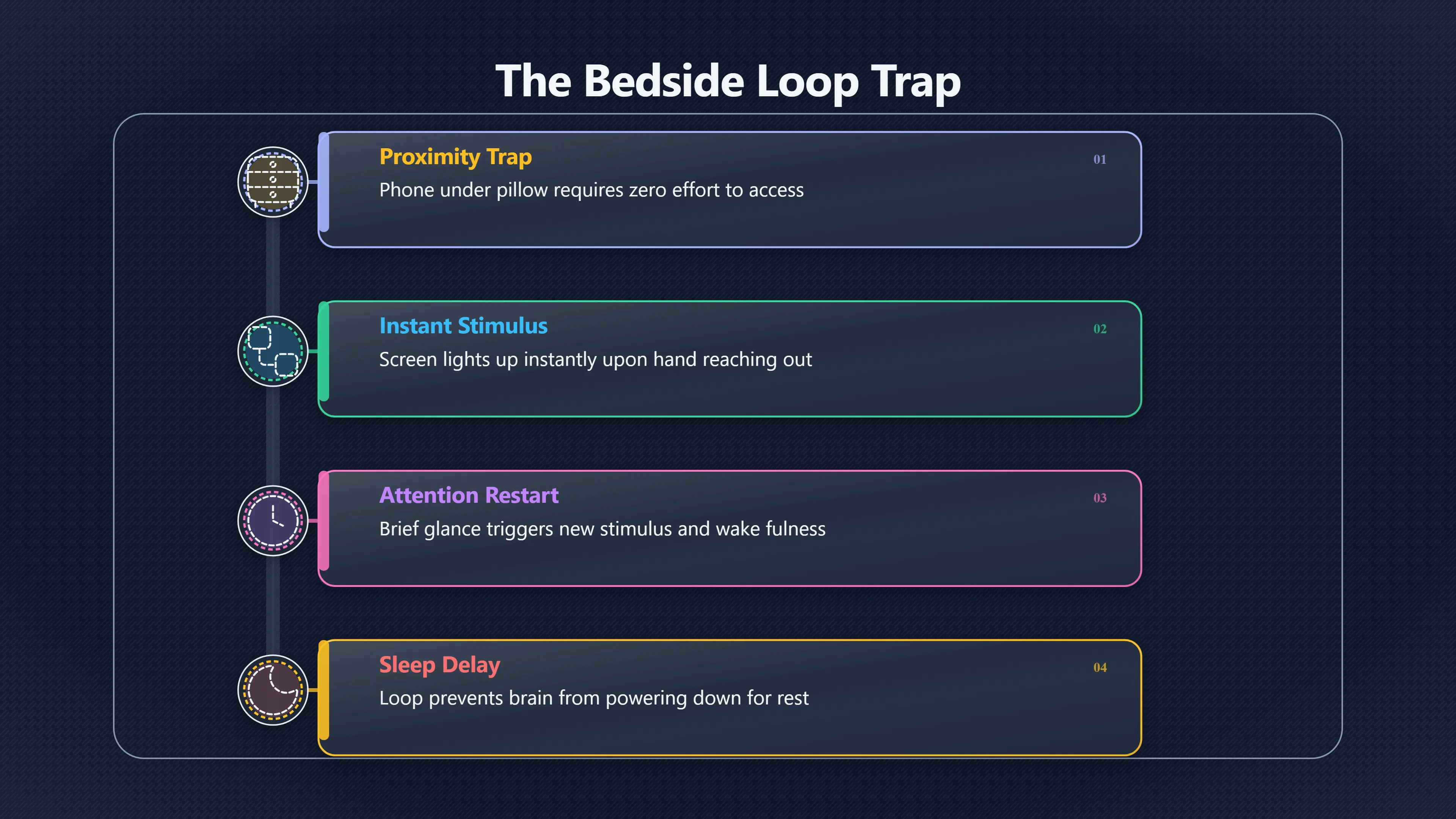
The bedside phone wins because it turns a single bedtime decision into a series of tiny decisions. Few people plan to spend an extra forty minutes awake checking messages, scrolling feeds or repeatedly looking at the time. What happens instead is a loop: a brief glance creates a new stimulus, the stimulus triggers another check, and attention is restarted when the brain should be powering down. The problem is not simply screen light. It is that a phone within arm’s reach makes checking effortless at exactly the moment self-control is weakest. Research on bedtime phone restriction, sleep behaviour and insomnia treatment points to the same mechanism: reducing access reduces opportunities for re-engagement, which helps protect sleep.[PubMed]pubmed.ncbi.nlm.nih.govEffect of restricting bedtime mobile phone use on sleep…10 Feb 2020 — Conclusions: Restricting mobile phone use close to bedtim…[PubMed Central]pmc.ncbi.nlm.nih.govPubMed Central“Leave your smartphone out of bed”: quantitative analysis of…by S Kheirinejad · 2022 · Cited by 80 — Our findings indica…

Why Proximity Beats Good Intentions
Most people think of sleep disruption as a matter of choice. In practice, proximity changes the choice itself.
A phone on the bedside table creates an unusually low-friction source of stimulation. There is no need to get up, switch rooms or interrupt comfort. A hand reaches out, the screen lights up, and a tired brain is presented with notifications, messages, news, entertainment or work. Each interaction feels trivial, yet each one creates a fresh opportunity to stay awake.
Behavioural researchers often distinguish between intentions and environments. Intentions are fragile when people are tired. Environments are persistent. A phone across the room is a different environment from a phone under the pillow. The first requires effort to access. The second requires effort not to access.
This distinction helps explain why studies restricting bedtime phone use have found improvements in sleep latency, sleep duration and pre-sleep arousal. The benefit is not merely the absence of screen exposure. It is the removal of repeated opportunities to restart attention.[PubMed]pubmed.ncbi.nlm.nih.govEffect of restricting bedtime mobile phone use on sleep…10 Feb 2020 — Conclusions: Restricting mobile phone use close to bedtim…
A useful way to think about the bedside phone is as a standing invitation. Even when unused, it remains available for immediate engagement. That availability matters because nighttime wakefulness often occurs in short, vulnerable moments. A person wakes briefly, feels restless or uncertain about the time, and the phone supplies an instant action.
Clock-Checking, Notifications and One-More-Swipe Loops
The Clock-Checking Trap
One of the most common nighttime behaviours is checking the time.
At first glance this seems harmless. Yet sleep specialists have long warned against visible clocks during the night because time-checking can create performance anxiety around sleep. Seeing that it is 2:43 a.m. or 4:17 a.m. encourages mental calculations: “I only have three hours left.” Those calculations increase alertness precisely when relaxation is needed. Stimulus-control approaches to insomnia often recommend keeping clocks out of sight for this reason.[East London NHS Foundation Trust]elft.nhs.ukEast London NHS Foundation TrustStimulus Control – or “keeping bed for sleep”Stimulus control gradually makes bed a stronger cue for slee…
A smartphone intensifies the problem because checking the time rarely ends with checking the time. The clock is attached to every other digital temptation. What begins as reassurance often becomes interaction.
Notifications as Attention Hooks
Notifications create another loop.
Even when alerts are infrequent, they establish a state of anticipation. A nearby phone can encourage subconscious monitoring: a person knows the device may produce information at any moment. Sleep experts increasingly describe this as a form of anticipatory arousal, where availability alone can make disengagement harder.[Tom's Guide]tomsguide.comTom's Guide'You're not winding down, your stimulating your nervous systemand the $10 gadget that stopped itMarch 2, 2026 — This article explores how the common habit of keeping a phone on the nightstand can dis…
The interruption itself may last only seconds. The cognitive consequences often last longer. A message from work, a social update or unexpected news can trigger emotional processing that continues after the screen is dark again.
The One-More-Swipe Effect
The most familiar loop is the promise of one final check.
Many digital platforms are designed around novelty. The next refresh may reveal something interesting, useful or rewarding. Because the reward is unpredictable, disengagement becomes difficult. The user intends to stop after one interaction, but each interaction creates another reason to continue.
Research on nighttime phone use consistently finds associations between pre-sleep device engagement, longer sleep latency and poorer sleep quality. Studies of young adults have also found that emotionally stimulating phone content before bed is linked to greater sleep difficulty and longer time to fall asleep.[PubMed Central]pmc.ncbi.nlm.nih.govPubMed Central“Leave your smartphone out of bed”: quantitative analysis of…by S Kheirinejad · 2022 · Cited by 80 — Our findings indica… ScienceDirect The important point is that the loop does not require hours of scrolling. Several short re-engagements can be enough to delay sleep and fragm[sciencedirect.com]sciencedirect.comAssociations between device use before bed, mood…by NA Walsh · 2020 · Cited by 21 — This study explored the association between device… ent the transition from wakefulness to rest.
Why the Loop Feels Smaller Than It Is
The checking loop survives partly because each individual action appears insignificant.
Checking a notification takes seconds. Looking at the weather takes seconds. Confirming the alarm takes seconds. The brain evaluates each decision in isolation. Sleep, however, experiences them collectively.
A person may spend only two minutes on each interaction yet repeat the cycle many times. The cumulative effect can be substantial. Smartphone-use data show that many people continue interacting with phones late into the night and often leave only a narrow phone-free window before morning use resumes.[murmuras]murmuras.comsleepstudy 2020Good Morning Smartphone! How Germany sleeps in 202025 Nov 2020 — 65% of phone alarm clocks ring before 7 am. In every fifth night…
This helps explain why people frequently underestimate bedtime phone use. They remember individual checks rather than the entire sequence.
Another reason the loop feels harmless is that it masquerades as preparation. Checking the alarm, checking tomorrow’s schedule or checking whether a message arrived can feel responsible. Yet once the device is unlocked, the boundary between practical use and attention capture becomes extremely thin.
How Distance Changes the Bedtime Decision
Distance works because it changes the economics of attention.
When a phone remains beside the bed, every awakening contains an easy path toward stimulation. When the phone is charging in another room, the same awakening contains friction. The user must decide whether the information is important enough to justify leaving bed.
Most nighttime impulses fail that test.
This is one reason stimulus-control approaches emphasise preserving a strong association between bed and sleep. The more often the bed becomes a place for scrolling, checking, worrying or planning, the weaker that sleep association becomes. The more often bed is used only for sleeping, the stronger the cue grows. East London NHS Foundation Trust[Sleep Health Solutions]sleephealthsolutionsohio.comstimulus control therapy insomniaStimulus Control Therapy for Sleep | BlogJul 16, 2020 — Stimulus control therapy is a behavioral technique designed to help individuals w…
Distance does not require perfect discipline. It reduces the number of decisions that need discipline in the first place.
A bedside phone asks repeatedly, “Would you like to check?” A phone outside the bedroom asks a different question: “Is this important enough to get up for?” Most late-night impulses disappear when faced with that second question.
The Real Advantage of Moving the Phone
The strongest argument for moving a phone out of the bedroom is not that phones are uniquely harmful. It is that proximity creates a self-reinforcing loop.
The loop starts with availability, continues through checking, and ends with renewed wakefulness that creates further checking. Notifications, clock-watching, curiosity and boredom all feed the cycle. Research showing benefits from reducing bedtime phone use, alongside sleep-medicine principles that minimise wakeful activities in bed, suggests that breaking the loop is often more effective than trying to win it repeatedly through willpower alone.[PubMed Central]pmc.ncbi.nlm.nih.govPubMed Central“Leave your smartphone out of bed”: quantitative analysis of…by S Kheirinejad · 2022 · Cited by 80 — Our findings indica…[PubMed]pubmed.ncbi.nlm.nih.govEffect of restricting bedtime mobile phone use on sleep…10 Feb 2020 — Conclusions: Restricting mobile phone use close to bedtim…[PubMed Central]pmc.ncbi.nlm.nih.govPubMed Central“Leave your smartphone out of bed”: quantitative analysis of…by S Kheirinejad · 2022 · Cited by 80 — Our findings indica…
For people trying to improve sleep, the key mechanism is simple: when the phone is within reach, checking is the default. When the phone is elsewhere, sleep becomes the default again.
Amazon book picks
Further Reading
Books and field guides related to Why the Bedside Phone Keeps Winning. Use these as the next step if you want deeper reading beyond the article.
How to Break Up with Your Phone
Explains checking loops, attention capture and phone habits.
eBay marketplace picks
Marketplace Samples
Topic-anchored marketplace searches for visual, collectible, or second-hand items related to this page.



Endnotes
1.
Source: elft.nhs.uk
Link:https://www.elft.nhs.uk/sites/default/files/2023-12/good_bed_bad_bed.pdf
Source snippet
East London NHS Foundation TrustStimulus Control – or “keeping bed for sleep”Stimulus control gradually makes bed a stronger cue for slee...
2.
Source: sciencedirect.com
Link:https://www.sciencedirect.com/science/article/abs/pii/S2352721820301169
Source snippet
Associations between device use before bed, mood...by NA Walsh · 2020 · Cited by 21 — This study explored the association between device...
3.
Source: murmuras.com
Title: sleepstudy 2020
Link:https://murmuras.com/en/blog/sleepstudy-2020
Source snippet
Good Morning Smartphone! How Germany sleeps in 202025 Nov 2020 — 65% of phone alarm clocks ring before 7 am. In every fifth night...
4.
Source: pubmed.ncbi.nlm.nih.gov
Link:https://pubmed.ncbi.nlm.nih.gov/32040492/
Source snippet
Effect of restricting bedtime mobile phone use on sleep...10 Feb 2020 — Conclusions: Restricting mobile phone use close to bedtim...
5.
Source: pmc.ncbi.nlm.nih.gov
Link:https://pmc.ncbi.nlm.nih.gov/articles/PMC9643910/
Source snippet
PubMed Central“Leave your smartphone out of bed”: quantitative analysis of...by S Kheirinejad · 2022 · Cited by 80 — Our findings indica...
6.
Source: pmc.ncbi.nlm.nih.gov
Link:https://pmc.ncbi.nlm.nih.gov/articles/PMC3554970/
Source snippet
PubMed CentralBehavioral interventions for insomnia: Theory and practiceby MP Sharma · 2012 · Cited by 129 — Behavioral interventions for...
7.
Source: pmc.ncbi.nlm.nih.gov
Title: Pub Med Central Effect of restricting bedtime mobile phone use on sleep
Link:https://pmc.ncbi.nlm.nih.gov/articles/PMC7010281/
Source snippet
by J He · 2020 · Cited by 150 — This study aimed to assess the effects of restricting mobile phone use before bedtime on sleep, pre-sl...
8.
Source: tomsguide.com
Title: Tom’s Guide’You’re not winding down, your stimulating your nervous system’
Link:https://www.tomsguide.com/wellness/sleep/keep-waking-up-at-3-a-m-experts-explain-the-usd10-switch-that-can-help-you-kick-bad-sleep-habits-and-why-it-worked-for-me
Source snippet
and the $10 gadget that stopped itMarch 2, 2026 — This article explores how the common habit of keeping a phone on the nightstand can dis...
Published: March 2, 2026
9.
Source: pmc.ncbi.nlm.nih.gov
Link:https://pmc.ncbi.nlm.nih.gov/articles/PMC10899973/
Source snippet
PubMed CentralNighttime cell phone use and sleep quality in young adultsby SC Joshi · 2021 · Cited by 20 — Young adults who used cell pho...
10.
Source: sleephealthsolutionsohio.com
Title: stimulus control therapy insomnia
Link:https://www.sleephealthsolutionsohio.com/blog/stimulus-control-therapy-insomnia/
Source snippet
Stimulus Control Therapy for Sleep | BlogJul 16, 2020 — Stimulus control therapy is a behavioral technique designed to help individuals w...
Additional References
11.
Source: researchgate.net
Link:https://www.researchgate.net/publication/339152901_Effect_of_restricting_bedtime_mobile_phone_use_on_sleep_arousal_mood_and_working_memory_A_randomized_pilot_trial
Source snippet
Effect of restricting bedtime mobile phone use on sleep...10 Feb 2020 — Conclusions Restricting mobile phone use close to bedtime reduce...
12.
Source: researchgate.net
Link:https://www.researchgate.net/publication/365257943_Leave_your_smartphone_out_of_bed_quantitative_analysis_of_smartphone_use_effect_on_sleep_quality
Source snippet
(PDF) “Leave your smartphone out of bed”: quantitative...9 Nov 2022 — Our findings indicate that smartphone use in bed has significant a...
13.
Source: timeofcare.com
Link:https://www.timeofcare.com/sleep-hygiene-and-stimulus-control-counseling/
Source snippet
Sleep Hygiene and Stimulus Control CounselingStimulus control counseling refers to actions that you can take that will decrease the stimu...
14.
Source: vogue.com
Link:https://www.vogue.com/article/best-alarm-clocks-health-benefits-unplugging-smartphone-better-sleep-rest
Source snippet
Shelby Harris, a behavioral sleep-medicine specialist, highlights that blue light exposure from screens can impair sleep and overall heal...
15.
Source: bigtreesmd.com
Link:https://www.bigtreesmd.com/post/ditch-the-phone-win-the-sleep-tackling-chronic-insomnia-with-smarter-bedtime-habits
Source snippet
Tackling Chronic Insomnia with Smarter Bedtime HabitsDec 24, 2024 — Avoiding phone use for 30 minutes before bedtime has been shown to si...
16.
Source: inkblotdoc.com
Link:https://inkblotdoc.com/sleep-hygiene-that-actually-works-an-evidence-based-guide-now-with-4-7-8-breathing/
Source snippet
Sleep Hygiene Guide to Improve Your Sleep QualitySep 4, 2025 — The most effective sleep hygiene steps · 1) Anchor your body clock with st...
17.
Source: frontiersin.org
Link:https://www.frontiersin.org/journals/psychiatry/articles/10.3389/fpsyt.2026.1735186/full
Source snippet
Background: Nighttime screen use is associated with poor sleep and may represent an emerging public health concern.Read more...
18.
Source: researchgate.net
Title: 355999681 Nighttime cell phone use and sleep quality in young adults
Link:https://www.researchgate.net/publication/355999681_Nighttime_cell_phone_use_and_sleep_quality_in_young_adults
Source snippet
(PDF) Nighttime cell phone use and sleep quality in young...Nov 8, 2021 — Young adults who used cell phones before sleep and access emot...
19.
Source: researchgate.net
Title: 285334439 Bedtime Mobile Phone Use and Sleep in Adults
Link:https://www.researchgate.net/publication/285334439_Bedtime_Mobile_Phone_Use_and_Sleep_in_Adults
Source snippet
(PDF) Bedtime Mobile Phone Use and Sleep in Adults11 Dec 2015 — This cross-sectional study set out to examine the association between bed...
20.
Source: facebook.com
Link:https://www.facebook.com/omanobserver/posts/at-first-glance-keeping-a-phone-by-your-bedside-may-seem-harmless-but-research-s/1192377122934177/
Source snippet
t realizing that smartphones emit low levels of electromagnetic...Read more...
Topic Tree