Within Automaticity
Can Your Room Remind You Better?
Objects placed in the right location can turn the environment into a reminder without relying on motivation alone.
On this page
- How objects become prompts for action
- Where to place cues so they appear at the decision point
- When visible cues become clutter or get ignored
Page outline Jump by section
Introduction
Making a desired action visible at the moment it can actually be performed is one of the simplest ways to make self-improvement more reliable. Rather than relying on memory, motivation, or repeated self-reminders, visible cues allow the environment itself to prompt behaviour. Habit research consistently finds that behaviours become linked to recurring context cues, and that those cues can trigger action automatically over time. The practical implication is straightforward: if an object associated with a behaviour appears exactly where a decision is made, it can function as a reminder at the moment it matters.[PubMed]pubmed.ncbi.nlm.nih.govPsychology of Habitby W Wood · 2016 · Cited by 1884 — This review characterizes habits in terms of their cognitive, motivational, a…[USC Dornsife]dornsife.usc.eduDornsife Psychology of Habitb) insensitivity to short-term changes in goals (a.k.a., not…Read more…
 Within stable contexts and habit formation, the goal is not merely to own useful objects. It is to place them where they become difficult to overlook when the opportunity for action arrives.
Can Your Room Remind You Better?
A common mistake in self-improvement is separating reminders from the situations in which action happens. People place a book on a shelf and intend to read more, store exercise equipment in a cupboard and intend to exercise more, or keep vitamins in a drawer and intend to take them daily. The desired behaviour remains mentally important, but physically invisible.
Research on habit formation suggests that context cues matter because repeated behaviours become associated with recurring environments, locations, and objects. Over time, these cues can activate behaviour with less conscious effort.[PubMed]pubmed.ncbi.nlm.nih.govPsychology of Habitby W Wood · 2016 · Cited by 1884 — This review characterizes habits in terms of their cognitive, motivational, a…[Sage Journals]journals.sagepub.comSage JournalsHabit in Personality and Social Psychology24 Jul 2017 — The context cues that activate habits range from simple elements of…
The practical lesson is that a cue works best when it appears naturally within an existing routine. Instead of asking, “How can I remember?”, a more useful question is, “What will I see immediately before I need to act?”
How Objects Become Prompts for Action
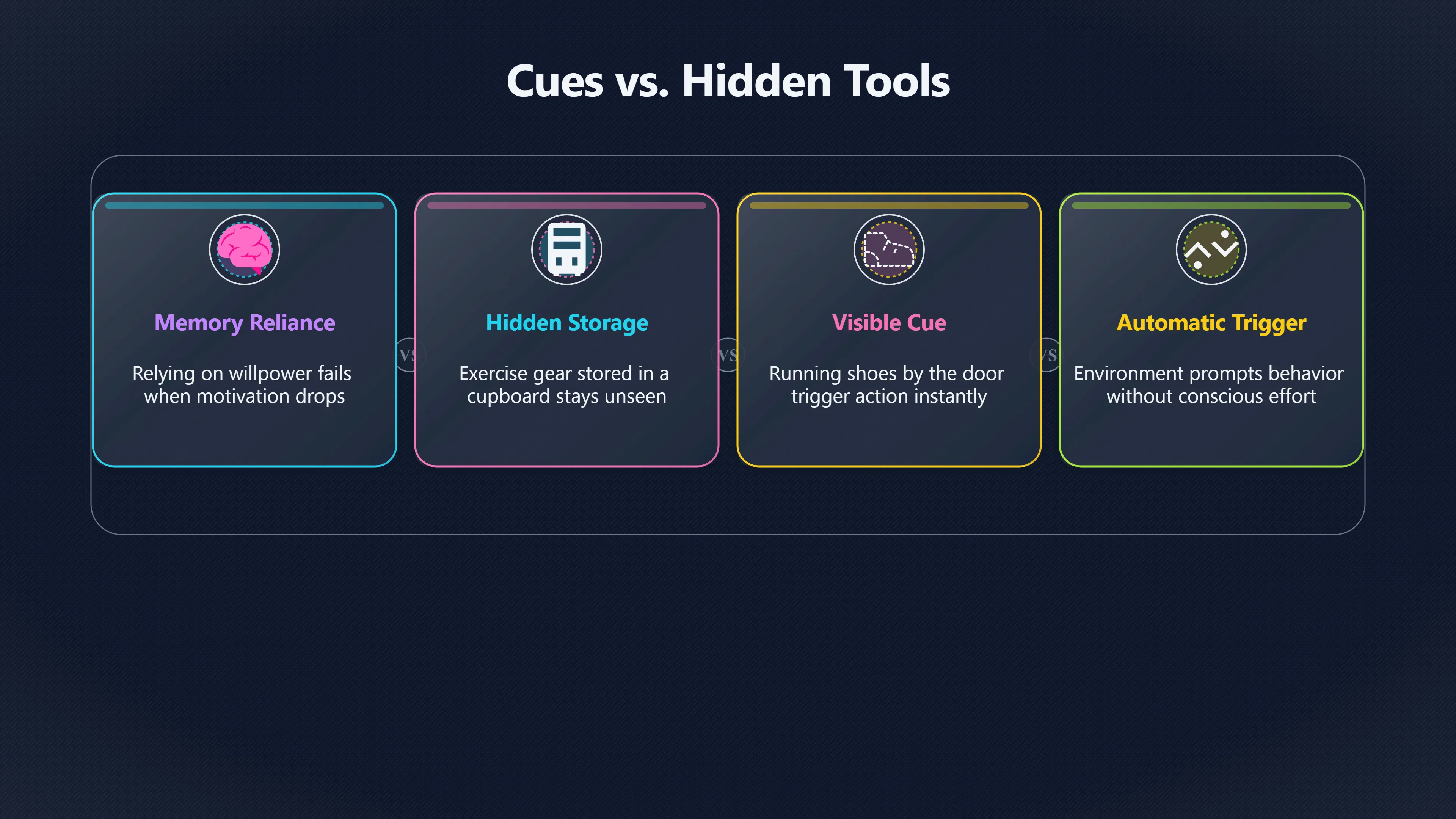
Visible objects can serve as behavioural prompts because they capture attention at the point where a choice is being made.
Studies examining how people choose cues for new habits found that many participants deliberately kept related objects in visible locations or close at hand. The aim was to reduce effort and increase the chance of noticing the cue when needed. Researchers also observed that vague plans and reliance on weak or inconsistent reminders were associated with poorer performance.[PMC]pmc.ncbi.nlm.nih.govMarch 30, 2020 — Cue selection was primarily influenced by a desire to minimise effort, eg keeping related objects at hand or in a visibl…
Several mechanisms make visible cues effective:
- Attention capture: An object in plain sight is harder to forget than an intention stored in memory.
- Context association: Repeatedly seeing the same cue before the same behaviour strengthens the cue-behaviour link.[USC Dornsife]dornsife.usc.eduDornsife Psychology of Habitb) insensitivity to short-term changes in goals (a.k.a., not…Read more…
- Reduced friction: The cue often doubles as preparation. Running shoes by the door are both a reminder and a ready-to-use tool.
- Decision simplification: The environment suggests the next step, reducing the need for active deliberation.
A water bottle left on a desk, a notebook opened on a work surface, or a guitar resting on a stand all communicate a possible action without requiring a conscious planning session. The cue appears exactly when the behaviour can occur.[GlobalRPH]globalrph.comPlacing a water bottle on the desk prompts hydration, leaving running shoes by…Read more…
Where to Place Cues So They Appear at the Decision Point
The most effective location for a cue is rarely the most visible place in the room. It is the place where the relevant decision happens.
Match the cue to the action location
A cue for reading belongs where reading normally occurs. A cue for stretching belongs where sitting or working occurs. A cue for healthy eating belongs where food decisions are made.
Habit researchers emphasise that behaviours are strongly tied to performance contexts such as locations and recurring situations. A cue that appears in the wrong place may be seen frequently but still fail to influence behaviour.[ScienceDirect]sciencedirect.comScienceDirect How do habits guide behavior?Perceived and actual…by DT Neal · 2012 · Cited by 668 — Two studies reveal that strong habits are influenced by context cues associate…
For example:
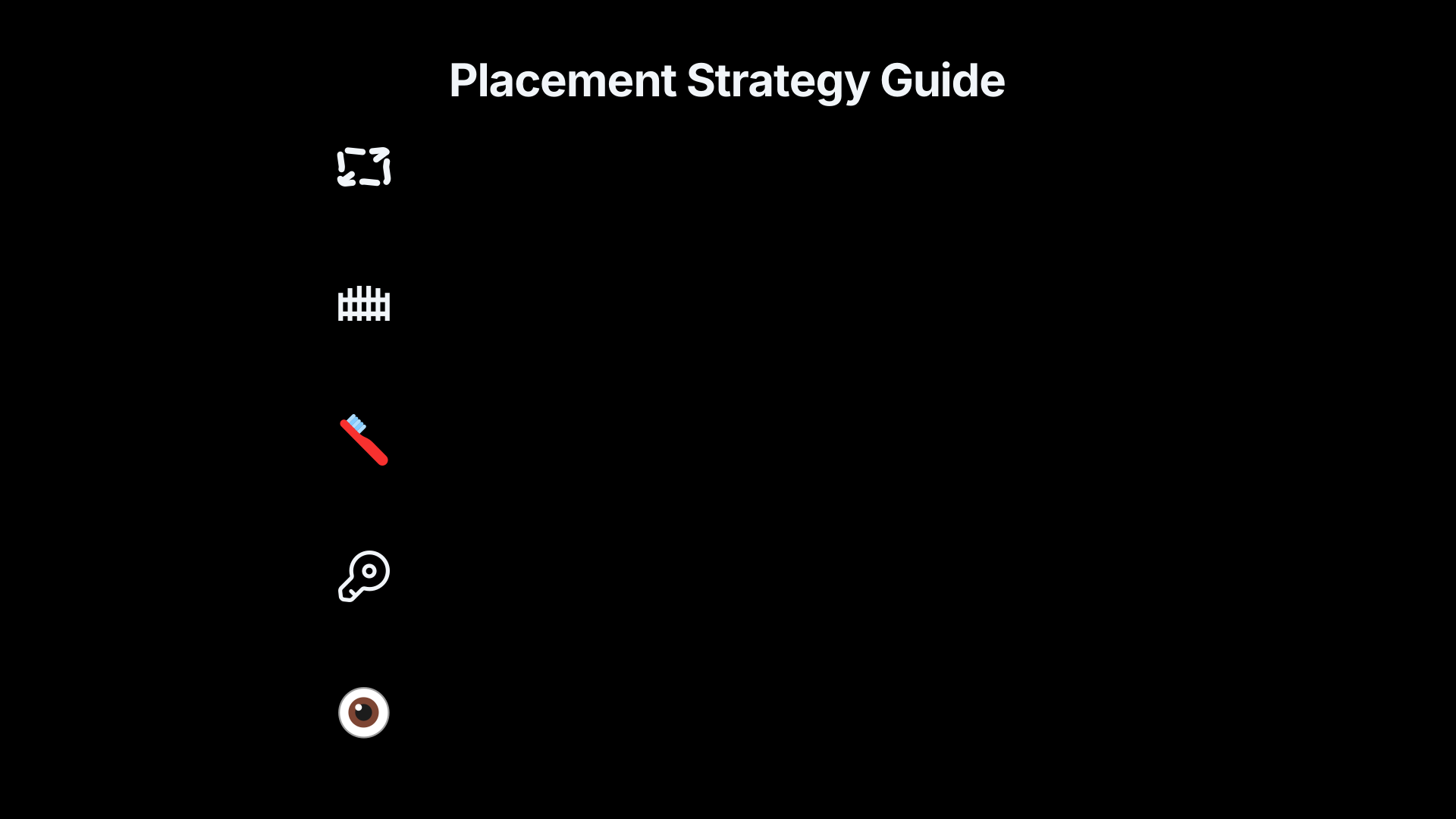
- Place a book on a pillow if the goal is bedtime reading.
- Put floss beside a toothbrush rather than in a cabinet.
- Leave walking shoes near the door used for daily departures.
- Keep a reusable shopping bag by the keys rather than in a distant cupboard.
Each example places the cue directly before the decision point.
Use existing behavioural pathways
The strongest locations are often those that people already pass through automatically.
A coffee mug beside medication, a journal beside a laptop, or a refillable water bottle beside a work monitor all exploit existing routines. Instead of creating a new reminder system, they attach a cue to a stable part of everyday life. This aligns with evidence showing that habit formation is strengthened when behaviours repeatedly occur in recurring contexts.[PubMed]pubmed.ncbi.nlm.nih.govPsychology of Habitby W Wood · 2016 · Cited by 1884 — This review characterizes habits in terms of their cognitive, motivational, a…
Prioritise visibility over storage
Many useful behaviours fail because the tools required are hidden.
From a habit perspective, the most organised arrangement is not always the most effective. A neatly stored object that is never seen cannot act as a cue. During habit formation, temporary visibility often matters more than perfect tidiness.
Why Timing Matters More Than Quantity
People often assume that more reminders create stronger habits. In practice, the timing of exposure is usually more important than the number of exposures.
Seeing a running shoe twenty times while relaxing on the sofa may have little effect. Seeing it once while reaching for the front door may immediately trigger action.
This principle resembles the logic behind implementation intentions, sometimes called “if-then” plans. These plans work by linking behaviour to a specific cue or situation rather than a vague intention. The cue becomes meaningful because it appears at a precisely defined moment.[Cancer Control]cancercontrol.cancer.govCancer ControlImplementation Intentionsby PM Gollwitzer — Implementation intentions are formed for the purpose of enhancing the translati…[Durmonski.com]durmonski.comimplementation intentionsDefining Implementation Intentions and How to Make Them…23 Dec 2022 — Implementation intentions are self-regulating strategies – creat…
A visible cue is therefore most powerful when it answers a concrete question:
- When I sit at my desk, what will I see?
- When I enter the kitchen, what will be in front of me?
- When I leave the house, what object will appear before I reach the door?
The closer the cue is to the moment of choice, the less motivation is required.
When Visible Cues Become Clutter or Get Ignored
Not every visible object remains effective.
One risk is cue overload. When many objects compete for attention, none stands out. A desk covered with books, notes, devices, planners, supplements, and exercise equipment may contain many reminders but few effective cues.
Another problem is habituation. Objects that never change and never lead to action can become part of the background. People continue to see them without consciously noticing them.
Several warning signs suggest a cue has stopped working:
- You walk past it without awareness.
- It no longer feels connected to a specific action.
- Multiple unrelated cues occupy the same space.
- The object remains visible for weeks without triggering behaviour.
When this happens, the solution is usually not adding more reminders. It is redesigning the environment so that the cue regains relevance at the decision point.
A useful rule is that every visible cue should have one primary job. A book should remind reading, not reading, journalling, language study, meditation, and planning simultaneously.
Designing an Environment That Reminds You Automatically
The most effective environment cues are often small and unremarkable. They do not depend on inspiration or discipline. They simply appear at the right place and time.
Habit research repeatedly shows that behaviour is shaped by recurring contexts and environmental triggers. People are more likely to act when the environment makes the desired behaviour noticeable, convenient, and easy to begin.[Behavioral Scientist]behavioralscientist.orggood habits bad habits a conversation with wendy woodWe form habits based on what's easy and rewarding, what's easy for us to do repeatedly and…Read more…[PubMed]pubmed.ncbi.nlm.nih.govPsychology of Habitby W Wood · 2016 · Cited by 1884 — This review characterizes habits in terms of their cognitive, motivational, a…[USC Dornsife]dornsife.usc.eduDornsife Psychology of Habitb) insensitivity to short-term changes in goals (a.k.a., not…Read more…
For self-improvement, this means treating the environment as part of the habit itself. A visible cue is not merely a reminder. It is part of the behavioural system. When the cue reliably appears at the decision point, the room begins to share the work that motivation once had to do alone.
Amazon book picks
Further Reading
Books and field guides related to Can Your Room Remind You Better?. Use these as the next step if you want deeper reading beyond the article.
Atomic Habits
Rating: 3.5/5 from 7 Google Books ratings
Covers environment design, visible cues, and making good habits obvious.
The Power of Habit
Introduces cue-routine-reward concepts that connect directly to visible reminders.
eBay marketplace picks
Marketplace Samples
Example marketplace items related to this page. Use the search link to explore similar finds on eBay.

Endnotes
1.
Source: dornsife.usc.edu
Title: Dornsife Psychology of Habit
Link:https://dornsife.usc.edu/wendy-wood/wp-content/uploads/sites/183/2023/10/wood.runger.2016.pdf
Source snippet
(b) insensitivity to short-term changes in goals (a.k.a., not...Read more...
2.
Source: sciencedirect.com
Title: ScienceDirect How do habits guide behavior?
Link:https://www.sciencedirect.com/science/article/abs/pii/S002210311100254X
Source snippet
Perceived and actual...by DT Neal · 2012 · Cited by 668 — Two studies reveal that strong habits are influenced by context cues associate...
3.
Source: pmc.ncbi.nlm.nih.gov
Link:https://pmc.ncbi.nlm.nih.gov/articles/PMC7106637/
Source snippet
March 30, 2020 — Cue selection was primarily influenced by a desire to minimise effort, eg keeping related objects at hand or in a visibl...
Published: March 30, 2020
4.
Source: globalrph.com
Link:https://globalrph.com/2026/04/the-science-of-habit-formation-how-to-rewire-your-brain-for-change/
Source snippet
Placing a water bottle on the desk prompts hydration, leaving running shoes by...Read more...
5.
Source: sciencedirect.com
Link:https://www.sciencedirect.com/science/article/abs/pii/S2352154617301602
Source snippet
Habit formation and changeby L Carden · 2018 · Cited by 341 — This review highlights emerging findings and new directions in research on...
6.
Source: cancercontrol.cancer.gov
Link:https://cancercontrol.cancer.gov/brp/research/constructs/implementation-intentions
Source snippet
Cancer ControlImplementation Intentionsby PM Gollwitzer — Implementation intentions are formed for the purpose of enhancing the translati...
7.
Source: durmonski.com
Title: implementation intentions
Link:https://durmonski.com/psychology/implementation-intentions/
Source snippet
Defining Implementation Intentions and How to Make Them...23 Dec 2022 — Implementation intentions are self-regulating strategies – creat...
8.
Source: dornsife.usc.edu
Title: It isn’t always obvious how to handle change.Read more
Link:https://dornsife.usc.edu/wendy-wood/good-habits-bad-habits/
Source snippet
Habits, Bad Habits - Wendy Wood - USC DornsifeHabit science offers a blueprint for how to handle changes in our lives in order to be happ...
9.
Source: dornsife.usc.edu
Link:https://dornsife.usc.edu/wendy-wood/wp-content/uploads/sites/183/2023/10/Wood.Quinn_.Kashy_.2002_Habits_in_everyday_life.pdf
Source snippet
in Everyday Life: Thought, Emotion, and Actionby W Wood · 2002 · Cited by 1669 — Because of the importance of context stability to automa...
10.
Source: pubmed.ncbi.nlm.nih.gov
Link:https://pubmed.ncbi.nlm.nih.gov/26361052/
Source snippet
Psychology of Habitby W Wood · 2016 · Cited by 1884 — This review characterizes habits in terms of their cognitive, motivational, a...
11.
Source: journals.sagepub.com
Link:https://journals.sagepub.com/doi/10.1177/1088868317720362
Source snippet
Sage JournalsHabit in Personality and Social Psychology24 Jul 2017 — The context cues that activate habits range from simple elements of...
12.
Source: behavioralscientist.org
Title: good habits bad habits a conversation with wendy wood
Link:https://behavioralscientist.org/good-habits-bad-habits-a-conversation-with-wendy-wood/
Source snippet
We form habits based on what's easy and rewarding, what's easy for us to do repeatedly and...Read more...
13.
Source: learningcenter.unc.edu
Title: changing habits
Link:https://learningcenter.unc.edu/tips-and-tools/changing-habits/
Source snippet
Habits - The Learning CenterThe first step is cue. It is a trigger that tells your brain to go into automatic mode and prompts the behavi...
14.
Source: readingraphics.com
Link:https://readingraphics.com/book-summary-review-good-habits-bad-habits/
Source snippet
Research tells us that we engage with what is close to us while ignoring what is...Read more...
Additional References
15.
Source: researchgate.net
Link:https://www.researchgate.net/publication/49832449_Breaking_Habits_With_Implementation_Intentions_A_Test_of_Underlying_Processes
Source snippet
(PDF) Breaking Habits With Implementation IntentionsImplementation intentions specifying the replacement of a habitual response with an a...
16.
Source: cultivatewhatmatters.com
Link:https://cultivatewhatmatters.com/blogs/cwm/achieving-your-goals-by-changing-cues-in-your-environment?srsltid=AfmBOorSY-FVQTIlvT7mWtqpU9vTdLnG3kZnBQMPK7hZZH4uL6PQ3jEM
Source snippet
Achieving Your Goals by Changing Environmental CuesWe're going to dive into why environmental cues are so powerful in habit formation and...
17.
Source: advanced-hindsight.com
Link:https://advanced-hindsight.com/behavioral-design-podcast/building-habits-with-wendy-wood/
Source snippet
Building Habits with Wendy WoodIt features a conversation with the world-renowned habit researcher, Wendy Wood. Wendy has devoted the las...
18.
Source: therapyroute.com
Link:https://www.therapyroute.com/article/habit-formation-by-therapyroute
Source snippet
Habit FormationContext: The specific environment or circumstances in which the habit occurs.... Visual Cues: Using reminders and prompts...
19.
Source: medium.com
Link:https://medium.com/%40the.mindset.project/the-real-reason-you-cant-stick-to-habits-your-environment-wins-33b5a2125aa4
Source snippet
The Real Reason You Can't Stick to HabitsResearch on habits consistently points to the power of context cues.... Wendy Wood and colleagu...
20.
Source: merriam-webster.com
Link:https://www.merriam-webster.com/dictionary/visual
21.
Source: wjarr.com
Link:https://wjarr.com/sites/default/files/fulltext_pdf/WJARR-2025-1333.pdf
Source snippet
The environment significantly influences habit formation through cues and contextual factors that trigger specific behaviors...
22.
Source: facebook.com
Title: dr wendy wood explains how habits form why they resist change and how small envi
Link:https://www.facebook.com/AmericanPsychologicalAssociation/posts/dr-wendy-wood-explains-how-habits-form-why-they-resist-change-and-how-small-envi/1280398210788514/
Source snippet
Wendy Wood explains how habits form, why they resist...Habits Are Automatic Behaviors Wood explains that habits are automatic responses...
23.
Source: scribd.com
Link:https://www.scribd.com/document/488808946/Wood-PSPR
Source snippet
One approach is to target the cues that activate habit perfor- Habits of Cross-Group InteractionRead more...
24.
Source: behaviouralleeway.com
Link:https://behaviouralleeway.com/behaviour-frameworks-to-[support
Source snippet
Behaviour Frameworks to Support Habit FormationMay 8, 2024 — Using behavioural science strengthens habit formation...
Published: May 8, 2024
Topic Tree