Within App Blockers
The blocker has to fit the habit
App blockers work better when the target apps, timing, and escape rules match the user's real routine and failure pattern.
On this page
- Autopilot, leakage, avoidance, and sleep
- Why the same app changes by context
- Designing escape routes without collapse
Page outline Jump by section
Introduction
The most effective app blocker is rarely the strictest one. It is the one that matches the specific way a person gets distracted. Research on digital self-control tools consistently finds that people respond best when blockers fit their own definition of distraction, their daily routine, and the situations in which attention breaks down. A tool that works brilliantly for one person can fail completely for another because the underlying behaviour pattern is different.[ScienceDirect]sciencedirect.comThe Goldilocks level of support: Using user reviews, ratings…by U Lyngs · 2022 · Cited by 55 — We analyse ratings & revie…
 This matters because distraction is not a single habit. Some people open social media automatically without thinking. Others use entertainment to avoid difficult work. Some lose sleep because of late-night scrolling, while others get pulled into messaging apps throughout the day. Matching the blocker to the failure pattern creates targeted friction at the right moment instead of imposing a blanket ban that is constantly fought, bypassed, or abandoned.[ScienceDirect]sciencedirect.comThe Goldilocks level of support: Using user reviews, ratings…by U Lyngs · 2022 · Cited by 55 — We analyse ratings & revie…[ResearchGate]researchgate.netThe Goldilocks Level of Support: Using User Reviews…To help users reduce distractions, many digital self-control tools (DS…
The blocker has to fit the habit
A common mistake is treating every distracting app as equally problematic. In practice, the same application can support goals in one context and undermine them in another. Messaging apps may be essential for work during office hours but become a source of procrastination during focused study. Video platforms may be educational in the afternoon and destructive to sleep after midnight.
Research examining hundreds of digital self-control tools found that users want systems that adapt to their personal definitions of distraction rather than assuming every use of a target app is bad. The most highly rated tools tend to combine enforcement with flexibility, allowing people to define when and why a service becomes distracting.[ScienceDirect]sciencedirect.comThe Goldilocks level of support: Using user reviews, ratings…by U Lyngs · 2022 · Cited by 55 — We analyse ratings & revie…
The practical question is therefore not, “Which app should I block?” but “When, why, and under what conditions does this app interfere with what I want to do?”
Autopilot, leakage, avoidance, and sleep
Different distraction patterns call for different forms of friction.
Autopilot checking
Autopilot behaviour happens when a person opens an app without a conscious decision. The trigger may be boredom, waiting in a queue, finishing a task, or simply unlocking the phone.
For this pattern, a short interruption often works better than a total ban. Delays, breathing prompts, confirmation screens, or a requirement to state an intention can break the automatic sequence between trigger and action. A field experiment involving the self-nudging app one sec found that participants reduced actual openings of selected apps by 57% over six weeks. The intervention worked by inserting a brief pause and reflection point before access.[ResearchGate]researchgate.netThe Goldilocks Level of Support: Using User Reviews…To help users reduce distractions, many digital self-control tools (DS…[One Sec]one-sec.appResearchWe have conducted research on the psychological effects of the app demonstrating that one sec reduces app usage by 57% and signif…
The key insight is that the user does not necessarily want permanent restriction. They want protection from automatic behaviour.
Attention leakage
Some people are not derailed by long scrolling sessions. Instead, they lose focus through dozens of brief interruptions.
For this pattern, scheduled blocking during work sessions is often more useful than daily limits. The problem is not total screen time but fragmentation of attention. Blocking notifications, messaging services, and quick-check websites during designated focus periods directly targets the source of leakage. Research reviews of digital self-control interventions suggest that environmental changes such as blocking and access restrictions tend to be more effective than awareness alone because they alter the action pathway itself. Wiley Online Library[Michael Inzlicht]michael-inzlicht.squarespace.comSelf Control in CyberspaceDIGITAL SELF-CONTROL TOOLS. To explore how this model may be useful in mapping digital self-control interventions, we…Read mor…
Avoidance of difficult work
Some distraction is not impulsive but strategic. A person encounters uncertainty, complexity, or anxiety and turns to a familiar app for relief.
In these cases, blocking can help, but only if it is linked to the task being avoided. Otherwise the avoidance simply migrates elsewhere. Someone prevented from opening Instagram may suddenly spend an hour organising files, reading news, or checking email.
For avoidance-driven distraction, blockers often work best when combined with a defined work commitment: for example, locking entertainment apps until thirty minutes of writing, studying, or coding has been completed. The blocker is supporting engagement with the difficult task rather than merely suppressing an alternative activity.
Sleep-related distraction
Late-night phone use follows a different pattern from daytime procrastination. Fatigue weakens self-control, while infinite feeds, messaging, and video recommendations remain highly stimulating.
Here, timing matters more than app category. Night-time schedules, device lockouts, greyscale displays, and automated shutdown periods are often more appropriate than all-day restrictions. The objective is not productivity but protection of sleep and recovery. Studies of smartphone reduction strategies commonly include interventions such as disabling notifications and modifying phone settings because environmental changes can reduce habitual engagement during vulnerable periods.[PubMed Central]pmc.ncbi.nlm.nih.govPub Med Central A Nudge-Based Intervention to Reduce Problematicby JA Olson · 2022 · Cited by 114 — We tested an intervention with ten strategies that nudge users to reduce their smartphone use, for…
Why the same app changes by context
People often assume that if an app is distracting, it should always be blocked. Real behaviour is rarely that simple.
A messaging platform may serve four different functions in the same week:
- Coordinating family responsibilities.
- Handling work communication.
- Maintaining friendships.
- Providing an escape from difficult tasks.
Only one of those uses may be causing problems.
This explains why blanket restrictions frequently fail. They treat all interactions with an app as identical, forcing users into constant exceptions and overrides. Research on digital self-control tools has highlighted the importance of autonomy and context-sensitive control because overly rigid systems can create resistance and encourage circumvention.[ResearchGate]researchgate.netThe Goldilocks Level of Support: Using User Reviews…To help users reduce distractions, many digital self-control tools (DS…
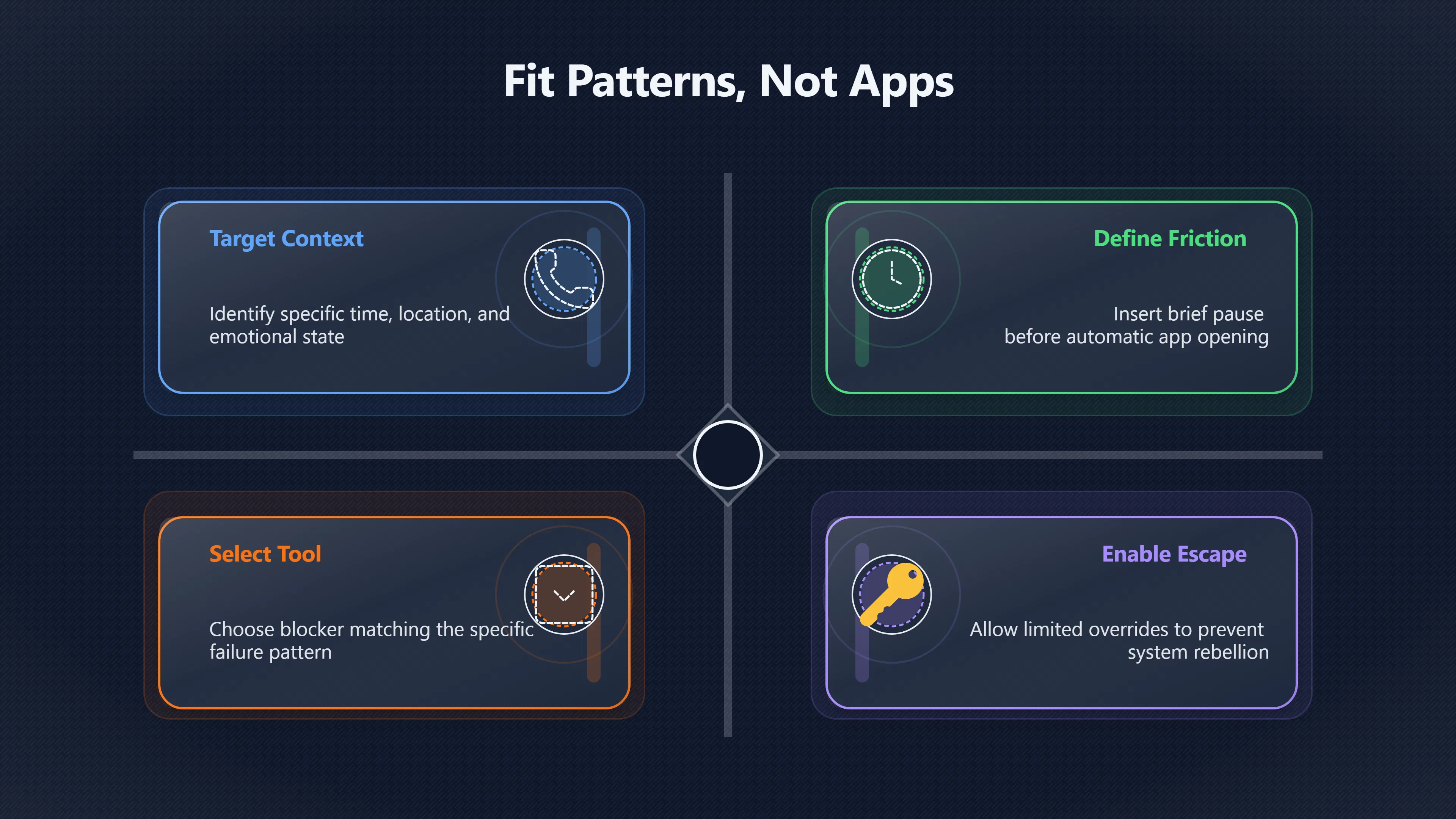
A more effective approach is to identify the specific combination of:
- App.
- Time.[time.com]time.comThis brief pause encourages a breathing exercise, helping users reconsider their social media usage. The app, available on iOS and soon o…
- Location.
- Emotional state.
- Activity being interrupted.
That combination is often the real target.
For example:
- Social media during a lunch break may be harmless.
- Social media during a writing session may be disruptive.
- Social media in bed at 1 a.m. may be damaging.
The app is the same. The behavioural context is not.
Designing escape routes without collapse
The strongest blockers are not necessarily the hardest to bypass. They are the ones that include deliberate escape routes.
Research on digital self-control tools repeatedly identifies a tension between effective restriction and psychological reactance—the tendency to push back against limits that feel overly coercive. When people feel trapped by a blocker, they often search for loopholes, uninstall the tool, switch devices, or create alternative distraction habits.[ResearchGate]researchgate.netThe Goldilocks Level of Support: Using User Reviews…To help users reduce distractions, many digital self-control tools (DS…
Well-designed escape routes preserve commitment while reducing rebellion.
Examples include:
- A waiting period before disabling a block.
- A limited number of emergency overrides per day.
- Access codes that require deliberate effort.
- Temporary exceptions that expire automatically.
- Different rules for workdays and weekends.
The goal is not to make failure impossible. It is to make impulsive failure less convenient than sticking with the original intention.
The evidence points towards a “Goldilocks” balance: enough friction to interrupt the unwanted habit, but not so much restriction that the system feels hostile. Users consistently rate adaptable, autonomy-supporting tools more highly than systems that rely solely on rigid enforcement.[ScienceDirect]sciencedirect.comThe Goldilocks level of support: Using user reviews, ratings…by U Lyngs · 2022 · Cited by 55 — We analyse ratings & revie…[ORA]ora.ox.ac.ukThe Goldilocks level of support: using user reviews, ratings…by U Lyngs · 2022 · Cited by 55 — The Goldilocks level of support: usi…

Fit patterns, not apps
When people say an app blocker “worked” or “didn’t work”, they are often describing a mismatch between the tool and the behaviour it was trying to change.
A delay can be highly effective against automatic checking but weak against deliberate avoidance. A work-session lockout can protect concentration but do little for late-night scrolling. A sleep schedule can improve recovery while leaving daytime distraction untouched.
The practical lesson is simple: identify the recurring failure pattern first, then choose the blocker that introduces friction at exactly that point. The closer the match between the intervention and the behaviour, the less willpower is required to make the change stick.[Michael Inzlicht]michael-inzlicht.squarespace.comSelf Control in CyberspaceDIGITAL SELF-CONTROL TOOLS. To explore how this model may be useful in mapping digital self-control interventions, we…Read mor…[3ResearchGate 3Wiley]researchgate.netThe Goldilocks Level of Support: Using User Reviews…To help users reduce distractions, many digital self-control tools (DS…
Amazon book picks
Further Reading
Books and field guides related to The blocker has to fit the habit. Use these as the next step if you want deeper reading beyond the article.
Indistractable
Directly addresses distraction triggers, internal prompts, and digital self-control.
Digital Minimalism
Helps readers match technology use to values rather than default habits.
Atomic Habits
Rating: 3.5/5 from 7 Google Books ratings
Explains habit loops, cues, friction, and environment design that underpin effective app blocking.
The Power of Habit
Provides foundational understanding of why different distraction patterns require different interventions.
eBay marketplace picks
Marketplace Samples
Example marketplace items related to this page. Use the search link to explore similar finds on eBay.


Endnotes
1.
Source: sciencedirect.com
Link:https://www.sciencedirect.com/science/article/pii/S1071581922000957
Source snippet
The Goldilocks level of support: Using user reviews, ratings...by U Lyngs · 2022 · Cited by 55 — We analyse ratings & revie...
2.
Source: ora.ox.ac.uk
Link:https://ora.ox.ac.uk/objects/uuid%3A1b26d9f8-8a14-467a-97db-634e583036b5
Source snippet
The Goldilocks level of support: using user reviews, ratings...by U Lyngs · 2022 · Cited by 55 — The Goldilocks level of support: usi...
3.
Source: researchgate.net
Link:https://www.researchgate.net/publication/361246406_The_Goldilocks_Level_of_Support_Using_User_Reviews_Ratings_and_Installation_Numbers_to_Investigate_Digital_Self-Control_Tools
Source snippet
The Goldilocks Level of Support: Using User Reviews...To help users reduce distractions, many digital self-control tools (DS...
4.
Source: researchgate.net
Title: Research Gate Directing smartphone use through the self-nudge app one
Link:https://www.researchgate.net/publication/368573395_Directing_smartphone_use_through_the_self-nudge_app_one_sec
Source snippet
open target apps 37% less than in the first week. In sum, one sec decreased users' actual opening of target apps by 57% after six consecu...
5.
Source: one-sec.app
Link:https://one-sec.app/research/
Source snippet
ResearchWe have conducted research on the psychological effects of the app demonstrating that one sec reduces app usage by 57% and signif...
6.
Source: time.com
Link:https://time.com/6240981/social-media-addiction-app/
Source snippet
This brief pause encourages a breathing exercise, helping users reconsider their social media usage. The app, available on iOS and soon o...
7.
Source: onlinelibrary.wiley.com
Link:https://onlinelibrary.wiley.com/doi/10.1111/jcal.12581
Source snippet
These interventions use...Read more...
8.
Source: researchgate.net
Link:https://www.researchgate.net/publication/353906557Digital_self-control_interventions_for_distracting_media_multitasking-_A_systematic_review
Source snippet
These interventions use different...Read more...
9.
Source: researchgate.net
Title: 374003343 Use of digital self control tools in higher education a survey study
Link:https://www.researchgate.net/publication/374003343Use_of_digital_self-control_tools_in_higher_education-_a_survey_study
Source snippet
(PDF) Use of digital self-control tools in higher education18 Sept 2023 — Digital self-control tools, which aim to assist users in their...
10.
Source: michael-inzlicht.squarespace.com
Title: Self Control in Cyberspace
Link:https://michael-inzlicht.squarespace.com/s/Self-Control-in-Cyberspace.pdf
Source snippet
DIGITAL SELF-CONTROL TOOLS. To explore how this model may be useful in mapping digital self-control interventions, we...Read mor...
11.
Source: pmc.ncbi.nlm.nih.gov
Title: Pub Med Central A Nudge-Based Intervention to Reduce Problematic
Link:https://pmc.ncbi.nlm.nih.gov/articles/PMC9112639/
Source snippet
by JA Olson · 2022 · Cited by 114 — We tested an intervention with ten strategies that nudge users to reduce their smartphone use, for...
12.
Source: pmc.ncbi.nlm.nih.gov
Title: Pub Med Central Why Are We Distracted by Social Media
Link:https://pmc.ncbi.nlm.nih.gov/articles/PMC8674581/
Source snippet
NIHby C Koessmeier · 2021 · Cited by 120 — Social media is a major source of distraction and thus can hinder users from successfull...
13.
Source: play.google.com
Link:https://play.google.com/store/apps/details?hl=en_US&id=wtf.riedel.onesec
Source snippet
sec | app blocker, focus5 days ago — App usage drops by 57% on average thanks to one sec – proven by science!... Having two more weeks p...
Additional References
14.
Source: facebook.com
Link:https://www.facebook.com/PNASNews/
Source snippet
PNAS | Washington D.C. DCCutting edge news and reports from PNAS, one of the world's most-cited multidisciplinary scientific journals.Rea...
15.
Source: pnas.org
Link:https://www.pnas.org/
Source snippet
Explore High-Impact Scientific Research Across...PNAS is one of the world's most-cited and comprehensive multidisciplinary scient...
16.
Source: Wikipedia
Title: Proceedings of the National Academy of Sciences of the United States of America
Link:https://en.wikipedia.org/wiki/Proceedings_of_the_National_Academy_of_Sciences_of_the_United_States_of_America
Source snippet
Proceedings of the National Academy of SciencesIt is the official journal of the National Academy of Sciences, published since 1915, a...
17.
Source: youtube.com
Link:https://www.youtube.com/c/PNASNews/videos
Source snippet
PNASPNAS is one of the world's most-cited and comprehensive multidisciplinary scientific journals, publishing more than 3,500 research pa...
18.
Source: jstor.org
Link:https://www.jstor.org/journal/procnatiacadscie
Source snippet
It publishes high-impact research reports, commentaries, perspectives, reviews, colloquium...Read more...
19.
Source: pmc.ncbi.nlm.nih.gov
Link:https://pmc.ncbi.nlm.nih.gov/articles/PMC12894810/
Source snippet
nih.govSelf‐nudging toward physical activity: Scale development...by AB Bakker · 2026 — This study uses nudging theory to develop and va...
20.
Source: reddit.com
Link:https://www.reddit.com/r/science/comments/1167elo/directing_smartphone_use_through_the_selfnudge/
Source snippet
dismiss their consumption attempt after having opened a target app...Read more...
21.
Source: meetzario.com
Title: productivity in the age of digital distraction
Link:https://www.meetzario.com/post/productivity-in-the-age-of-digital-distraction
Source snippet
How to be more productive with digital distractions10 May 2023 — Digital technologies can pose major distractions that can impact our pro...
Published: May 2023
22.
Source: dipf.de
Title: can software tools help to avoid distraction during digital learning
Link:https://www.dipf.de/en/dipf-news/press-releases/can-software-tools-help-to-avoid-distraction-during-digital-learning
Source snippet
This is because the used devices offer many opportunities to pass the time in other ways.Read more...
23.
Source: edutec.science
Link:https://edutec.science/new-publication-use-of-digital-self-control-tools-in-higher-education/
Source snippet
New publication: Use of digital self-control tools in higher...Digital Self-Control Tools have surfaced as potential aids in this battle...
Topic Tree