Within Automaticity
Does It Really Take 66 Days?
Habit automaticity usually grows on a curve, so the famous 66-day average is less useful than consistent cue-response repetition.
On this page
- What the 12 week habit study actually found
- Why automaticity is a curve, not a switch
- What missed days do and do not mean
Page outline Jump by section
Introduction
The idea that “it takes 66 days to form a habit” is one of the most widely repeated claims in self-improvement. It sounds scientific, precise and motivating. The problem is that it turns a nuanced research finding into a countdown timer. People often assume that if they repeat a behaviour for 66 days, the habit should be fully established. If it is not, they conclude that they have failed.
 The underlying research says something quite different. The famous number came from a study of habit automaticity that found substantial variation between people and behaviours. More importantly, the researchers observed that habits tend to strengthen gradually along a curve rather than switching on at a fixed point. For anyone interested in self improvement that works, the practical lesson is not to chase a specific day count but to focus on repeatedly performing the same behaviour in response to the same cue.[Wiley Online Library]onlinelibrary.wiley.comWiley Online LibraryModelling habit formation in the real world - Lally - 2010by P Lally · 2010 · Cited by 3613 — The median time to reac…[PMC]pmc.ncbi.nlm.nih.govhealth habitual: the psychology of 'habit-formation' and…by B Gardner · 2012 · Cited by 890 — More relevant research found that automa…
Does It Really Take 66 Days?
The answer is no—not in the way the claim is usually presented.
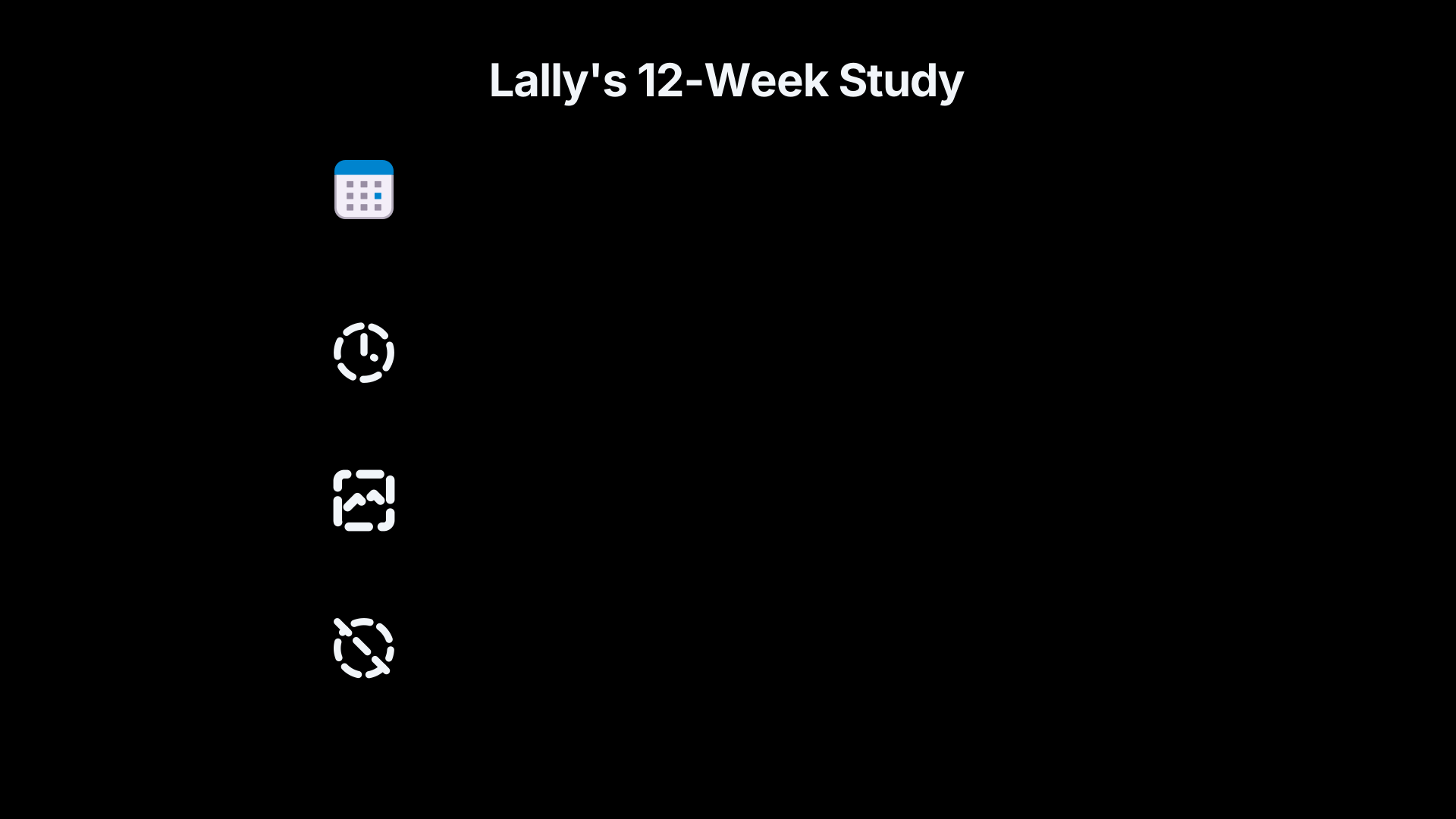
The number comes from a study led by health psychologist Phillippa Lally. Participants selected a simple daily behaviour, such as eating fruit with lunch or going for a walk, and repeated it in a consistent context over a 12-week period. Researchers tracked how automatic the behaviour felt over time.[Wiley Online Library]onlinelibrary.wiley.comWiley Online LibraryModelling habit formation in the real world - Lally - 2010by P Lally · 2010 · Cited by 3613 — The median time to reac…
A crucial detail is often lost when the finding is summarised online. The study did not discover a universal habit-formation deadline. Instead, it found that the median time required to reach near-maximum automaticity was 66 days, with individual estimates ranging from 18 to 254 days.[Wiley Online Library]onlinelibrary.wiley.comWiley Online LibraryModelling habit formation in the real world - Lally - 2010by P Lally · 2010 · Cited by 3613 — The median time to reac…[Studocu]studocu.vn54 days. There was substantial variation in curve parameters across…
That range matters far more than the headline number.
A person who needs 120 days for a behaviour to become highly automatic is not doing anything wrong. Likewise, a very simple behaviour may feel automatic much sooner. The study showed variability, not a rule. As Lally herself later explained, the research demonstrated that habit formation is highly variable rather than fixed at 66 days.[University of Surrey]surrey.ac.ukUniversity of SurreyDoes it really take 66 days to form a habit?Jan 21, 2026 — The average time it took for the participants in my study…
What the 12-week habit study actually found
Three findings are especially relevant:
- Automaticity increased with repetition rather than appearing suddenly.
- Different behaviours followed different timelines.
- Different people followed different timelines even when performing similar behaviours.[Wiley Online Library]onlinelibrary.wiley.comWiley Online LibraryModelling habit formation in the real world - Lally - 2010by P Lally · 2010 · Cited by 3613 — The median time to reac…[Wiley Online Library]onlinelibrary.wiley.comWiley Online LibraryModelling habit formation in the real world - Lally - 2010by P Lally · 2010 · Cited by 3613 — The median time to reac…
The study therefore supports a process view of habit formation, not a countdown view. Its most important contribution was showing how habits develop over repeated cue-response experiences in everyday life.[Wiley Online Library]onlinelibrary.wiley.comWiley Online LibraryModelling habit formation in the real world - Lally - 2010by P Lally · 2010 · Cited by 3613 — The median time to reac…

Why automaticity is a curve, not a switch
One reason the 66-day rule misleads people is that it encourages an all-or-nothing mental model. People imagine that a habit is either absent or present, with day 66 acting as the transition point.
The data suggest something closer to a learning curve. Automaticity rises relatively quickly at first, then gains become smaller as the behaviour approaches a plateau. Researchers modelled the pattern as an asymptotic curve: repetition continues to strengthen the cue-behaviour association, but each additional repetition tends to contribute less than earlier repetitions.[Wiley Online Library]onlinelibrary.wiley.comWiley Online LibraryModelling habit formation in the real world - Lally - 2010by P Lally · 2010 · Cited by 3613 — The median time to reac…[Wiley Online Library]onlinelibrary.wiley.comWiley Online LibraryModelling habit formation in the real world - Lally - 2010by P Lally · 2010 · Cited by 3613 — The median time to reac…
This changes how progress should be interpreted.
If someone starts walking after dinner every evening, the first few weeks may create large gains in consistency and ease. Later weeks still matter, but the changes become less noticeable because the behaviour is already becoming familiar and automatic. The habit is not waiting for a specific day to activate; it is gradually strengthening throughout the process.[Wiley Online Library]onlinelibrary.wiley.comWiley Online LibraryModelling habit formation in the real world - Lally - 2010by P Lally · 2010 · Cited by 3613 — The median time to reac…
The countdown model hides this reality. It causes people to focus on a future finish line instead of recognising that automaticity is already increasing with each successful repetition.
What missed days do and do not mean
Another harmful consequence of the 66-day myth is the belief that any interruption resets progress.
The original study found that missing a single opportunity to perform the behaviour did not materially disrupt habit formation. Participants did not return to zero because of one lapse. The overall pattern of repetition mattered more than isolated mistakes.[Repositório ISPA]repositorio.ispa.ptRepositório ISPAModelling habit formation in the real worldThe time it took participants to reach 95% of their asymptote of automaticity… Studocu This does not mean missed days are irrelevant. Repeated disruptions reduce the consistency that helps build strong cue-behaviour associations[studocu.vn]studocu.vn54 days. There was substantial variation in curve parameters across…. However, the evidence suggests that occasional lapses are far less damaging than many people assume.[Repositório ISPA]repositorio.ispa.ptRepositório ISPAModelling habit formation in the real worldThe time it took participants to reach 95% of their asymptote of automaticity…
The practical distinction is important:
- A missed day is an interruption.
- Giving up is the real problem.
People who believe in a fixed 66-day countdown often interpret a lapse as proof that the streak has been ruined. In reality, habit formation is usually robust enough to tolerate ordinary imperfections. Returning to the routine is typically more important than preserving a flawless record.[Repositório ISPA]repositorio.ispa.ptRepositório ISPAModelling habit formation in the real worldThe time it took participants to reach 95% of their asymptote of automaticity…

Why the myth persists
The 66-day rule survives because it offers certainty. Self-improvement advice often becomes more appealing when it can be reduced to a simple number.
Unfortunately, precision can create false expectations. A person may expect a reading habit, exercise routine or healthy eating behaviour to feel effortless after exactly two months. When that expectation is not met, motivation can collapse even though the habit is developing normally.
The original evidence points in the opposite direction. Habit formation depends on the interaction between the person, the behaviour and the stability of the context in which it is repeated. Complexity, frequency and consistency all influence how quickly automaticity develops. A single universal timeline ignores those differences. Wiley Online Library[University of Surrey]surrey.ac.ukUniversity of SurreyDoes it really take 66 days to form a habit?Jan 21, 2026 — The average time it took for the participants in my study…
The more useful takeaway
The strongest lesson from the research is not “wait 66 days.” It is “keep repeating the behaviour in the same context.”
Stable cues help the brain learn what action follows a particular situation. Repetition strengthens that association. Automaticity then grows gradually, often unevenly, over time.[Wiley Online Library]onlinelibrary.wiley.comWiley Online LibraryModelling habit formation in the real world - Lally - 2010by P Lally · 2010 · Cited by 3613 — The median time to reac…
For self improvement that works, success is better measured by the reliability of the cue-response pattern than by the number of days on a calendar. The famous 66-day figure is best understood as a statistical summary from one study, not a deadline. What predicts lasting habits is not reaching day 66—it is continuing to perform the behaviour when the cue appears, long enough for the behaviour to become the normal response. Wiley Online Library[University of Surrey]surrey.ac.ukUniversity of SurreyDoes it really take 66 days to form a habit?Jan 21, 2026 — The average time it took for the participants in my study…
Amazon book picks
Further Reading
Books and field guides related to Does It Really Take 66 Days?. Use these as the next step if you want deeper reading beyond the article.
Atomic Habits
Rating: 3.5/5 from 7 Google Books ratings
Emphasizes consistent repetition over chasing arbitrary timelines.
The Power of Habit
Explains the mechanisms behind habit development rather than fixed timelines.
Making Habits, Breaking Habits
Examines evidence-based habit formation and individual variation.
eBay marketplace picks
Marketplace Samples
Example marketplace items related to this page. Use the search link to explore similar finds on eBay.




Endnotes
1.
Source: onlinelibrary.wiley.com
Link:https://onlinelibrary.wiley.com/doi/10.1002/ejsp.674
Source snippet
Wiley Online LibraryModelling habit formation in the real world - Lally - 2010by P Lally · 2010 · Cited by 3613 — The median time to reac...
2.
Source: pmc.ncbi.nlm.nih.gov
Link:https://pmc.ncbi.nlm.nih.gov/articles/PMC3505409/
Source snippet
health habitual: the psychology of 'habit-formation' and...by B Gardner · 2012 · Cited by 890 — More relevant research found that automa...
3.
Source: onlinelibrary.wiley.com
Link:https://onlinelibrary.wiley.com/doi/10.1002/ejsp.674?538fcd4b_page=6&d2101103page=2&ref=b2b_cm_3p_cs_t_ww
Source snippet
Wiley Online LibraryHow are habits formed: Modelling habit formation in the...16 Jul 2009 — The present study therefore addressed the fo...
4.
Source: studocu.vn
Link:https://www.studocu.vn/vn/document/truong-dai-hoc-ngoai-ngu-dai-hoc-da-nang/ngon-ngu-anh/modelling-habit-formation-insights-from-eur-j-soc-psychol-40-2010/157504686
Source snippet
54 days. There was substantial variation in curve parameters across...
5.
Source: repositorio.ispa.pt
Link:https://repositorio.ispa.pt/entities/publication/fae72a1c-b2b6-4991-9951-5d20b607f688
6.
Source: studocu.vn
Title: Modelling Habit Formation: Insights from Eur
Link:https://www.studocu.vn/vn/document/hoc-vien-ngoai-giao-viet-nam/van-hoa-viet-nam-va-hoi-nhap-quoc-te/modelling-habit-formation-insights-from-eur-j-soc-psychol-40-2010/147722239
Source snippet
J. Soc....The time it took participants to reach 95% of their asymptote of automaticity ranged from 18 to 254 days; indicating considera...
7.
Source: pmc.ncbi.nlm.nih.gov
Link:https://pmc.ncbi.nlm.nih.gov/articles/PMC11641623/
Source snippet
median time to reach 95% automaticity was 66 days (range: 18 to 254 days). Lally et al.'s earlier [37] study focused on healthy eating an...
8.
Source: surrey.ac.uk
Link:https://www.surrey.ac.uk/news/does-it-really-take-66-days-form-habit-we-asked-expert-dr-pippa-lally
Source snippet
University of SurreyDoes it really take 66 days to form a habit?Jan 21, 2026 — The average time it took for the participants in my study...
9.
Source: vocabulary.com
Link:https://www.vocabulary.com/dictionary/lally
Source snippet
Definition, [Meaning]({{ 'meaning/' | relative_url }}) & Synonymssupport column consisting of a steel cylinder filled with concrete. synonyms: lally column. see moresee les...
10.
Source: music.apple.com
Link:https://music.apple.com/kr/artist/lally/205825655
Source snippet
Music에서 Lally의 음악을 감상하세요. Glass in hand (feat. Lally), Mirror (feat. Lally) 등 Lally의 인기곡 및 앨범을 찾아보세요...
11.
Source: Wikipedia
Link:https://en.wikipedia.org/wiki/Lally
Source snippet
LallyPeople with the given name · Lally Bowers, British actress · Lally Cadeau, Canadian actress · Lally Horstmann, German writer · La...
12.
Source: dictionary.cambridge.org
Link:https://dictionary.cambridge.org/dictionary/english/modelling
Source snippet
English meaning - Cambridge Dictionarythe activity of using mathematical models (= simple descriptions of a system or process) to make...
13.
Source: en.wiktionary.org
Link:https://en.wiktionary.org/wiki/lally
Source snippet
(plural lallies). (Polari, usually in the plural) Leg. 1967, Kenneth Horne, Bona Bijou Tourettes (Round the Horne), season 3, episode 12...
Additional References
14.
Source: models1.co.uk
Link:https://www.models1.co.uk/apply
Source snippet
APPLYModels1 stands as the ultimate platform for aspiring models in London and beyond, supporting the talent behind today's most iconic c...
15.
Source: modelsdirect.com
Link:https://www.modelsdirect.com/become-a-model
Source snippet
Become a modelModels Direct is a trusted modelling agency connecting real people with exciting opportunities in fashion, TV, film, promot...
16.
Source: nationalcareers.service.gov.uk
Link:https://nationalcareers.service.gov.uk/job-profiles/fashion-model
17.
Source: merriam-webster.com
Link:https://www.merriam-webster.com/dictionary/Lally
Source snippet
LALLY Definition & Meaningnoun Lal· ly ˈlä-lē civil engineering: a concrete-filled cylindrical steel structural column formerly a US reg...
18.
Source: blog.theteamw.com
Link:https://www.blog.theteamw.com/2011/03/18/100-things-you-should-know-about-people-84-average-time-to-form-a-habit-is-66-days/
Source snippet
Time To Form A Habit Is 66 Days – The Team W, Inc.18 Mar 2011 — For some people and some behaviors it took 18 days, but depending on the...
19.
Source: researchgate.net
Title: 32898894 How are habits formed Modeling habit formation in the real world
Link:https://www.researchgate.net/publication/32898894_How_are_habits_formed_Modeling_habit_formation_in_the_real_world
Source snippet
Modeling habit formation in the real world | Request PDFAccording to the literature, it takes an average of 66 days, with a range of 18 t...
20.
Source: bmamodels.com
Link:https://bmamodels.com/
Source snippet
our goal is to be seen as the modelling agency by which all others are measured.Read more...
21.
Source: basemodels.co.uk
Link:https://www.basemodels.co.uk/
Source snippet
We are London based and represent a variety of Models, Artist's & Content...Read more...
22.
Source: keelify.com
Title: The 66-day habit rule explained — what Lally’s data
Link:https://keelify.com/blog/66-day-habit-rule-explained
Source snippet
Apr 26, 2026 — It's the median. In Lally's 2010 study, half of behaviors reached automaticity in fewer than 66 days; the other hal...
23.
Source: scienceofselfhelp.org
Link:https://scienceofselfhelp.org/articles-1/phillippa-lally-and-the-number-of-days-to-form-a
Source snippet
Habit26 Jul 2013 — The study suggests that some tasks take less time and some tasks more time before they are considered a habit, but the...
Topic Tree