Within Motivation
When goals motivate by hurting first
The same habit can feel either punishing or chosen depending on whether it is powered by shame, approval, or personal values.
On this page
- How shame creates urgency but raises emotional cost
- How values make difficult actions feel self endorsed
- Rewriting common self critical goals into chosen goals
Page outline Jump by section
Introduction
Many self-improvement goals fail not because the target is wrong, but because the motivation behind it is emotionally expensive. The same behaviour—going to the gym, studying, saving money, eating differently—can feel either like self-punishment or like a chosen act of self-respect. The difference often lies in whether the goal is powered by shame or by personal values.
 Shame-based goals create urgency by making a person feel inadequate, flawed, or unacceptable until they change. Values-based goals connect action to something the person genuinely cares about, such as health, mastery, contribution, family, or independence. Research in self-determination theory consistently finds that motivations rooted in guilt, shame, and pressure belong to a more controlled form of motivation, while goals aligned with personal values are more autonomous and more likely to be sustained over time.[ScienceDirect]sciencedirect.comcontrolled form motivation. When the pressure is experienced internally (e.g., motivation to avoid shame or guilt), it reflects introject…[TheoryHub]open.ncl.ac.ukself determination theoryTheoryHubSelf-Determination Theory: A review14 Mar 2026 —… shame, or the pursuit of self-worth (Deci & Ryan, 2000; Deci & Ryan… mot…
The distinction matters because self-improvement that works is not merely about getting yourself to act today. It is about creating reasons to continue acting when motivation fluctuates, progress slows, or mistakes happen.
How shame creates urgency but raises emotional cost
Shame is often misunderstood because it can be motivating in the short term. People frequently report making resolutions after feeling embarrassed, judged, unattractive, unsuccessful, or behind their peers. Research has found that shame can indeed create a strong desire for self-change.[PubMed]pubmed.ncbi.nlm.nih.govShame and the motivation to change the selfWe report 2 studies examining people's lived experiences of self-conscious emotions, par…
The problem is not that shame never motivates. The problem is the price it charges.
A shame-based goal usually sounds like:
- “I need to lose weight because I look awful.”
- “I have to earn more money so people respect me.”
- “I must become productive because I am lazy.”
- “I need to get fit so nobody judges me.”
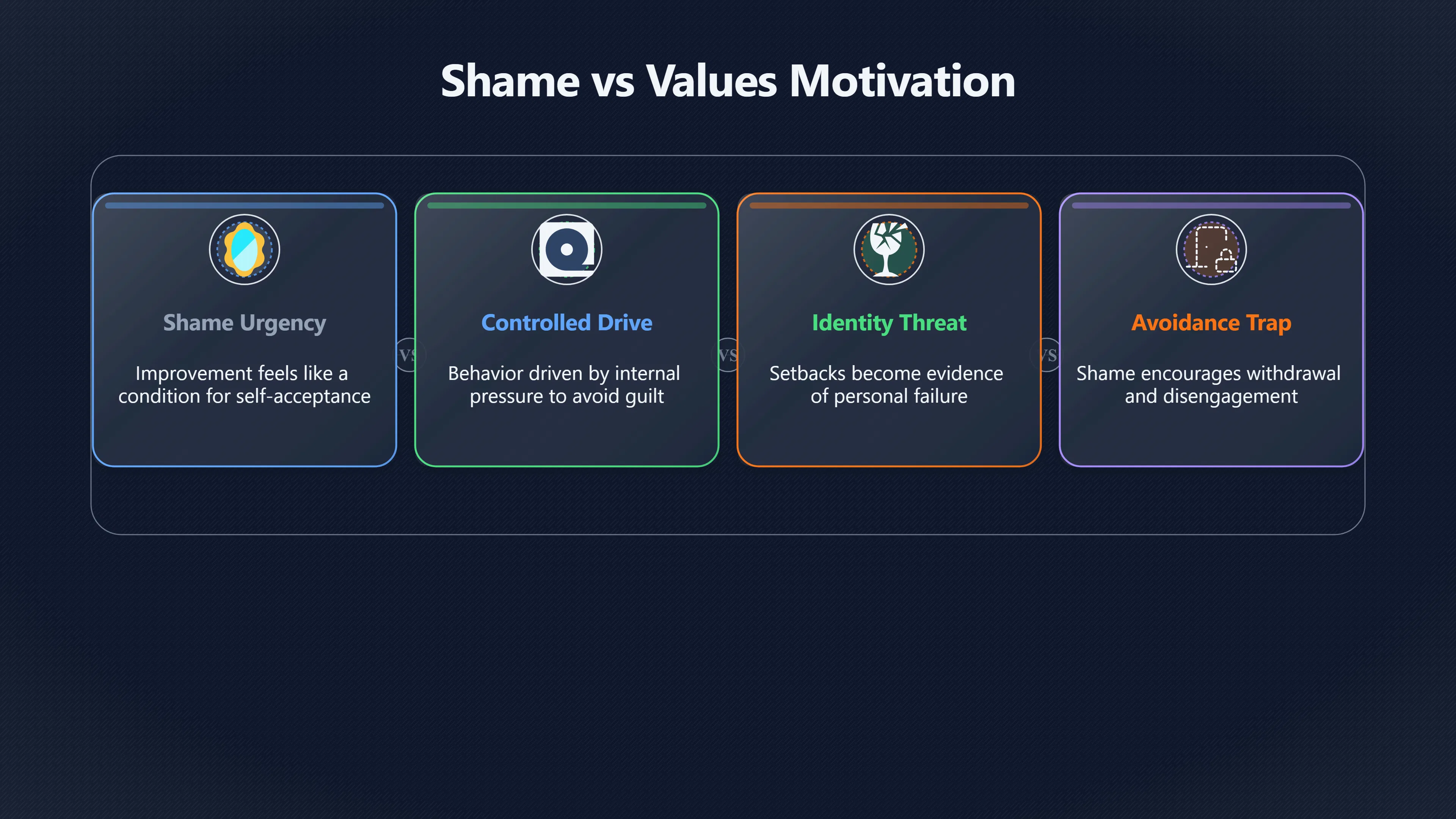
The emotional logic is that improvement becomes a condition for self-acceptance. Until the goal is achieved, the person feels defective.
Self-determination theory classifies this kind of motivation as a controlled form of regulation. Behaviour is driven by internal pressure—avoiding shame, guilt, anxiety, or feelings of low worth—rather than by genuine endorsement of the goal. Self-Determination Theory[Frontiers]frontiersin.orgself-worth, shame or guilt (Assor et al., 2009). According to these authors, introjected approach would be more self-determined than…[ScienceDirect]sciencedirect.comcontrolled form motivation. When the pressure is experienced internally (e.g., motivation to avoid shame or guilt), it reflects introject…
This creates several predictable problems:
Success rarely feels complete. If the goal exists to repair a damaged sense of self, achievement often moves the standard rather than resolving the underlying criticism.
Setbacks become identity threats. Missing one workout is no longer a scheduling issue. It becomes evidence that “I am failing again.”
Effort feels emotionally draining. The person is not only doing the task; they are also carrying the burden of self-judgment while doing it.
Avoidance becomes tempting. Shame frequently encourages withdrawal, hiding, or disengagement rather than constructive persistence. Research on shame and self-criticism repeatedly links these experiences to psychological distress and defensive coping patterns.[PMC]pmc.ncbi.nlm.nih.govBreaking the vicious cycles of self-criticism: a qualitative study…by B Šoková · 2025 · Cited by 8 — The psychoanalytic literature…[PMC]pmc.ncbi.nlm.nih.govby V Zaccari · 2024 · Cited by 9 — High levels of SC lead to emotions of failure, guilt, inferiority, and shame (Blatt & Luyten, 2009…[ScienceDirect]sciencedirect.comA network approach to shame: The central roles of self…by B ShamsAlam · 2025 · Cited by 1 — This network analysis provides a precise u…
This helps explain a common self-improvement cycle: harsh self-criticism produces a burst of action, the burst fades, a setback occurs, shame increases, and the person abandons the effort altogether.
Why values-based goals feel more self-endorsed
Values-based goals can look almost identical on the surface.
A person may still exercise four times a week, study every evening, or maintain a budget. The difference is not necessarily the behaviour. It is the reason.
Values-based goals sound more like:
- “I want a stronger body because physical capability matters to me.”
- “I want financial stability because independence is important.”
- “I want to learn this skill because I care about mastery.”
- “I want to look after my health so I can stay active with my family.”
The goal is connected to a chosen value rather than an attempt to escape self-rejection.[alliancecoaching.co.uk]alliancecoaching.co.ukICPR Goal Self ConcordanceEnhancing goal self-concordance through coachingby D Burke · 2007 · Cited by 120 — (Sheldon & Elliot, 1999) describes self- concordant go…
Research on self-concordant goals—goals aligned with a person’s interests and core values—shows that such goals are associated with greater sustained effort, higher attainment rates, and greater wellbeing benefits when achieved. Frontiers 3Self-Determination Theory PubMed An important feature of values-based motivation is that it does not require constant enjoyment.[pubmed.ncbi.nlm.nih.gov]pubmed.ncbi.nlm.nih.govShame and the motivation to change the selfWe report 2 studies examining people's lived experiences of self-conscious emotions, par…
A person may dislike early-morning runs, difficult study sessions, physiotherapy exercises, or tedious financial planning. Yet they can still experience these actions as self-endorsed because the activity serves something they genuinely value. Self-determination theory refers to this as a more autonomous form of motivation: the behaviour has been accepted as personally meaningful rather than merely imposed by pressure.[Peer Community Journal]peercommunityjournal.orgSelf-determination theory in physiotherapy practice: A rapid…by J O'Neil · 2026 · Cited by 2 — Controlled motivation refers to behavio…
This changes the emotional experience of effort.
Instead of:
“I must do this because I am not good enough.”
The internal message becomes:
“I choose this because it supports the kind of life I want.”
The action may remain difficult, but it no longer feels like a punishment.

The hidden trap: approval-seeking goals that look positive
Not all non-shame goals are genuinely values-based.
Many goals sit in a middle category where behaviour is driven by the pursuit of approval, status, pride, or validation.
Examples include:
- “I want people to admire my discipline.”
- “I need to prove I am successful.”
- “I want others to think I am attractive.”
- “I want to feel superior to my peers.”
These goals can feel more pleasant than shame-based goals because they focus on gaining approval rather than avoiding criticism. Yet they still depend heavily on external evaluation.
Research within self-determination theory refers to this pattern as introjected motivation: behaviour is regulated through internal pressures tied to self-worth, pride, guilt, or shame. It is more internal than direct external pressure but still not fully self-endorsed.[Frontiers]frontiersin.orgself-worth, shame or guilt (Assor et al., 2009). According to these authors, introjected approach would be more self-determined than…[TheoryHub]open.ncl.ac.ukself determination theoryTheoryHubSelf-Determination Theory: A review14 Mar 2026 —… shame, or the pursuit of self-worth (Deci & Ryan, 2000; Deci & Ryan… mot…
The practical consequence is that motivation remains fragile. It depends on maintaining a particular image rather than expressing a value.
If admiration disappears, the reason for effort may disappear with it.
Rewriting self-critical goals into chosen goals
One of the most useful self-improvement skills is learning to rewrite a goal without changing its practical target.
The aim is not to lower standards. The aim is to change the motivational foundation.
Shame-based versionValues-based version“I need to lose weight because I hate how I look.”“I want eating and movement habits that support my health and energy.”“I must stop being lazy.”“I want to become someone who reliably follows through on commitments.”“I need a better career so people respect me.”“I want work that develops my abilities and supports the life I want.”“I have to fix my body.”“I want to build physical capability and resilience.”“I need to catch up with everyone else.”“I want steady progress towards goals that matter to me.”
Notice that the desired behaviours do not disappear. The difference is that the goal stops treating the current self as a problem that must be repaired before it deserves respect.
A useful test is to ask:
If nobody else knew about this goal, would it still matter to me?
If the answer is yes, the goal is more likely to be rooted in personal values.

What happens after failure reveals the true motivation
The clearest way to distinguish shame-based and values-based goals is not during success but during failure.
When a shame-based goal encounters a setback, the setback often becomes evidence of personal deficiency:
- “I knew I lacked discipline.”
- “I always fail.”
- “This proves I am hopeless.”
The goal and identity become fused together.
Values-based goals create a different interpretation:
- “That did not go well.”
- “What got in the way?”
- “How do I get back on track?”
The failure remains meaningful, but it does not become a verdict on personal worth.
This distinction helps explain why values-based motivation is often more durable. The person can recover from mistakes because the goal remains connected to something they care about rather than something they are trying to escape. Research on self-concordance suggests that when goals are aligned with core values and interests, people are more likely to sustain effort and derive psychological benefits from the pursuit itself. Frontiers 3Self-Determination Theory[PubMed]pubmed.ncbi.nlm.nih.govShame and the motivation to change the selfWe report 2 studies examining people's lived experiences of self-conscious emotions, par…
Choosing goals that do not require self-rejection
A common myth in self-improvement is that people need harsh self-criticism to change. The evidence paints a more complicated picture. Shame can generate urgency and may spark a desire for change, but motivations built around avoiding shame, guilt, or worthlessness tend to carry higher emotional costs and are harder to sustain over time.[Peer Community Journal]peercommunityjournal.orgSelf-determination theory in physiotherapy practice: A rapid…by J O'Neil · 2026 · Cited by 2 — Controlled motivation refers to behavio…[PubMed]pubmed.ncbi.nlm.nih.govShame and the motivation to change the selfWe report 2 studies examining people's lived experiences of self-conscious emotions, par…[Psychology]psychologytoday.comshame and motivation to changeJan 29, 2015 — Feeling shame was a stronger predictor than guilt or regret for motivation for positive self-change.Read more…
Values-based goals offer a different route. They allow a person to acknowledge shortcomings while still acting from choice rather than self-rejection. The resulting effort may not always feel easier, but it is more likely to feel like an expression of who the person wants to be rather than a punishment for who they are.
For long-term self-improvement, that difference is often the difference between repeatedly starting over and continuing forward.
Amazon book picks
Further Reading
Books and field guides related to When goals motivate by hurting first. Use these as the next step if you want deeper reading beyond the article.
The Gifts of Imperfection
Addresses shame, self-worth, and values-driven living directly.
The Happiness Trap
Centers on values-guided action rather than self-criticism or emotional avoidance.
eBay marketplace picks
Marketplace Samples
Example marketplace items related to this page. Use the search link to explore similar finds on eBay.








The evidence at a glance
The shame-versus-values comparison above, condensed into its verified structure. Every attribute and evidence row below is grounded in the primary sources this page already cites in its endnotes; each row carries its own resolvable sources. This comparison carries no commercial channel — it is editorial throughout.
Shame-based goals
| Attribute | What the sources establish | Sources |
|---|---|---|
| shame creates a strong desire for self-change | people frequently report making resolutions after feeling embarrassed, judged or behind others, and research finds shame can indeed spark the wish to change | pubmed.ncbi.nlm.nih.gov · www.psychologytoday.com · www.researchgate.net |
| the regulation is controlled and introjected | behaviour is driven by internal pressure - avoiding shame, guilt, anxiety or low worth - rather than genuine endorsement of the goal | www.sciencedirect.com · www.frontiersin.org · en.wikipedia.org |
| shame and self-criticism link to distress and defensive coping | withdrawal, hiding or disengagement rather than constructive persistence is the documented coping pattern | pmc.ncbi.nlm.nih.gov · www.sciencedirect.com |
| striving is ego-involved and anxiety-associated | introjected motivation is the less self-determined form, associated with anxiety, guilt and shame pressure | selfdeterminationtheory.org · www.researchgate.net |
| documented costs to self-esteem and well-being | meta-analytic work links shame to psychological distress and damaged self-evaluation rather than durable change | pmc.ncbi.nlm.nih.gov · www.sciencedirect.com |
Values-based goals — † marks an attribute verified against a corpus-held primary source
| Attribute | What the sources establish | Sources |
|---|---|---|
| the goal is connected to a chosen value | ‘I want to look after my health so I can stay active with my family’ - connected to a chosen value rather than an attempt to escape self-rejection | www.alliancecoaching.co.uk · peercommunityjournal.org · www.frontiersin.org |
| autonomous motivation is more likely to be sustained | goals aligned with personal values are more autonomous and more likely to be sustained over time | www.sciencedirect.com · www.frontiersin.org · positivepsychology.com |
| self-concordant striving predicts longitudinal well-being † | goal striving that satisfies basic psychological needs predicts well-being over time, beyond attainment itself | pubmed.ncbi.nlm.nih.gov · selfdeterminationtheory.org · www.frontiersin.org · www.researchgate.net · pure-oai.bham.ac.uk |
| what happens after failure reveals the true motivation | when attainment alone cannot sustain need satisfaction, ego-involved goals show their cost exactly at the failure point | pubmed.ncbi.nlm.nih.gov · www.frontiersin.org · www.alliancecoaching.co.uk |
| self-critical goals can be rewritten into chosen goals | compassionate, autonomy-supportive reframing of shame-driven goals is evidence-bearing practice rather than affirmation | www.actwithcompassion.com · healthinfosource.com · www.rallisoncounseling.com |
Evidence rows
| # | Claim | Sources |
|---|---|---|
| 1 | self-determination theory distinguishes controlled (shame/guilt-driven, introjected) motivation from autonomous motivation, and autonomy predicts sustained behaviour | www.sciencedirect.com · open.ncl.ac.uk · www.frontiersin.org · en.wikipedia.org · www.apa.org |
| 2 | shame can create a strong short-term desire for self-change; the lived experience of self-conscious emotions is well documented | pubmed.ncbi.nlm.nih.gov · www.psychologytoday.com · www.researchgate.net · academic.oup.com |
| 3 | shame and self-criticism are repeatedly linked to psychological distress, defensive coping and damaged self-evaluation, including meta-analytically | pmc.ncbi.nlm.nih.gov · www.sciencedirect.com |
| 4 | self-concordant goal striving predicts need satisfaction and longitudinal well-being, with effects beyond mere goal attainment | pubmed.ncbi.nlm.nih.gov · selfdeterminationtheory.org · www.frontiersin.org · www.researchgate.net · pure-oai.bham.ac.uk |
| 5 | compassionate, autonomy-supportive reframing of self-critical, shame-driven goals is an evidence-bearing practice direction | www.actwithcompassion.com · healthinfosource.com · www.rallisoncounseling.com · bestchoicecounselling.com · selfdeterminationtheory.org |
Dated verdict
Shame can start a change attempt, but the evidence base favours goals endorsed by chosen values: autonomous, self-concordant motivation sustains striving and protects well-being in a way shame-based pressure does not.
— Better Change corpus synthesis of the cited primary sources, 2026-10-02 (basis: this page’s “How shame creates urgency but raises emotional cost”, “Why values-based goals feel more self-endorsed” and “What happens after failure reveals the true motivation”).
† Attribute verified against a primary source the corpus itself holds — not a claim reproducible from marketing pages.
Endnotes
1.
Source: sciencedirect.com
Link:https://www.sciencedirect.com/science/article/abs/pii/S0001879120300841
Source snippet
controlled form motivation. When the pressure is experienced internally (e.g., motivation to avoid shame or guilt), it reflects introject...
2.
Source: pmc.ncbi.nlm.nih.gov
Link:https://pmc.ncbi.nlm.nih.gov/articles/PMC11916919/
Source snippet
Breaking the vicious cycles of self-criticism: a qualitative study...by B Šoková · 2025 · Cited by 8 — The psychoanalytic literature...
3.
Source: sciencedirect.com
Link:https://www.sciencedirect.com/science/article/pii/S2666915325000204
Source snippet
A network approach to shame: The central roles of self...by B ShamsAlam · 2025 · Cited by 1 — This network analysis provides a precise u...
4.
Source: pmc.ncbi.nlm.nih.gov
Link:https://pmc.ncbi.nlm.nih.gov/articles/PMC11745034/
Source snippet
by V Zaccari · 2024 · Cited by 9 — High levels of SC lead to emotions of failure, guilt, inferiority, and shame (Blatt & Luyten, 2009...
5.
Source: pmc.ncbi.nlm.nih.gov
Title: PMCShame and Self-Esteem: A Meta-Analysis
Link:https://pmc.ncbi.nlm.nih.gov/articles/PMC8768475/
Source snippet
and Self-Esteem: A Meta-Analysis - PMCby Y Budiarto · 2021 · Cited by 145 — Scholars agree that shame has many effects related to psychol...
6.
Source: sciencedirect.com
Link:https://www.sciencedirect.com/org/science/article/pii/S1462373021000158
Source snippet
Goal Self-Concordance Model: What Have We Learned...by P Wan · 2021 · Cited by 15 — Goal self-concordance reflects self-generated person...
7.
Source: Wikipedia
Title: Self-determination theory
Link:https://en.wikipedia.org/wiki/Self-determination_theory
8.
Source: Wikipedia
Title: Shame (2011 film)
Link:https://en.wikipedia.org/wiki/Shame_%282011_film%29
Source snippet
Shame (2011 film)Shame is a 2011 British erotic psychological drama film, set in New York, directed by Steve McQueen, co-written by Mc...
9.
Source: sciencedirect.com
Link:https://www.sciencedirect.com/science/article/abs/pii/S2352250X1400027X
Source snippet
Shame, self-criticism, self-stigma, and compassion in...by JB Luoma · 2015 · Cited by 328 — Within the past decade, empirical evidence h...
10.
Source: sciencedirect.com
Link:https://www.sciencedirect.com/science/article/pii/S0191886923002829
Source snippet
self-disgust, and self-hate in patients with anxious attachment and addressing shame and feelings of inadequacy in patients with avoidant...
11.
Source: open.ncl.ac.uk
Title: self determination theory
Link:https://open.ncl.ac.uk/theories/20/self-determination-theory/
Source snippet
TheoryHubSelf-Determination Theory: A review14 Mar 2026 —... shame, or the pursuit of self-worth (Deci & Ryan, 2000; Deci & Ryan... mot...
12.
Source: peercommunityjournal.org
Link:https://peercommunityjournal.org/articles/10.24072/pcjournal.680/
Source snippet
Self-determination theory in physiotherapy practice: A rapid...by J O'Neil · 2026 · Cited by 2 — Controlled motivation refers to behavio...
13.
Source: pubmed.ncbi.nlm.nih.gov
Link:https://pubmed.ncbi.nlm.nih.gov/25401288/
Source snippet
Shame and the motivation to change the selfWe report 2 studies examining people's lived experiences of self-conscious emotions, par...
14.
Source: psychologytoday.com
Title: shame and motivation to change
Link:https://www.psychologytoday.com/us/blog/creative-synthesis/201501/shame-and-motivation-to-change
Source snippet
Jan 29, 2015 — Feeling shame was a stronger predictor than guilt or regret for motivation for positive self-change.Read more...
15.
Source: frontiersin.org
Link:https://www.frontiersin.org/journals/psychology/articles/10.3389/fpsyg.2022.987582/full
Source snippet
self-worth, shame or guilt (Assor et al., 2009). According to these authors, introjected approach would be more self-determined than...
16.
Source: selfdeterminationtheory.org
Title: 2024 WangWangEtAl MetaEdu
Link:https://selfdeterminationtheory.org/wp-content/uploads/2024/06/2024_WangWangEtAl_MetaEdu.pdf
Source snippet
2024_WangWangEtAl_MetaEdu.pdfby Y Wang · 2024 · Cited by 200 — As this type of motivation is ego-involved and anxiety/guilt/shame-associa...
17.
Source: selfdeterminationtheory.org
Link:https://selfdeterminationtheory.org/SDT/documents/1999_SheldonElliot.pdf
Source snippet
Self-Determination TheoryGoal Striving, Need Satisfaction, and Longitudinal Well-Beingby KM Sheldon · 1999 · Cited by 4353 — The self-con...
18.
Source: pubmed.ncbi.nlm.nih.gov
Link:https://pubmed.ncbi.nlm.nih.gov/10101878/
Source snippet
Goal striving, need satisfaction, and longitudinal well-beingby KM Sheldon · 1999 · Cited by 4356 — Second, those who attain self-c...
19.
Source: frontiersin.org
Link:https://www.frontiersin.org/journals/psychology/articles/10.3389/fpsyg.2024.1382345/full
Source snippet
Establishing self-concordant goals: a longitudinal study on...by L Cao · 2024 · Cited by 5 — Sheldon and Elliot (1999), building on the...
20.
Source: positivepsychology.com
Title: self determination theory
Link:https://positivepsychology.com/self-determination-theory/
Source snippet
and How It Explains Motivation21 Jun 2018 — Deci and Ryan's Self-Determination Theory (SDT) identifies autonomy, relatedness, and compete...
21.
Source: yukaichou.com
Title: self determination theory guide to ryan and decis motivation framework
Link:https://yukaichou.com/gamification-analysis/self-determination-theory-guide-to-ryan-and-decis-motivation-framework/
Source snippet
Self-Determination Theory: Complete Guide (2026)6 May 2026 — Instead of an external authority applying pressure, the person applies press...
Published: May 2026
22.
Source: psychologytoday.com
Title: Avoidance That Hides in “Productive” Therapy2 hours ago — Shame
Link:https://www.psychologytoday.com/nz/blog/psychosensible/202605/avoidance-that-hides-in-productive-therapy
Source snippet
Taking responsibility requires realistic assessment of ourselves, others, and situations. More from Psychology Today. Therapy.Read more...
23.
Source: suebehaviouraldesign.com
Title: self determination theory explained
Link:https://www.suebehaviouraldesign.com/en/blog/self-determination-theory-explained/
Source snippet
Self-Determination Theory explained: autonomy...1 Mar 2026 — SDT describes a spectrum from amotivation (no motivation) through external...
24.
Source: alliancecoaching.co.uk
Title: ICPR Goal [Self Concordance]({{ ‘self-concordance/’ | relative_url }})
Link:https://www.alliancecoaching.co.uk/pdfs/ICPR-Goal-Self-Concordance.pdf
Source snippet
Enhancing goal self-concordance through coachingby D Burke · 2007 · Cited by 120 — (Sheldon & Elliot, 1999) describes self- concordant go...
25.
Source: youtube.com
Link:https://www.youtube.com/watch?v=pFRlJ87GlIQ
Source snippet
Sprouts · 431K views; Richard Ryan || Self-Determination Theory & Human Motivation. The Psychology Podcast...
26.
Source: youtube.com
Link:https://www.youtube.com/watch?v=_juPDoa3GBY
Source snippet
Self-Determination Theory ExplainedSelf-determination Theory argues that we do what we do because we are motivated by three basic needs t...
27.
Source: youtube.com
Link:https://www.youtube.com/watch?v=gIosWS8jyMo
Source snippet
SELF-DETERMINATION THEORY. EXTRINSEC MOTIVATIONSelf-determination theory distinguishes three qualities or types of motivation along a con...
28.
Source: apa.org
Title: self determination theory
Link:https://www.apa.org/research-practice/conduct-research/self-determination-theory.html
Source snippet
Self-determination theory: A quarter century of human...2 Mar 2025 — According to self-determination theory, human motivation relies on...
29.
Source: simplypsychology.org
Title: self determination theory
Link:https://www.simplypsychology.org/self-determination-theory.html
Source snippet
Self-Determination Theory Of Motivation1 Apr 2026 — The term self-determination refers to a person's own ability to manage themselves, to...
30.
Source: urmc.rochester.edu
Title: self determination theory
Link:https://www.urmc.rochester.edu/community-health/patient-care/self-determination-theory
Source snippet
rochester.eduSelf-Determination Theory of Motivation - URMC.Rochester.eduSelf-determination theory suggests that all humans have three ba...
31.
Source: ebsco.com
Link:https://www.ebsco.com/research-starters/social-sciences-and-humanities/self-determination-theory
Source snippet
Self-Determination Theory | Social Sciences and HumanitiesSelf-determination theory is a theory of motivation which posits that humans co...
Additional References
32.
Source: actwithcompassion.com
Link:https://www.actwithcompassion.com/20_science_based_recommendations_for_therapy_with_highly_self_critical_or_shame_prone_clients
Source snippet
20 science-based recommendations for therapy with highly...Jun 9, 2016 — We have pulled together the 20 research findings we feel are mo...
33.
Source: rallisoncounseling.com
Link:https://www.rallisoncounseling.com/depression-driven-self-criticism/
Source snippet
Depression-Driven Self-CriticismResearch in Clinical Psychology & Psychotherapy demonstrates CFT's effectiveness for depression character...
34.
Source: scribd.com
Link:https://www.scribd.com/document/683276802/Becoming-Oneself-The-Central-Role-of-Self-Concordant-Goal-Selection
Source snippet
Self-Concordant Goals and Well-Being | PDF | MotivationalThis document discusses the concept of self-concordant goal selection, which ref...
35.
Source: researchgate.net
Link:https://www.researchgate.net/publication/240333261_The_self-concordance_model_of_healthy_goal-striving_When_personal_goals_correctly_represent_the_pe
Source snippet
The self-concordance model of healthy goal-strivingSelf-concordant striving not only affects optimism about goal attainment but also infl...
36.
Source: healthinfosource.com
Title: beyond punishment case compassionate approaches motivating behavioral change
Link:https://healthinfosource.com/blog/beyond-punishment-case-compassionate-approaches-motivating-behavioral-change
Source snippet
Beyond punishment: The case for compassionate approaches...Nov 5, 2024 — The cycle of shame and self-criticism can trap individuals in n...
37.
Source: bestchoicecounselling.com
Link:https://bestchoicecounselling.com/shame-vs-guilt-psychology-what-science-reveals-about-your-emotions/
Source snippet
Research shows that people feel intense discomfort and want to hide when experiencing shame...
38.
Source: researchgate.net
Title: 258029062 Shame A self determination theory perspective
Link:https://www.researchgate.net/publication/258029062_Shame_A_self-determination_theory_perspective
Source snippet
(PDF) Shame: A self-determination theory perspective8 Oct 2019 — This chapter aims to explore the utility of self-determination theory (S...
39.
Source: researchgate.net
Title: 268449831 Shame and the Motivation to Change the Self
Link:https://www.researchgate.net/publication/268449831_Shame_and_the_Motivation_to_Change_the_Self
Source snippet
Shame and the Motivation to Change the SelfOct 9, 2025 — Public shaming has long been thought to promote positive behavioral change. Howe...
40.
Source: academic.oup.com
Link:https://academic.oup.com/edited-volume/45638/chapter/396161642
Source snippet
The Oxford Handbook of Self-Determination Theory23 Feb 2023 — 39 [Autonomy Support]({{ 'autonomy-support/' | relative_url }}) and Autonomous Motivation: Common Factors in Counseli...
41.
Source: pure-oai.bham.ac.uk
Title: bham.ac.uk Goal Striving, Coping, and Well-Being
Link:https://pure-oai.bham.ac.uk/ws/files/10759361/2011_Smith_Ntoumanis_and_Duda._Goal_Striving_Coping_and_Well_Being.pdf
Source snippet
Striving, Coping, and Well-Being - Pureby AL Smith · 2011 · Cited by 239 — Grounded in self-determination theory (SDT; Deci & Ryan, 1985)...
Topic Tree