Within Small Starts
How Small Is Too Small to Matter?
A tiny habit only helps when the first version is observable, repeatable and still connected to the bigger skill.
On this page
- What makes a behaviour minimum but useful
- Examples that preserve a path to growth
- Signs the starter version has become symbolic
Page outline Jump by section
Introduction
A tiny habit is only useful if it remains a real instance of the skill you are trying to build. The smallest effective starting point is not the easiest possible action. It is the smallest action that still contains the core behaviour. A single sentence written by a future author, one careful scale played by a future musician, or one deliberate sales call made by a future salesperson all build capability. Reading productivity quotes, buying equipment, or endlessly organising a system may feel productive, but they do not necessarily strengthen the underlying skill.
 This distinction matters because starting small is meant to reduce friction, not replace practice. Research on habit formation, implementation intentions, and skill acquisition consistently points towards the same principle: repetition works best when the repeated action is closely connected to the capability being developed. Small actions become powerful when they are genuine repetitions of the target behaviour rather than symbolic substitutes.[Cancer Control]cancercontrol.cancer.govCancer ControlImplementation Intentionsby PM Gollwitzer — Implementation intentions are formed for the purpose of enhancing the translati…[MDPI]mdpi.comTime to Form a Habit: A Systematic Review and Meta-…by B Singh · 2024 · Cited by 92 — Healthy habit formation is a critical aspect…
What Makes a Behaviour Minimum but Useful?
A minimum viable behaviour sits at the intersection of two requirements:
- It is easy enough to perform consistently.
- It still exercises the capability you want to improve.
Many people satisfy the first requirement and miss the second. The result is a habit that survives but never produces meaningful growth.
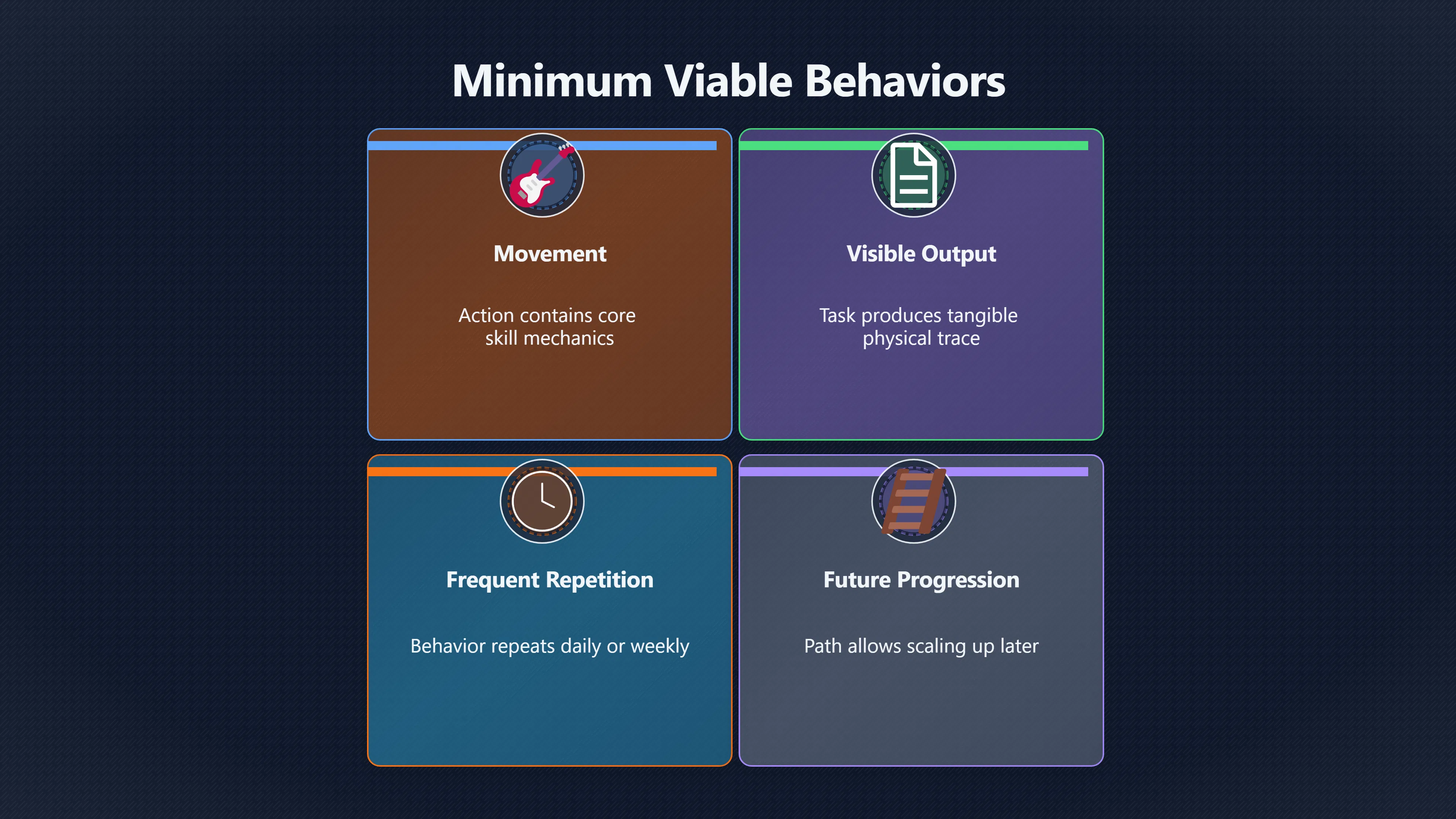
A useful minimum behaviour usually has four characteristics:
- It contains the essential movement of the larger skill.
- It produces a visible output.
- It can be repeated frequently.
- It allows future progression without changing direction.
Consider writing. Opening a document every morning may help establish a routine, but writing one sentence is a stronger minimum because it practises the actual skill. The difference is subtle but important. One behaviour prepares for writing; the other is writing.
The same logic appears in research on deliberate practice. Improvement comes from performing the target skill repeatedly, receiving information about performance, and refining execution over time. Activities that merely surround the skill often contribute far less than people assume.[ScienceDirect]sciencedirect.comScienceDirect Deliberate PracticeDeliberate Practice - an overviewEricsson et al. define deliberate practice as a well-defined task with immediate feedback…[PubMed]pubmed.ncbi.nlm.nih.govpractice and acquisition of expert performanceby KA Ericsson · 2008 · Cited by 2809 — Traditionally, professional expertise has been judg…
The Capability Test
A simple question helps identify whether a starter habit is meaningful:
If repeated for a month, would this behaviour produce even a small improvement in the target skill?
If the answer is no, the behaviour is probably too small or too indirect.
For example:
GoalWeak minimumUseful minimumBecome a better writerOpen writing softwareWrite one sentenceLearn guitarHold the guitarPlay one scale slowlyImprove fitnessPut on trainersWalk for five minutesLearn a languageOpen the appComplete one exerciseImprove salesRead sales adviceMake one prospecting contact
The useful version remains tiny, but it creates genuine practice.
Why Capability Requires Contact with the Real Skill
A common mistake is confusing preparation with performance.
Preparation activities feel productive because they are easy to complete and psychologically rewarding. Planning, organising, researching, and optimising all have value. However, capability grows most reliably through direct engagement with the skill itself.
Motor-learning research has long shown that learning is specific. People improve most in the actions they actually practise. General activity around a skill often transfers less than expected.[PubMed]pubmed.ncbi.nlm.nih.govpractice and acquisition of expert performanceby KA Ericsson · 2008 · Cited by 2809 — Traditionally, professional expertise has been judg…
This helps explain why some tiny habits produce results while others stall.
A person who writes fifty words daily accumulates hundreds of repetitions of idea generation, sentence construction, and self-expression. A person who spends the same period reorganising note-taking systems may become better at organisation without becoming a significantly better writer.
The minimum version should therefore preserve contact with the real task. The action can be small, but it should not become a substitute.
Examples That Preserve a Path to Growth
The best minimum viable behaviours contain a built-in growth route. The action performed today is recognisably the same action that will be performed at a higher level later.
Fitness
A five-minute walk is a genuine form of physical activity. It can become ten minutes, then thirty, then structured training. The movement pattern remains connected to the larger objective.
In contrast, repeatedly reading about exercise routines does not naturally scale into fitness. At some point a completely different behaviour must begin.
Writing
One sentence per day seems trivial, yet it contains idea generation, wording, and completion. The progression path is obvious:
- One sentence
- One paragraph
- Two hundred words
- A complete article
Each stage expands the same capability rather than replacing it.
Learning
Completing one practice problem develops problem-solving ability. Reading about how to solve problems does not necessarily do the same thing.
The minimum version should expose the learner to the actual challenge, even if only briefly.
Communication
If someone wants to become a better speaker, recording a thirty-second explanation of a topic is a meaningful minimum. It exercises organisation of thought, verbal delivery, and self-observation.
Watching speaking videos may be useful, but it is supporting activity rather than the capability itself.
The Role of Cues and Implementation Intentions
Even a well-designed minimum behaviour fails if it is rarely performed.
Implementation-intention research shows that specifying exactly when and where a behaviour will occur improves the likelihood that intentions become actions. These “if-then” plans reduce the gap between wanting and doing.[Cancer Control]cancercontrol.cancer.govCancer ControlImplementation Intentionsby PM Gollwitzer — Implementation intentions are formed for the purpose of enhancing the translati…[Cambridge University Press & Assessment]cambridge.orgUniversity Press & Assessment39Cambridge University Press & Assessment39 - Planning and Implementation Intention InterventionsSeveral reviews and meta-analyses have exp…
For minimum viable behaviours, this means attaching the action to a stable cue:
- After making coffee, write one sentence.
- After brushing teeth, perform one stretch.
- After lunch, complete one language exercise.
The behaviour remains small, but repetition becomes more reliable because the cue is predictable.
Research on habit formation also suggests that stable contexts help automaticity develop over time. Consistency of situation can matter as much as consistency of effort.[Frontiers]frontiersin.orgFrontiersContext Stability in Habit Building Increases Automaticity…by M Stojanovic · 2022 · Cited by 25 — In this paper, we investiga…
Signs the Starter Version Has Become Symbolic
The danger of starting small is not that the action is too easy. The danger is that it becomes disconnected from improvement.
Several warning signs suggest this has happened.
Completion Has Replaced Practice
The person focuses on checking the box rather than exercising the skill.
For example, opening a textbook each day becomes the goal rather than learning from it.
The Behaviour Never Produces Output
Real capability usually leaves traces:
- Words written
- Problems solved
- Repetitions completed
- Conversations held
- Designs created
If months pass without tangible outputs, the habit may be functioning as a ritual rather than practice.

The Behaviour Avoids Difficulty Entirely
Capability grows when the skill is exercised, even at a small scale. If the habit has been engineered to remove every challenge, it may no longer train anything.
Deliberate-practice research repeatedly emphasises focused engagement with performance, feedback, and improvement rather than mere repetition.[ScienceDirect]sciencedirect.comScienceDirect Deliberate PracticeDeliberate Practice - an overviewEricsson et al. define deliberate practice as a well-defined task with immediate feedback…[2Life in the Fast Lane • LITFL]litfl.comLife in the Fast Lane • LITFLDeliberate PracticeDeliberate practice: Rtitive performance of intended cognitive or psychomotor skills in a…
There Is No Obvious Growth Path
A healthy starter habit should answer a simple question:
What would the next level look like?
If no clear progression exists, the behaviour may be disconnected from the larger goal.
The Smallest Rep That Counts
When people ask how small is too small to matter, the answer is not measured in minutes, repetitions, or words. It is measured by connection.
A behaviour is small enough when it can be performed consistently. It is large enough when it still counts as genuine practice.
The ideal minimum viable behaviour feels almost embarrassingly modest, yet it remains a real repetition of the capability being developed. It is not preparation for the skill. It is the first version of the skill itself. Over time, that distinction determines whether a habit becomes a pathway to growth or merely a comforting routine.
Amazon book picks
Further Reading
Books and field guides related to How Small Is Too Small to Matter?. Use these as the next step if you want deeper reading beyond the article.
Atomic Habits
Rating: 3.5/5 from 7 Google Books ratings
Shows how tiny actions connect to meaningful outcomes.
eBay marketplace picks
Marketplace Samples
Example marketplace items related to this page. Use the search link to explore similar finds on eBay.






Endnotes
1.
Source: cancercontrol.cancer.gov
Link:https://cancercontrol.cancer.gov/brp/research/constructs/implementation-intentions
Source snippet
Cancer ControlImplementation Intentionsby PM Gollwitzer — Implementation intentions are formed for the purpose of enhancing the translati...
2.
Source: mdpi.com
Link:https://www.mdpi.com/2227-9032/12/23/2488
Source snippet
Time to Form a Habit: A Systematic Review and Meta-...by B Singh · 2024 · Cited by 92 — Healthy habit formation is a critical aspect...
3.
Source: sciencedirect.com
Title: ScienceDirect Deliberate Practice
Link:https://www.sciencedirect.com/topics/psychology/deliberate-practice
Source snippet
Deliberate Practice - an overviewEricsson et al. define deliberate practice as a well-defined task with immediate feedback...
4.
Source: cambridge.org
Title: University Press & Assessment39
Link:https://www.cambridge.org/core/books/handbook-of-behavior-change/planning-and-implementation-intention-interventions/E1C8DA422E9BA21E7D2C4881A04898D0
Source snippet
Cambridge University Press & Assessment39 - Planning and Implementation Intention InterventionsSeveral reviews and meta-analyses have exp...
5.
Source: litfl.com
Link:https://litfl.com/deliberate-practice/
Source snippet
Life in the Fast Lane • LITFLDeliberate PracticeDeliberate practice: Rtitive performance of intended cognitive or psychomotor skills in a...
6.
Source: sciencedirect.com
Title: Deliberate Practice
Link:https://www.sciencedirect.com/topics/computer-science/deliberate-practice
Source snippet
an overviewDeliberate practice in the context of Computer Science refers to engaging in effortful training activities over a long period...
7.
Source: sciencedirect.com
Title: habit formation has been over valued as a behavior change
Link:https://www.sciencedirect.com/science/article/pii/S1364661324002663
Source snippet
Leveraging cognitive neuroscience for making and...by EK Buabang · 2025 · Cited by 44 — Effectiveness of the use of implementation inten...
8.
Source: sciencedirect.com
Link:https://www.sciencedirect.com/science/article/abs/pii/S1469029213000290
Source snippet
From intentions via planning and behavior to physical...by L Fleig · 2013 · Cited by 103 — Two field studies investigated the effect of...
9.
Source: pubmed.ncbi.nlm.nih.gov
Link:https://pubmed.ncbi.nlm.nih.gov/18778378/
Source snippet
practice and acquisition of expert performanceby KA Ericsson · 2008 · Cited by 2809 — Traditionally, professional expertise has been judg...
10.
Source: pubmed.ncbi.nlm.nih.gov
Link:https://pubmed.ncbi.nlm.nih.gov/2094928/
Source snippet
Specificity and variability of practiceby CH Shea · 1990 · Cited by 335 — The specificity of learning principle proposes that motor...
11.
Source: frontiersin.org
Link:https://www.frontiersin.org/journals/psychology/articles/10.3389/fpsyg.2022.883795/full
Source snippet
FrontiersContext Stability in Habit Building Increases Automaticity...by M Stojanovic · 2022 · Cited by 25 — In this paper, we investiga...
12.
Source: link.springer.com
Link:https://link.springer.com/rwe/10.1007/978
Source snippet
Intentions | Springer Nature Link27 Apr 2019 — Implementation intentions and goal achievement: A meta-analysis of effects and processes...
13.
Source: frontiersin.org
Link:https://www.frontiersin.org/journals/psychology/articles/10.3389/fpsyg.2019.02396/full
Source snippet
Deliberate Practice and Proposed [Limits]({{ 'limits/' | relative_url }}) on the Effects of...by KA Ericsson · 2019 · Cited by 494 — The paper concludes with recommendati...
14.
Source: jsomers.net
Title: deliberate practice
Link:https://jsomers.net/blog/deliberate-practice
Source snippet
The Role of Deliberate Practice in the Acquisition of Expert...9 Feb 2010 — “The subjects should receive immediate informative feedback...
Additional References
15.
Source: researchgate.net
Link:https://www.researchgate.net/publication/49832449_Breaking_Habits_With_Implementation_Intentions_A_Test_of_Underlying_Processes
Source snippet
(PDF) Breaking Habits With Implementation IntentionsImplementation intentions specifying the replacement of a habitual response with an a...
16.
Source: bjfogg.com
Link:https://www.bjfogg.com/tiny-habits
Source snippet
Behavior Scientist & Author of Tiny HabitsBuilding on his groundbreaking model, which shows that behavior occurs when [motivation]({{ 'motivation/' | relative_url }}), ability...
17.
Source: sourcesofinsight.com
Link:https://sourcesofinsight.com/deliberate-practice/
18.
Source: thedecisionlab.com
Link:https://thedecisionlab.com/reference-guide/psychology/fogg-behavior-model
Source snippet
Fogg Behavior ModelIt involves manipulating motivation, ability, and prompts to encourage desired actions and facilitate positive behavio...
19.
Source: scribd.com
Link:https://www.scribd.com/document/979014585/Habit-Attitude-and-Planned-Behaviour-Is-Construct-or-an-Habit-an-Empty-Interesting-Case-Goal-directed-Automaticity
Source snippet
Habit and Goal-Directed Automaticity | PDF15 Apr 2011 — Forming implementation intentions only resulted in fat avoidance when no unhealth...
20.
Source: studocu.vn
Link:https://www.studocu.vn/vn/document/dai-hoc-kinh-te-quoc-dan/viet-luan-chuong-trinh-tien-tien/implementation-intentions-and-goal-achievement-a-review-of-effects-and/149995507
Source snippet
Implementation Intentions and Goal AchievementThis article reviews the role of implementation intentions in achieving goals, highlighting...
21.
Source: behaviormodel.org
Link:https://www.behaviormodel.org/prompts
Source snippet
Prompts in the Fogg Behavior ModelLearn how prompts activate behavior in the Fogg Behavior Model and how to design effective triggers tha...
22.
Source: tinyhabits.com
Link:https://tinyhabits.com/
Source snippet
Tiny Habits: BJ FoggCreate any habit you want in your life using Tiny Habits: A breakthrough method created by Stanford behavior scientis...
23.
Source: cris.brighton.ac.uk
Link:https://cris.brighton.ac.uk/ws/portalfiles/portal/391023/How%2Bexperts%2Bpractice-%2Ba%2Bnovel%2Btest%2Bof%2Bdeliberate%2Bpractice%2Btheory.pdf
Source snippet
novel test of deliberate practice theoryFirst, the “monotonic benefits assumption” (pp. 7. 368) holds that the amount of time invested in...
24.
Source: drpaulmccarthy.com
Title: tiny habits the breakthrough method for building life changing behaviors
Link:https://www.drpaulmccarthy.com/post/tiny-habits-the-breakthrough-method-for-building-life-changing-behaviors
Source snippet
Tiny Habits: The Breakthrough Method for Building Life-...10 Feb 2026 — Use the B=MAP formula: Every behavior needs Motivation, Ability...
Topic Tree