Within Better Change
Why the Phone Belongs Outside the Bedroom
Charging a phone outside the bedroom changes the contest between tired willpower and optimized devices.
On this page
- The bedtime friction problem
- Charging station options
- Handling alarms and exceptions
Page outline Jump by section
Introduction
Putting the phone outside the bedroom is one of the cleaner examples of self improvement that works because it changes the environment before willpower is exhausted. The point is not moral purity about screens. It is practical: the bed is where tired people meet an attention machine designed to keep them awake, so the easiest contest to win is the one you do not start. Charging the phone elsewhere removes the late-night scroll, the “just checking” loop, the visible clock, and the morning notification trap in one move.
The evidence is not that every person must ban every device from every bedroom. It is that bedtime phone use is consistently linked with poorer sleep, and experimental restriction studies suggest that cutting phone use near sleep can improve sleep quality, sleep duration and pre-sleep arousal. A phone-free bedroom turns that evidence into a concrete design choice: make sleep the default, not the thing you try to negotiate after one more swipe. JMIR[PLOS]journals.plos.orgEffect of restricting bedtime mobile phone use on sleep…by J He · 2020 · Cited by 152 — Restricting mobile phone use before bedtim…
The bedtime friction problem
The most important feature of the phone is not the screen. It is proximity. A phone on the bedside table turns every weak moment into a fresh decision: check the time, check the message, check the news, check whether the alarm is set, check one short video, check why sleep is not happening yet. Good sleep advice often says to “avoid screens before bed”, but that instruction still leaves the hardest part to the most tired version of the person.
This is why the charging-location rule is stronger than a vague screen-time promise. “Do not use your phone in bed” requires repeated inhibition. “The phone charges in the kitchen” changes the choice architecture. Behaviour-change research on implementation intentions supports this kind of move: if-then plans work best when they connect a specific situation to a specific response, such as “if I brush my teeth, then I plug the phone in outside the bedroom”. They help bridge the familiar gap between intending to behave well and actually doing it when tired or distracted.[Cancer Control]cancercontrol.cancer.govSource details in endnotes.
The bedroom rule also fits the sleep principle known as stimulus control. NHS sleep guidance from Imperial College Healthcare advises avoiding electronic devices such as tablets or phones within an hour of bedtime, turning off electronic devices, and keeping timepieces out of sight at night. It also recommends using the bed or bedroom only for sleep and related activities, because the brain learns associations from repeated context. A bed repeatedly paired with scrolling, arguing online, working, checking messages and watching the time becomes less cleanly associated with sleep.[imperial]imperial.nhs.ukImperial College Healthcare Sleep hygiene patient information leafletImperial College Healthcare Sleep hygiene patient information leaflet College Healthcare[Imperial College Healthcare]imperial.nhs.ukImperial College Healthcare Sleep hygiene patient information leafletImperial College Healthcare Sleep hygiene patient information leaflet
The risk is not only blue light, although light can matter. The phone brings content, social pressure, novelty, anxiety, games, work and reward loops into the one place where the nervous system is supposed to downshift. A 2022 quantitative study using smartphone app-use data and wearable-ring sleep data found that smartphone use in bed was associated with adverse effects on sleep latency, awake time, average heart rate and heart-rate variability. That matters because it points beyond simple screen exposure: the phone in bed can be a behavioural and physiological disturbance, not just a lamp.[PubMed Central]pmc.ncbi.nlm.nih.govSource details in endnotes.
What the sleep evidence really supports
The strongest practical claim is modest but useful: bedtime phone restriction is likely to help many people sleep better, especially those who already lose time to scrolling, messages or anxious checking. A 2024 systematic review and meta-analysis covering 55 papers and more than 41,000 participants found electronic media use was significantly associated with poorer sleep quality and more sleep problems, though effects varied across subgroups and cultures. This does not prove that every individual’s phone causes every sleep problem, but it supports treating bedtime media as a credible sleep risk rather than a harmless habit.[JMIR]jmir.orgElectronic Media Use and Sleep Qualityby X Han · 2024 · Cited by 92 — The meta-analysis revealed that electronic media use was signif…
Intervention evidence is especially relevant for this page because “phone out of the bedroom” is an intervention, not just a diagnosis. In a randomised pilot trial, restricting mobile phone use before bedtime for four weeks reduced sleep latency and pre-sleep arousal, increased sleep duration, improved sleep quality, and was associated with better positive affect and working memory. A later trial focused on restricting while-in-bed smartphone use among undergraduates with problematic smartphone use also reported improved sleep quality and reduced pre-sleep cognitive arousal, with effects appearing within the intervention period.[PLOS]journals.plos.orgEffect of restricting bedtime mobile phone use on sleep…by J He · 2020 · Cited by 152 — Restricting mobile phone use before bedtim…
The evidence is still uneven. Some studies rely on self-report; many focus on students or younger adults; and “screen use” can mean anything from a quiet audiobook to an emotionally charged argument, a work emergency or an endless video feed. There are also credible cautions against blaming blue light alone. Reporting on the research debate has noted that interaction, alerting content and anxiety may explain a great deal of the sleep disruption sometimes attributed solely to screen colour. That critique strengthens, rather than weakens, the case for moving the phone away: distance reduces content exposure, notification temptation, clock-checking and light all at once.[WIRED]wired.comSmartphones May Affect Sleep-but Not Because of Blue LightSmartphones May Affect Sleep-but Not Because of Blue Light
A useful rule follows: the phone does not have to be the only cause of poor sleep for removing it to be worth trying. Sleep problems can come from stress, caffeine, alcohol, pain, shift work, children, medical issues or insomnia. But a bedside phone is unusually easy to change and unusually good at exploiting the hour when people are least able to self-regulate.
Charging station options
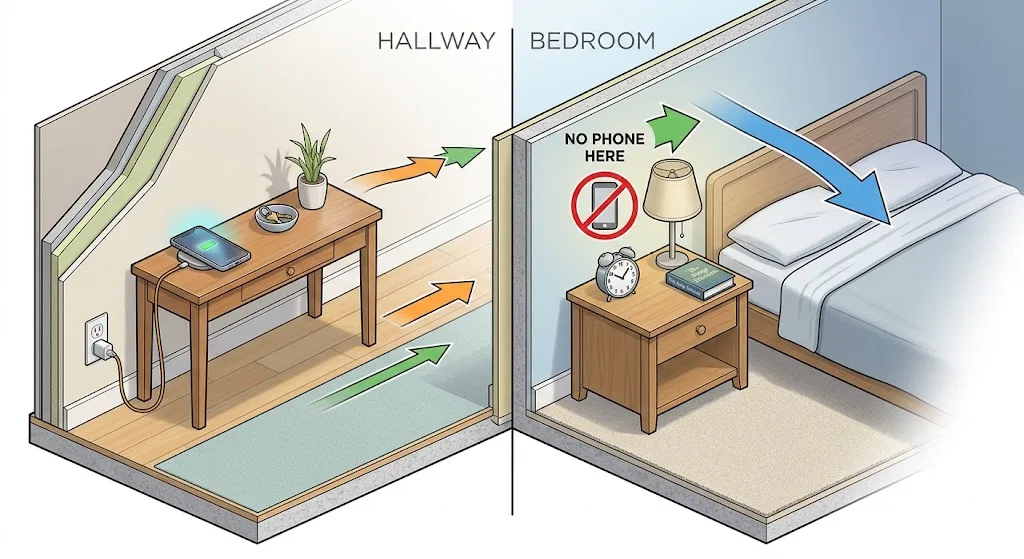
A good phone-free bedroom plan is boring by design. It should make the desired behaviour automatic, not dramatic. The best charging station is close enough to be convenient and far enough away that getting the phone requires standing up, leaving the room and breaking the spell of “I’ll only check one thing”.
For most people, one of these setups works:
- Hallway charging point: useful when the phone still needs to be audible for urgent calls, but not reachable from bed.
- Kitchen or living-room charger: best for a stronger boundary, especially where late-night scrolling is the main problem.
- Desk or work-bag station: useful when the morning goal is to avoid starting the day in bed with messages.
- Shared household charging shelf: helpful for families or couples who want the rule to feel normal rather than punitive.
The key detail is to decide the location before bedtime. A person who waits until midnight to decide whether to take the phone to bed has already made the rule fragile. The stronger habit is: plug in the phone at the same point in the evening routine, then switch to a replacement activity that does not lead back to the device. Sleep Foundation advice makes the same practical substitutions: use a basic alarm clock if the phone is the alarm, keep printed reading nearby, consider a white-noise machine if the phone supplies sound, and set boundaries with people who expect late-night access.[Sleep Foundation]sleepfoundation.orgtechnology in the bedroomtechnology in the bedroom
This is also where the critique matters. A charging station can fail if it is treated as a symbol rather than a system. If the phone leaves the bedroom but the laptop comes into bed, the habit has merely changed screen size. If the phone is outside the room but a smartwatch keeps buzzing on the wrist, the cue remains. If the person uses the move as part of an anxious sleep-optimisation campaign, they may trade scrolling for clock-watching. Imperial College Healthcare’s patient guidance explicitly warns against visible timepieces at night because checking the time can increase anxiety around not sleeping.[imperial]imperial.nhs.ukImperial College Healthcare Sleep hygiene patient information leafletImperial College Healthcare Sleep hygiene patient information leaflet

Handling alarms and exceptions
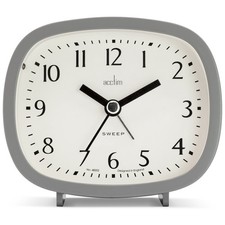
The most common objection is the alarm. It is also the easiest to solve. A cheap alarm clock, a low-brightness clock, a sunrise alarm, a vibrating alarm, a watch alarm or a phone placed outside the bedroom but within hearing range can all work. The important distinction is between an alarm and an internet-connected bedside portal. Sleep guidance from Imperial College says that, if an alarm is needed, the device should be heard but not seen; Sleep Foundation similarly recommends a basic alarm clock as a substitute when the phone is being used as the alarm.[imperial]imperial.nhs.ukImperial College Healthcare Sleep hygiene patient information leafletImperial College Healthcare Sleep hygiene patient information leaflet
Emergencies need a more careful rule. Some people genuinely need to be reachable overnight: carers, on-call workers, parents of teenagers, people with vulnerable relatives, or those using medical apps. For them, “phone out of the bedroom” should become “phone out of reach and stripped down”. That might mean leaving it across the room, enabling emergency bypass for selected contacts, using Do Not Disturb, disabling non-essential notifications, turning the screen face down, or routing urgent calls through a landline or shared household device.
There are also accessibility exceptions. Some people rely on a phone for medication reminders, glucose monitoring, hearing support, guided relaxation, white noise, safety check-ins or disability-related communication. The workable question is not “can the bedroom be perfectly phone-free?” but “which functions are necessary, and which functions are merely tempting?” If the phone must stay, the self-improvement principle still applies: remove as many hooks as possible. Delete or block the most stimulating apps after a set hour, charge the device away from the bed, use greyscale, set a hard Focus mode, and keep only the functions that genuinely serve sleep or safety.
A useful emergency test is this: if the reason for keeping the phone nearby is rare but real, design for the rare event without leaving the everyday temptation intact. Let urgent calls through; do not let every shopping alert, work message, social notification and news headline into the room at 1 am.
Why this small rule often works better than a big promise
“Phone out of the bedroom” works because it is specific, physical and repeatable. It does not ask for a new identity. It asks for a new charging location. That is why it belongs in the practical wing of self improvement: the method changes the contest between tired willpower and optimised devices.
It also produces two benefits that people often underestimate. First, it protects the last minutes of the day. Those minutes shape sleep timing, mental arousal and the emotional tone carried into bed. Second, it protects the first minutes of the morning. A phone beside the bed makes the day begin with other people’s demands, algorithmic novelty and unresolved messages. A phone outside the room creates a short buffer in which waking, washing, light, movement or breakfast can happen before the feed arrives.
The habit should be judged by outcomes, not purity. After one or two weeks, the useful questions are simple: Is bedtime earlier? Is falling asleep easier? Is there less night waking or clock-checking? Is the morning less reactive? Is the rule easy enough to repeat? If the answer is yes, the charging station is doing its job. If not, the problem may not be the phone alone, or the system may need adjustment: a better alarm, a clearer emergency plan, a more appealing wind-down routine, or professional support for persistent insomnia.
The deeper lesson is portable. Good self improvement often looks like removing a bad option from the moment when it usually wins. The phone outside the bedroom is not a complete sleep cure, and it is not a moral verdict on technology. It is a practical boundary: sleep happens here; the attention economy charges somewhere else.
Amazon book picks
Further Reading
Books and field guides related to Why the Phone Belongs Outside the Bedroom. Use these as the next step if you want deeper reading beyond the article.
Why We Sleep
Provides the strongest sleep-focused rationale for protecting the bedroom environment.
How to Break Up with Your Phone
Directly addresses changing phone habits and reducing bedtime use.
Digital Minimalism
Advocates intentional technology use and reducing constant connectivity.
Atomic Habits
Rating: 3.5/5 from 7 Google Books ratings
Supports environment design such as charging phones outside the bedroom.
eBay marketplace picks
Marketplace Samples
Example marketplace items related to this page. Use the search link to explore similar finds on eBay.


Endnotes
1.
Source: jmir.org
Link:https://www.jmir.org/2024/1/e48356/
Source snippet
Electronic Media Use and Sleep Qualityby X Han · 2024 · Cited by 92 — The meta-analysis revealed that electronic media use was signif...
2.
Source: journals.plos.org
Link:https://journals.plos.org/plosone/article?id=10.1371%2Fjournal.pone.0228756
Source snippet
Effect of restricting bedtime mobile phone use on sleep...by J He · 2020 · Cited by 152 — Restricting mobile phone use before bedtim...
3.
Source: cancercontrol.cancer.gov
Link:https://cancercontrol.cancer.gov/brp/research/constructs/implementation-intentions
4.
Source: imperial.nhs.uk
Title: Imperial College Healthcare Sleep hygiene patient information leaflet
Link:https://www.imperial.nhs.uk/-/media/website/patient-information-leaflets/respiratory-medicine/sleep-services/a-timetable-for-a-better-nights-sleep.pdf?rev=19327ecef29a4781bd3257883b06383c&sc_lang=en
5.
Source: wired.com
Title: Smartphones May Affect Sleep-but Not Because of Blue Light
Link:https://www.wired.com/story/blue-light-smartphone-screen-sleep
6.
Source: uhs.nhs.uk
Title: Sleep hygiene
Link:https://www.uhs.nhs.uk/Media/UHS-website-2019/Patientinformation/Other/Sleep-hygiene-3276-PIL.pdf
7.
Source: nhs.uk
Title: www.nhs.uk Sleep problems
Link:https://www.nhs.uk/every-mind-matters/mental-health-issues/sleep/
8.
Source: oxfordhealth.nhs.uk
Link:https://oxfordhealth.nhs.uk/camhs/self-care/sleep/difficulties/screens/
9.
Source: mental.jmir.org
Link:https://mental.jmir.org/2025/1/e77796
10.
Source: whittington.nhs.uk
Link:https://www.whittington.nhs.uk/default.asp?c=46665
11.
Source: rightdecisions.scot.nhs.uk
Link:https://www.rightdecisions.scot.nhs.uk/media/rnsat0su/sleep-hygiene-nhsggc.pdf
12.
Source: wwl.nhs.uk
Link:https://www.wwl.nhs.uk/media/.leaflets/604a0438bfc575.41668856.pdf
13.
Source: pmc.ncbi.nlm.nih.gov
Link:https://pmc.ncbi.nlm.nih.gov/articles/PMC9643910/
14.
Source: sleepfoundation.org
Title: technology in the bedroom
Link:https://www.sleepfoundation.org/bedroom-environment/technology-in-the-bedroom
15.
Source: cdc.gov
Link:https://www.cdc.gov/physical-activity-education/staying-healthy/sleep.html
16.
Source: sleepfoundation.org
Title: blue light
Link:https://www.sleepfoundation.org/bedroom-environment/blue-light
17.
Source: sleepfoundation.org
Title: how electronics affect sleep
Link:https://www.sleepfoundation.org/how-sleep-works/how-electronics-affect-sleep
18.
Source: sleepfoundation.org
Title: how blue light affects kids sleep
Link:https://www.sleepfoundation.org/children-and-sleep/how-blue-light-affects-kids-sleep
19.
Source: kuscholarworks.ku.edu
Link:https://kuscholarworks.ku.edu/server/api/core/bitstreams/e65c3f01-dbfa-44a0-bc38-a1372264aae4/content
20.
Source: youtube.com
Link:https://www.youtube.com/watch?v=TaLFBTvB1iQ
21.
Source: youtube.com
Link:https://www.youtube.com/watch?v=x54oLlLw9_s
22.
Source: durmonski.com
Title: implementation intentions
Link:https://durmonski.com/psychology/implementation-intentions/
Additional References
23.
Source: youtube.com
Link:https://www.youtube.com/watch?v=iV9K54TE9qk
Source snippet
4 The 6 things I do at night that lower my morning blood sugar...
24.
Source: youtube.com
Title: Stop Waking Up Tired: 15-Minute Morning Routine for Busy Men
Link:https://www.youtube.com/watch?v=h_sXiLB8U4E
Source snippet
3 A Magic Alarm Clock That Stops Your Bedroom Doom Scrolling? (He Invented That Product)...
25.
Source: youtube.com
Title: The 6 things I do at night that lower my morning blood sugar
Link:https://www.youtube.com/watch?v=RAeS52NdkoU
Source snippet
5 Why What You Watch Before Bed Could Disrupt Your Sleep Cycle...
26.
Source: cdc.gov
Link:https://www.cdc.gov/niosh/work-hour-training-for-nurses/longhours/mod6/02.html
27.
Source: academia.edu
Link:https://www.academia.edu/104354980/Bedtime_mobile_phone_use_and_sleep_in_adults
28.
Source: researchgate.net
Link:https://www.researchgate.net/publication/339152901_Effect_of_restricting_bedtime_mobile_phone_use_on_sleep_arousal_mood_and_working_memory_A_randomized_pilot_trial
29.
Source: cureus.com
Link:https://www.cureus.com/articles/353972-mobile-phone-addiction-and-sleep-quality-among-children-and-adolescents-unraveling-the-health-consequences
30.
Source: researchgate.net
Link:https://www.researchgate.net/publication/365257943_Leave_your_smartphone_out_of_bed_quantitative_analysis_of_smartphone_use_effect_on_sleep_quality
31.
Source: researchgate.net
Link:https://www.researchgate.net/publication/388197281_Screen_Time_And_Sleep_Quality_A_Narrative_Review_Of_Digital_Device_Usage_And_Its_Impact_On_Well-Being
32.
Source: linkedin.com
Link:https://www.linkedin.com/pulse/4-life-changing-hacks-charging-my-phone-outside-bedroom-briggs-bqvrc
Topic Tree