Within Willpower
Let Repetition Carry the Habit
Stable cues and repeated small actions make useful behaviour more automatic, so motivation has less work to do.
On this page
- How cues become linked to actions
- Why timelines vary between habits
- Designing a low friction repeatable routine
Page outline Jump by section
Introduction
The central idea behind habit formation is simple: if a useful behaviour depends on feeling motivated every time, it is fragile. If the behaviour becomes a habit, repetition carries more of the workload. In the context of self improvement, this is one of the most practical ways to treat willpower as a backup rather than an engine. Instead of repeatedly deciding whether to act, you create conditions in which the action becomes the normal response to a familiar situation.
 Research on habit formation consistently finds that habits develop when behaviours are repeated in stable contexts. Over time, cues in the environment become linked to specific actions, reducing the need for conscious deliberation. The goal is not to eliminate choice entirely but to reduce the number of moments that require motivation, negotiation or self-control.[PMC]pmc.ncbi.nlm.nih.govMaking health habitual: the psychology of 'habit-formation' and…by B Gardner · 2012 · Cited by 875 — Decades of psychological resea…[PubMed]pubmed.ncbi.nlm.nih.govPsychology of Habitby W Wood · 2016 · Cited by 1867 — As the proverbial creatures of habit, people tend to repeat the same behavior…
How Cues Become Linked to Actions
Many people imagine habits as behaviours repeated so often that they become effortless through sheer practice. Repetition matters, but the mechanism is more specific than that. Habits form when repetition occurs in a consistent context.
A context cue can be almost anything:
- A particular time of day
- A location
- A preceding action
- A visual object
- A social situation
When the same behaviour repeatedly follows the same cue, the brain gradually learns the association. Eventually the cue itself begins to trigger the behaviour automatically. Researchers Wendy Wood and colleagues describe habits as responses activated by contextual cues that have accompanied previous performance of the behaviour.[PubMed]pubmed.ncbi.nlm.nih.govPsychology of Habitby W Wood · 2016 · Cited by 1867 — As the proverbial creatures of habit, people tend to repeat the same behavior…[Sage Journals]journals.sagepub.comSage Journals Habits—A Repeat PerformanceNeal, Wendy…Abstract. Habits are response dispositions that are activated automatically by the context cues that co-occurred with resp…
Consider two people trying to establish a reading habit:
- Person A reads whenever they feel inspired.
- Person B reads for ten minutes immediately after making evening tea.
Both may read the same total amount during the first week. However, Person B is repeatedly pairing the behaviour with a stable cue. Over time, making tea becomes a prompt for reading. The habit is being attached to a situation rather than to a fluctuating emotional state.
This distinction helps explain why motivation-based routines often collapse during stressful periods. Motivation changes from day to day. A stable cue remains available even when enthusiasm disappears.
Research on everyday behaviour suggests that a large share of what people do occurs in repeated contexts and follows familiar patterns. Habit systems take advantage of that tendency rather than fighting it.[USC Dornsife]dornsife.usc.eduUSC DornsifeHabits—A Repeat Performanceby DT Neal · Cited by 972 — In experience-sampling diary studies using both student and community…[Frontiers]frontiersin.orgFrontiersHabits, Quick and Easy: Perceived Complexity Moderates…by K McCloskey · 2019 · Cited by 67 — Habits are behaviors that are pe…
Automaticity Is the Real Target
A common misunderstanding is that habit formation is mainly about frequency. Frequency helps, but the real outcome is automaticity: the extent to which an action starts happening with less conscious effort.
Habit researchers often distinguish between performing a behaviour frequently and performing it automatically. A person can force themselves to exercise for weeks while still feeling as if they are making a fresh decision every time. A stronger habit develops when the behaviour begins to feel like the obvious or default response to a cue.[EHPS]ehps.netHabit as automaticity, not frequencyby B Gardner · 2012 · Cited by 260 — Empirical work has demonstrated that, because habits are tri…[Taylor & Francis Online]tandfonline.comTaylor & Francis OnlinePromoting habit formation: Health Psychology Reviewby P Lally · 2013 · Cited by 1243 — Habits are automatic behavi…
That shift is important because automatic behaviours place fewer demands on attention and self-control. The behaviour does not become effortless in every respect, but getting started requires less mental friction.
Why Timelines Vary Between Habits
Popular advice often claims that habits take a fixed number of days to form. The evidence does not support a single universal timeline.
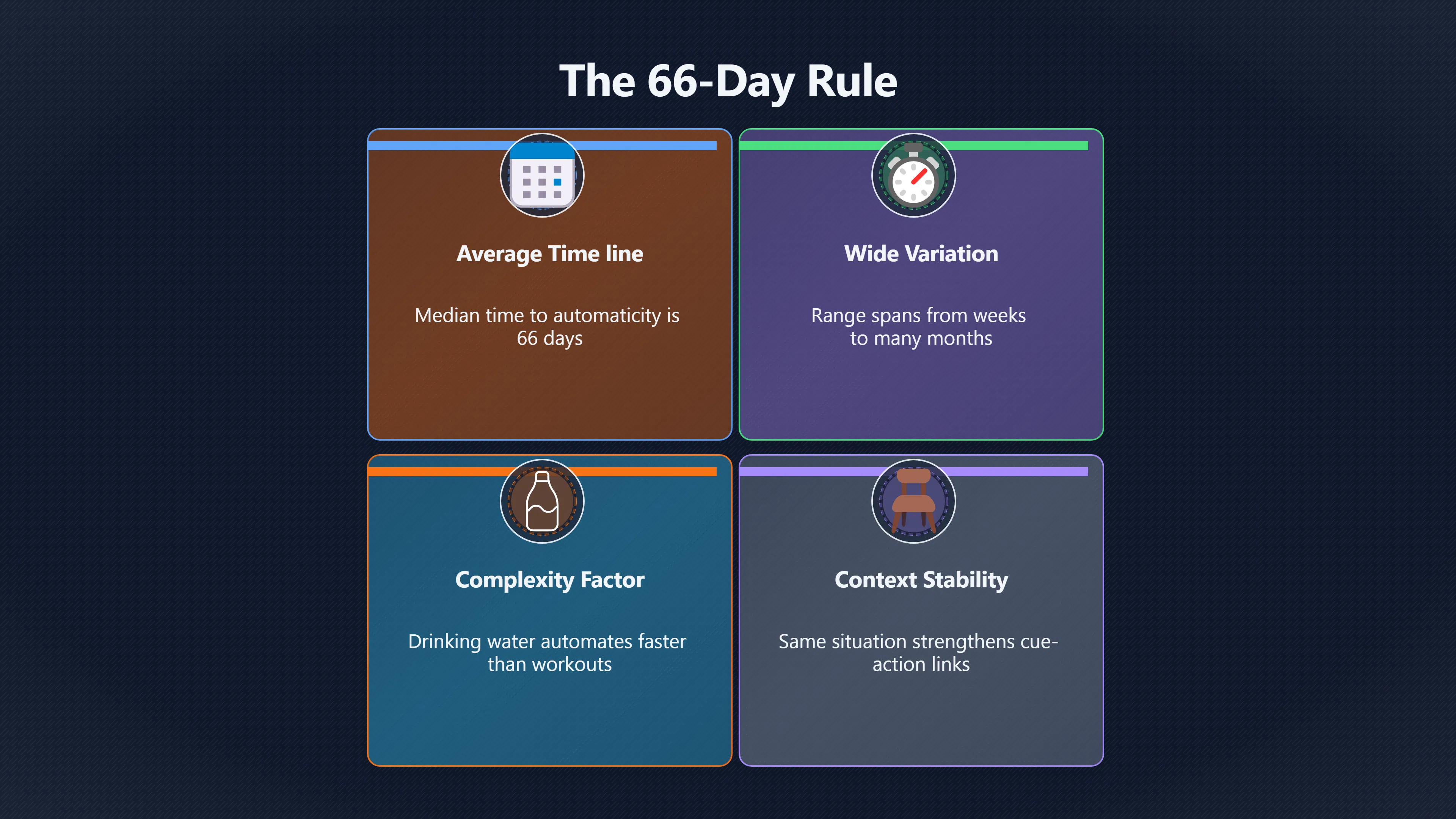
One influential study by Phillippa Lally and colleagues tracked people as they repeated new health-related behaviours in daily life. Habit strength increased gradually, and the average time to reach a high level of automaticity was around 66 days. However, the range was extremely wide. Some habits developed much faster, while others took many months.[Wiley Online Library]onlinelibrary.wiley.comOnline Library Modelling habit formation in the real worldWiley Online LibraryModelling habit formation in the real world - Lally - 2010by P Lally · 2010 · Cited by 3636 — The aim of the present…[University College London]ucl.ac.ukhow long does it take form habitUniversity College LondonHow long does it take to form a habit?4 Aug 2009 — It takes an average 66 days to form a new habit, according to…
The practical lesson is not that everyone needs exactly 66 days. It is that habit formation follows a gradual curve rather than a sudden transformation.
Several factors influence how quickly repetition becomes automatic:
Behaviour complexity. Drinking a glass of water after breakfast is easier to automate than completing a demanding workout.
Context stability. Repeating an action in the same situation strengthens cue-action links more efficiently than performing it under constantly changing conditions.[Frontiers]frontiersin.orgFrontiersHabits, Quick and Easy: Perceived Complexity Moderates…by K McCloskey · 2019 · Cited by 67 — Habits are behaviors that are pe…
Frequency of repetition. Behaviours performed more often create more learning opportunities.
Environmental support. Easy access to the required tools, locations or materials reduces friction and increases consistency.
Importantly, missing a single repetition does not appear to erase progress. The habit-building process is generally more resilient than many people assume. What matters most is returning to the pattern rather than interpreting an interruption as failure.[Wiley Online Library]onlinelibrary.wiley.comOnline Library Modelling habit formation in the real worldWiley Online LibraryModelling habit formation in the real world - Lally - 2010by P Lally · 2010 · Cited by 3636 — The aim of the present…

Why Some Habits Feel Stuck
When people report that a habit never became automatic, the problem is often not insufficient effort but inconsistent conditions.
A study schedule that shifts between mornings, afternoons and late nights provides weak cues. A workout routine that depends on finding spare time creates constant decision points. Repetition is occurring, but the cue structure is unstable.
From a habit perspective, the question is not only “How often am I doing this?” but also “What reliably signals that it is time to do it?”
Designing a Low-Friction Repeatable Routine
The most effective habit-building strategies often look surprisingly modest. Their purpose is not to maximise intensity but to maximise repetition.
A repeatable routine typically has three characteristics:
Start With a Small Action
Smaller actions create more consistent repetition.
For example:
- One push-up is easier to repeat than a one-hour workout.
- Five minutes of study is easier to repeat than an ambitious two-hour session.
- Preparing vegetables for dinner is easier to repeat than redesigning an entire diet.
Small actions generate successful repetitions, and repetitions are what build the cue-action association. Once a habit becomes established, expansion is usually easier.
Attach the Behaviour to an Existing Cue
One of the most reliable approaches is to place a new behaviour immediately after something that already happens consistently.
Examples include:
- After brushing teeth, floss one tooth.
- After making coffee, review today’s priority.
- After arriving home, change into exercise clothes.
- After sitting at a desk, write one sentence.
This approach works because the existing routine supplies a stable cue. Recent discussions of habit-stacking build on this principle: the old habit acts as an anchor for the new one.[The Washington Post]washingtonpost.comPopularized by authors BJ Fogg and James Clear, and widely used by behavioral therapists, habit-stacking involves "stacking" small, speci…
Reduce Friction Before It Appears
Habit formation is easier when the desired action is the easiest available option.
Examples include:
- Keeping a book on the bedside table.
- Leaving walking shoes by the door.
- Preparing lunch ingredients in advance.
- Keeping distracting apps off the home screen.
These changes matter because habits compete with alternatives. The environment often determines which behaviour wins before motivation enters the picture.
What Habit Repetition Changes
The deepest value of habits is not efficiency. It is reliability.
When a behaviour is driven mainly by motivation, performance rises and falls with mood, energy and enthusiasm. When a behaviour becomes habitual, those fluctuations matter less. The cue carries part of the behavioural load.
This does not mean habits eliminate the need for willpower. Difficult days still occur. Unexpected disruptions still happen. However, the number of situations requiring heroic self-control becomes smaller. The person who studies after sitting at the same desk each evening, walks after lunch every day, or saves money automatically each payday has transferred part of the work from motivation to repetition.
That transfer is precisely why habits fit the broader principle that self improvement works best when willpower serves as a backup system. The more useful behaviour can be tied to stable cues and repeated under consistent conditions, the less progress depends on winning the same motivational argument over and over again.[PMC]pmc.ncbi.nlm.nih.govMaking health habitual: the psychology of 'habit-formation' and…by B Gardner · 2012 · Cited by 875 — Decades of psychological resea…[PubMed]pubmed.ncbi.nlm.nih.govPsychology of Habitby W Wood · 2016 · Cited by 1867 — As the proverbial creatures of habit, people tend to repeat the same behavior…
Amazon book picks
Further Reading
Books and field guides related to Let Repetition Carry the Habit. Use these as the next step if you want deeper reading beyond the article.
Atomic Habits
Rating: 3.5/5 from 7 Google Books ratings
Covers cues, repetition, environment design and automatic behaviour in practical detail.
Better Than Before
Explores how everyday routines become sustainable behavioural patterns.
The Power of Habit
Introduces the cue-routine-reward framework central to habit formation.
eBay marketplace picks
Marketplace Samples
Example marketplace items related to this page. Use the search link to explore similar finds on eBay.


Endnotes
1.
Source: pmc.ncbi.nlm.nih.gov
Link:https://pmc.ncbi.nlm.nih.gov/articles/PMC3505409/
Source snippet
Making health habitual: the psychology of 'habit-formation' and...by B Gardner · 2012 · Cited by 875 — Decades of psychological resea...
2.
Source: dornsife.usc.edu
Link:https://dornsife.usc.edu/wendy-wood/wp-content/uploads/sites/183/2023/10/Neal.Wood_.Quinn_.2006_Habits_a_repeat_performance.pdf
Source snippet
USC DornsifeHabits—A Repeat Performanceby DT Neal · Cited by 972 — In experience-sampling diary studies using both student and community...
3.
Source: ehps.net
Link:https://www.ehps.net/ehp/index.php/contents/article/download/ehp.v14.i2.p32/1012
Source snippet
Habit as automaticity, not frequencyby B Gardner · 2012 · Cited by 260 — Empirical work has demonstrated that, because habits are tri...
4.
Source: onlinelibrary.wiley.com
Title: Online Library Modelling habit formation in the real world
Link:https://onlinelibrary.wiley.com/doi/full/10.1002/ejsp.674
Source snippet
Wiley Online LibraryModelling habit formation in the real world - Lally - 2010by P Lally · 2010 · Cited by 3636 — The aim of the present...
5.
Source: onlinelibrary.wiley.com
Title: Online Library Modelling habit formation in the real world
Link:https://onlinelibrary.wiley.com/doi/10.1002/ejsp.674
Source snippet
Wiley Online LibraryModelling habit formation in the real world - Lally - 2010by P Lally · 2010 · Cited by 3493 — To investigate the proc...
6.
Source: dornsife.usc.edu
Link:https://dornsife.usc.edu/wendy-wood/wp-content/uploads/sites/183/2023/10/wood.neal_.2007psychrev_a_new_look_at_habits_and_the_interface_between_habits_and_goals.pdf
Source snippet
Slow-learning, conservative memory...Read more...
7.
Source: dornsife.usc.edu
Title: neal.wood.labrecque.lally.2012
Link:https://dornsife.usc.edu/wendy-wood/wp-content/uploads/sites/183/2024/01/neal.wood_.labrecque.lally_.2012.pdf
Source snippet
Perceived and actual triggers...by DT Neal · 2011 · Cited by 669 — This consensus aside, it remains unclear how goals and context cues i...
8.
Source: pubmed.ncbi.nlm.nih.gov
Link:https://pubmed.ncbi.nlm.nih.gov/26361052/
Source snippet
Psychology of Habitby W Wood · 2016 · Cited by 1867 — As the proverbial creatures of habit, people tend to repeat the same behavior...
9.
Source: tandfonline.com
Link:https://www.tandfonline.com/doi/abs/10.1080/17437199.2011.603640
Source snippet
Taylor & Francis OnlinePromoting habit formation: Health Psychology Reviewby P Lally · 2013 · Cited by 1243 — Habits are automatic behavi...
10.
Source: journals.sagepub.com
Title: Sage Journals Habits—A Repeat Performance
Link:https://journals.sagepub.com/doi/10.1111/j.1467-8721.2006.00435.x
Source snippet
Neal, Wendy...Abstract. Habits are response dispositions that are activated automatically by the context cues that co-occurred with resp...
11.
Source: journals.sagepub.com
Title: Sage Journals Habits—A Repeat Performance
Link:https://journals.sagepub.com/doi/abs/10.1111/j.1467-8721.2006.00435.x
Source snippet
Neal, Wendy...by DT Neal · 2006 · Cited by 983 — Abstract. Habits are response dispositions that are activated automatically by the cont...
12.
Source: frontiersin.org
Link:https://www.frontiersin.org/journals/psychology/articles/10.3389/fpsyg.2019.01556/full
Source snippet
FrontiersHabits, Quick and Easy: Perceived Complexity Moderates...by K McCloskey · 2019 · Cited by 67 — Habits are behaviors that are pe...
13.
Source: ucl.ac.uk
Title: how long does it take form habit
Link:https://www.ucl.ac.uk/news/2009/aug/how-long-does-it-take-form-habit
Source snippet
University College LondonHow long does it take to form a habit?4 Aug 2009 — It takes an average 66 days to form a new habit, according to...
14.
Source: frontiersin.org
Link:https://www.frontiersin.org/journals/psychology/articles/10.3389/fpsyg.2022.883795/full
Source snippet
FrontiersContext Stability in Habit Building Increases Automaticity...by M Stojanovic · 2022 · Cited by 25 — In this paper, we investiga...
15.
Source: washingtonpost.com
Link:https://www.washingtonpost.com/wellness/2026/04/26/habit-stacking/
Source snippet
Popularized by authors BJ Fogg and James Clear, and widely used by behavioral therapists, habit-stacking involves "stacking" small, speci...
16.
Source: Wikipedia
Link:https://en.wikipedia.org/wiki/Automaticity
Source snippet
Automaticity - WikipediaThe “66-day rule” for habit formation comes from a 2009 study...
17.
Source: pubmed.ncbi.nlm.nih.gov
Link:https://pubmed.ncbi.nlm.nih.gov/21749245/
Source snippet
of habit formation: a qualitative studyby P Lally · 2011 · Cited by 367 — Results showed that [behaviour change]({{ 'behaviour-change/' | relative_url }}) was initially experienced...
18.
Source: thebump.com
Link:https://www.thebump.com/b/phillippa-baby-name
Source snippet
Baby Name Meaning, Origin and PopularityAn equivalent of the masculine name Philip, Phillippa is a feminine Greek name meaning "friend of...
Additional References
19.
Source: filippa-k.com
Link:https://www.filippa-k.com/
Source snippet
FILIPPA K | Effortless Scandinavian MinimalismAt FILIPPA K, we stand for effortless style, simplicity, and quality, crafting timeless, hi...
20.
Source: researchgate.net
Title: 32898894 How are habits formed Modeling habit formation in the real world
Link:https://www.researchgate.net/publication/32898894_How_are_habits_formed_Modeling_habit_formation_in_the_real_world
Source snippet
Modeling habit formation in the real world | Request PDFThese students reached their peak automaticity after about 56 days (or 8 weeks)...
21.
Source: surrey.ac.uk
Title: does it really take 66 days form habit we asked expert dr pippa lally
Link:https://www.surrey.ac.uk/news/does-it-really-take-66-days-form-habit-we-asked-expert-dr-pippa-lally
Source snippet
University of SurreyDoes it really take 66 days to form a habit?21 Jan 2026 — In 2010, Dr Pippa Lally, with colleagues at UCL, published...
22.
Source: philippalondon.com
Link:https://www.philippalondon.com/
23.
Source: researchgate.net
Title: 10974303 Habits in Everyday Life Thought Emotion and Action
Link:https://www.researchgate.net/publication/10974303_Habits_in_Everyday_Life_Thought_Emotion_and_Action
Source snippet
Habits in Everyday Life: Thought, Emotion, and Action9 Oct 2025 — A major portion of our daily activities is driven by habits, with appro...
24.
Source: cambridge.org
Link:https://www.cambridge.org/core/books/handbook-of-behavior-change/changing-behavior-using-habit-theory/5F222BC3AF6ADD9A8307BBB726D43F5C
Source snippet
cue contexts will promote habit strength and facilitate enduring behavior change.Read more...
25.
Source: scienceofselfhelp.org
Link:https://scienceofselfhelp.org/articles-1/phillippa-lally-and-the-number-of-days-to-form-a
Source snippet
Habit26 Jul 2013 — The study suggests that some tasks take less time and some tasks more time before they are considered a habit, but the...
26.
Source: studocu.vn
Title: Modelling Habit Formation: Insights from Eur
Link:https://www.studocu.vn/vn/document/truong-dai-hoc-ngoai-ngu-dai-hoc-da-nang/ngon-ngu-anh/modelling-habit-formation-insights-from-eur-j-soc-psychol-40-2010/157504686
Source snippet
J. Soc....This research article explores the process of habit formation through a study involving 96 participants who tracked their dail...
27.
Source: studocu.vn
Title: Modelling Habit Formation: Insights from Eur
Link:https://www.studocu.vn/vn/document/hoc-vien-ngoai-giao-viet-nam/van-hoa-viet-nam-va-hoi-nhap-quoc-te/modelling-habit-formation-insights-from-eur-j-soc-psychol-40-2010/147722239
Source snippet
J. Soc....The findings indicate that habits develop through consistent repetition in stable contexts, with automaticity increasing over...
28.
Source: aftertone.io
Title: Habit Formation: It Takes 66 Days, Not 21
Link:https://www.aftertone.io/science/habit-formation-timeline-66-days-not-21
Source snippet
Lally and colleagues tracked 96 adults forming real habits over 84 days and found the median time to automaticity was 66 days...
Topic Tree