Within Digital Tools
Why do self improvement apps get abandoned?
App abandonment is often a design and fit problem, not simply a motivation problem.
On this page
- Early enthusiasm and rapid drop off
- Measurement without meaningful feedback
- Choosing tools that fit ordinary life
Page outline Jump by section
Introduction
Many people install self-improvement apps with genuine intentions. They want to exercise more, sleep better, study consistently, meditate regularly, save money or build healthier routines. Yet a large proportion stop using these tools within weeks or months. Research on digital behaviour-change interventions suggests that abandonment is rarely explained by laziness alone. More often, it reflects a mismatch between the app, the person’s circumstances and the realities of long-term behaviour change. Studies of health and lifestyle apps consistently find that users leave because of poor fit, weak feedback, excessive effort, changing goals, technical frustrations or a simple failure to see meaningful progress.[PMC]pmc.ncbi.nlm.nih.govPMCUser Engagement and Abandonment of m HealthEngagement and Abandonment of mHealth - PMC - NIHby AS Mustafa · 2022 · Cited by 150 — Another primary reason is lack of motivation to su…[JMIR]jmir.orgWhen and Why Adults Abandon Lifestyle Behavior…by PG Kidman · 2024 · Cited by 39 — In total, 22 unique reasons for abandonment wer…
 Understanding why people abandon self-improvement apps matters because sustained behaviour change depends less on downloading the right tool and more on whether the tool continues to support useful action after the initial excitement fades.
Early enthusiasm and rapid drop-off
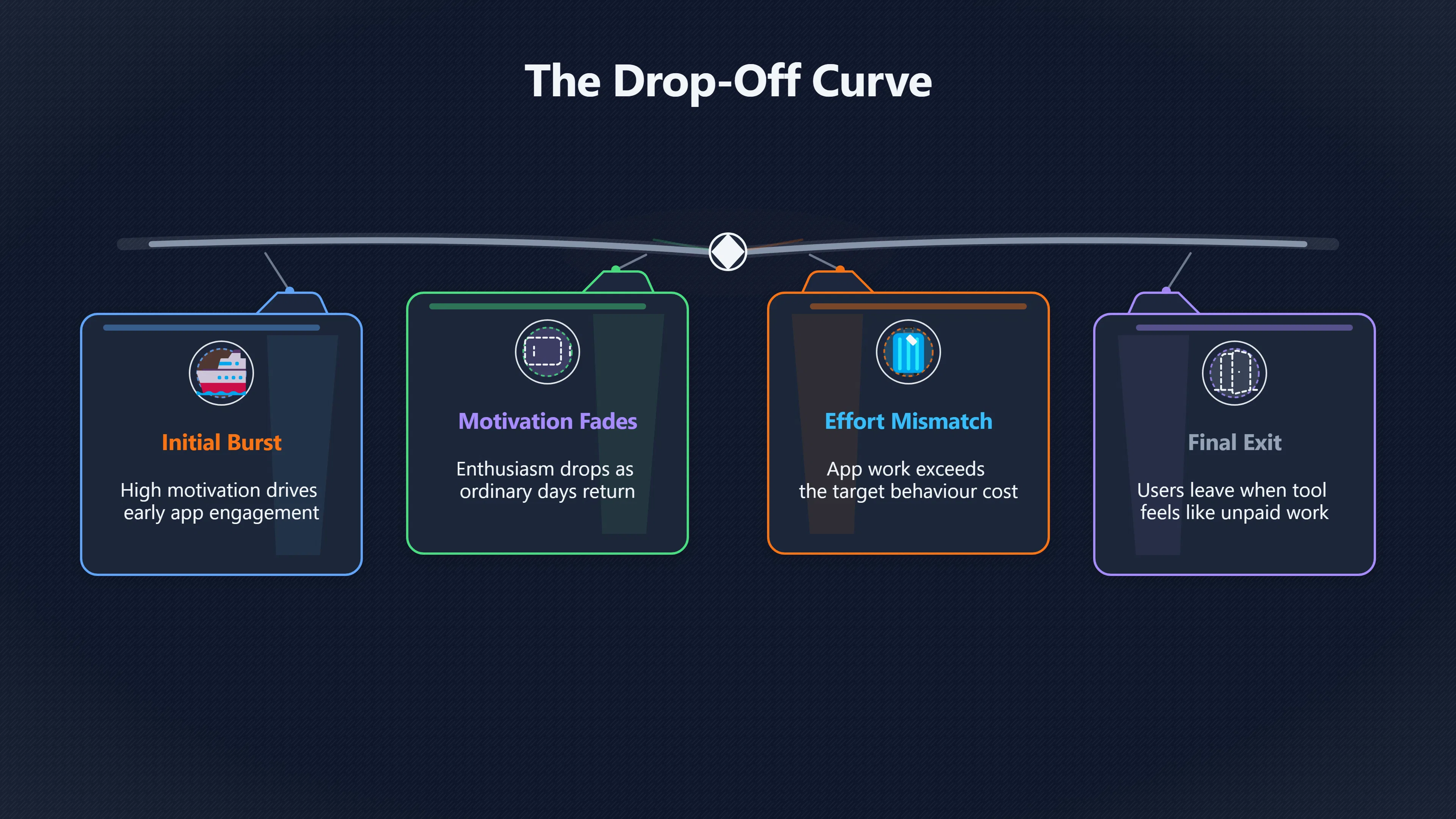
One of the most reliable patterns in behaviour-change technology is an early burst of engagement followed by a steep decline. People often begin with high motivation, especially after a life event, a New Year’s resolution or a moment of frustration with their current habits. During this phase, almost any app can feel useful because motivation is temporarily doing most of the work.
The challenge begins when motivation naturally fluctuates. Long-term behaviour change requires support during ordinary days rather than during moments of peak enthusiasm. Reviews of app abandonment repeatedly find that users stop engaging when the app no longer feels relevant, rewarding or worth the effort required to maintain it. Researchers examining lifestyle and mental-health apps identified a wide range of abandonment reasons, including poor user experience, weak content, time costs and changing personal needs.[JMIR]jmir.orgChallenges in Participant Engagement and Retention…by S Amagai · 2022 · Cited by 363 — However, many studies using mHealth apps are ha…
This helps explain a common misunderstanding. People often assume they abandoned an app because they lacked discipline. In reality, an app that works only when motivation is already high may not be providing much behavioural support at all.
Research on engagement with mobile health applications also shows that sustaining participation is a widespread challenge, not an unusual personal failure. High attrition rates appear across many app categories and study designs.[PMC]pmc.ncbi.nlm.nih.govPMCUser Engagement and Abandonment of m HealthEngagement and Abandonment of mHealth - PMC - NIHby AS Mustafa · 2022 · Cited by 150 — Another primary reason is lack of motivation to su…
Measurement without meaningful feedback
Many self-improvement apps are excellent at collecting data and much less effective at helping users act on it.
Tracking steps, calories, study sessions, mood ratings or hours slept can create awareness. Awareness is useful, but awareness alone rarely changes behaviour for long. When an app repeatedly asks users to record information without providing insight, guidance or adaptation, logging activity starts to feel like unpaid administrative work.
Evidence reviews examining behaviour-change techniques associated with engagement consistently identify self-monitoring and feedback as a pair rather than as independent features. Users are more likely to stay engaged when tracking is connected to meaningful feedback, goals, rewards, prompts or social support.[PMC]pmc.ncbi.nlm.nih.govPMCUser Engagement and Abandonment of m HealthEngagement and Abandonment of mHealth - PMC - NIHby AS Mustafa · 2022 · Cited by 150 — Another primary reason is lack of motivation to su…[Frontiers]frontiersin.orgFrontiersPotential associations between behavior change…by M Milne-Ives · 2023 · Cited by 75 — Six BCTs were repeatedly associated wit…
A practical example is the difference between:
- An app that records that a user exercised twice this week.
- An app that notices exercise happens more often on weekends and suggests a realistic weekday alternative.
The first collects information. The second helps solve a behavioural problem.
Many abandoned apps fail at this transition from measurement to guidance. Users accumulate charts, scores and streaks but gain little understanding of what to do differently tomorrow.
When optimisation becomes exhausting
Another reason for abandonment is that some apps increase the amount of work required to improve.
Behaviour-change tools are supposed to reduce friction. Yet many require constant logging, repeated check-ins, extensive customisation or frequent responses to notifications. Over time, the effort needed to maintain the system can become greater than the effort needed to perform the target behaviour itself.
Researchers studying app abandonment have identified time costs and usability burdens as recurring reasons people stop using apps. Technical problems and functional frustrations further increase these costs.[JMIR]mhealth.jmir.orgJMIR mHealth and uHealthAdults' Preferences for Behavior Change Techniques and…by A DeSmet · 2019 · Cited by 38 — Apps should provide…
This creates a paradox. A habit-tracking app may begin as a tool for building a habit but eventually become another obligation competing for attention.
The most successful long-term tools often minimise data entry, automate tracking where possible and focus attention on a small number of actions rather than an expanding collection of metrics.
Why streaks and reminders eventually lose power
Many self-improvement apps rely heavily on reminders, streaks, badges and notifications. These can be useful in the early stages of habit formation because they draw attention to a desired behaviour.
However, behavioural effects often weaken through familiarity. Notifications that initially felt helpful can become background noise. Streak systems can also create an all-or-nothing mindset. Missing one day may feel like failure, causing some users to disengage completely rather than resume imperfectly.
Research into engagement with behaviour-change technologies suggests that prompts and rewards can support engagement, but they work best alongside other mechanisms such as feedback, goal-setting and social support. They are rarely sufficient on their own.[Frontiers]frontiersin.orgFrontiersPotential associations between behavior change…by M Milne-Ives · 2023 · Cited by 75 — Six BCTs were repeatedly associated wit…
Emerging research on personalised digital nudges also points to a similar pattern: interventions may produce strong early effects that gradually weaken as users adapt to them. Initial motivation can be sustained for a period, but novelty alone does not guarantee long-term engagement.[arXiv]arxiv.orgDoes Personalized Nudging Wear Off? A Longitudinal Study of AI Self-Modeling for Behavioral EngagementFebruary 27, 2026…
Choosing tools that fit ordinary life
A common mistake is choosing an app that fits an ideal version of life rather than actual life.
An app may assume uninterrupted routines, abundant free time, stable schedules or high daily commitment. Real lives contain illness, travel, deadlines, family responsibilities and unexpected disruptions. When an app cannot accommodate these realities, users often conclude that they have failed when the design itself may be the problem.
Recent analyses of abandonment highlight the importance of evolving needs and goals. People change. Their priorities change. A tool that was useful during one phase of life may become irrelevant later. Abandonment is not always evidence that the app failed; sometimes the user’s needs simply moved elsewhere.[JMIR]jmir.orgUser Engagement and Attrition in an App-Based Physical…by S Edney · 2019 · Cited by 127 — Attrition was defined as occurring once the…
The strongest behaviour-change tools tend to be flexible enough to accommodate inconsistency. They allow missed days, changing goals and varying levels of engagement without turning normal life interruptions into apparent failure.
The hidden problem of poor personalisation
Many self-improvement apps promise personalisation but deliver standardised advice.
Users frequently receive generic targets, generic reminders and generic recommendations regardless of their experience, environment or constraints. This can create a growing sense that the app does not understand the problem it claims to solve.
Research on user engagement repeatedly points to the value of tailoring, relevant feedback and support matched to user circumstances. Users also express preferences for features that connect self-monitoring to feedback, coaching and social support rather than simple data collection.[JMIR mHealth and uHealth]mhealth.jmir.orgJMIR mHealth and uHealthAdults' Preferences for Behavior Change Techniques and…by A DeSmet · 2019 · Cited by 38 — Apps should provide…
When recommendations feel unrealistic or disconnected from everyday experience, engagement tends to decline. The user stops seeing the app as a useful partner and starts seeing it as a source of generic advice.
Abandonment is not always failure
One of the most important findings from research on app engagement is that abandonment does not automatically mean a behaviour-change intervention failed.
Some users stop using an app because they have internalised the habit. A person who used a walking app for three months may continue walking without needing reminders. Someone who tracked spending carefully may eventually understand their finances well enough to stop logging every purchase.
Researchers therefore distinguish between app engagement and behaviour change. Continued app use is sometimes valuable, but the ultimate goal is usually the behaviour itself.[PMC]pmc.ncbi.nlm.nih.govPMCUser Engagement and Abandonment of m HealthEngagement and Abandonment of mHealth - PMC - NIHby AS Mustafa · 2022 · Cited by 150 — Another primary reason is lack of motivation to su…
The more useful question is not whether an app keeps users forever. It is whether it helps people build behaviours that survive when the app is no longer needed.
For self-improvement that works, the lesson is straightforward: people rarely abandon apps simply because they lack willpower. More often, they abandon tools that create effort without insight, tracking without feedback, or motivation without lasting support. The best digital interventions fit ordinary life, provide meaningful guidance and gradually help users depend less on the app and more on the habits they are trying to build.
Amazon book picks
Further Reading
Books and field guides related to Why do self improvement apps get abandoned?. Use these as the next step if you want deeper reading beyond the article.
Atomic Habits
Rating: 3.5/5 from 7 Google Books ratings
Explains why motivation fades and how systems sustain behavior beyond initial enthusiasm.
The Power of Habit
Helps readers understand habit loops and why routines are abandoned.
Hooked: How to Build Habit-Forming Products
Examines product engagement and retention, directly related to app abandonment.
eBay marketplace picks
Marketplace Samples
Topic-anchored marketplace searches for visual, collectible, or second-hand items related to this page.


Endnotes
1.
Source: pmc.ncbi.nlm.nih.gov
Link:https://pmc.ncbi.nlm.nih.gov/articles/PMC11694054/
Source snippet
When and Why Adults Abandon Lifestyle Behavior and Mental...by PG Kidman · 2024 · Cited by 39 — We explored the abandonment of apps u...
2.
Source: jmir.org
Link:https://www.jmir.org/2024/1/e56897/
Source snippet
When and Why Adults Abandon Lifestyle Behavior...by PG Kidman · 2024 · Cited by 39 — In total, 22 unique reasons for abandonment wer...
3.
Source: pmc.ncbi.nlm.nih.gov
Title: PMCUser Engagement and Abandonment of m Health
Link:https://pmc.ncbi.nlm.nih.gov/articles/PMC8872344/
Source snippet
Engagement and Abandonment of mHealth - PMC - NIHby AS Mustafa · 2022 · Cited by 150 — Another primary reason is lack of motivation to su...
4.
Source: pmc.ncbi.nlm.nih.gov
Link:https://pmc.ncbi.nlm.nih.gov/articles/PMC9092233/
Source snippet
Challenges in Participant Engagement and Retention Using...by S Amagai · 2022 · Cited by 367 — However, many studies using mHealth ap...
5.
Source: jmir.org
Link:https://www.jmir.org/2022/4/e35120/
Source snippet
Challenges in Participant Engagement and Retention...by S Amagai · 2022 · Cited by 363 — However, many studies using mHealth apps are ha...
6.
Source: pmc.ncbi.nlm.nih.gov
Link:https://pmc.ncbi.nlm.nih.gov/articles/PMC10545861/
Source snippet
Potential associations between behavior change techniques...by M Milne-Ives · 2023 · Cited by 75 — Six BCTs were repeatedly associate...
7.
Source: mhealth.jmir.org
Link:https://mhealth.jmir.org/2019/12/e15707/
Source snippet
JMIR mHealth and uHealthAdults' Preferences for Behavior Change Techniques and...by A DeSmet · 2019 · Cited by 38 — Apps should provide...
8.
Source: arxiv.org
Link:https://arxiv.org/abs/2602.23688
Source snippet
Does Personalized Nudging Wear Off? A Longitudinal Study of AI Self-Modeling for Behavioral EngagementFebruary 27, 2026...
Published: February 27, 2026
9.
Source: jmir.org
Link:https://www.jmir.org/2019/11/e14645/
Source snippet
User Engagement and Attrition in an App-Based Physical...by S Edney · 2019 · Cited by 127 — Attrition was defined as occurring once the...
10.
Source: user.com
Link:https://user.com/
Source snippet
Marketing Automation PlatformUser.com is a marketing automation platform that helps companies streamline processes and grow their busines...
11.
Source: frontiersin.org
Link:https://www.frontiersin.org/journals/psychology/articles/10.3389/fpsyg.2023.1227443/full
Source snippet
FrontiersPotential associations between behavior change...by M Milne-Ives · 2023 · Cited by 75 — Six BCTs were repeatedly associated wit...
12.
Source: vocabulary.com
Link:https://www.vocabulary.com/dictionary/user
Source snippet
Definition, [Meaning]({{ 'meaning/' | relative_url }}) & SynonymsA user is someone who employs or uses a particular thing, like a user of nicotine or a user of an internet...
Additional References
13.
Source: thedecisionlab.com
Link:https://thedecisionlab.com/big-problems/improving-well-being-apps
Source snippet
Improving Well-Being AppsChallenge #1: Users Abandon Apps Too Quickly for Long-Term Behavior Change. High customer churn is a problem for...
14.
Source: eprints.whiterose.ac.uk
Link:https://eprints.whiterose.ac.uk/id/eprint/215742/1/Long-term%20participant%20retention%20and%20engagement%20patterns%20in%20an%20app%20and%20wearable-based%20multinational%20remote%20digital%20depression.pdf
Source snippet
whiterose.ac.ukLong-term participant retention and engagement patterns...by Y Zhang · 2023 · Cited by 59 — We report findings on long-te...
15.
Source: reddit.com
Link:https://www.reddit.com/r/EnglishLearning/comments/1e4mukw/whats_this_user_mean/
Source snippet
What's this "user" mean?: r/EnglishLearningA user is a person who manipulates other people to get things out of them. You're using the p...
16.
Source: linkedin.com
Link:https://www.linkedin.com/pulse/mental-health-app-retention-crisis-scott-jqt9c
Source snippet
Why Digital Mental Health Can't Keep Its UsersMental health apps are failing their users, and fast. Roughly 97% of people abandon them wi...
17.
Source: linkedin.com
Link:https://www.linkedin.com/pulse/mobile-health-app-engagement-crisis-scott-6xryc
18.
Source: merriam-webster.com
Link:https://www.merriam-webster.com/dictionary/user
19.
Source: collinsdictionary.com
Link:https://www.collinsdictionary.com/us/dictionary/english/user
Source snippet
USER definition in American EnglishA user is a person or thing that uses something such as a place, facility, product, or machine. Beach...
20.
Source: termsfeed.com
Link:https://www.termsfeed.com/dictionary/user-definition/
21.
Source: mobihealthnews.com
Link:https://www.mobihealthnews.com/news/mobile-app-based-health-studies-hampered-low-participant-engagement-retention-rates
Source snippet
Mobile app-based health studies hampered by low...Apr 29, 2022 — Studies using mobile health applications are hampered by significantly...
22.
Source: fit-minded.com
Title: why women abandon health apps by february and why the data keeps being ignored
Link:https://fit-minded.com/why-women-abandon-health-apps-by-february-and-why-the-data-keeps-being-ignored/
Source snippet
Why Women Abandon Health Apps by February and Why...Jan 13, 2026 — Digital health retention often drops after January because rigid enga...
Topic Tree