Within Goal Setting
Should Your Goal Really Be Daily?
The best frequency is not always daily; it is the schedule that creates repeatable action and a recovery path after misses.
On this page
- Why daily goals often break
- Building recovery into the schedule
- Matching frequency to motivation and context
Page outline Jump by section
Introduction
A common mistake in self-improvement is assuming that the most effective goal is the most frequent one. People often default to “every day” because it sounds committed and disciplined. In practice, however, the best goal frequency is usually the one that still works when life becomes inconvenient. Illness, travel, family responsibilities, busy work periods and simple fatigue are not rare interruptions; they are normal parts of life.
 A behaviour goal succeeds when it can be repeated over months, not when it survives a perfect week. Research on habit formation and self-regulation consistently points toward repetition in stable contexts, but it does not suggest that every worthwhile behaviour must occur daily. Sustainable frequency matters because missed days are inevitable, and a goal that collapses after ordinary disruption is often poorly designed rather than poorly motivated.[PMC]pmc.ncbi.nlm.nih.govTime to Form a Habit: A Systematic Review and Meta-Analysis…by B Singh · 2024 · Cited by 95 — The meta-analysis showed significant…[PMC]pmc.ncbi.nlm.nih.govMaking health habitual: the psychology of 'habit-formation' and…by B Gardner · 2012 · Cited by 896 — Psychological theory and evide…
Should Your Goal Really Be Daily?
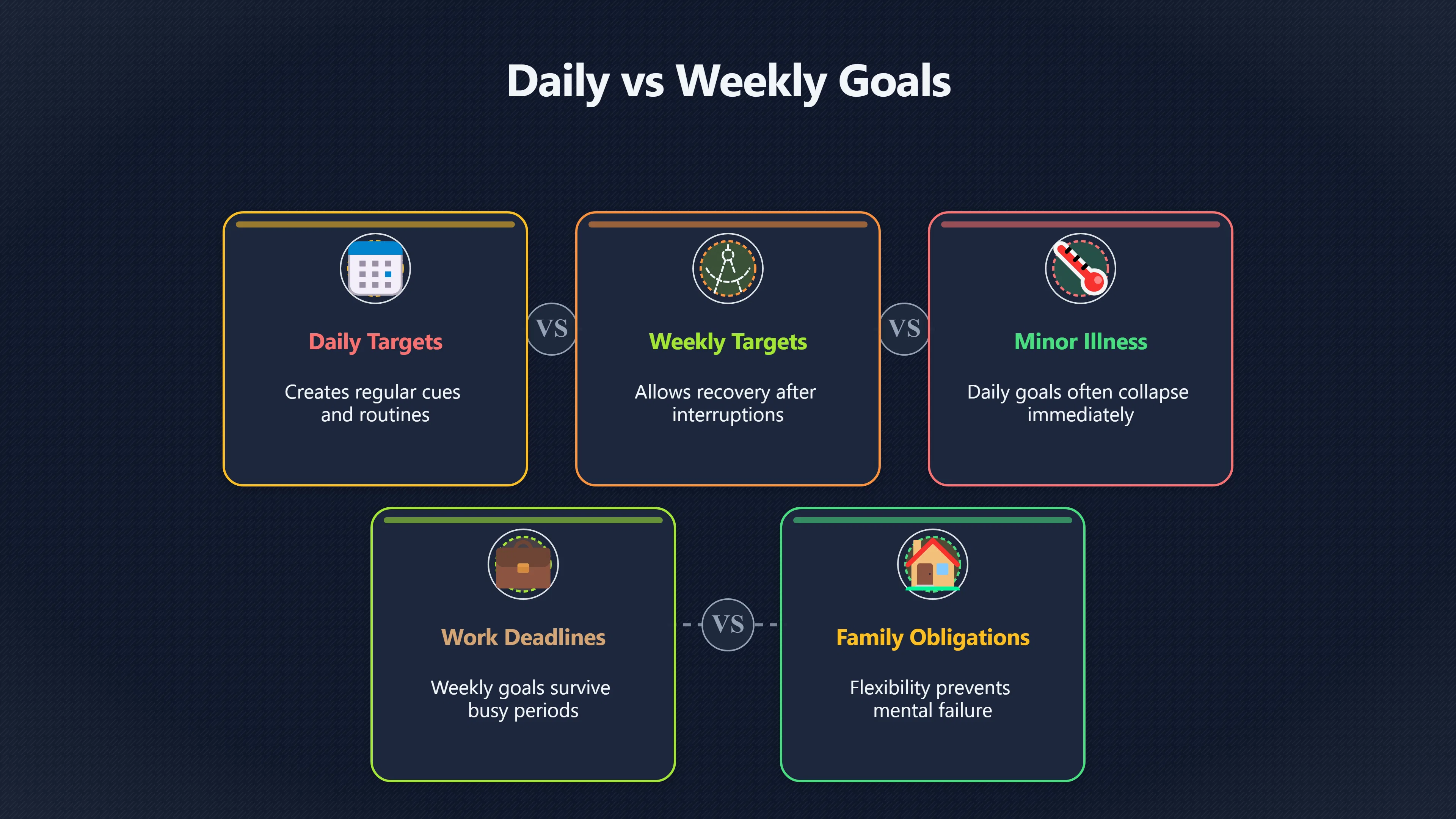
Daily goals have obvious advantages. They create regular cues, reduce decision-making and can speed the development of routines. Repetition in consistent contexts is a key ingredient of habit formation, which is one reason daily behaviours are often recommended.[PMC]pmc.ncbi.nlm.nih.govTime to Form a Habit: A Systematic Review and Meta-Analysis…by B Singh · 2024 · Cited by 95 — The meta-analysis showed significant…
The problem is that people often confuse “daily” with “better”.
Consider two reading goals:
- Read for 20 minutes every day.
- Read on five days each week.
The first sounds more ambitious. The second may be more durable. A person who misses Monday can still succeed. A person with the daily goal may feel they have already broken the streak and mentally write off the week.
This is one reason overly rigid schedules can backfire. They create an all-or-nothing standard in which one interruption becomes evidence of failure. Self-regulation research has long shown that maintaining goal-directed behaviour requires adaptation to changing circumstances, not simply stronger willpower.[ScienceDirect]sciencedirect.comSelf-regulation and goal-directed behavior: A systematic…by S Billore · 2023 · Cited by 112 — This article is one of the…
A useful question is not “What frequency would be ideal in a perfect month?” but “What frequency would I still achieve during a stressful month?”
The answer is often lower than people initially expect.
Why Daily Goals Often Break
The biggest weakness of daily goals is not that they are difficult. It is that they leave no margin for reality.
Most adults experience recurring disruptions:
- Minor illness
- Work deadlines
- Travel
- Family obligations
- Poor sleep
- Unexpected emergencies
A daily goal assumes that every day offers a reasonable opportunity to act. Real life rarely cooperates.
When goals repeatedly collide with circumstances, people often draw the wrong conclusion. Instead of questioning the schedule, they question themselves. They assume the problem is laziness or lack of discipline when the real issue is that the frequency requirement exceeded what their environment could support.
Research on habit formation also suggests that automaticity develops through consistent repetition over time, but the process is highly variable. Some habits form relatively quickly, while others take many months. The critical factor is sustained repetition, not perfection. Missing occasional opportunities does not erase progress.[PMC]pmc.ncbi.nlm.nih.govMaking health habitual: the psychology of 'habit-formation' and…by B Gardner · 2012 · Cited by 896 — Psychological theory and evide…[ResearchGate]researchgate.netPDF) Time to Form a Habit: A Systematic Review and…4 Dec 2024 — Habit formation typically takes 2 to 6 months, and up to a year for s…
This distinction matters. A goal that can survive occasional misses is often stronger than a goal that demands uninterrupted compliance.
Building Recovery Into the Schedule
Strong behaviour goals include a recovery path.
Many people create a plan for success but not a plan for interruption. As a result, the first missed session becomes a crisis rather than a normal event.
A more resilient approach is to define success across a larger time frame.
Instead of:
- Exercise every day.
Consider:
- Exercise four times each week.
Instead of:
- Write every evening.
Consider:
- Complete three writing sessions each week.
The weekly target creates flexibility while preserving accountability. A missed Tuesday can be recovered on Thursday. The goal remains alive.
This approach mirrors how many evidence-based health recommendations are structured. For example, physical activity guidelines focus on total weekly activity rather than requiring exercise every day. The emphasis is on accumulated behaviour across the week because consistency over time matters more than perfect daily execution.[World Health Organization]who.intphysical activityWorld Health OrganizationPhysical activity26 Jun 2024 — The WHO Global guidelines on physical activity and sedentary behaviour provide re…
Recovery-based goals reduce the psychological damage caused by inevitable disruptions. They encourage the mindset: “Resume as soon as possible” rather than “Start over next Monday.”
That shift may sound minor, but it changes how people respond after setbacks.
Matching Frequency to Motivation and Context
Different behaviours benefit from different frequencies.
A useful rule is to match the schedule to the nature of the behaviour rather than forcing every goal into a daily format.

When daily often makes sense
Daily frequency can work well when the behaviour:
- Takes only a few minutes.
- Fits naturally into an existing routine.
- Has a strong environmental cue.
- Requires little preparation.
Examples include:
- Taking medication.
- Reading five pages.
- Practising a language for ten minutes.
- Writing a brief journal entry.
These behaviours are small enough that daily repetition creates consistency without creating excessive burden.
When several times per week is often better
A less frequent schedule may work better when the behaviour:
- Requires significant energy.
- Depends on external conditions.
- Involves travel or equipment.
- Competes with other responsibilities.
Examples include:
- Gym training.
- Long study sessions.
- Deep work projects.
- Meal preparation.
Attempting these daily can create unnecessary friction. Three or four successful sessions each week often produce better long-term adherence than seven partially completed attempts.

When weekly goals are the right unit
Some goals naturally belong at the weekly level.
Examples include:
- Calling family members.
- Publishing content.
- Reviewing finances.
- Planning the coming week.
For these behaviours, forcing daily action may add complexity without adding value.
The schedule should reflect the behaviour’s natural rhythm.
The Hidden Advantage of Undercommitting
Many people secretly know that their planned frequency is unrealistic.
They choose seven days because six feels weak. They choose six workouts because four seems insufficient. The result is a goal they follow for two weeks and abandon in six.
There is often more long-term value in a frequency that feels slightly too easy than one that feels inspiring but fragile.
Habit researchers emphasise repetition in stable contexts because consistency creates the conditions for automatic behaviour. A smaller commitment repeated reliably usually produces more repetition than a larger commitment that repeatedly collapses. PMC[USC Dornsife]dornsife.usc.eduWood.Mazar.Neal.2021USC DornsifeHabits and Goals in Human Behavior: Separate but Interacting…by W Wood · 2021 · Cited by 195 — Other lines of research hav…
A person who studies three times every week for a year will generally outperform someone who studies daily for a month and then stops.
The impressive schedule matters less than the repeatable schedule.
A Practical Test for Choosing Frequency
Before finalising a behaviour goal, ask three questions:
- Could I still do this during a difficult week?
If the answer is no, reduce the frequency.
- What happens after I miss one session?
If the goal has no recovery path, redesign it.
- Would I rather succeed at this frequency for a year or a higher frequency for a month?
The honest answer usually reveals the better schedule.
The most effective behaviour goals are not the most ambitious on paper. They are the ones that survive ordinary life. A frequency that allows flexibility, recovery and repetition may look less impressive than a strict daily commitment, but it is often far more likely to produce lasting change.
Amazon book picks
Further Reading
Books and field guides related to Should Your Goal Really Be Daily?. Use these as the next step if you want deeper reading beyond the article.
Atomic Habits
Rating: 3.5/5 from 7 Google Books ratings
Discusses sustainable repetition and habit schedules.
The Power of Habit
Provides context for repetition, routines, and behavioural consistency.
eBay marketplace picks
Marketplace Samples
Topic-anchored marketplace searches for visual, collectible, or second-hand items related to this page.




Endnotes
1.
Source: pmc.ncbi.nlm.nih.gov
Link:https://pmc.ncbi.nlm.nih.gov/articles/PMC11641623/
Source snippet
Time to Form a Habit: A Systematic Review and Meta-Analysis...by B Singh · 2024 · Cited by 95 — The meta-analysis showed significant...
2.
Source: pmc.ncbi.nlm.nih.gov
Link:https://pmc.ncbi.nlm.nih.gov/articles/PMC3505409/
Source snippet
Making health habitual: the psychology of 'habit-formation' and...by B Gardner · 2012 · Cited by 896 — Psychological theory and evide...
3.
Source: dornsife.usc.edu
Title: Wood.Mazar.Neal.2021
Link:https://dornsife.usc.edu/wendy-wood/wp-content/uploads/sites/183/2023/10/Wood.Mazar_.Neal_.2021.pdf
Source snippet
USC DornsifeHabits and Goals in Human Behavior: Separate but Interacting...by W Wood · 2021 · Cited by 195 — Other lines of research hav...
4.
Source: sciencedirect.com
Link:https://www.sciencedirect.com/science/article/pii/S0148296322009006
Source snippet
Self-regulation and goal-directed behavior: A systematic...by S Billore · 2023 · Cited by 112 — This article is one of the...
5.
Source: researchgate.net
Link:https://www.researchgate.net/publication/386593213_Time_to_Form_a_Habit_A_Systematic_Review_and_Meta-Analysis_of_Health_Behaviour_Habit_Formation_and_Its_Determinants
Source snippet
(PDF) Time to Form a Habit: A Systematic Review and...4 Dec 2024 — Habit formation typically takes 2 to 6 months, and up to a year for s...
6.
Source: who.int
Title: physical activity
Link:https://www.who.int/news-room/fact-sheets/detail/physical-activity
Source snippet
World Health OrganizationPhysical activity26 Jun 2024 — The WHO Global guidelines on physical activity and sedentary behaviour provide re...
7.
Source: researchgate.net
Link:https://www.researchgate.net/publication/236956891_Habit_Formation_Among_Regular_Exercisers_at_Fitness_Centers_An_Exploratory_Study
Source snippet
nd then to inform interventions to increase exercise adherence...
Additional References
8.
Source: healthline.com
Link:https://www.healthline.com/health/how-long-does-it-take-to-form-a-habit
Source snippet
Habit Formation: How Long It Takes and How to Start NowOne strategy is to identify the places, people, or activities that are linked in y...
9.
Source: topics.consensus.app
Link:https://topics.consensus.app/news/meta-analysis-shows-planning-workouts-enhances-exercise-adherence-and-habit-formation-evidence-review
Source snippet
consensus.appMeta-analysis shows planning workouts enhances...22 Jan 2026 — Related studies consistently find that exercise adherence is...
10.
Source: wjarr.com
Link:https://wjarr.com/sites/default/files/fulltext_pdf/WJARR-2025-1333.pdf
Source snippet
, this review aims to highlight effective strategies for fostering positive behavioral...Read more...
11.
Source: changeit.co.nz
Title: changing habits through [goal setting]({{ ‘goal-setting/’ | relative_url }}) and planning
Link:https://www.changeit.co.nz/changing-habits-through-goal-setting-and-planning/
Source snippet
5 Sept 2015 — While statistics confirm that most resolutions will never be kept, a few simple [techniques]({{ 'techniques/' | relative_url }}) may improve your chances of success...
12.
Source: malpaper.com
Title: how to track your habits for long term success
Link:https://malpaper.com/blogs/news/how-to-track-your-habits-for-long-term-success?srsltid=AfmBOorkitl6Mpc8pOzaogWEQg8cxDaDpzGVIF_orrq_DPtUGMP0Dmx2
Source snippet
How to Track Your Habits for Long-Term Success8 Jul 2024 — Daily tracking is essential for maintaining consistency and building momentum...
13.
Source: facebook.com
Link:https://www.facebook.com/snehworld/posts/changing-old-habits-varies-for-each-person-it-depends-on-habit-complexity-motiva/1016503583175684/
Source snippet
takes 18 to 254 days for a person to form a new habit. The study...
14.
Source: trainingbyrobyn.com
Title: This means that making exercise a habit
Link:https://trainingbyrobyn.com/blog/setting-fitness-goals-that-last-how-to-build-sustainable-habitsbr
Source snippet
Setting Fitness Goals That Last: How to Build Sustainable...26 Jan 2026 — Wendy Wood, in her research on habit formation, found that nea...
15.
Source: ncbi.nlm.nih.gov
Link:https://www.ncbi.nlm.nih.gov/books/NBK566046/
Source snippet
WHO Guidelines on Physical Activity...Adults should do at least 150–300 minutes of moderate-intensity aerobic physical activity; or at l...
16.
Source: marketing.wharton.upenn.edu
Title: Paper Wood Wendy 03 18 2013
Link:https://marketing.wharton.upenn.edu/wp-content/uploads/2020/07/Paper-Wood-Wendy-03-18-2013.pdf
Source snippet
as External Self-RegulationThis prior research has focused on goal-incongruent behaviors because of their obvious adverse effects on heal...
17.
Source: hingehealth.com
Title: smart goal examples
Link:https://www.hingehealth.com/resources/articles/smart-goal-examples/
Source snippet
SMART Goals: Examples and How to Set Them7 Apr 2025 — One of the most popular goal-setting strategies is the SMART framework. It stands f...
Topic Tree