Within Goals vs Systems
Is Motivation Really the Missing Piece?
Many stalled goals need better capability or opportunity, not another burst of motivation.
On this page
- Capability problems disguised as willpower
- Opportunity problems in everyday environments
- Turning a stuck goal into a system redesign
Page outline Jump by section
Introduction
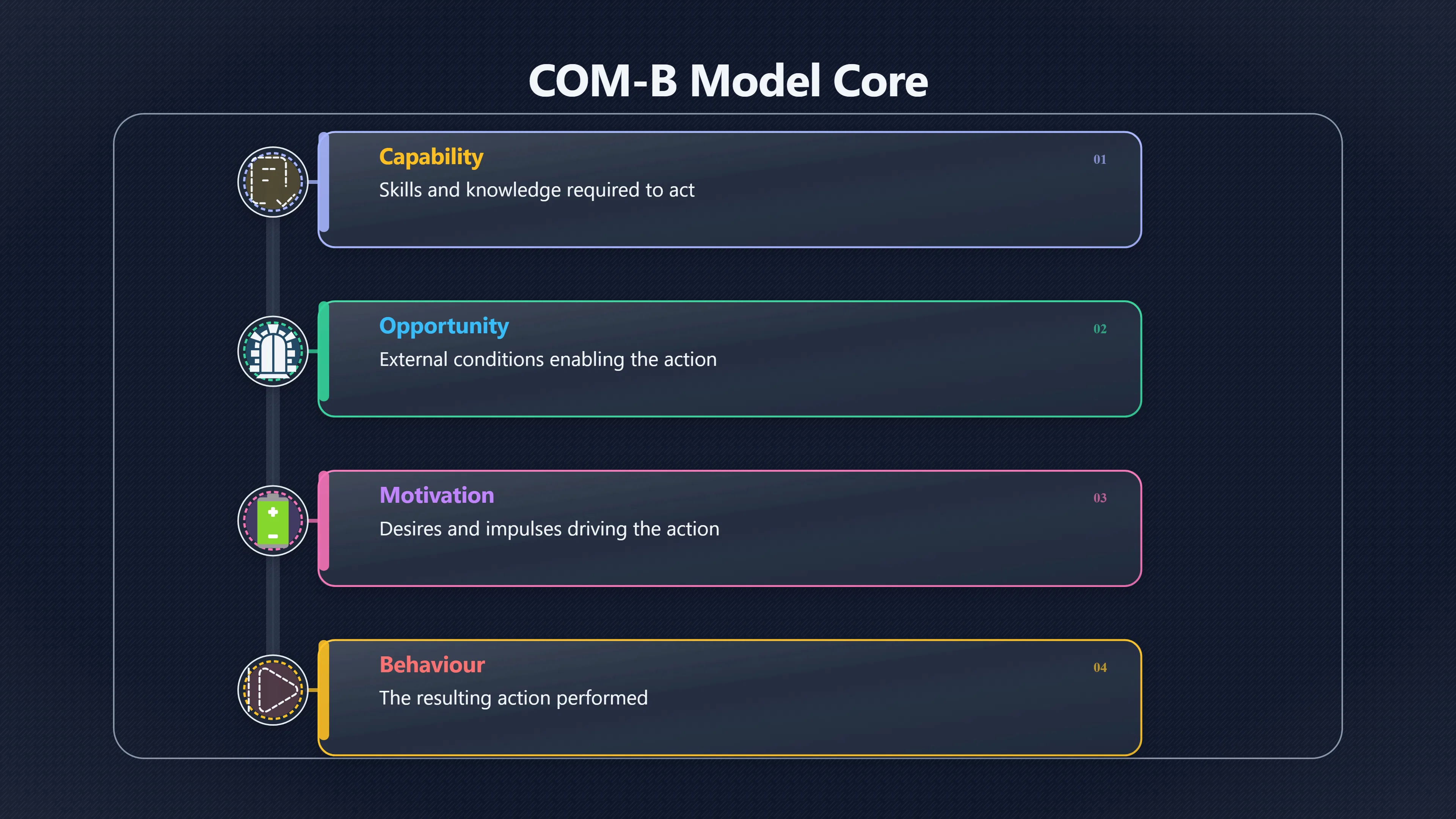
Many goals fail for a reason that is both frustrating and surprisingly ordinary: the problem is not a lack of determination. People often respond to stalled progress by trying to become more motivated, when the real obstacle is that they lack the capability, opportunity, or support needed to perform the behaviour consistently. The COM-B model was developed precisely to diagnose this problem. It proposes that behaviour depends on three interacting conditions: Capability, Opportunity, and Motivation. If any of these are missing, the desired behaviour becomes difficult to sustain regardless of how strong the original goal may be.[PMC]pmc.ncbi.nlm.nih.govby S Michie · 2011 · Cited by 17077 — At the centre of a proposed new framework is a 'behaviour system' involving three essential cond…
 Within a systems-design approach to self-improvement, COM-B shifts attention away from asking “How can I try harder?” and towards asking “What is preventing this behaviour from occurring reliably?” That change in perspective often reveals that repeated failure is less a character flaw than a design flaw.[UCL Discovery]discovery.ucl.ac.ukUCL DiscoveryA brief introduction to the COM-B Model of behaviour and the…by R West · 2020 · Cited by 635 — It identifies three factor…
Is Motivation Really the Missing Piece?
The COM-B framework, developed by Susan Michie, Maartje van Stralen and Robert West, argues that behaviour emerges from the interaction of capability, opportunity and motivation. These factors influence one another over time rather than operating independently.[PMC]pmc.ncbi.nlm.nih.govby S Michie · 2011 · Cited by 17077 — At the centre of a proposed new framework is a 'behaviour system' involving three essential cond…
This matters because many people diagnose every failure as a motivation problem:
- Missed workouts become evidence of laziness.
- Abandoned study plans become evidence of poor discipline.
- Repeated overspending becomes evidence of weak self-control.
COM-B suggests a different interpretation. A behaviour may fail because:
- You do not yet possess the required skills or knowledge (capability).
- Your environment makes the behaviour difficult (opportunity).
- Competing rewards or habits outweigh the intended action (motivation).
In practice, motivation is often the most visible symptom but not the root cause. Someone who repeatedly skips exercise may genuinely want to exercise. The issue may be poor sleep, lack of transport, uncertainty about what to do in the gym, or a schedule that creates constant time pressure. Treating those barriers as a motivation deficit can lead to endless cycles of goal setting without meaningful progress.[The Decision Lab]thedecisionlab.comThe Decision LabThe COM-B Model for Behavior ChangeThe COM-B model for behavior change cites capability (C), opportunity (O), and motivat…
Research examining COM-B in health-related behaviours has found that capability and opportunity often influence behaviour through their effects on motivation. In other words, people frequently become more motivated after barriers are removed rather than before.[Springer]link.springer.comIn the physical activity model…Read more…
Capability Problems Disguised as Willpower
Capability refers to having the psychological and physical ability to perform a behaviour. Psychological capability includes knowledge, planning skills, attention and decision-making. Physical capability includes strength, stamina and practical competence.[behaviourchangewheel.com]behaviourchangewheel.comThe BCW: from behavioural diagnosis to intervention designIt uses the COM-B ('capability', 'opportunity', 'motivation' and 'behaviour') m…
A common mistake in self-improvement is assuming that repeated failure reflects insufficient effort when the behaviour actually exceeds current capability.
Consider several examples:
The aspiring runner. A person sets a goal to run five kilometres three times a week. After two weeks they quit. The apparent problem is motivation. The actual problem may be physical capability: the programme started beyond their current fitness level.
The budgeter. Someone repeatedly fails to stick to a spending target. They blame poor self-control. Yet they have never learned a budgeting method or built a tracking system. The obstacle is psychological capability rather than motivation.
The would-be reader. A goal to read for an hour every evening repeatedly collapses. Closer examination reveals severe mental fatigue after work and an inability to concentrate for extended periods. The behaviour requires cognitive resources that are unavailable at that time.
A systems approach therefore asks different questions:
- Does the person know exactly how to perform the behaviour?
- Is the behaviour scaled appropriately for their current ability?
- Have they practised the necessary skills?
- Is the task simple enough to succeed repeatedly?
Many “discipline” problems improve when the behaviour is made easier, smaller, or more structured. The goal remains the same, but capability is deliberately increased through training, education, repetition or simplification.[Norfolk County Council]norfolk.gov.ukNorfolk County CouncilCOM-B and the behaviour change wheelSo at the heart of the wheel are the sources of behaviour, which can be broken…

Opportunity Problems in Everyday Environments
Opportunity refers to external conditions that make a behaviour possible. COM-B distinguishes between physical opportunity and social opportunity. Physical opportunity includes time, resources, locations and environmental cues. Social opportunity includes cultural expectations, social norms and interpersonal influence.[behaviourchangewheel.com]behaviourchangewheel.comThe Behaviour Change Wheel BookA Guide To Designing…Written by Susan Michie, Lou Atkins & Robert West · Welcome to the Wheel · Psychological Capability · Physical Ca…
This category is especially important because people often underestimate how strongly environments shape behaviour.
A person may set a goal to eat healthier while keeping highly processed snacks visible throughout the house. Another may intend to write every morning while leaving email, messaging apps and notifications as the first thing they encounter when opening a laptop.
The problem is not necessarily weak commitment. The environment is simply producing different behaviour than the goal requires.
Opportunity failures commonly appear as:
- Insufficient time buffers.
- Friction that makes the desired action inconvenient.
- Easy access to competing behaviours.
- Social groups that reinforce the unwanted habit.
- Lack of equipment, resources or suitable spaces.
The Behaviour Change Wheel framework surrounding COM-B explicitly identifies environmental restructuring as a major intervention strategy because changing surroundings often changes behaviour more reliably than increasing effort alone.[PMC]pmc.ncbi.nlm.nih.govby S Michie · 2011 · Cited by 17077 — At the centre of a proposed new framework is a 'behaviour system' involving three essential cond…
For example:
GoalCommon ResponseCOM-B Opportunity FixExercise regularlyTry to be more disciplinedPack gym clothes the night before and choose a fixed locationRead more booksMake a stronger commitmentKeep a book visible and remove competing cuesSave moneySet a larger savings targetAutomate transfers immediately after paydayEat healthierIncrease willpowerChange what enters the shopping basket
These interventions work because they redesign the environment instead of demanding continuous self-control.
Turning a Stuck Goal into a System Redesign
When a goal repeatedly fails, COM-B can be used as a diagnostic tool rather than a motivational tool.
Start by identifying the exact behaviour that is failing. Then ask three questions.
What capability is missing?
Look for gaps in knowledge, skill, stamina, attention or planning.
Examples:
- Learn meal preparation before attempting a strict nutrition plan.
- Follow a beginner training programme instead of an advanced one.
- Create templates and checklists for recurring work tasks.

What opportunity is missing?
Look for environmental barriers, lack of resources, scheduling conflicts or social obstacles.
Examples:
- Put running shoes by the door.
- Block study time before meetings fill the calendar.
- Remove distracting apps from primary devices.
- Join a group where the desired behaviour is normal.
What motivation is missing?
Only after examining capability and opportunity should motivation become the main focus.[thecenterforimplementation.com]thecenterforimplementation.comThe Capability, Opportunity, MotivationBehavior (COM-B)…26 Sept 2025 — The Capability, Opportunity, Motivation - Behavior (COM-B) theory is an individual-level theory of beh…
COM-B distinguishes between reflective motivation (conscious plans, evaluations and intentions) and automatic motivation (habits, impulses, emotions and learned responses).[behaviourchangewheel.com]behaviourchangewheel.comThe BCW: from behavioural diagnosis to intervention designIt uses the COM-B ('capability', 'opportunity', 'motivation' and 'behaviour') m…
Possible interventions include:
- Linking the behaviour to a personally meaningful outcome.
- Tracking progress visibly.
- Creating immediate rewards for completion.
- Building routines that reduce reliance on moment-to-moment decisions.
The key insight is that motivation is often easier to maintain once capability and opportunity are improved. A person who knows exactly what to do and can do it in a supportive environment usually experiences less resistance than someone fighting constant barriers.[Springer]link.springer.comIn the physical activity model…Read more…
Why COM-B Fits a Systems View of Self-Improvement
Goal-centred thinking tends to focus on outcomes. COM-B focuses on the conditions that generate behaviour. That distinction makes it particularly useful when goals have been attempted repeatedly without success.
The model treats behaviour as part of a dynamic system in which capability, opportunity and motivation influence one another through feedback loops. Success can increase confidence and motivation; improved capability can make behaviours easier; supportive environments can strengthen both. Likewise, poor environments can erode motivation and capability over time. UCL Discovery[2habitweekly.com]habitweekly.comThe COM-B ModelThe COM-B model of behaviour change suggests that to engage in a behaviour (B), a person needs to have the capability (C)…
For practical self-improvement, the lesson is straightforward: when a goal keeps failing, resist the temptation to immediately raise motivation. First diagnose the system. The most effective intervention may not be another inspiring target or a stronger commitment. It may be learning a missing skill, removing friction, changing a routine, or redesigning the environment so that the desired behaviour becomes the easier choice. That is often where lasting change begins.[PMC]pmc.ncbi.nlm.nih.govby S Michie · 2011 · Cited by 17077 — At the centre of a proposed new framework is a 'behaviour system' involving three essential cond…
Amazon book picks
Further Reading
Books and field guides related to Is Motivation Really the Missing Piece?. Use these as the next step if you want deeper reading beyond the article.
Atomic Habits
Rating: 3.5/5 from 7 Google Books ratings
Shows how redesigning systems often beats relying on motivation.
eBay marketplace picks
Marketplace Samples
Example marketplace items related to this page. Use the search link to explore similar finds on eBay.




Endnotes
1.
Source: pmc.ncbi.nlm.nih.gov
Link:https://pmc.ncbi.nlm.nih.gov/articles/PMC3096582/
Source snippet
by S Michie · 2011 · Cited by 17077 — At the centre of a proposed new framework is a 'behaviour system' involving three essential cond...
2.
Source: behaviourchangewheel.com
Link:https://www.behaviourchangewheel.com/about-wheel
Source snippet
The BCW: from behavioural diagnosis to intervention designIt uses the COM-B ('capability', 'opportunity', 'motivation' and 'behaviour') m...
3.
Source: habitweekly.com
Link:https://www.habitweekly.com/models-frameworks/the-com-b-model
4.
Source: link.springer.com
Link:https://link.springer.com/article/10.1186/s12889-021-11019-w
Source snippet
In the physical activity model...Read more...
5.
Source: behaviourchangewheel.com
Title: The Behaviour Change Wheel Book
Link:https://www.behaviourchangewheel.com/
Source snippet
A Guide To Designing...Written by Susan Michie, Lou Atkins & Robert West · Welcome to the Wheel · Psychological Capability · Physical Ca...
6.
Source: discovery.ucl.ac.uk
Link:https://discovery.ucl.ac.uk/id/eprint/10095640/
Source snippet
UCL DiscoveryA brief introduction to the COM-B Model of behaviour and the...by R West · 2020 · Cited by 635 — It identifies three factor...
7.
Source: thedecisionlab.com
Link:https://thedecisionlab.com/reference-guide/organizational-behavior/the-com-b-model-for-behavior-change
Source snippet
The Decision LabThe COM-B Model for Behavior ChangeThe COM-B model for behavior change cites capability (C), opportunity (O), and motivat...
8.
Source: norfolk.gov.uk
Link:https://www.norfolk.gov.uk/article/42184/COM-B-and-the-behaviour-change-wheel
Source snippet
Norfolk County CouncilCOM-B and the behaviour change wheelSo at the heart of the wheel are the sources of behaviour, which can be broken...
9.
Source: sciencedirect.com
Link:https://www.sciencedirect.com/topics/psychology/com-b-model
Source snippet
COM-B Model - an overview | ScienceDirect TopicsThe behavior change wheel is closely linked to the COM-B model, which stands for Capabili...
10.
Source: thecenterforimplementation.com
Title: The Capability, Opportunity, Motivation
Link:https://thecenterforimplementation.com/toolbox/com-b
Source snippet
Behavior (COM-B)...26 Sept 2025 — The Capability, Opportunity, Motivation - Behavior (COM-B) theory is an individual-level theory of beh...
Additional References
11.
Source: modelthinkers.com
Link:https://modelthinkers.com/mental-model/com-b-behaviour-change-wheel
Source snippet
COM-B & Behaviour Change WheelAt its heart is the COM-B behaviour model, which posits that Behaviour occurs as an interaction between Cap...
12.
Source: netzerogo.org.uk
Link:https://netzerogo.org.uk/resources/the-behaviour-change-wheel/
Source snippet
The Behaviour Change WheelIt uses the COM-B ('capability', 'opportunity', 'motivation', and 'behaviour') model. This model recognises tha...
13.
Source: netzerogo.org.uk
Link:https://netzerogo.org.uk/resources/the-com-b-model-of-behaviour/
Source snippet
The COM-B Model of BehaviourThe COM-B model proposes that there are three components to any Behaviour (B): Capability (C), Opportunity (O...
14.
Source: togetheragency.co.uk
Link:https://togetheragency.co.uk/news/the-com-b-model-of-behaviour-change-explained
Source snippet
The COM-B model of behaviour change explainedThe COM-B model of behaviour change suggests that capability (C), opportunity (O) and motiva...
15.
Source: unicef.org
Link:https://www.unicef.org/innocenti/media/3801/file/Evidence-based-Intervention-Design-Behaviour-Change-2023.pdf
Source snippet
This theory is known as the. COM-B model (capability, opportunity...Read more...
16.
Source: pubmed.ncbi.nlm.nih.gov
Link:https://pubmed.ncbi.nlm.nih.gov/21513547/
Source snippet
behaviour change wheel: a new method for...by S Michie · 2011 · Cited by 16845 — At the centre of a proposed new framework is a 'behavio...
17.
Source: social-change.co.uk
Link:https://social-change.co.uk/files/02.09.19COM-B_and_changing_behaviour.pdf
Source snippet
O) and Motivation (M). In order to · perform a...Read more...
18.
Source: thinkingaboutbehavior.substack.com
Title: the [limits]({{ ‘limits/’ | relative_url }}) of com b and the behaviour
Link:https://thinkingaboutbehavior.substack.com/p/the-limits-of-com-b-and-the-behaviour
Source snippet
limits of COM-B and the Behaviour Change WheelCritics argue that by focusing on broad categories like Capability, Opportunity, and Motiva...
19.
Source: youtube.com
Link:https://www.youtube.com/watch?v=4LjuiMymOCs
Source snippet
CHANGE Your Behaviour Using THIS! | Patrick Elliott | #80...
20.
Source: youtube.com
Title: Dr. Susan Michie, The Behaviour Change Wheel
Link:https://www.youtube.com/watch?v=2-KvaIsb0fM
Source snippet
Want LASTING Change? Discover Robert Dilts Logical Levels of Change & COM-B Model of Behavior Change...
Topic Tree