Within Gym Routine
The 20 Minute Workout That Saves the Habit
A planned 20-minute minimum workout keeps the habit alive on tired days without turning every evening into an all-or-nothing test.
On this page
- Why all or nothing plans fail after work
- Simple strength, cardio, and mobility minimums
- How to decide whether to continue or leave
Page outline Jump by section
Introduction
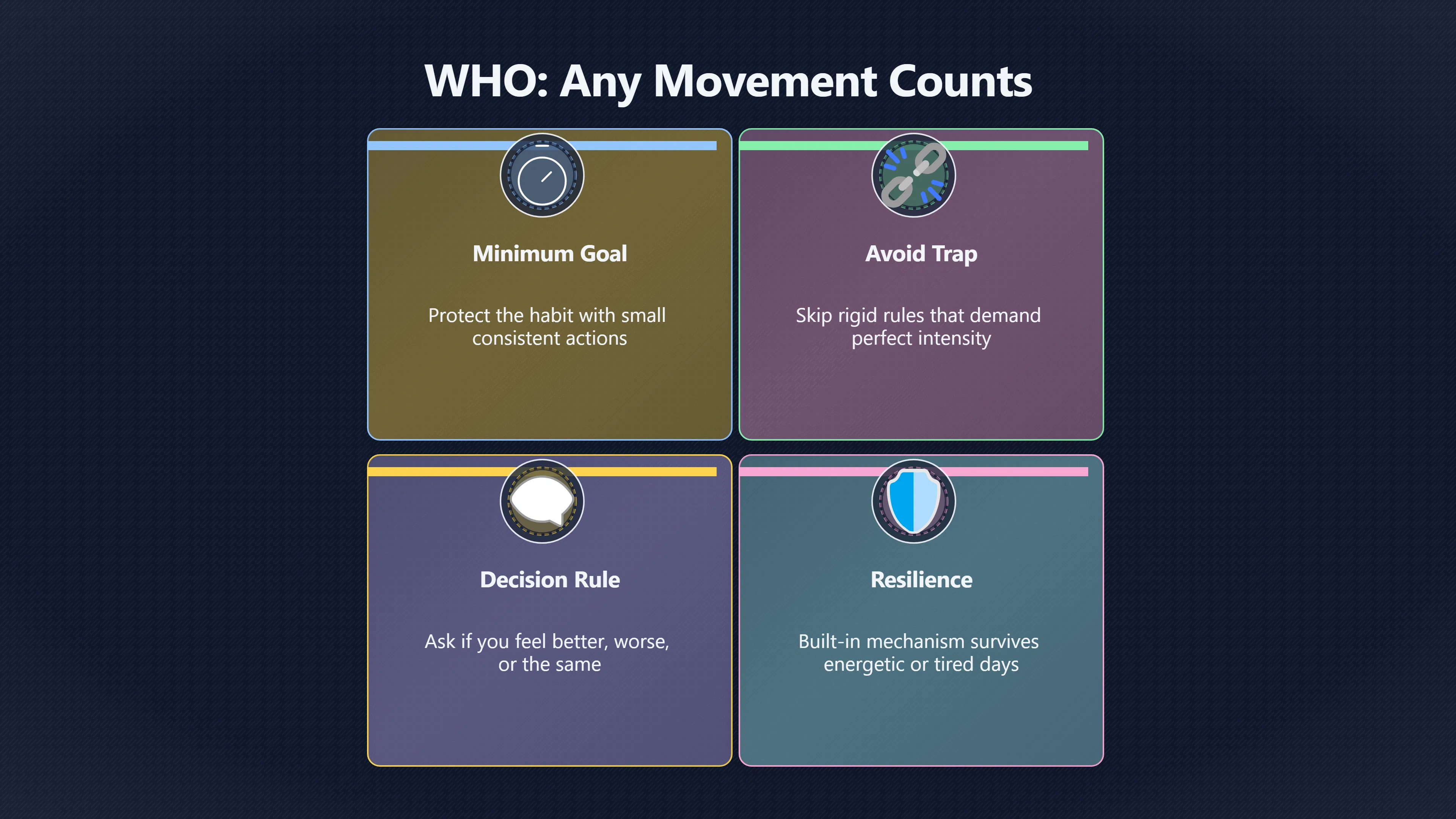
A successful after-work gym routine needs a fallback plan for the evenings when energy is low. The mistake many people make is treating every workout as a pass-or-fail test: either complete the full session or skip it entirely. In practice, consistency is usually built by doing something smaller when work has been draining, the commute was difficult, or motivation is absent. Research on physical activity habits consistently shows that regular repetition helps behaviours become more automatic over time, while public-health guidance emphasises that some activity is better than none.[PubMed Central]pmc.ncbi.nlm.nih.govFuture studies could leverage the insights form this study.Read more…[World Health Organization]who.intphysical activityWorld Health OrganizationPhysical activity26 Jun 2024 — The guidelines highlight that any amount of physical activity is better than none…
 The purpose of a minimum workout is not to maximise fitness on every evening. It is to protect the habit. A planned 20-minute session keeps the routine alive, maintains the identity of being someone who trains after work, and prevents a missed day from becoming a missed week.
The 20-Minute Workout That Saves the Habit
Low-energy evenings are predictable. Meetings overrun, deadlines pile up, sleep is imperfect, and motivation fluctuates. Building a gym routine that assumes every evening will feel energetic is therefore a design flaw rather than a personal failing.
Recent research into exercise adherence highlights how habit formation benefits from consistent repetition, even when the activity itself is modest. People are more likely to sustain physical activity when the behaviour becomes automatic and embedded in daily routines.[PubMed Central]pmc.ncbi.nlm.nih.govFuture studies could leverage the insights form this study.Read more…
A minimum workout works because it changes the question. Instead of asking, “Do I have enough energy for a full workout?”, the question becomes, “Can I complete my minimum?” Most evenings, the answer is yes.
The minimum should be:
- Short enough to feel achievable when tired.
- Structured in advance rather than improvised.
- Effective enough to maintain momentum.
- Easy to scale upward if energy improves.
Twenty minutes is often a practical compromise. It is long enough to include meaningful movement yet short enough to feel manageable after a demanding day.
Why All-or-Nothing Plans Fail After Work
Many people unknowingly adopt rigid rules about exercise. A workout must last an hour. It must feel intense. It must match the best sessions from previous weeks. If those standards cannot be met, the session gets abandoned entirely.
Emerging research on exercise behaviour suggests that this “all-or-nothing” thinking can undermine consistency. People frequently dismiss a short workout as not counting, even though shorter bouts of activity still provide benefits and reinforce the exercise habit.[The Washington Post]washingtonpost.comThis mentality, where people believe workouts must be intense, lengthy, or perfect to count, causes many to give up when they fall short…
The problem becomes especially visible after work because fatigue reduces willingness to tackle demanding tasks. When the only acceptable option is a complete gym session, tiredness often turns into inactivity.
A minimum workout removes that trap. Instead of trying to win every evening, the goal becomes avoiding a zero.
This distinction matters because public-health recommendations increasingly emphasise that all movement counts. Modern guidelines no longer require activity to occur in long continuous blocks before it is considered beneficial. World Health Organization[PubMed Central]pmc.ncbi.nlm.nih.govFuture studies could leverage the insights form this study.Read more…
Simple Strength, Cardio, and Mobility Minimums
The best minimum workout is one that requires little thought. Decision-making is often the first thing to disappear after a tiring workday.
Strength Minimum
A strength-focused minimum session can be completed in about 20 minutes:
- Goblet squats or bodyweight squats – 2 sets.
- Push-ups or machine chest press – 2 sets.
- Dumbbell rows or cable rows – 2 sets.
- Plank – 2 rounds.
The objective is not maximum effort. It is simply to train the major movement patterns and leave knowing that the session happened.
Evidence on minimal-dose resistance training suggests that even surprisingly small amounts of strength work can improve strength and fitness when performed consistently. Single-set approaches and other low-volume strategies have shown meaningful benefits, particularly for people who might otherwise do nothing.[PubMed Central]pmc.ncbi.nlm.nih.govFuture studies could leverage the insights form this study.Read more…

Cardio Minimum
For evenings when mental fatigue is high but movement feels possible:
- 20 minutes of brisk treadmill walking.
- 20 minutes on a stationary bike at conversational intensity.
- 10 minutes of easy cardio followed by 10 minutes slightly harder.
This option works particularly well when concentration is low and the thought of lifting weights feels overwhelming.
Walking remains one of the simplest and most sustainable forms of physical activity. Organisations such as the American Heart Association emphasise that short bouts accumulated throughout the day still contribute to health benefits.[www.heart.org]heart.orgaha recs for physical activity in adultsAnd you can break it up into short bouts of activity throughout the day. Taking a brisk walk for…Read more…
Mobility Minimum
Some evenings are genuinely recovery evenings.
A mobility minimum might include:
- Five minutes of walking.
- Hip mobility drills.
- Thoracic spine rotations.
- Hamstring stretches.
- Shoulder mobility work.
- Light core exercises.
This session is deliberately easy. The value lies in preserving the routine of arriving, changing clothes, and moving.
How to Decide Whether to Continue or Leave
A minimum workout should include a clear decision point.
After 20 minutes, ask a simple question: “Do I feel better, worse, or the same?”
Three outcomes are possible:
Continue.
Many people discover that the hardest part was starting. Energy improves once movement begins, and the session naturally expands into a normal workout.
Stop and leave.
If fatigue remains high and performance feels poor, the minimum workout has already succeeded. The goal was attendance and movement, not heroics.
Switch gears.
Sometimes the original plan is unrealistic, but a lighter version is possible. A heavy strength session may become easy cardio. An intense interval workout may become mobility work.
This decision rule prevents guilt. The evening is no longer judged by whether the full programme was completed. Success was defined before the workout started.
Why Minimum Workouts Often Produce Better Long-Term Results
A minimum workout can appear inefficient when viewed in isolation. Twenty minutes is less impressive than sixty. One light session burns fewer calories than a hard session.
The problem is that fitness outcomes are produced by months and years of behaviour, not by isolated evenings.
Research on habit formation repeatedly shows that consistent repetition helps establish automatic patterns. The person who completes three minimum workouts during a difficult week often stays engaged with exercise. The person who skips all three because they could not perform the ideal session often loses momentum entirely.[PubMed Central]pmc.ncbi.nlm.nih.govFuture studies could leverage the insights form this study.Read more…
Evidence from studies of short activity bouts and minimal-dose exercise also points in the same direction: meaningful health and fitness benefits can arise from smaller amounts of activity than many people assume. The biggest difference is often between doing nothing and doing something.[ScienceDirect]sciencedirect.comShort bouts of accumulated exercise: Review and…by M Yin · 2025 · Cited by 15 — Insufficient physical activity (PA)—defined as failing…[PubMed Central]pmc.ncbi.nlm.nih.govFuture studies could leverage the insights form this study.Read more…[PubMed Central]pmc.ncbi.nlm.nih.govFuture studies could leverage the insights form this study.Read more…
For an after-work gym routine, the minimum workout is therefore not a compromise. It is a built-in resilience mechanism. On energetic days, it becomes the first 20 minutes of a full session. On exhausting days, it becomes the session itself. Either way, the habit survives.
Amazon book picks
Further Reading
Books and field guides related to The 20 Minute Workout That Saves the Habit. Use these as the next step if you want deeper reading beyond the article.
Atomic Habits
Rating: 3.5/5 from 7 Google Books ratings
Perfect fit for minimum viable workouts and consistency.
eBay marketplace picks
Marketplace Samples
Example marketplace items related to this page. Use the search link to explore similar finds on eBay.



Endnotes
1.
Source: who.int
Title: physical activity
Link:https://www.who.int/news-room/fact-sheets/detail/physical-activity
Source snippet
World Health OrganizationPhysical activity26 Jun 2024 — The guidelines highlight that any amount of physical activity is better than none...
2.
Source: heart.org
Title: aha recs for physical activity in adults
Link:https://www.heart.org/en/healthy-living/exercise-and-physical-activity/fitness-basics/aha-recs-for-physical-activity-in-adults
Source snippet
And you can break it up into short bouts of activity throughout the day. Taking a brisk walk for...Read more...
3.
Source: sciencedirect.com
Link:https://www.sciencedirect.com/science/article/pii/S2095254625000705
Source snippet
Short bouts of accumulated exercise: Review and...by M Yin · 2025 · Cited by 15 — Insufficient physical activity (PA)—defined as failing...
4.
Source: who.int
Link:https://www.who.int/publications/i/item/9789240015128
Source snippet
WHO guidelines on physical activity and sedentary behaviour25 Nov 2020 — The WHO Guidelines on physical activity and sedentary behaviour...
5.
Source: who.int
Link:https://www.who.int/initiatives/behealthy/physical-activity
Source snippet
Physical activityShould do at least 150 minutes of moderate-intensity physical activity throughout the week, or do at least 75 minutes of...
6.
Source: who.int
Link:https://www.who.int/europe/publications/i/item/9789240014886
Source snippet
WHO guidelines on physical activity and sedentary behaviour4 May 2021 — For health and wellbeing, WHO recommends at least 150 to 300 minu...
Published: May 2021
7.
Source: pmc.ncbi.nlm.nih.gov
Link:https://pmc.ncbi.nlm.nih.gov/articles/PMC10498635/
Source snippet
Future studies could leverage the insights form this study.Read more...
8.
Source: pmc.ncbi.nlm.nih.gov
Link:https://pmc.ncbi.nlm.nih.gov/articles/PMC7719906/
Source snippet
by FC Bull · 2020 · Cited by 13059 — Many of the benefits of physical activity are observed within average weekly volumes of 150–300 m...
9.
Source: washingtonpost.com
Link:https://www.washingtonpost.com/wellness/2026/02/25/all-or-nothing-exercise-mindset/
Source snippet
This mentality, where people believe workouts must be intense, lengthy, or perfect to count, causes many to give up when they fall short...
10.
Source: pmc.ncbi.nlm.nih.gov
Link:https://pmc.ncbi.nlm.nih.gov/articles/PMC11127831/
Source snippet
PubMed CentralResistance Exercise Minimal Dose Strategies for Increasing...by JL Nuzzo · 2024 · Cited by 48 — We define and overview evi...
11.
Source: pmc.ncbi.nlm.nih.gov
Title: Pub Med Central American College of Sports Medicine Position Stand
Link:https://pmc.ncbi.nlm.nih.gov/articles/PMC12965823/
Source snippet
by BS CURRIER · 2026 — Individualized programs can increase exercise adoption and adherence (10), but individualization has been scarc...
12.
Source: pmc.ncbi.nlm.nih.gov
Link:https://pmc.ncbi.nlm.nih.gov/articles/PMC11562445/
Source snippet
PubMed CentralHealth-Related Benefits and Adherence for Multiple Short...by NI Brown · 2024 · Cited by 13 — Prescribing or recommending...
13.
Source: frontiersin.org
Link:https://www.frontiersin.org/journals/physiology/articles/10.3389/fphys.2025.1548382/full
Source snippet
The effects of exercise based on adherence to ACSM...by J Li · 2025 — This meta-analysis revealed that exercise interventions with high...
Additional References
14.
Source: researchgate.net
Link:https://www.researchgate.net/publication/343679552_Protocol_for_Minute_Calisthenics_A_randomized_controlled_study_of_a_daily_habit-based_bodyweight_resistance_training_program
Source snippet
A randomized controlled study of a daily, habit-based...5 Aug 2020 — The approach is unique in that it utilizes brief but frequent body...
15.
Source: researchgate.net
Link:https://www.researchgate.net/publication/347179596_World_Health_Organization_2020_guidelines_on_physical_activity_and_sedentary_behaviour
Source snippet
(PDF) World Health Organization 2020 guidelines on...21 Dec 2020 — All adults should undertake 150–300 min of moderate-intensity, or 75–...
16.
Source: researchgate.net
Link:https://www.researchgate.net/publication/394314358_Exploring_the_impact_of_short-term_adherence_to_physical_activity_guidelines_to_improve_the_intrinsic_capacity_of_older_adults
Source snippet
Exploring the impact of short-term adherence to physical...5 Aug 2025 — Therefore, this study aimed to assess the impact of 4 weeks adhe...
17.
Source: acsm.org
Link:https://acsm.org/education-resources/trending-topics-resources/acsm-fitness-trends/
Source snippet
ACSM Fitness TrendsThis article from ACSM's Health & Fitness Journal® reveals how power declines faster than strength, why that matters f...
18.
Source: neacsm.org
Link:https://www.neacsm.org/acsm-links
Source snippet
ACSM LinksAmerican College of Sports Medicine (ACSM). Advancing health through science, education, and medicine. Much more than a slogan...
19.
Source: acsm.org
Link:https://acsm.org/resistance-training-guidelines-update-2026/
Source snippet
ACSM Publishes Updated Resistance Training GuidelinesUnderstand the key points of the ACSM Resistance Training Guidelines for effective m...
20.
Source: acsm.org
Link:https://acsm.org/education-resources/trending-topics-resources/physical-activity-guidelines/
Source snippet
Physical Activity GuidelinesACSM provides recommendations and guidelines for physical activity and exercise based on the latest science a...
21.
Source: news.mcmaster.ca
Link:https://news.mcmaster.ca/consistency-over-perfection-new-resistance-training-guidelines-say/
Source snippet
over perfection, new resistance-training...5 days ago — ACSM last published a Position Stand on resistance training for healthy adults i...
22.
Source: nhs.uk
Link:https://www.nhs.uk/live-well/exercise/physical-activity-guidelines-for-adults-aged-19-to-64/
Source snippet
activity guidelines for adults aged 19 to 64General health and fitness guidelines for adults aged 19 to 64, including tips on how to achi...
23.
Source: researchgate.net
Link:https://www.researchgate.net/publication/227020267_Physical_Activity_and_Adherence
Topic Tree