Within Better Change
Can the Gym Survive the Workday?
An after-work gym plan succeeds when clothes, timing, travel and fatigue are designed in advance.
On this page
- Packing the night before
- Choosing realistic days
- Backup workouts for low energy
Page outline Jump by section
Introduction
An after-work gym routine works best when it is treated less like a test of motivation and more like a logistics problem. The decisive details are often dull but powerful: clothes packed before bed, a gym chosen near work or on the route home, a fixed start time, a short “minimum workout” for tired days, and a rule that prevents the sofa from becoming the real destination. That matters because exercise plans commonly fail at the handover point between work and home, when decision fatigue, commuting friction and physical tiredness are highest.
The practical aim is not to build the perfect programme on paper. It is to make the first 20 minutes after work almost automatic. Public health guidance gives the broad target: adults should aim for 150 minutes of moderate activity, or 75 minutes of vigorous activity, each week, plus muscle-strengthening work on at least two days. But an after-work routine succeeds by translating that target into repeatable evenings that can survive meetings running late, a crowded train, hunger, and the familiar thought that tomorrow would be easier.[nhs.uk]nhs.ukTake the healthyPhysical activity guidelines for adults aged 19 to 64Muscle-strengthening exercises are not always an aerobic activity, so you'll need to…
Why the after-work slot is difficult
The after-work gym plan has one obvious advantage: the working day is already over, so training does not have to compete with early alarms or school-run pressure. It also has one obvious enemy: fatigue. Research on working populations has repeatedly found that tiredness after work is associated with lower leisure-time physical activity, especially where work is physically demanding or recovery is poor. A Danish study of more than 10,000 adults examined work-related fatigue and leisure-time activity, while a later Finnish study similarly found that tiredness after work was linked with less self-reported physical activity during leisure time.[PubMed]pubmed.ncbi.nlm.nih.govIs fatigue after work a barrier for leisure-time physical…by R Bláfoss · 2019 · Cited by 98 — This study investigates the associ…
This does not mean evening gym plans are doomed. It means they need a different design from a weekend workout. A Saturday plan can rely on open time; a post-work plan needs a handrail. The question is not “Will I feel like going?” but “What happens automatically when I leave the office?” The most useful routine removes as many decisions as possible before the vulnerable moment arrives.
That is where after-work training fits the wider idea of self improvement that works. It is not a dramatic personality change. It is a behaviour design problem: reduce friction, make the cue specific, prepare for predictable obstacles, and choose a version of the habit that can be repeated on imperfect days.
Packing the night before changes the decision
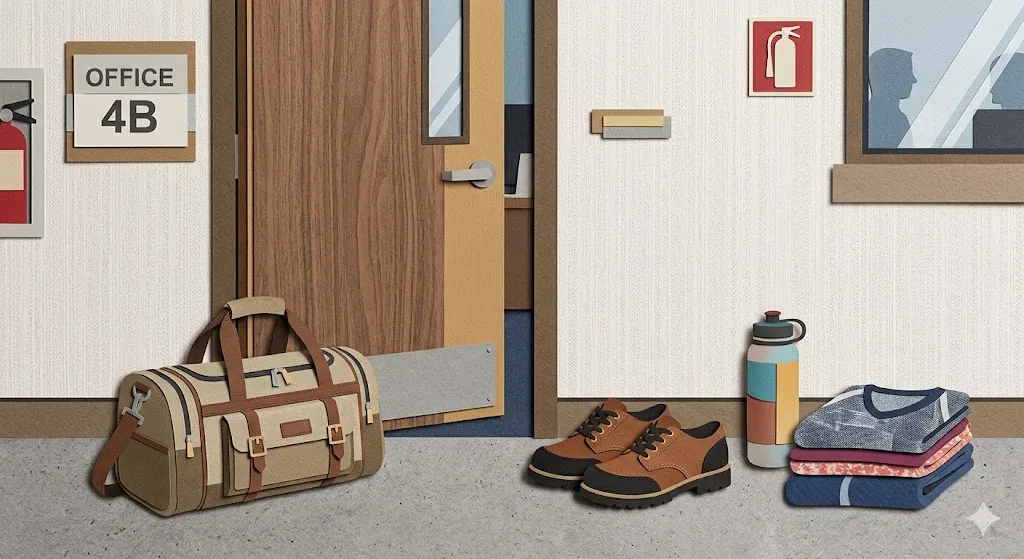
The gym bag is not just a container. It is a commitment device. Packing it the night before turns tomorrow’s workout from a vague intention into a visible plan: shoes, clothes, towel, headphones, water bottle, lock, snack, and any work-to-gym transition items are already handled. This matters because action planning is consistently treated in behaviour-change research as a way to bridge the gap between intending to exercise and actually doing it.
Implementation intentions are “if–then” plans: if a particular situation occurs, then a specific action follows. Reviews and meta-analyses have found that implementation intentions can help promote physical activity, though effects vary and are usually not magical on their own. The more useful takeaway for after-work gym routines is practical: “I should go to the gym” is weak; “If it is Tuesday at 5.45 pm, I leave work, change at the gym, and do workout B” is stronger.[PubMed Central]pmc.ncbi.nlm.nih.govPub Med Central Impact of implementation intentions on physical activityPub Med Central Impact of implementation intentions on physical activity
Packing the night before makes that if–then plan physical. It also stops the morning from becoming the first failure point. A good packed bag is boringly complete:
- Training clothes and shoes: no “I forgot socks” excuse.
- Workday bridge items: deodorant, towel, hair ties, toiletries, lock, charger.
- Fuel: a simple snack if hunger is a common reason for skipping.
- Plan card: the exact workout, written in notes or on paper.
- Backup option: a 20-minute version for low-energy days.
The key is not owning more kit. It is reducing the number of things that must be remembered when you are leaving the house, already thinking about work. In behaviour-change terms, the packed bag acts as a prompt and reduces friction; both are commonly used ingredients in physical-activity interventions. An umbrella review of behaviour-change techniques in physical activity found recurring use of techniques such as goal setting, self-monitoring, feedback, prompts and social support across interventions, while newer reviews continue to identify prompts, self-monitoring and support as more common in effective programmes.[PubMed Central]pmc.ncbi.nlm.nih.govPub Med Central Impact of implementation intentions on physical activityPub Med Central Impact of implementation intentions on physical activity

Choosing realistic days beats chasing the perfect week
The classic mistake is planning five after-work gym sessions because the future self appears energetic. The useful starting point is usually two or three realistic evenings, chosen around the actual week rather than the imaginary one. The NHS and ACSM guidelines do not require gym attendance every day; they point to weekly totals and at least two days of muscle-strengthening activity. That leaves room for a routine built around consistency rather than punishment.[nhs.uk]nhs.ukOpen source on nhs.uk.
A realistic schedule starts by identifying the evenings least likely to collapse. For many people, Monday is psychologically clean but operationally crowded; Friday is socially fragile; Wednesday may be the best anchor because it splits the week. The right answer depends on work patterns, commute, childcare, sleep and gym access. The test is simple: which two evenings can survive an ordinary bad day?
A strong beginner template might look like this:
Two-day foundation: Tuesday and Thursday after work, 45 minutes each. Both sessions include full-body strength training and a short cardio finish.
Three-day routine: Monday, Wednesday and Friday, with two strength sessions and one lighter cardio, class or mobility session.
Flexible two-plus-one: Two fixed gym evenings and one optional weekend session. This works well for people whose job regularly overruns.
The realistic-days principle also protects recovery. Exercise habits often fail when people confuse ambition with volume. Starting smaller creates more successful repetitions, and successful repetitions are what make the routine feel normal. A large fitness-club study on exercise adherence found that many new members have low attendance in the first months, while newer gym-attendance research suggests that sustained engagement is shaped by timing, social dynamics, personal guidance and visit patterns rather than membership alone.[PubMed Central]pmc.ncbi.nlm.nih.govPub Med Central Impact of implementation intentions on physical activityPub Med Central Impact of implementation intentions on physical activity
The commute is part of the workout plan
For after-work gym routines, location is not a minor detail. A gym that is excellent but awkward may lose to a merely adequate gym that sits between work and home. The danger zone is the moment you arrive home before training. Once shoes come off, dinner starts, or the sofa becomes available, the routine needs far more willpower.
The practical rule is: avoid a second departure. Go directly from work to the gym where possible. That could mean choosing a gym near the office, near the station, or on the commute route. If the only available gym is near home, the routine needs an arrival script: walk in, put the bag down by the door, change immediately, leave within ten minutes. The plan should not include “sit down for a bit”.
This is where self improvement becomes environmental design. The route either supports the behaviour or asks motivation to rescue it. A slightly less ideal gym that you can actually reach at 6.15 pm is usually better than a perfect gym that requires a detour, a bus change and fresh enthusiasm.
Crowding matters too. Some people skip because the gym after work feels chaotic: all benches taken, classes full, changing rooms packed. The solution is not always to find a quieter gym. It may be to design a “crowded gym” workout with flexible equipment: dumbbells instead of barbells, machines instead of fixed stations, or a circuit that can be rearranged. The post-work routine should assume mild inconvenience, not collapse when the squat rack is busy.
What to do when energy is low
A sustainable after-work routine needs a planned low-energy version. Without one, the choice becomes “full workout or failure”, and tired evenings turn into missed evenings. Research on work-related fatigue suggests that exhaustion can reduce leisure-time activity, but the Danish study also noted that lower-intensity activity may remain more feasible for fatigued workers than high-intensity exercise.[PubMed]pubmed.ncbi.nlm.nih.govIs fatigue after work a barrier for leisure-time physical…by R Bláfoss · 2019 · Cited by 98 — This study investigates the associ…
The backup workout should be decided before it is needed. It is not a consolation prize; it is the routine’s shock absorber. The goal is to preserve the identity and rhythm of showing up without forcing a hard session from a depleted body.
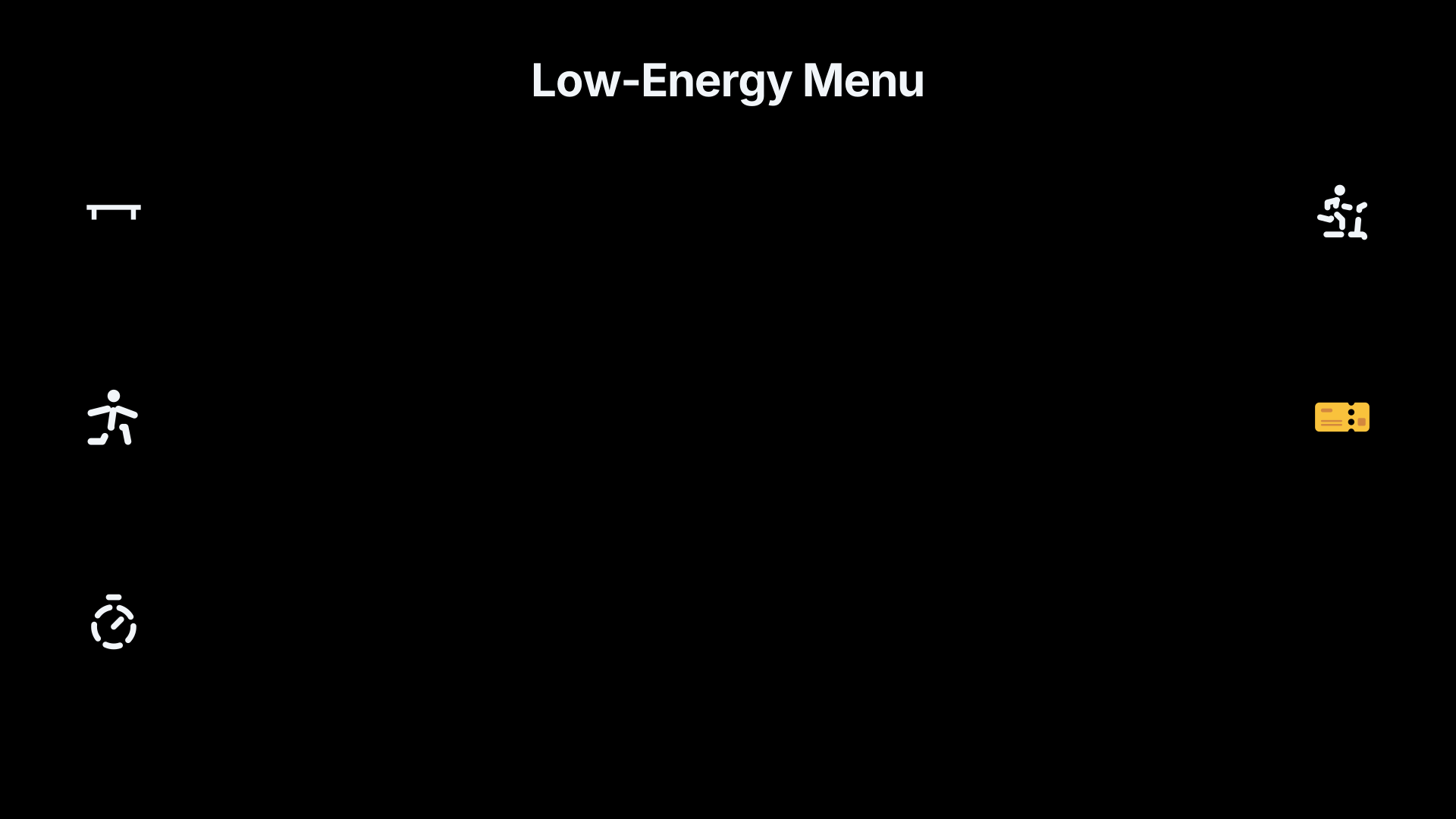
A useful low-energy menu includes:
- The 20-minute strength minimum: one push, one pull, one squat or hinge, two easy sets each.
- The treadmill reset: 20 to 30 minutes of incline walking or easy cycling.
- The mobility-and-core session: stretching, light carries, dead bugs, side planks, easy machines.
- The class fallback: a booked class where the main decision is simply to attend.
- The “scan and leave” rule: enter the gym, warm up for five minutes, then decide whether to continue. Leaving after the minimum is allowed.
This works because it protects continuity. Habit formation research does not support the popular myth that a complex habit becomes automatic in 21 days. Reviews of health-related habit formation suggest that habits vary widely in how long they take, with consistency, timing, enjoyment and context all shaping the process. For exercise, which is more demanding than drinking a glass of water, the early win is not automaticity; it is reducing the number of broken links in the chain.[Verywell Health]verywellhealth.comVerywell Health Here's How Long It Takes to Make Exercise a Regular HabitExperts recommend four strategies to help make exercise a consistent habit: start small and schedule workouts as non-negotiable appointme…
Evening training and sleep: useful, unless it runs too late
Many people avoid after-work gym plans because they worry evening exercise will damage sleep. The evidence is more nuanced. A 2019 meta-analysis found that evening exercise did not generally harm sleep in healthy participants, but vigorous exercise ending within an hour of bedtime could impair sleep onset, total sleep time or sleep efficiency. More recent large-cohort evidence suggests that later, high-strain evening exercise is associated with delayed sleep, shorter sleep duration, lower sleep quality and less favourable overnight recovery markers, while sessions ending at least four hours before sleep were not associated with those changes.[PubMed]pubmed.ncbi.nlm.nih.govIs fatigue after work a barrier for leisure-time physical…by R Bláfoss · 2019 · Cited by 98 — This study investigates the associ…
The practical conclusion is not “never train after work”. It is “match the workout to bedtime”. If bedtime is 10.30 pm, a hard 8.45 pm interval class may be a poor fit. If training ends at 7.00 pm, evening exercise is much less likely to be a problem for many people. Intensity also matters: heavy lifting, maximal intervals and competitive sport are more stimulating than steady cycling, moderate lifting or mobility work.
A sensible evening structure is:
Straight after work: best slot for harder strength training or vigorous cardio, especially if it finishes several hours before bed.
Later evening: better for moderate lifting, easy cardio, technique work or mobility.
Within the final hour before bed: avoid turning the session into a high-adrenaline event; use gentle movement if training at all.
This protects the bigger self-improvement system. A gym routine that steals sleep may look disciplined for two weeks and then fail because recovery is poor. The useful routine is the one that makes tomorrow easier, not just today more impressive.
A simple after-work routine that survives real life
The most reliable plan is specific enough to execute and flexible enough not to break. It should name the days, the route, the start trigger, the workout type and the fallback. The following model can be adapted without changing the underlying logic.
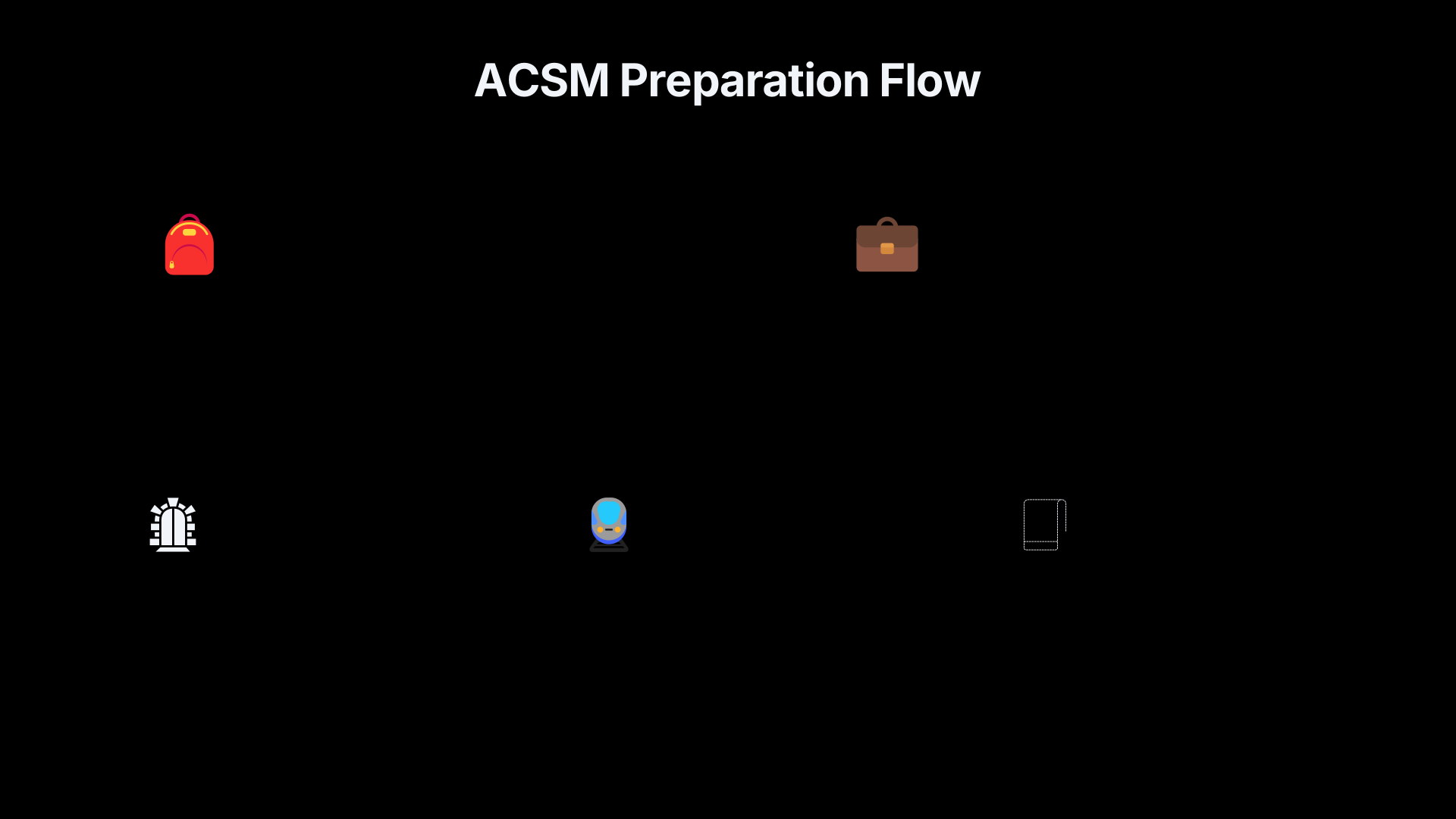
Night before: pack the gym bag, put it by the door, and check the next day’s workout. The plan should be short enough to read in ten seconds.
Morning: take the bag to work. Do not rely on returning home for it.
End of workday: close the laptop, change location immediately, and travel directly to the gym. The cue is leaving work, not “feeling motivated”.
At the gym: start with the first exercise even if energy is low. Motivation often arrives after the warm-up, but the plan should not require it beforehand.
After training: record the session simply: done, duration, one note. Self-monitoring and feedback are common behaviour-change tools because they make progress visible and help adjust the plan.[PubMed Central]pmc.ncbi.nlm.nih.govPub Med Central Impact of implementation intentions on physical activityPub Med Central Impact of implementation intentions on physical activity
For a beginner, two full-body sessions are enough to build the habit:
Session A: leg press or squat pattern, chest press or press-up, seated row, Romanian deadlift or hip hinge, plank, 10 minutes easy cardio.
Session B: split squat or lunge, shoulder press, lat pulldown, hamstring curl, carry or core exercise, 10 minutes easy cardio.
The exact exercises matter less than the repeatable structure. Each session should feel clear before arrival. The after-work brain should not have to design a programme in the changing room.
The common failure points and the better rule
After-work gym plans usually fail in predictable places. The fix is to write rules for those places before they happen.
Failure point: “I am too hungry.”
Better rule: eat a planned snack 60 to 90 minutes before leaving work, or keep something simple in the bag. Hunger should not get a vote every evening.
Failure point: “Work ran late.”
Better rule: if the full session is impossible, do the 20-minute minimum. The routine survives by shrinking, not disappearing.
Failure point: “I forgot my kit.”
Better rule: keep a spare set at work or in the car where possible. One forgotten item should not cancel the whole system.
Failure point: “The gym is packed.”
Better rule: use the crowded-gym version. Swap equipment rather than waiting for perfect conditions.
Failure point: “I went home first.”
Better rule: no sitting down before changing. If home is unavoidable, the first action is putting on gym clothes.
These rules are forms of coping planning: anticipating barriers and deciding responses in advance. Studies of action planning and coping planning describe them as self-regulatory strategies intended to bridge the intention–behaviour gap, with action planning covering when, where and how, and coping planning covering obstacles and responses.[PubMed Central]pmc.ncbi.nlm.nih.govPub Med Central Impact of implementation intentions on physical activityPub Med Central Impact of implementation intentions on physical activity
When the gym should not survive the workday
A routine that works is not one that ignores every signal from the body. Sometimes the correct after-work decision is not the gym. Illness, sharp pain, dizziness, severe sleep deprivation, unusual chest symptoms or a genuinely unsafe commute are not motivation problems. They are reasons to stop, seek appropriate advice where needed, and protect recovery.
More commonly, the decision is not gym versus no gym but hard training versus light movement. On a mentally draining but physically ordinary day, a short session may help. On a physically exhausting day, low-intensity movement may be more appropriate than heavy lifting. The self-improvement lesson is to avoid all-or-nothing thinking: the plan can include rest, but rest should be intentional rather than the accidental result of a poorly designed evening.
The after-work gym routine survives when it is built for the person who actually leaves work tired, hungry and ready to negotiate. Pack before the day begins. Choose realistic days. Travel directly. Keep the workout simple. Use a backup session without shame. Protect sleep. That is less glamorous than a transformation montage, but it is much closer to self improvement that works.
Amazon book picks
Further Reading
Books and field guides related to Can the Gym Survive the Workday?. Use these as the next step if you want deeper reading beyond the article.
Atomic Habits
Rating: 3.5/5 from 7 Google Books ratings
Ideal for building consistent exercise routines.
eBay marketplace picks
Marketplace Samples
Example marketplace items related to this page. Use the search link to explore similar finds on eBay.


Endnotes
1.
Source: nhs.uk
Title: Take the healthy
Link:https://www.nhs.uk/live-well/exercise/physical-activity-guidelines-for-adults-aged-19-to-64/
Source snippet
Physical activity guidelines for adults aged 19 to 64Muscle-strengthening exercises are not always an aerobic activity, so you'll need to...
2.
Source: acsm.org
Link:https://acsm.org/education-resources/trending-topics-resources/physical-activity-guidelines/
Source snippet
Physical Activity GuidelinesAll healthy adults aged 18–65 years should participate in moderate intensity aerobic physical activity fo...
3.
Source: habits.it
Link:https://www.habits.it/
4.
Source: nhs.uk
Link:https://www.nhs.uk/live-well/exercise/
5.
Source: nhs.uk
Link:https://www.nhs.uk/live-well/exercise/physical-activity-guidelines-older-adults/
6.
Source: mydiabetesmyway.scot.nhs.uk
Title: exercise and physical activity healthy living
Link:https://mydiabetesmyway.scot.nhs.uk/resources/internal/exercise-and-physical-activity-healthy-living/
7.
Source: myhealthlondon.nhs.uk
Title: exercise and physical activity healthy living
Link:https://www.myhealthlondon.nhs.uk/resources/internal/exercise-and-physical-activity-healthy-living/
8.
Source: nhsprofessionals.nhs.uk
Link:https://www.nhsprofessionals.nhs.uk/health-and-wellbeing/helpful-links/movement
9.
Source: train.fitness
Title: inspiring long term exercise adherence for women
Link:https://train.fitness/personal-trainer-blogs/inspiring-long-term-exercise-adherence-for-women
10.
Source: who.int
Link:https://www.who.int/initiatives/behealthy/physical-activity
11.
Source: southtees.nhs.uk
Title: physical activity 2
Link:https://www.southtees.nhs.uk/staff/staff-wellbeing/physical-activity-2/
12.
Source: habit.com
Link:https://habit.com/
13.
Source: digital.nhs.uk
Title: Adult physical activity
Link:https://digital.nhs.uk/data-and-information/publications/statistical/health-survey-for-england/2021-part-2/physical-activity
14.
Source: youtube.com
Title: Forged After Work
Link:https://www.youtube.com/watch?v=VrKwa4CKz-E
Source snippet
30 min - Post workout Stretch Routine - Static Stretching and Breath Work...
15.
Source: youtube.com
Title: 30 min
Link:https://www.youtube.com/watch?v=161dUd2HIYU
16.
Source: pubmed.ncbi.nlm.nih.gov
Link:https://pubmed.ncbi.nlm.nih.gov/29609495/
Source snippet
Is fatigue after work a barrier for leisure-time physical...by R Bláfoss · 2019 · Cited by 98 — This study investigates the associ...
17.
Source: pmc.ncbi.nlm.nih.gov
Title: Pub Med Central Impact of implementation intentions on physical activity
Link:https://pmc.ncbi.nlm.nih.gov/articles/PMC6235272/
18.
Source: pmc.ncbi.nlm.nih.gov
Link:https://pmc.ncbi.nlm.nih.gov/articles/PMC12649445/
19.
Source: pmc.ncbi.nlm.nih.gov
Link:https://pmc.ncbi.nlm.nih.gov/articles/PMC8194699/
20.
Source: verywellhealth.com
Title: Verywell Health Here’s How Long It Takes to Make Exercise a Regular Habit
Link:https://www.verywellhealth.com/how-long-does-it-take-to-form-a-habit-11716094
Source snippet
Experts recommend four strategies to help make exercise a consistent habit: start small and schedule workouts as non-negotiable appointme...
21.
Source: pubmed.ncbi.nlm.nih.gov
Link:https://pubmed.ncbi.nlm.nih.gov/30374942/
22.
Source: pmc.ncbi.nlm.nih.gov
Link:https://pmc.ncbi.nlm.nih.gov/articles/PMC8997544/
23.
Source: pubmed.ncbi.nlm.nih.gov
Link:https://pubmed.ncbi.nlm.nih.gov/35742582/
24.
Source: pubmed.ncbi.nlm.nih.gov
Link:https://pubmed.ncbi.nlm.nih.gov/34416428/
25.
Source: Wikipedia
Link:https://en.wikipedia.org/wiki/Habit
26.
Source: it.pons.com
Link:https://it.pons.com/traduzione/tedesco-italiano/Habit
27.
Source: wordreference.com
Link:https://www.wordreference.com/enit/habit
28.
Source: psychologytoday.com
Title: habit formation
Link:https://www.psychologytoday.com/us/basics/habit-formation
29.
Source: frontiersin.org
Link:https://www.frontiersin.org/journals/psychology/articles/10.3389/fpsyg.2022.921285/full
Additional References
30.
Source: arxiv.org
Link:https://arxiv.org/html/2501.01779v2
31.
Source: youtube.com
Title: Getting To Gym After Work and How Often Should You Go
Link:https://www.youtube.com/watch?v=eu1uMK-pZoI
Source snippet
How To Work Out After A Long Work Day Without Leaving Home...
32.
Source: researchgate.net
Link:https://www.researchgate.net/publication/236956891_Habit_Formation_Among_Regular_Exercisers_at_Fitness_Centers_An_Exploratory_Study
33.
Source: researchgate.net
Link:https://www.researchgate.net/publication/359462121_Increasing_Physical_Exercise_through_Action_and_Coping_Planning
34.
Source: academia.edu
Link:https://www.academia.edu/48503574/Is_fatigue_after_work_a_barrier_for_leisure_time_physical_activity_Cross_sectional_study_among_10_000_adults_from_the_general_working_population
35.
Source: researchgate.net
Link:https://www.researchgate.net/publication/360189434_Behaviour_Change_Techniques_in_Physical_Activity_Interventions_for_Adults_with_Substance_Use_Disorders_A_Systematic_Review
36.
Source: researchgate.net
Link:https://www.researchgate.net/publication/369883726_Time-of-Day_Effects_of_Exercise_on_Cardiorespiratory_Responses_and_Endurance_Performance-A_Systematic_Review_and_Meta-Analysis
37.
Source: researchgate.net
Link:https://www.researchgate.net/publication/386593213_Time_to_Form_a_Habit_A_Systematic_Review_and_Meta-Analysis_of_Health_Behaviour_Habit_Formation_and_Its_Determinants
38.
Source: jamesclear.com
Link:https://jamesclear.com/implementation-intentions
39.
Source: mymlc.com
Link:https://www.mymlc.com/health-information/articles/b/barriers-to-fitness-overcoming-common-challenges/?section=4.+I%27m+too+tired+to+exercise+after+work
Topic Tree