Within Self Help Myths
Why 21 Days Does Not Make a Habit
The popular 21-day habit rule is a tidy myth that hides how differently habits form across behaviours, people and contexts.
On this page
- Where the 21 day claim came from
- What habit automaticity research actually found
- How to judge progress without a false deadline
Page outline Jump by section
Introduction
One of the most persistent myths in self-help is that a new habit takes exactly 21 days to form. The claim is attractive because it offers a clear finish line: endure three weeks of effort and the behaviour will supposedly become automatic. The evidence tells a different story. Habit formation is not governed by a universal countdown. Different behaviours, people and circumstances produce very different timelines, and many habits take considerably longer than 21 days to become automatic.[Scientific American]scientificamerican.comhow long does it really take to form a habitScientific AmericanHow Long Does It Really Take to Form a Habit?Jan 24, 2024 — There's a myth that it takes 21 days to form a habit. Expe…
 This matters because false deadlines create unnecessary discouragement. Someone who still finds exercise, meditation or healthy eating difficult after three weeks may conclude they have failed, when in reality they may be progressing normally. Understanding how habits actually develop leads to more realistic expectations and better long-term results.
Where the 21-day claim came from
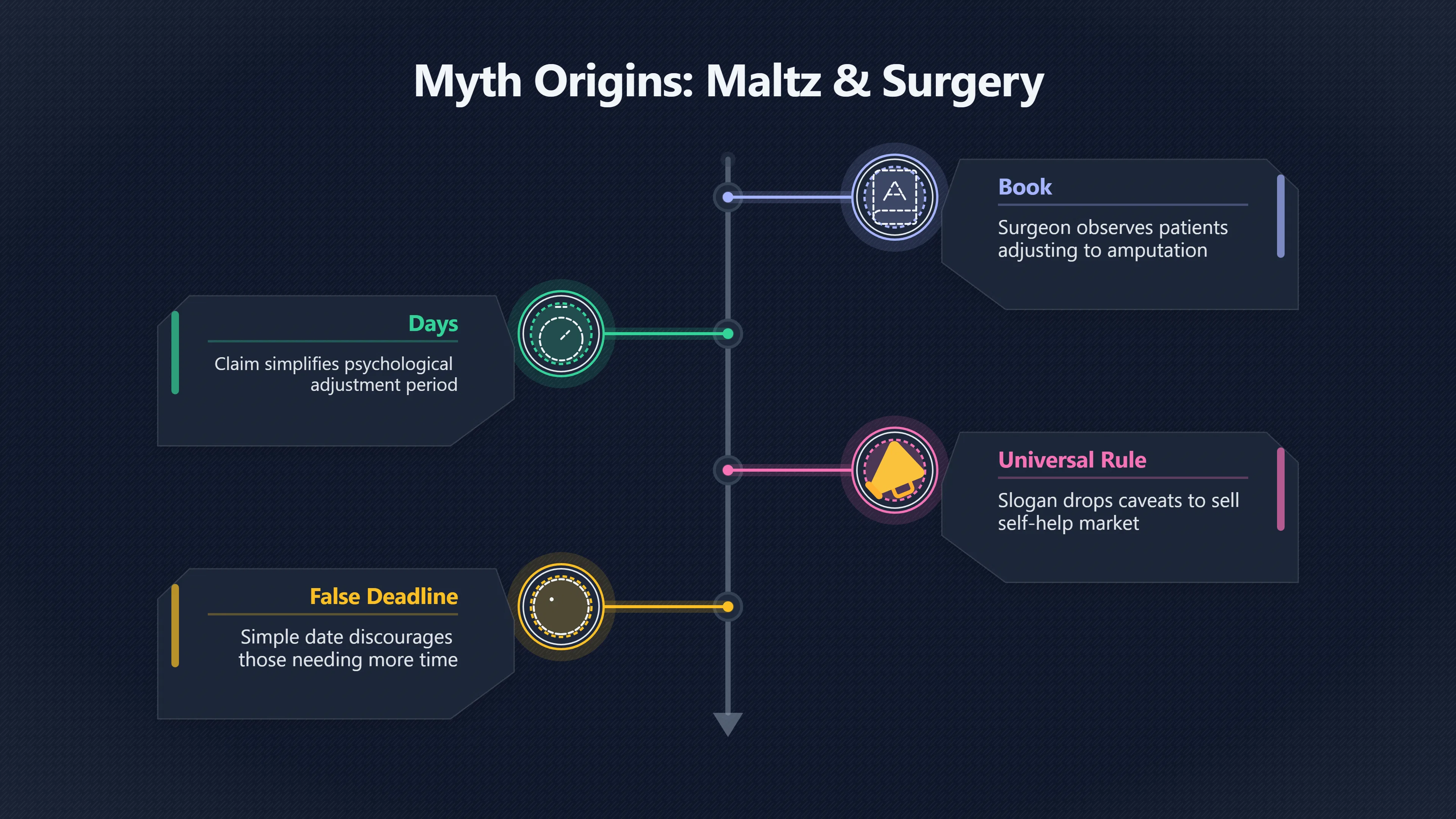
The famous number did not originate in habit research. It is generally traced to the plastic surgeon and author Maxwell Maltz, whose 1960 book Psycho-Cybernetics described how patients often seemed to need about 21 days to adjust psychologically to changes such as surgery or amputation. Maltz referred to adjustment periods and suggested that changes in self-image appeared to require a minimum of around three weeks. Over time, that observation was simplified and transformed into the much stronger claim that all habits take 21 days to form.[Women's Health Research Institute]womenshealth.obgyn.msu.eduWomen's Health Research InstituteDebunking the 21 Day Myth about bad habitsThe myth seems to have originated in the 1960 book, Psycho-cyb…[James Clear]jamesclear.comJames Clear How Long Does it Take to Form a Habit?Backed by Science.In 1960, Maltz published that quote and his other thoughts on behavior change in a book called Psycho-Cybernetics (audi…
The distinction is important. Maltz was not conducting controlled habit-formation experiments. He was describing clinical observations about adaptation to change. The modern slogan removed the caveats, dropped the word “minimum”, and converted an anecdotal observation into a universal rule.[Opendeltas]opendeltas.com21 days habit formation mythThe 21 Days Habit Formation Myth and Mindfulness BenefitsJun 11, 2020 — In 1960, Maltz published this quote and his other thoug…[2habitzup.com]habitzup.com21 day habit formationMaxwell Maltz, a plastic surgeon in the 1950s. In his best-selling book, “Psycho-…Read more…
The resulting message was ideal for the self-help market. A 21-day challenge is easy to package, easy to remember and easy to sell. Unfortunately, simplicity is not the same as accuracy.
What habit automaticity research actually found
Researchers studying habits usually focus on automaticity: the extent to which a behaviour becomes something a person performs with little conscious effort when a particular cue appears.
One of the most cited studies in this area followed people who were trying to establish everyday health behaviours such as eating fruit with lunch, drinking water after breakfast or performing a daily activity. Participants reported how automatic the behaviour felt over time. The researchers found that automaticity increased gradually and then levelled off. The median time to reach maximum automaticity was 66 days, not 21. More importantly, individual results varied enormously, ranging from roughly 18 days to 254 days.[Wiley Online Library]onlinelibrary.wiley.comOnline Library Modelling habit formation in the real worldWiley Online LibraryModelling habit formation in the real world - Lally - 2010by P Lally · 2010 · Cited by 3514 — To investigate the proc…[British Psychological Society]bps.org.ukhow form habitBritish Psychological SocietyHow to form a habit | BPS6 Oct 2010 — The average time to reach maximum automaticity was 66 days, although t…
That range reveals the central problem with any single-number rule. Some habits become relatively automatic quickly. Others take months.
More recent evidence has reinforced this point. A 2024 systematic review examining habit-formation studies found substantial variability across behaviours and participants. Reported habit-formation times ranged from a few days to nearly a year, with median estimates commonly around two months and some average estimates extending well beyond 100 days.[PubMed Central]pmc.ncbi.nlm.nih.govPubMed CentralTime to Form a Habit: A Systematic Review and Meta-Analysis…by B Singh · 2024 · Cited by 95 — Four studies reported the…
The lesson is not that habit formation takes 66 days. It is that habit formation follows a distribution rather than a deadline. Even the researchers associated with the famous 66-day figure have repeatedly warned against treating it as a universal rule.[University of Surrey]surrey.ac.ukUniversity of SurreyDoes it really take 66 days to form a habit?21 Jan 2026 — In 2010, Dr Pippa Lally, with colleagues at UCL, published…
Why timelines vary so much
If there were a single biological clock for habits, researchers would see much more consistency. Instead, several factors influence how quickly automaticity develops.
Behaviour complexity matters. Drinking a glass of water after breakfast is simpler than establishing a regular gym routine. The more steps, planning and effort a behaviour requires, the longer it tends to take before it feels automatic.[Keelify]keelify.comThe 66-day habit rule explained — what Lally's data26 Apr 2026 — In Lally's 2010 study, half of behaviors reached automaticity in fewer than 66 days; the other half took longer. The…
Context stability matters. Habits are strongly linked to cues. A behaviour repeated in the same situation each day has a better chance of becoming automatic than one performed under constantly changing conditions.[PubMed Central]pmc.ncbi.nlm.nih.govPubMed CentralTime to Form a Habit: A Systematic Review and Meta-Analysis…by B Singh · 2024 · Cited by 95 — Four studies reported the…
Individual differences matter. Motivation, lifestyle, stress levels, existing routines and personal circumstances influence how consistently people repeat behaviours. Researchers analysing large real-world datasets have found that habit development can vary from a few weeks to several months depending on the behaviour and the person involved.[Health]health.comHow Many Days Does It Really Take For a New Habit to Stick?Though the popular belief is that it takes 21 days to form a habit, research led by Colin Camerer, PhD, shows that this figure lacks scie…
Rewards matter. Behaviours that produce immediate positive feedback are generally easier to repeat than behaviours whose benefits are delayed. This is one reason habits related to exercise, studying or saving money often feel harder to establish than simpler routines with instant rewards.
These factors make it unrealistic to expect everyone to reach the same destination on the same schedule.

Missing a day is not habit failure
The 21-day myth often encourages an all-or-nothing mindset. If a person breaks their streak on day 14, they may feel they must start over.
Research on habit development does not support that conclusion. In the landmark automaticity study, occasional missed opportunities did not destroy habit formation. What mattered was the overall pattern of repetition over time rather than perfect execution every day.[Wiley Online Library]onlinelibrary.wiley.comOnline Library Modelling habit formation in the real worldWiley Online LibraryModelling habit formation in the real world - Lally - 2010by P Lally · 2010 · Cited by 3514 — To investigate the proc…
This is one reason strict countdown thinking can be counterproductive. People become focused on protecting a streak instead of building a sustainable routine. A single lapse then feels catastrophic when it is often just a normal part of behaviour change.
Real habit formation is usually uneven. Motivation fluctuates. Life intervenes. Consistency remains important, but perfection is not required.
How to judge progress without a false deadline
A better question than “Has it been 21 days?” is “Is this behaviour becoming easier and more automatic?”
Useful signs of progress include:
- You need fewer reminders to perform the behaviour.
- The behaviour increasingly happens in response to a specific cue.
- You spend less mental energy deciding whether to do it.
- Missing the behaviour feels unusual rather than normal.
- The behaviour begins to fit naturally into existing routines.
These indicators track the actual goal of habit formation: reducing reliance on constant willpower.
Instead of measuring success against an arbitrary calendar date, measure success against repetition and automaticity. A habit is developing when the behaviour increasingly happens because the situation triggers it, not because you are forcing yourself to remember.
The real takeaway
The 21-day rule survives because it offers certainty. Real behaviour change is less tidy. The best evidence suggests that habits form on highly variable timelines shaped by the behaviour, the environment and the individual. Many habits require closer to two months than three weeks, and some take much longer.[British Psychological Society]bps.org.ukhow form habitBritish Psychological SocietyHow to form a habit | BPS6 Oct 2010 — The average time to reach maximum automaticity was 66 days, although t…[PubMed Central]pmc.ncbi.nlm.nih.govPubMed CentralTime to Form a Habit: A Systematic Review and Meta-Analysis…by B Singh · 2024 · Cited by 95 — Four studies reported the…
For people interested in self-improvement that works, the practical implication is simple: stop treating 21 days as a finish line. Habit formation is better understood as a gradual process of repetition in a stable context. The key question is not whether a habit has reached an arbitrary deadline, but whether it is becoming easier to perform than it was before. When judged by that standard, progress often appears long before automaticity is complete.
Amazon book picks
Further Reading
Books and field guides related to Why 21 Days Does Not Make a Habit. Use these as the next step if you want deeper reading beyond the article.
eBay marketplace picks
Marketplace Samples
Example marketplace items related to this page. Use the search link to explore similar finds on eBay.


Endnotes
1.
Source: opendeltas.com
Title: 21 days habit formation myth
Link:https://www.opendeltas.com/post/21-days-habit-formation-myth
Source snippet
The 21 Days Habit Formation Myth and Mindfulness BenefitsJun 11, 2020 — In 1960, Maltz published this quote and his other thoug...
2.
Source: habitzup.com
Title: 21 day habit formation
Link:https://habitzup.com/parenting/21-day-habit-formation/
Source snippet
Maxwell Maltz, a plastic surgeon in the 1950s. In his best-selling book, “Psycho-...Read more...
3.
Source: onlinelibrary.wiley.com
Title: Online Library Modelling habit formation in the real world
Link:https://onlinelibrary.wiley.com/doi/10.1002/ejsp.674
Source snippet
Wiley Online LibraryModelling habit formation in the real world - Lally - 2010by P Lally · 2010 · Cited by 3514 — To investigate the proc...
4.
Source: keelify.com
Title: The 66-day habit rule explained — what Lally’s data
Link:https://keelify.com/blog/66-day-habit-rule-explained
Source snippet
26 Apr 2026 — In Lally's 2010 study, half of behaviors reached automaticity in fewer than 66 days; the other half took longer. The...
5.
Source: health.com
Title: How Many Days Does It Really Take For a New Habit to Stick?
Link:https://www.health.com/how-many-days-form-habit-8418521
Source snippet
Though the popular belief is that it takes 21 days to form a habit, research led by Colin Camerer, PhD, shows that this figure lacks scie...
6.
Source: onlinelibrary.wiley.com
Link:https://onlinelibrary.wiley.com/doi/abs/10.1002/ejsp.674
Source snippet
are habits formed: Modelling habit formation in the...by P Lally · 2010 · Cited by 3514 — To investigate the process of habit formation...
7.
Source: youtube.com
Title: 21 Days to Build Any Habit – Does It Really Work
Link:https://www.youtube.com/watch?v=tSvIUTDGLDs
Source snippet
James Clear Explains How to Build Habits That Stick With One Simple Planning Trick || MasterClass...
8.
Source: youtube.com
Link:https://www.youtube.com/watch?v=UI8Mlh99QGg
9.
Source: scientificamerican.com
Title: how long does it really take to form a habit
Link:https://www.scientificamerican.com/article/how-long-does-it-really-take-to-form-a-habit/
Source snippet
Scientific AmericanHow Long Does It Really Take to Form a Habit?Jan 24, 2024 — There's a myth that it takes 21 days to form a habit. Expe...
10.
Source: pmc.ncbi.nlm.nih.gov
Link:https://pmc.ncbi.nlm.nih.gov/articles/PMC11641623/
Source snippet
PubMed CentralTime to Form a Habit: A Systematic Review and Meta-Analysis...by B Singh · 2024 · Cited by 95 — Four studies reported the...
11.
Source: womenshealth.obgyn.msu.edu
Link:https://womenshealth.obgyn.msu.edu/blog/debunking-21-day-myth-about-bad-habits
Source snippet
Women's Health Research InstituteDebunking the 21 Day Myth about bad habitsThe myth seems to have originated in the 1960 book, Psycho-cyb...
12.
Source: jamesclear.com
Title: James Clear How Long Does it Take to Form a Habit?
Link:https://jamesclear.com/new-habit
Source snippet
Backed by Science.In 1960, Maltz published that quote and his other thoughts on behavior change in a book called Psycho-Cybernetics (audi...
13.
Source: bps.org.uk
Title: how form habit
Link:https://www.bps.org.uk/research-digest/how-form-habit
Source snippet
British Psychological SocietyHow to form a habit | BPS6 Oct 2010 — The average time to reach maximum automaticity was 66 days, although t...
14.
Source: surrey.ac.uk
Link:https://www.surrey.ac.uk/news/does-it-really-take-66-days-form-habit-we-asked-expert-dr-pippa-lally
Source snippet
University of SurreyDoes it really take 66 days to form a habit?21 Jan 2026 — In 2010, Dr Pippa Lally, with colleagues at UCL, published...
15.
Source: blogs.ucl.ac.uk
Title: 66 days
Link:https://blogs.ucl.ac.uk/bsh/tag/66-days/
Source snippet
The best estimate is 66 days, but it's unwise to attempt to assign a number to this process...Read more...
16.
Source: pmc.ncbi.nlm.nih.gov
Link:https://pmc.ncbi.nlm.nih.gov/articles/PMC3505409/
Source snippet
How are habits formed: modelling habit formation in the real world. Euro J Soc Psychol. 2010;40:998–1009.Read more...
Additional References
17.
Source: researchgate.net
Link:https://www.researchgate.net/publication/386593213_Time_to_Form_a_Habit_A_Systematic_Review_and_Meta-Analysis_of_Health_Behaviour_Habit_Formation_and_Its_Determinants
Source snippet
(PDF) Time to Form a Habit: A Systematic Review and...Dec 4, 2024 — 21 Habit formation typically requires repeated exposure over time, w...
18.
Source: behavioraldesign.academy
Link:https://www.behavioraldesign.academy/resources/practices/the-21-day-habit-myth-what-the-science-actually-says/
Source snippet
CLAIM 1: It only takes 21-days to form a habitThere is no substantial evidence that habits are routinely formed in just 21-days. This is...
19.
Source: blog.theteamw.com
Link:https://www.blog.theteamw.com/2011/03/18/100-things-you-should-know-about-people-84-average-time-to-form-a-habit-is-66-days/
Source snippet
Time To Form A Habit Is 66 Days – The Team W, Inc.18 Mar 2011 — The average amount of time it took for people to form a habit was 66 days...
20.
Source: mentalzon.com
Title: 66 days to build a new habit why it’s not a myth but real habit psychology
Link:https://mentalzon.com/en/post/7770/66-days-to-build-a-new-habit-why-it%E2%80%99s-not-a-myth-but-real-habit-psychology
Source snippet
66 Days to Build a New Habit: Why It's Not a Myth, But Real...1 Nov 2025 — The result: on average, it took 66 days for the new behavior...
21.
Source: researchgate.net
Title: 32898894 How are habits formed Modeling habit formation in the real world
Link:https://www.researchgate.net/publication/32898894_How_are_habits_formed_Modeling_habit_formation_in_the_real_world
Source snippet
Modeling habit formation in the real world | Request PDFThese students reached their peak automaticity after about 56 days (or 8 weeks)...
22.
Source: facebook.com
Link:https://www.facebook.com/yasir.qadhi/posts/they-say-it-takes-21-days-to-form-a-habita-notion-rooted-in-the-observations-of-/1170582731094262/
Source snippet
Maxwell Maltz (a plastic surgeon) in his book 'Psycho-Cybernetics' from that he...Read more...
23.
Source: mindspacex.com
Title: the science of habit formation why 21 days isn t enough
Link:https://www.mindspacex.com/post/the-science-of-habit-formation-why-21-days-isn-t-enough
Source snippet
The Science of Habit Formation: Why 21 Days Isn't EnoughApr 3, 2025 — In his 1960 book "Psycho-Cybernetics," Maltz wrote: "It usually req...
24.
Source: bulletproofmusician.com
Title: how long does it really take to form a new habit
Link:https://bulletproofmusician.com/how-long-does-it-really-take-to-form-a-new-habit/
Source snippet
?24 Nov 2019 — On average, it took about 66 days for the participants' new behaviors to become a habit (ie for their habit strength score...
25.
Source: scienceofselfhelp.org
Link:https://scienceofselfhelp.org/articles-1/phillippa-lally-and-the-number-of-days-to-form-a
Source snippet
Habit26 Jul 2013 — The study suggests that some tasks take less time and some tasks more time before they are considered a habit, but the...
26.
Source: sciencealert.com
Title: No, It Doesn’t Take 21 Days to Form a New Habit
Link:https://www.sciencealert.com/no-it-doesnt-take-21-days-to-form-a-new-habit-a-new-study-shows-why
Source snippet
Apr 19, 2023 — In 1960, a plastic surgeon by the name of Maxwell Maltz published a wildly popular book that spawned a spurious factoid –...
Topic Tree