Within Better Change
When Self Improvement Feels Productive but Fails
Reading, planning and organizing can feel productive while daily conduct stays unchanged.
On this page
- The feeling of progress
- Planning as avoidance
- Tests that reveal real change
Page outline Jump by section
Introduction
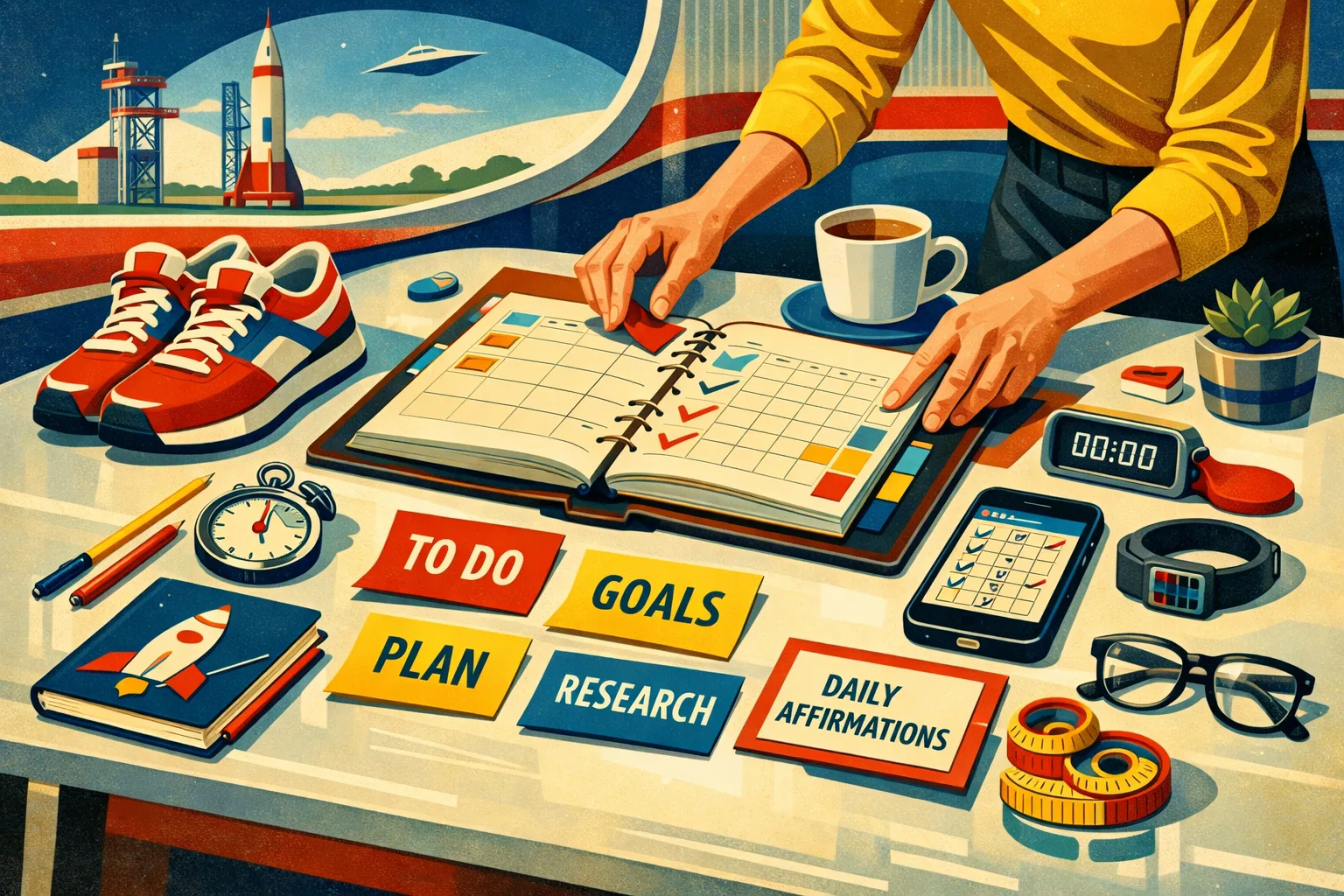
Self-improvement theatre is the performance of change without the friction of change. It is what happens when reading, planning, organising, tracking apps, morning routines, productivity videos and identity language create a convincing sense of progress while ordinary behaviour stays much the same. The problem is not that learning or planning are useless. Both can help when they lead quickly into specific action, feedback and adjustment. The risk is that they can also become a safer substitute for the thing that would actually test the goal: writing the page, making the call, going for the walk, apologising, sleeping earlier, practising the skill, or changing the environment that keeps pulling behaviour back to default.
This matters because self improvement that works is usually observable. It changes what a person does under real conditions, not just what they understand, intend or admire. Behaviour-change research repeatedly points towards active ingredients such as action planning, goal setting, self-monitoring, prompts, feedback, problem-solving and graded tasks, all of which become meaningful only when they touch actual conduct. The gap between “I am working on myself” and “my daily pattern is changing” is where false progress lives.[NCBI]ncbi.nlm.nih.govSource details in endnotes.
The feeling of progress
False progress is powerful because it often feels sincere. A person can spend two hours building a habit tracker, rewriting goals, highlighting a book, watching a lecture on discipline, or designing a new weekly system and genuinely feel more capable afterwards. The feeling is not fake. The mistake is treating that feeling as evidence that the behaviour has changed.
Planning and learning reduce uncertainty. They make a messy intention look orderly. They also provide immediate emotional reward: relief, control, optimism and the pleasing sense of becoming the kind of person who is “serious” about change. That is why self-improvement theatre is not laziness in a simple sense. It is often effortful. The person may be doing a great deal, but doing it at one remove from the real behaviour.
A practical example makes the distinction clear. Someone who wants to exercise may compare training plans, buy a notebook, follow fitness accounts, calculate macros and reorganise their wardrobe. Some of that may be useful preparation. But if the week ends with no walk, no session, no lighter dinner, no earlier bedtime and no environmental change that makes exercise easier next week, the activity has been mostly symbolic. It changed the person’s relationship to the idea of exercising, not their exercising.
The same pattern appears in intellectual goals. Reading books about writing can be valuable, but it does not create a writing practice unless it changes the next writing block. Watching videos on focus can clarify attention problems, but it does not improve focus unless it changes cues, distractions, task design or recovery. Theatre begins when the preparation becomes self-sealing: the person keeps preparing because preparation feels competent and action feels exposing.
There is also a measurement problem. Real behaviour has awkward evidence. Did the action happen? How often? Under what conditions? What got in the way? Did the plan survive tiredness, boredom, social pressure or a bad mood? By contrast, self-improvement theatre is measured by internal states: inspiration, clarity, identity, motivation, aesthetic order. Those states are not worthless, but they are unstable evidence. A method that makes someone feel transformed on Sunday night may still fail at 4.30 pm on Wednesday.
Planning as avoidance
Planning becomes avoidance when it protects a person from the discomfort that the plan is supposed to solve. The core mechanism is simple: the real task carries some aversive feeling, while the planning task carries a more tolerable feeling. Planning a diet is less exposing than feeling hungry at 9 pm. Designing a study timetable is less frustrating than struggling through a hard problem. Creating a business plan is less vulnerable than contacting the first customer.
This fits a major line of procrastination research: delay is often not just poor time management, but short-term mood regulation. Sirois and Pychyl’s work frames procrastination as giving priority to the present self’s mood over the future self’s interests; people avoid tasks partly because easier or more pleasant alternatives repair mood in the short term. That helps explain why “productive” avoidance is so sticky. It does not look like giving up. It looks like preparing responsibly.[White Rose Research Online]eprints.whiterose.ac.ukSource details in endnotes.
Self-improvement planning is especially good at disguising avoidance because it borrows the language of discipline. A person can say, truthfully, “I am getting organised.” But the useful question is: organised for what action, by when, and how will the action be checked? If those questions remain vague, planning has become a holding pattern.
The planning fallacy adds a second trap. Classic work by Buehler, Griffin and Ross found that people often predict future task completion from an optimistic inside view, focusing on the story of how the task should unfold while neglecting relevant past evidence about how long similar tasks actually took. In self improvement, this can make new plans feel more credible than they are. The person thinks, “This week will be different because the system is better,” without using base-rate evidence from previous abandoned systems.[Massachusetts Institute of Technology]web.mit.eduMassachusetts Institute of Technology
A better plan is not the one that feels most complete. It is the one that has made contact with reality soonest. A two-minute test often beats a two-hour redesign. For example:
- Instead of planning a perfect morning routine, test putting the phone outside the bedroom tonight.
- Instead of designing a six-month reading plan, read ten pages after lunch today.
- Instead of creating a complete fitness spreadsheet, walk for ten minutes before dinner.
- Instead of rewriting a career vision, send one specific email to one specific person.
These are not small because ambition is bad. They are small because they produce evidence. Once behaviour has happened, the person can adjust from reality rather than fantasy.
When self-help helps, and when it becomes theatre
A fair critique of false progress should not dismiss self-help, books, worksheets or digital tools outright. Self-guided interventions can work in some contexts. For example, a systematic review and meta-analysis of self-help interventions for children and adolescents with common mental health difficulties found a moderate positive effect compared with control groups, while also warning that results varied and should be interpreted cautiously. Older clinical literature on self-help books similarly suggests that some self-help materials can change problematic behaviours, especially when paired with support and compliance with the actual exercises.[PubMed]pubmed.ncbi.nlm.nih.govSource details in endnotes.
The dividing line is whether the material becomes an input to behaviour or a replacement for behaviour. A book is useful if it produces a changed cue, a changed response, a practised skill, a hard conversation, a completed exposure, a tracked behaviour, or a revised environment. It becomes theatre when the reader collects insight as a substitute for practice.
Digital tools create the same tension. A 2024 systematic review of digital behaviour-change interventions for habit formation found that common techniques included prompts and cues, goal setting, self-monitoring, feedback and social support. Those are potentially useful because they connect intention to repeated behaviour. But another review of self-determination theory in behaviour-change technologies warned that designers may optimise engagement with the technology itself rather than the target behaviour. In plain English: the app can become the habit.[JMIR]jmir.orgJournal of Medical Internet ResearchJournal of Medical Internet Research
That distinction is visible in everyday use. Logging meals can support better eating if the data changes shopping, portioning, timing or meal choices. Logging meals becomes theatre if the person records everything but never reviews patterns or alters the food environment. A habit streak can support consistency if it nudges the next repetition. It becomes theatre if protecting the streak matters more than the behaviour’s purpose. A journal can help if it clarifies triggers and commitments. It becomes theatre if the same reflections repeat for months without a changed response.
The safest rule is to treat self-improvement content as a prompt, not a product. Its value is proven downstream. After reading, watching or planning, the next question should be: what behaviour is now easier, more specific, more likely, better supported or better measured?
Tests that reveal real change
The cure for self-improvement theatre is not cynicism. It is better evidence. Real change leaves behavioural traces: repetitions completed, environments altered, skills practised, choices made under imperfect conditions, feedback received, and plans revised after contact with obstacles.
A useful test is the “calendar test”. If someone says a method is working, the calendar should show it. Not as a vague theme, but as concrete instances: three walks, two writing sessions, one difficult phone call, five nights with the phone out of the bedroom, four packed lunches, one appointment booked. The calendar does not capture everything important, but it exposes whether the goal has entered time.
The “friction test” asks whether the environment has changed. Many intentions fail because the old surroundings keep making the old behaviour easy. A real self-improvement method often changes friction: snacks are no longer on the desk, the alarm is across the room, the app is blocked during writing hours, gym clothes are by the door, money moves automatically into savings, the first step is made visible. This is why behaviour-change taxonomies give attention to prompts, cues, self-monitoring, feedback and problem-solving rather than inspiration alone.[NCBI]ncbi.nlm.nih.govSource details in endnotes.
The “bad-day test” may be the most revealing. A plan that only works when life is calm is still fragile. Real improvement usually includes a minimum viable version for tired days: one paragraph instead of none, ten minutes of walking instead of an abandoned workout, a simple meal instead of takeaway, a short repair message instead of a perfect apology drafted forever. This is not lowering standards permanently. It is protecting continuity when motivation drops.
The “review test” asks whether tracking changes decisions. Self-monitoring is not magic by itself. It matters because it creates feedback. If a person tracks sleep, spending, studying or exercise but never asks what pattern the data reveals, tracking has become decoration. In behaviour-change terms, monitoring should reveal discrepancy between current behaviour and the goal, then lead to changed strategy.[NCBI]ncbi.nlm.nih.govSource details in endnotes.
The “transfer test” asks whether improvement shows up outside the self-improvement setting. Someone may feel disciplined in a productivity app but still avoid the one task that matters. Someone may speak fluently about emotional maturity but still respond defensively in conflict. Someone may know the science of habits but still leave every cue unchanged. Real change transfers from the study of improvement into the ordinary scene where the old pattern used to run.
Why false progress is emotionally safer than change
False progress protects identity. If the person is still “researching”, “planning” or “building the system”, the goal remains safely possible. Once they act, the result can disappoint them. The first workout may feel weak. The first draft may be bad. The first sales call may be awkward. The apology may not be received warmly. The budget may reveal uncomfortable numbers. Action turns aspiration into evidence, and evidence can bruise.
This is why self-improvement theatre often appears around goals that matter. People rarely over-plan things they do not care about. They over-plan the book, the body, the relationship, the career change, the recovery, the exam, the creative project. Planning lets them remain close to the valued identity without risking the immediate discomfort of being a beginner.
There is a social reward too. Self-improvement has become highly displayable: routines, bookshelves, apps, journals, supplements, desk setups, challenge screenshots, before-and-after intentions. Some displays are harmless and motivating. The risk is that the visible symbols of effort become easier to maintain than the invisible repetitions that produce change. A person can look like someone transforming while carefully avoiding the repeated, unglamorous moments where transformation would be tested.
The antidote is not shame. Shame can worsen avoidance by making the task feel even more aversive. Research on procrastination suggests that negative feelings around delay can feed further delay, while changing the expected emotional payoff of procrastination may matter for future behaviour. A more useful stance is sober curiosity: what did the theatre protect me from, and what is the smallest real test I am willing to run next?[White Rose Research Online]eprints.whiterose.ac.ukSource details in endnotes.
How to turn preparation into progress
Preparation becomes progress when it is tied to a behaviour, a deadline, a cue and a review. That means reading with an experiment attached, planning with a first action scheduled, and organising only enough to reduce friction for the next repetition.
A practical rule is to put an “action tax” on self-improvement consumption. For every chapter, video, podcast or planning session, there must be a small behavioural output before more input is allowed. After reading about sleep, change tonight’s phone location. After watching a lecture on focus, run one 25-minute distraction-free session. After learning about communication, send the message or practise the conversation. The point is not to ban learning, but to prevent learning from becoming a refuge.
Another useful rule is to separate design time from doing time. Design time asks, “What behaviour do I want, what cue will trigger it, what might block it, and how will I know it happened?” Doing time asks only, “What is the next rep?” Many people keep redesigning during doing time because redesigning feels safer than confronting the task. A fixed tiny start can break the loop: open the document, put on shoes, begin the timer, wash one plate, write the first sentence.
The strongest plans also include adjustment. The Behaviour Change Technique framework includes reviewing behaviour goals, action planning, problem-solving, self-monitoring and noticing discrepancies between current behaviour and the goal. That matters because real life will expose flaws in any plan. A failed attempt is not proof that the person lacks discipline; it is information about cue, friction, timing, difficulty, support or reward.[NCBI]ncbi.nlm.nih.govSource details in endnotes.
A simple weekly review can keep self improvement honest:

- What behaviour actually happened?
- What did not happen?
- What condition made the desired behaviour easier?
- What condition made the old behaviour easier?
- What one change will make the next repetition more likely?
This is deliberately plain. False progress thrives on elaborate systems that create more to manage than to do. Real progress often depends on making the next behaviour too clear to hide from.
The cleanest signal of progress
The cleanest signal is not motivation, insight, organisation or identity. It is changed conduct under ordinary pressure. A person who reads less but practises more is usually closer to change than a person who reads constantly and avoids the first rep. A person with a messy notebook and a repeated behaviour is usually ahead of a person with a beautiful system and no behavioural evidence.
Self-improvement theatre asks, “Do I feel like someone who is improving?” Self improvement that works asks, “What did I do differently, what did I learn from the result, and what will I adjust next?” The second question is less glamorous, but it is harder to fake.
Amazon book picks
Further Reading
Books and field guides related to When Self-Improvement Feels Productive but Fails. Use these as the next step if you want deeper reading beyond the article.
Atomic Habits
Rating: 3.5/5 from 7 Google Books ratings
Focuses on measurable behavior change rather than intentions.
eBay marketplace picks
Marketplace Samples
Example marketplace items related to this page. Use the search link to explore similar finds on eBay.



Endnotes
1.
Source: ncbi.nlm.nih.gov
Link:https://www.ncbi.nlm.nih.gov/books/NBK567039/
2.
Source: jmir.org
Title: Journal of Medical Internet Research
Link:https://www.jmir.org/2024/1/e54375/
3.
Source: web.mit.edu
Title: Massachusetts Institute of Technology
Link:https://web.mit.edu/curhan/www/docs/Articles/biases/67_J_Personality_and_Social_Psychology_366%2C_1994.pdf
4.
Source: formative.jmir.org
Link:https://formative.jmir.org/2023/1/e50573
5.
Source: eprints.whiterose.ac.uk
Link:https://eprints.whiterose.ac.uk/id/eprint/91793/1/Compass%20Paper%20revision%20FINAL.pdf
6.
Source: pubmed.ncbi.nlm.nih.gov
Link:https://pubmed.ncbi.nlm.nih.gov/30775782/
7.
Source: pubmed.ncbi.nlm.nih.gov
Link:https://pubmed.ncbi.nlm.nih.gov/17395062/
8.
Source: Wikipedia
Title: Planning fallacy
Link:https://en.wikipedia.org/wiki/Planning_fallacy
9.
Source: sk.sagepub.com
Title: planning fallacy
Link:https://sk.sagepub.com/ency/edvol/download/socialpsychology/chpt/planning-fallacy.pdf
Additional References
10.
Source: youtube.com
Title: The Self-Improvement Trap: Why Trying to Fix Yourself Makes Everything Worse
Link:https://www.youtube.com/watch?v=Lo7dtGrbxf8
Source snippet
Psychology of People Who Dream Big But Fake Progress...
11.
Source: youtube.com
Title: Psychology of People Who Dream Big But Fake Progress
Link:https://www.youtube.com/watch?v=MkgnlM9OPjQ
Source snippet
The Self-Help Trap - What 20+ Years of “Optimizing” Has Taught Me...
12.
Source: researchgate.net
Link:https://www.researchgate.net/publication/389169432_Behavior_Change_Support_Systems_for_Self-Treating_Procrastination_Systematic_Search_in_App_Stores_and_Analysis_of_Motivational_Design_Archetypes
13.
Source: researchgate.net
Link:https://www.researchgate.net/publication/251449615_The_Planning_Fallacy
14.
Source: researchgate.net
Link:https://www.researchgate.net/publication/381407301_The_effectiveness_of_self-guided_interventions_in_adults_with_depressive_symptoms_a_systematic_review_and_meta-analysis
15.
Source: researchgate.net
Link:https://www.researchgate.net/publication/310506836_Behavior_Change_Techniques
16.
Source: facebook.com
Link:https://www.facebook.com/groups/2788777944712613/posts/4475877269335997/
17.
Source: semanticscholar.org
Link:https://www.semanticscholar.org/paper/Goal-Setting-and-Action-Planning-for-Health-Change-Bailey/9e7ffac24e8b84289e9abcf71c69271746264c3c
18.
Source: scilit.com
Link:https://www.scilit.com/publications/f4303d2ef5c9c3054918bf71f5d046d7
19.
Source: researchgate.net
Link:https://www.researchgate.net/publication/15577534_Goal_Setting_as_a_Strategy_for_Health_Behavior_Change
Topic Tree