Within Missed Days
When Streak Trackers Make Habits Brittle
A tracker should make restarting easier by recording useful data, not by making one missed day feel like defeat.
On this page
- When streaks motivate and when they backfire
- Minimum version marks and neutral miss labels
- Weekly consistency scores versus perfect chains
Page outline Jump by section
Introduction
A streak tracker can be useful, but only if it helps people recover from interruptions rather than treating every missed day as failure. In the context of relapse and missed days, the best trackers are not those that enforce perfect chains. They are the ones that record what happened, preserve momentum after ordinary disruptions, and make restarting easy. Research on habit formation suggests that occasional missed opportunities do not seriously damage the development of habits. What often causes more harm is the interpretation of the miss: a broken streak can become a psychological reset that encourages abandonment of the habit altogether.[PubMed Central]pmc.ncbi.nlm.nih.govPubMed CentralMaking health habitual: the psychology of 'habit-formation' and…by B Gardner · 2012 · Cited by 899 — Missing the occasio…
 For self improvement that works, tracking should be designed as a recovery tool. The goal is not to prove that a person has never missed a day. The goal is to help them continue after they inevitably do.
When Streaks Motivate and When They Backfire
Streaks solve a real problem. They provide visible feedback, make progress concrete, and create a reason to show up today rather than postponing until tomorrow. Many people find that a growing chain of completed days increases attention and consistency.[EHM Tech]ehm-tech.comEHM TechHabit Streaks: Why They Work and When They BackfireMarch 10, 2026 — 10 Mar 2026 — Apply the Two-Day Rule: never miss two days in…
The problem appears when the streak becomes more important than the behaviour itself. A person who has exercised for thirty days may begin protecting the number rather than building a durable exercise routine. When the chain breaks because of illness, travel, family responsibilities or simple forgetfulness, the emotional reaction can be disproportionate to the event. Instead of seeing one missed session, the person sees a lost achievement.[Professor Game]professorgame.comProfessor GameWhy streaks backfire and what works | Ep 423December 15, 2025 — 14 Dec 2025 — The abstinence violation effect (“what the he…
This risk fits closely with the abstinence violation effect described in relapse-prevention research. A lapse can trigger guilt, self-criticism and the belief that previous progress has been erased. The resulting discouragement may cause more damage than the original missed day.[Professor Game]professorgame.comProfessor GameWhy streaks backfire and what works | Ep 423December 15, 2025 — 14 Dec 2025 — The abstinence violation effect (“what the he…
A helpful tracker therefore treats streaks as information, not as judgement. It encourages the question, “What happened yesterday?” rather than the conclusion, “I failed.”
Minimum-Version Marks and Neutral Miss Labels
One of the simplest improvements to streak tracking is recognising partial success.
Many habit systems fail because they only allow two states: complete success or complete failure. Real life is rarely that tidy. Someone may not complete a full workout but still manage a five-minute walk. A writer may not produce a thousand words but may write a single paragraph. BJ Fogg’s Tiny Habits approach emphasises behaviours that remain achievable even on difficult days, reducing the chance that one disruption becomes a total break in continuity.[Maria Shriver]mariashriver.comYou set the bar low (just two pushups, just one breath) and you keep it low. Even…Read more…[Stanford Graduate School of Business]gsb.stanford.edubuilding habits key lasting behavior changeStanford Graduate School of BusinessBuilding Habits: The Key to Lasting Behavior Change18 Apr 2023 — In this episode, BJ Fogg reveals the…
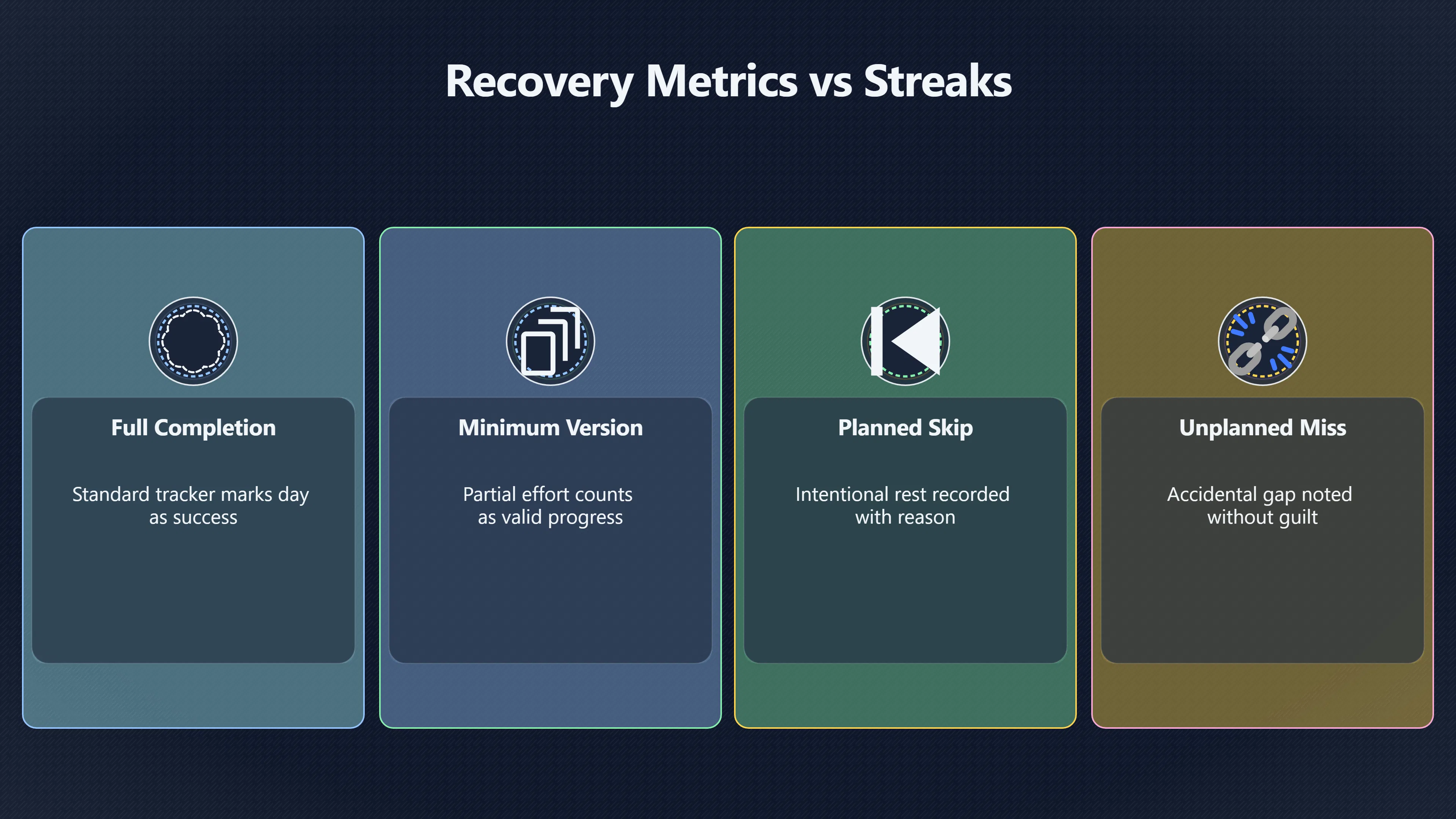
A more resilient tracker can therefore distinguish between:
- Full completion.
- Minimum-version completion.
- Planned skip.
- Unplanned miss.
This design matters because it changes the meaning of the record. Instead of a red mark that announces failure, the tracker captures context.
For example:
DayTraditional TrackerRecovery-Oriented TrackerMondayCompleteCompleteTuesdayCompleteCompleteWednesdayMissedTravel dayThursdayCompleteMinimum version completedFridayCompleteComplete
The second record contains information that can improve future behaviour. The first only records a broken chain.
Neutral miss labels are especially valuable. A missed day caused by illness, family care or travel is not the same as abandoning a habit. Recording the reason can reveal patterns that guide future adjustments. If every interruption occurs on late-shift workdays, the problem may be scheduling rather than motivation.
Why a Single Miss Should Not Reset Everything
Habit-formation research provides an important correction to common tracking culture: missing one day is not equivalent to starting over.
Research led by Phillippa Lally found that habit strength generally increased through repeated performance and that occasional missed opportunities did not seriously impair the habit-formation process. Automaticity resumed once the behaviour was performed again.[PubMed Central]pmc.ncbi.nlm.nih.govPubMed CentralMaking health habitual: the psychology of 'habit-formation' and…by B Gardner · 2012 · Cited by 899 — Missing the occasio…
Subsequent explanations of the study have repeatedly highlighted the same practical lesson: a single missed day does not erase previous gains.[The Behavioral Scientist]thebehavioralscientist.comThe Behavioral Scientist How Long Does It Take to Form a Habit?What Lally et al…by J Hreha — It showed that missing a single day doesn't derail habit formation. A missed opportunity reduced automat…[University of Surrey]surrey.ac.ukdoes it really take 66 days form habit we asked expert dr pippa lallyDoes it really take 66 days to form a habit?21 Jan 2026 — In 2010, Dr Pippa Lally, with colleagues at UCL, published a study that found t…
This evidence suggests that the common “back to zero” logic used by many trackers is psychologically dramatic but behaviourally misleading.
A better policy is to separate habit strength from streak length.
A tracker might continue displaying:
- Total repetitions.
- Number of active weeks.
- Percentage consistency.
- Longest streak.
Under this approach, breaking a streak removes only one metric. It does not erase the entire history of effort.

Weekly Consistency Scores Versus Perfect Chains
Perfect daily chains are often the wrong measure.
Many worthwhile habits are not naturally daily. Strength training, language study, deep work sessions and social connection may be better evaluated across a week than across consecutive days.
A weekly consistency score asks a different question:
Did you perform the behaviour often enough to support your goal?
Examples include:
- Reading on five of seven days.
- Exercising three times per week.
- Writing on four evenings per week.
- Meditating on twenty days this month.
This approach has several advantages.
First, it reflects actual behavioural goals more accurately. Second, it accommodates normal variation in work schedules, health and family demands. Third, it reduces the emotional cost of isolated misses. A missed Tuesday matters less when the target is five successful days across the week.[PubMed Central]pmc.ncbi.nlm.nih.govPubMed CentralMaking health habitual: the psychology of 'habit-formation' and…by B Gardner · 2012 · Cited by 899 — Missing the occasio…
From a governance perspective, weekly scoring changes the incentives built into the system. The user is rewarded for sustained participation rather than uninterrupted perfection.
The Value of Recovery Metrics
Most trackers celebrate continuation. Few celebrate recovery.
Yet recovery may be the more important skill.
A recovery-oriented tracker can record measures such as:
- Days until restart after a miss.[productivity-hub.app]productivity-hub.appHow to Make New Habits Stick Easily and Consistently?4 days ago — Instead of abandoning a habit entirely after a missed day, employ the '…
- Number of successful recoveries.
- Percentage of lapses followed by next-day action.
- Longest recovery delay.
These metrics shift attention towards resilience.
Consider two users:
- User A maintains a 60-day streak and quits after it breaks.
- User B misses occasionally but restarts within 24 hours every time.
Traditional tracking praises User A. Long-term behaviour change may favour User B.
The second user has learned a more transferable skill: how to resume action after disruption.

The “Never Miss Twice” Alternative
One widely discussed alternative to rigid streak culture is the “never miss twice” rule. The idea is simple: a single miss is treated as normal, but a second consecutive miss becomes a signal that attention is needed. Goals and Progress[Productivity Hub]productivity-hub.appHow to Make New Habits Stick Easily and Consistently?4 days ago — Instead of abandoning a habit entirely after a missed day, employ the '…
This rule aligns more closely with habit-formation evidence than strict reset systems. It acknowledges that interruptions occur while preserving urgency around recovery. Research summaries of the Lally findings consistently note that occasional missed performances do not significantly derail habit formation, whereas extended gaps become more problematic.[PubMed Central]pmc.ncbi.nlm.nih.govPubMed CentralMaking health habitual: the psychology of 'habit-formation' and…by B Gardner · 2012 · Cited by 899 — Missing the occasio…[Goals]goalsandprogress.comtwo day rule habit recoveryGoals and ProgressThe Two-day Rule: Recover From a Missed Habit (2026)4 days ago — The Two-day rule for habit recovery: one missed day is… and Progress
A tracker designed around this principle might display:
- Current streak.
- Recovery streak.
- Consecutive misses.
The critical warning appears after repeated absence rather than after a single imperfect day.
That design communicates a more accurate message: one interruption is normal; a growing pattern deserves attention.
Better Tracking Means Better Restarting
The strongest habit trackers do not act like scoreboards. They act like diagnostic tools.
They preserve useful information, reduce all-or-nothing thinking and encourage rapid recovery. They recognise minimum versions of behaviours, distinguish different kinds of misses and reward consistency across meaningful time periods rather than demanding uninterrupted perfection.
For people navigating relapse and missed days, the most valuable tracking question is not “How long is my streak?” It is “How quickly and reliably do I come back?” Research on habit formation suggests that occasional interruptions are rarely the decisive factor. What matters more is whether the system makes restarting feel possible. PubMed Central[Wiley Online Library]onlinelibrary.wiley.comOnline Library Modelling habit formation in the real worldWiley Online LibraryModelling habit formation in the real world - Lally - 2010by P Lally · 2010 · Cited by 3715 — To investigate the proc…
Amazon book picks
Further Reading
Books and field guides related to When Streak Trackers Make Habits Brittle. Use these as the next step if you want deeper reading beyond the article.
eBay marketplace picks
Marketplace Samples
Example marketplace items related to this page. Use the search link to explore similar finds on eBay.



Endnotes
1.
Source: onlinelibrary.wiley.com
Title: Online Library Modelling habit formation in the real world
Link:https://onlinelibrary.wiley.com/doi/abs/10.1002/ejsp.674
Source snippet
Wiley Online LibraryModelling habit formation in the real world - Lally - 2010by P Lally · 2010 · Cited by 3715 — To investigate the proc...
2.
Source: ehm-tech.com
Link:https://www.ehm-tech.com/habit/blog/habit-streaks-do-they-actually-work/
Source snippet
EHM TechHabit Streaks: Why They Work and When They BackfireMarch 10, 2026 — 10 Mar 2026 — Apply the Two-Day Rule: never miss two days in...
Published: March 10, 2026
3.
Source: gsb.stanford.edu
Title: building habits key lasting behavior change
Link:https://www.gsb.stanford.edu/insights/building-habits-key-lasting-behavior-change
Source snippet
Stanford Graduate School of BusinessBuilding Habits: The Key to Lasting Behavior Change18 Apr 2023 — In this episode, BJ Fogg reveals the...
4.
Source: productivity-hub.app
Link:https://productivity-hub.app/en/blog/how-to-make-new-habits-stick-easily-and-consistently-daily
Source snippet
How to Make New Habits Stick Easily and Consistently?4 days ago — Instead of abandoning a habit entirely after a missed day, employ the '...
5.
Source: pmc.ncbi.nlm.nih.gov
Link:https://pmc.ncbi.nlm.nih.gov/articles/PMC3505409/
Source snippet
PubMed CentralMaking health habitual: the psychology of 'habit-formation' and...by B Gardner · 2012 · Cited by 899 — Missing the occasio...
6.
Source: professorgame.com
Link:https://www.professorgame.com/podcast/423/
Source snippet
Professor GameWhy streaks backfire and what works | Ep 423December 15, 2025 — 14 Dec 2025 — The abstinence violation effect (“what the he...
Published: December 15, 2025
7.
Source: mariashriver.com
Link:https://mariashriver.com/stanford-researcher-bj-fogg-on-the-tiny-habits-that-lead-to-big-breakthroughs/
Source snippet
You set the bar low (just two pushups, just one breath) and you keep it low. Even...Read more...
8.
Source: thebehavioralscientist.com
Title: The Behavioral Scientist How Long Does It Take to Form a Habit?
Link:https://www.thebehavioralscientist.com/articles/how-long-to-form-a-habit
Source snippet
What Lally et al...by J Hreha — It showed that missing a single day doesn't derail habit formation. A missed opportunity reduced automat...
9.
Source: surrey.ac.uk
Title: does it really take [66 days]({{ ‘66-days/’ | relative_url }}) form habit we asked expert dr pippa lally
Link:https://www.surrey.ac.uk/news/does-it-really-take-66-days-form-habit-we-asked-expert-dr-pippa-lally
Source snippet
Does it really take 66 days to form a habit?21 Jan 2026 — In 2010, Dr Pippa Lally, with colleagues at UCL, published a study that found t...
10.
Source: pmc.ncbi.nlm.nih.gov
Link:https://pmc.ncbi.nlm.nih.gov/articles/PMC11641623/
Source snippet
PubMed CentralTime to Form a Habit: A Systematic Review and Meta-Analysis...by B Singh · 2024 · Cited by 97 — Research emphasises the im...
11.
Source: goalsandprogress.com
Title: two day rule habit recovery
Link:https://goalsandprogress.com/two-day-rule-habit-recovery/
Source snippet
Goals and ProgressThe Two-day Rule: Recover From a Missed Habit (2026)4 days ago — The Two-day rule for habit recovery: one missed day is...
12.
Source: goalsandprogress.com
Link:https://goalsandprogress.com/atomic-habits-vs-tiny-habits/
Source snippet
Use our Fit-First Filter to match Clear's systems or Fogg's micro-behaviors to where you are stuck...
Additional References
13.
Source: researchgate.net
Link:https://www.researchgate.net/publication/391205475_Small_changes_big_impact_A_mini_review_of_habit_formation_and_behavioral_change_principles
Source snippet
Small changes, big impact: A mini review of habit formation...27 Apr 2025 — This mini-review explores the science of habit formation, em...
14.
Source: epyst.com
Link:https://epyst.com/deck/the-2-day-rule-why-missing-twice-kills-habits-1770989685802
Source snippet
The 2-Day Rule: Why Missing Twice Kills HabitsNever miss twice. The behavioral science behind why two consecutive misses collapse a habit...
15.
Source: tinyhabits.com
Link:https://tinyhabits.com/book/
Source snippet
Tiny Habits Book | BJ FoggFogg has coined “Behavior Design”—cracks the code of habit formation. The content in this book is practical, im...
16.
Source: tinyhabits.com
Link:https://tinyhabits.com/
Source snippet
Tiny Habits: BJ FoggBJ Fogg, PhD, created the Tiny Habits method. He directs the Behavior Design Lab at Stanford University. Dr. Fogg's m...
17.
Source: medium.com
Link:https://medium.com/%40daramouracade/tiny-habits-the-small-changes-that-change-everything-book-summary-cfe2fb200f83
Source snippet
Tiny Habits: The Small Changes That Change EverythingFogg outlines the ABCs of habit formation: Anchor (establishing a trigger), Behavior...
18.
Source: researchgate.net
Link:https://www.researchgate.net/profile/Gonzalo_Marchant/post/Do-you-know-what-the-recommendation-is-for-physical-activity-and-sedentary-behavior-to-health/attachment/59d620af79197b807797f284/AS%3A291995114328067%401446628468694/download/Phillippa%2BLally%2C%2BJane%2BWardle%2Band%2BBenjamin%2BGardner.%2BExperiences%2Bof%2Bhabits%2Bformation%2B2011..pdf
19.
Source: researchgate.net
Title: 32898894 How are habits formed Modeling habit formation in the real world
Link:https://www.researchgate.net/publication/32898894_How_are_habits_formed_Modeling_habit_formation_in_the_real_world
Source snippet
Modeling habit formation in the real world | Request PDFAccording to the literature, it takes an average of 66 days, with a range of 18 t...
20.
Source: abebooks.co.uk
Link:https://www.abebooks.co.uk/9780753553244/Tiny-Habits-Why-Starting-Small-0753553244/plp
Source snippet
Tiny Habits: Why Starting Small Makes Lasting Change EasyBJ Fogg is the founder and director of the Behaviour Design Lab at Stanford...
21.
Source: madinamerica.com
Link:https://www.madinamerica.com/2026/03/the-compliance-machine-how-adhd-habit-tracking-apps-enforce-the-disease-model/
Source snippet
How ADHD Habit-Tracking Apps Enforce the Disease Model17 Mar 2026 — Users are rewarded with ”streaks,” miss one day and the streak collap...
22.
Source: coachpedropinto.com
Title: habit formation science backed strategies for leaders
Link:https://coachpedropinto.com/habit-formation-science-backed-strategies-for-leaders/
Source snippet
Habit Formation: Science-Backed Strategies For Leaders...4 Jun 2025 — Effective recovery strategies include: The “never miss twice” rule...
Topic Tree