Within Identity
When one missed habit feels like failure
Missed habits are easier to repair when they are treated as design feedback instead of proof of personal failure.
On this page
- Why identity heavy plans make lapses heavier
- How shame can interrupt behaviour repair
- How to turn a lapse back into useful data
Page outline Jump by section
Introduction
A missed habit is often a small event. One workout is skipped. One evening routine is forgotten. One planned writing session never happens. Yet for some people the emotional reaction is far larger than the behaviour itself. The lapse quickly becomes a judgement about character: “I am lazy”, “I have no discipline”, or “I am not the kind of person I thought I was”.
 This is one of the risks of tying habits too tightly to identity. Identity can help sustain behaviour, but it can also make ordinary setbacks feel like evidence of personal failure rather than information about a system that needs adjustment. Research on habit and identity shows that habits can become integrated into how people see themselves, making them psychologically significant beyond the behaviour alone.[PubMed]pubmed.ncbi.nlm.nih.govHabit and Identity: Behavioral, Cognitive, Affective…by B Verplanken · 2019 · Cited by 153 — When habits relate to feelings of i…
For self-improvement that works, the critical distinction is between a behaviour problem and an identity problem. A missed habit is usually the former. Shame turns it into the latter.
Why Identity-Heavy Plans Make Lapses Heavier
When a habit becomes part of identity, success and failure acquire extra meaning.
A person who says “I am training for a race” experiences a missed run differently from someone who says “I am a runner”. The second statement links the behaviour to self-concept. That connection can increase commitment and consistency, which is one reason identity-based approaches are popular. Research suggests that habits linked to identity are more strongly integrated into the self and may support long-term behavioural persistence.[PubMed]pubmed.ncbi.nlm.nih.govHabit and Identity: Behavioral, Cognitive, Affective…by B Verplanken · 2019 · Cited by 153 — When habits relate to feelings of i…[Frontiers]frontiersin.orgFrontiersHabit and Identity: Behavioral, Cognitive, Affective…by B Verplanken · 2019 · Cited by 153 — Linking habits to identity may s…
The problem appears when behaviour becomes the sole evidence for identity.
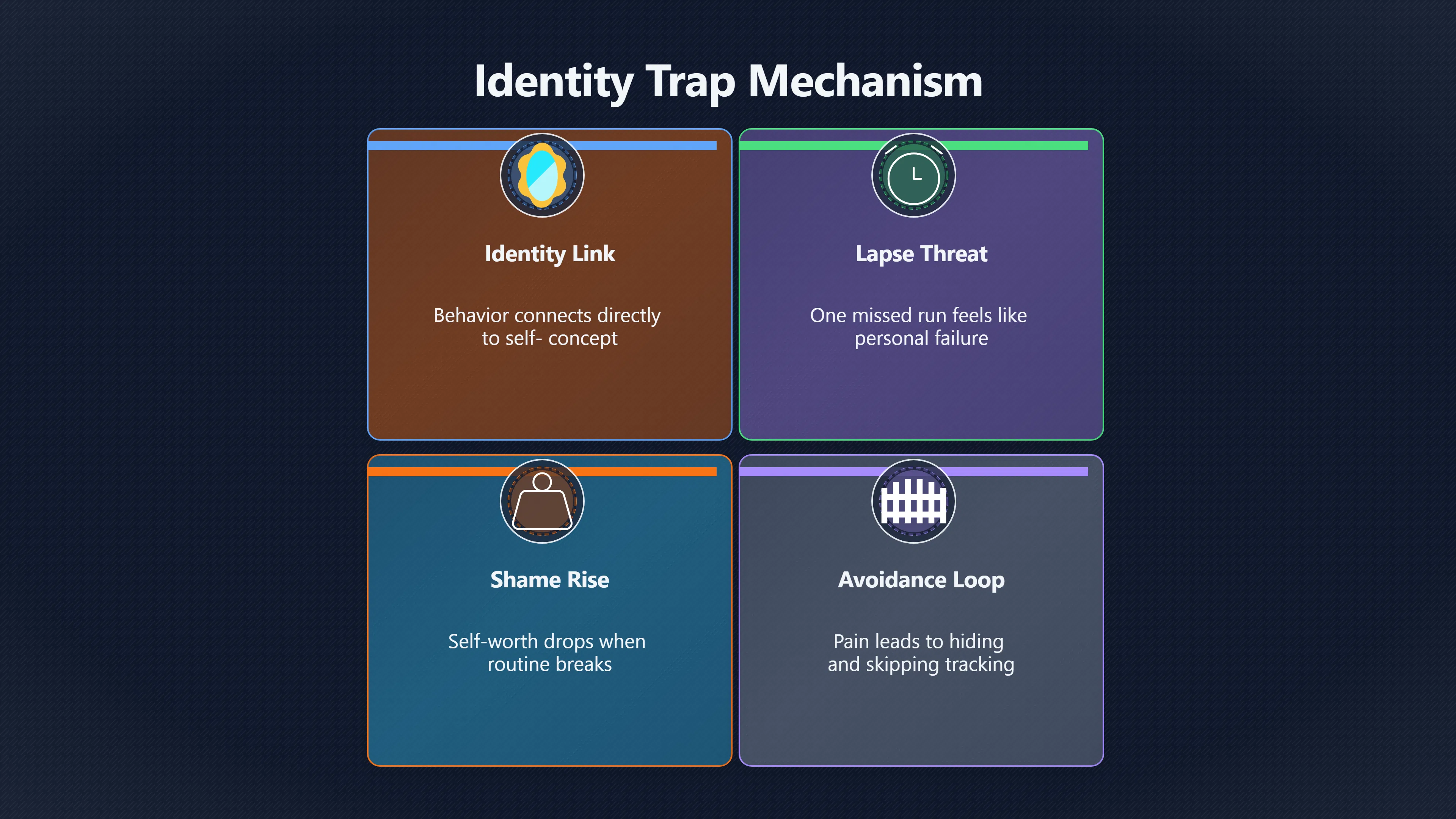
If a person’s self-worth depends heavily on maintaining a streak, any interruption threatens more than a routine. The missed action begins to feel like a contradiction of who they are. Instead of evaluating the behaviour, they evaluate themselves.
This creates a fragile form of motivation:
- Success reinforces identity.
- A lapse threatens identity.
- Threatened identity produces shame.
- Shame makes re-engagement harder.
The behaviour may have changed by only one day, but the interpretation has escalated into a story about personal inadequacy.
This is particularly common among perfectionistic people, who often treat mistakes as signs of deficiency rather than normal variation in performance. Research and clinical literature on self-compassion repeatedly find that many people resist self-kindness because they believe harsh self-criticism is necessary for accountability and improvement.[Psychology Today]psychologytoday.comleaving the road to hell and getting back on trackBehavior change is challenging and requires consistent effort and intentional modification of habits.Read more…
How Shame Interrupts Behaviour Repair
The most damaging feature of shame is that it changes the question being asked.
A useful response to a missed habit is:
What happened, and how can I make the behaviour easier tomorrow?
A shame-based response becomes:[psyche.co]psyche.cohow to be kinder to yourself by practising self compassionHow to be kinder to yourself by practising self-compassionAug 17, 2022 — In terms of evolution, self-criticism developed as a response to…
What is wrong with me?
These questions lead in completely different directions.
Psychologists often distinguish shame from guilt. Guilt focuses on a specific action. Shame focuses on the self. The difference may seem subtle, but it has major consequences for behaviour change. Shame encourages withdrawal, hiding and avoidance, whereas behaviour-focused responses are more compatible with learning and correction.[Nutrition By Carrie]nutritionbycarrie.comNutrition By CarrieSelf-compassion for shame and motivationMar 13, 2024 — Shame is mostly invisible: it makes us go small, go silent, or…[psyche]psyche.cohow to be kinder to yourself by practising self compassionHow to be kinder to yourself by practising self-compassionAug 17, 2022 — In terms of evolution, self-criticism developed as a response to… This is why a single missed habit sometimes produces a surprisingly destructive sequence:
- The habit is missed.
- Self-criticism intensifies.[psyche.co]psyche.cohow to be kinder to yourself by practising self compassionHow to be kinder to yourself by practising self-compassionAug 17, 2022 — In terms of evolution, self-criticism developed as a response to…
- Emotional discomfort rises.
- The person avoids tracking, planning or reviewing.
- More lapses occur.
- The original lapse appears to confirm the negative self-judgement.
The result is not merely a missed behaviour but a collapse in the feedback process that would normally repair it.
A related phenomenon appears in addiction research and relapse prevention. Researchers describe the “abstinence violation effect”, in which a lapse is interpreted as total failure. Instead of viewing the setback as a temporary deviation, the individual sees it as proof that the effort has failed, making further lapses more likely. Reframing the lapse as information rather than catastrophe is considered an important corrective.[Psychology Today]psychologytoday.comleaving the road to hell and getting back on trackBehavior change is challenging and requires consistent effort and intentional modification of habits.Read more…
The same mechanism often appears in everyday habits, even when no addiction is involved. Missing one gym session becomes “I’ve ruined the week”. Missing one planned study session becomes “I’m not serious enough”. The emotional interpretation causes more damage than the original lapse.
Why Harsh Self-Criticism Often Backfires
Many people assume shame is useful because it feels motivating.
The internal logic is simple: if failure feels painful enough, future failure will be avoided.
Evidence suggests reality is more complicated. Research on self-compassion consistently finds that responding to setbacks with understanding rather than harsh condemnation is associated with better coping, reduced rumination, stronger self-improvement intentions and more adaptive responses after failure. PMC[Self-Compassion]self-compassion.orgThe review discusses…Read more…
This does not mean ignoring mistakes. It means separating evaluation of the behaviour from condemnation of the person.
One reason self-criticism often fails is that it consumes attention that could be used for problem-solving. Instead of examining environmental obstacles, unrealistic plans, fatigue, competing priorities or weak cues, attention becomes trapped in self-judgement.
Research on shame also suggests that shame is associated with avoidance and disengagement rather than constructive repair. Self-compassion, by contrast, is linked to healthier emotional regulation and greater willingness to continue after setbacks. PMC[2Mindfulness y Autocompasión - MSC]mindfulnessyautocompasion.comMindfulness y Autocompasiónstudy was to investigate associations between mindfulness, self-compassion, and shame…. compassion when experiencing failure and pain…
In practical terms, a person who thinks “I failed because I am hopeless” learns very little. A person who thinks “I failed because my plan depended on energy I did not have after work” has identified a variable that can be changed.
Only the second response generates usable information.
How to Turn a Lapse Back Into Useful Data
The most effective response to a missed habit is often surprisingly mundane: investigate the system rather than the self.
Instead of treating the lapse as evidence about identity, treat it as evidence about design.
Questions that produce useful information include:
- Was the habit too large for ordinary days?
- Did the cue occur reliably?
- Was the environment supportive?
- Did another commitment interfere?
- Was the schedule realistic?
- Was the behaviour still personally valuable?
These questions shift attention from blame to diagnosis.
Habit research generally emphasises the importance of context, cues and repetition. Habits succeed when environments reliably support behaviour and fail when those supports break down. A lapse therefore often reveals a weakness in the behavioural system rather than a flaw in personal character.[cambridge]cambridge.orgUniversity Press & Assessment Habit Interventions (Chapter 41Cambridge University Press & AssessmentHabit Interventions (Chapter 41) - The Handbook of…This chapter outlines how developing new cue… University Press & Assessment[dspace]dspace.library.uu.nlDeveloping habit-based health behaviour change…by B Gardner · 2023 · Cited by 156 — Theory suggests that making healthy behaviou… A useful rule is to judge identity by patterns rather than incidents.
One missed workout says little about whether someone values fitness. One missed writing session says little about whether someone is a writer. Identity emerges from repeated behaviour over time, not from a single day’s deviation.
Seen this way, a lapse becomes a measurement rather than a verdict.

The Core Mistake: Turning Information Into Identity
The central danger of identity shame is not emotional discomfort alone. It is a category error.
Behaviour provides information about behaviour. It does not automatically provide information about worth, character or potential.
When a habit is missed, the most productive interpretation is usually the least dramatic one: the system failed in some way and now provides feedback about what needs adjustment.
Identity can still matter. Values, self-concept and personal meaning often help people persist through difficulty. But when every missed habit becomes a referendum on who a person is, identity stops supporting behaviour and starts obstructing it.
The people who recover fastest from lapses are often not those with the strongest self-discipline. They are those who can look at a missed habit without turning it into a moral judgement. They preserve enough psychological distance to ask the practical question that shame obscures:
What changed, and what should be redesigned next time?
Amazon book picks
Further Reading
Books and field guides related to When one missed habit feels like failure. Use these as the next step if you want deeper reading beyond the article.
Atomic Habits
Rating: 3.5/5 from 7 Google Books ratings
Encourages quick recovery from lapses instead of self-condemnation.
eBay marketplace picks
Marketplace Samples
Example marketplace items related to this page. Use the search link to explore similar finds on eBay.


Endnotes
1.
Source: psyche.co
Title: how to be kinder to yourself by practising self compassion
Link:https://psyche.co/guides/how-to-be-kinder-to-yourself-by-practising-self-compassion
Source snippet
How to be kinder to yourself by practising self-compassionAug 17, 2022 — In terms of evolution, self-criticism developed as a response to...
2.
Source: pmc.ncbi.nlm.nih.gov
Title: PMCAddressing Shame Through Self Compassion
Link:https://pmc.ncbi.nlm.nih.gov/articles/PMC11556665/
Source snippet
NIHby AB Cepni · 2024 · Cited by 15 — This paper highlights the role of Acceptance and Commitment Therapy and Compassion Focused Th...
3.
Source: pmc.ncbi.nlm.nih.gov
Link:https://pmc.ncbi.nlm.nih.gov/articles/PMC10543633/
Source snippet
This is consistent with past research showing that shame elicits...Read more...
4.
Source: self-compassion.org
Link:https://self-compassion.org/wp-content/uploads/2018/05/Biber2017.pdf
Source snippet
The review discusses...Read more...
5.
Source: pmc.ncbi.nlm.nih.gov
Title: PMCSelf-Compassion and Psycho-Physiological Recovery
Link:https://pmc.ncbi.nlm.nih.gov/articles/PMC6624795/
Source snippet
by LA Ceccarelli · 2019 · Cited by 205 — Results suggest that self-compassion promotes adaptive physiological and psychological respon...
6.
Source: mindfulnessyautocompasion.com
Title: Mindfulness y Autocompasión
Link:https://www.mindfulnessyautocompasion.com/investigacion-verguenza/exploring-the-relationships-between-mindfulness-self-compassion-and-shame
Source snippet
study was to investigate associations between mindfulness, self-compassion, and shame.... compassion when experiencing failure and pain...
7.
Source: cambridge.org
Title: University Press & Assessment Habit Interventions (Chapter 41)
Link:https://www.cambridge.org/core/books/handbook-of-behavior-change/habit-interventions/420CFDC7EE75036CC4D08EE137108E45
Source snippet
Cambridge University Press & AssessmentHabit Interventions (Chapter 41) - The Handbook of...This chapter outlines how developing new cue...
8.
Source: pmc.ncbi.nlm.nih.gov
Link:https://pmc.ncbi.nlm.nih.gov/articles/PMC12318445/
Source snippet
Applying the Science of Habit Formation to Evidence-Based...by AG Harvey · 2021 · Cited by 55 — We propose that there is an urgent ne...
9.
Source: self.inc
Link:https://www.self.inc/
Source snippet
Build Credit, Build Savings and Access CashBuild credit and savings with Self. The Credit Builder Account and Self Visa® Credit Ca...
10.
Source: pubmed.ncbi.nlm.nih.gov
Link:https://pubmed.ncbi.nlm.nih.gov/31354563/
Source snippet
Habit and Identity: Behavioral, Cognitive, Affective...by B Verplanken · 2019 · Cited by 153 — When habits relate to feelings of i...
11.
Source: frontiersin.org
Link:https://www.frontiersin.org/journals/psychology/articles/10.3389/fpsyg.2019.01504/full
Source snippet
FrontiersHabit and Identity: Behavioral, Cognitive, Affective...by B Verplanken · 2019 · Cited by 153 — Linking habits to identity may s...
12.
Source: psychologytoday.com
Title: leaving the road to hell and getting back on track
Link:https://www.psychologytoday.com/gb/blog/the-road-to-hell/201705/leaving-the-road-to-hell-and-getting-back-on-track
Source snippet
Behavior change is challenging and requires consistent effort and intentional modification of habits.Read more...
13.
Source: nutritionbycarrie.com
Link:https://nutritionbycarrie.com/2023/03/self-compassion-for-shame-and-motivation.html
Source snippet
Nutrition By CarrieSelf-compassion for shame and motivationMar 13, 2024 — Shame is mostly invisible: it makes us go small, go silent, or...
14.
Source: psychologytoday.com
Title: the abstinence violation effect and overcoming it
Link:https://www.psychologytoday.com/gb/blog/stigma-addiction-and-mental-health/202309/the-abstinence-violation-effect-and-overcoming-it
Source snippet
Psychology TodayThe Abstinence Violation Effect and Overcoming It2 Jan 2024 — Negative thoughts in early recovery can lead to shame and i...
15.
Source: dspace.library.uu.nl
Link:https://dspace.library.uu.nl/bitstreams/df64781b-08f5-4a1b-8d92-fde1069e3216/download
Source snippet
Developing habit-based health behaviour change...by B Gardner · 2023 · Cited by 156 — Theory suggests that making healthy behaviou...
16.
Source: Wikipedia
Link:https://en.wikipedia.org/wiki/Self
Source snippet
SelfIn philosophy, the self is an individual's own being, knowledge, and values, and the relationship between these attributes. The fi...
17.
Source: pubmed.ncbi.nlm.nih.gov
Link:https://pubmed.ncbi.nlm.nih.gov/34587780/
Source snippet
nih.govAttitudes, Habits, and Behavior Changeby B Verplanken · 2022 · Cited by 552 — There is evidence that changing attitudes leads to c...
18.
Source: frontiersin.org
Link:https://www.frontiersin.org/journals/psychology/articles/10.3389/fpsyg.2017.00229/full
Source snippet
On the Role of Self-compassion and Self-kindness in...by M Mantzios · 2017 · Cited by 105 — Self-compassion has been investigated in rel...
19.
Source: nailedapp.io
Link:https://nailedapp.io/blog/self-compassion-habit-change/
Source snippet
Self-Compassion in Habit Change: Stop Beating Yourself UpFeb 25, 2026 — Not only does self-criticism fail to stop nail biting, it activel...
20.
Source: youtube.com
Link:https://www.youtube.com/watch?v=3tAm7NcTQf4
Source snippet
Self Compassion An Antidote to Shame and Self CriticismSelf-Compassion: An Antidote to Shame and Self-Criticism The talk discussed how hu...
21.
Source: wisdomcenter.uchicago.edu
Link:https://wisdomcenter.uchicago.edu/news/wisdom-news/why-self-compassion-not-self-esteem-leads-success
Source snippet
self-compassion – not self-esteem – leads to successJan 13, 2021 — Do you still blush with shame, and scold yourself for having been so s...
Additional References
22.
Source: researchgate.net
Link:https://www.researchgate.net/publication/334156657_Habit_and_Behavior_Change
Source snippet
(PDF) Habit and Behavior ChangeIn this chapter we describe what habits are and what they do, such as effects on information processing, t...
23.
Source: researchgate.net
Link:https://www.researchgate.net/publication/391370291_Self-compassion_in_the_moment_Dynamic_changes_of_compassionate_and_uncompassionate_self-responding_in_daily_life
Source snippet
(PDF) Self-Compassion in the Moment: Dynamic Changes...5 May 2025 — Objectives Self-compassion involves a positive attitude towards ones...
Published: May 2025
24.
Source: sweetinstitute.com
Link:https://sweetinstitute.com/cognitive-behavioral-therapy-for-habit-formation-and-behavior-change-a-practical-model-for-sustainable-self-directed-growth/
Source snippet
Cognitive Behavioral Therapy for Habit Formation and...20 Aug 2025 — This article presents a practical, stepwise CBT model to support ha...
25.
Source: cci.health.wa.gov.au
Link:https://www.cci.health.wa.gov.au/~/media/CCI/Consumer-Modules/Building-Self-Compassion/Building-Self-Compassion—06—Self-Compassionate-Behaviour.pdf
Source snippet
health.wa.gov.auSelf-Compassionate BehaviourBuilding our own self-compassion can also be helped along by showing compassion towards other...
26.
Source: nhs.uk
Link:https://www.nhs.uk/live-well/addiction-support/drug-addiction-getting-help/
Source snippet
addiction: getting helpIf you need help for a drug problem, you're entitled to treatment in the same way as anyone else who has a health...
27.
Source: research.tue.nl
Title: habit attitude and planned behaviour is habit an empty construct
Link:https://research.tue.nl/en/publications/habit-attitude-and-planned-behaviour-is-habit-an-empty-construct-/
Source snippet
tue.nlHabit, attitude, and planned behaviour: is habit an empty...by B Verplanken · 1999 · Cited by 1798 — Verplanken, B & Aarts, HAG 1...
28.
Source: wjarr.com
Link:https://wjarr.com/sites/default/files/fulltext_pdf/WJARR-2025-1333.pdf
Source snippet
d habits, which posits that aligning habits with one's personal identity can lead to...Read more...
29.
Source: selfthebrand.com
Title: Join a vibrant community embracing individuality
Link:https://selfthebrand.com/
Source snippet
Self the brand: Luxury & confidence for your everyday life...Self: luxurious yet accessible, empowering rebellious girls with comfy, eff...
30.
Source: themindfulnessapp.com
Title: how to use mindfulness for habit formation
Link:https://www.themindfulnessapp.com/articles/how-to-use-mindfulness-for-habit-formation
Source snippet
29 Oct 2025 — Learn how mindfulness can enhance habit formation by increasing self-awareness and fostering intentional choices for lastin...
31.
Source: repository.essex.ac.uk
Title: Attitudes and Habits Final.09.05.2021.ARP
Link:https://repository.essex.ac.uk/30320/1/Attitudes%20and%20Habits_Final.09.05.2021.ARP.pdf
Source snippet
Essex Open Access Research Repositoryattitudes, habits and behavior changeby B Verplanken · 2022 · Cited by 550 — Verplanken and Sui (201...
Topic Tree