Within Small Starts
When Streaks Stop You Getting Better
A perfect streak can become a trap when protecting the record matters more than improving the behaviour.
On this page
- How streaks shift attention from growth to preservation
- Warning signs that the habit is protecting comfort
- Better ways to track resilient progress
Page outline Jump by section
Introduction
Streaks are one of the most popular tools in self-improvement because they make consistency visible. A growing number on a calendar, app or habit tracker can turn an abstract goal into something concrete. Research on self-monitoring suggests that tracking behaviour often improves follow-through, and streaks can provide a powerful short-term motivational boost.[James Clear]jamesclear.comJames ClearThe Ultimate Habit Tracker Guide: Why and How to Track…A habit tracker is a simple way to log your behavior, and the mere a…
 The problem begins when the streak becomes more important than the habit itself. Instead of asking, “What would help me improve now?”, people start asking, “What can I do without breaking the chain?” At that point, a tool designed to support growth can quietly shift attention towards preservation. The result is a common trap: someone who successfully started small becomes reluctant to take on a harder, more useful version of the behaviour because the existing streak feels too valuable to risk.
When a Helpful Streak Becomes a Limitation
Streaks work partly because they exploit a basic psychological tendency: people dislike losing something they already possess. Once a streak reaches 30, 100 or 500 days, breaking it feels like a loss rather than a neutral event. Researchers and behavioural writers frequently describe this as one reason streaks can be so motivating.[EHM Tech]ehm-tech.comhabit streaks do they actually workEHM TechHabit Streaks: Why They Work and When They BackfireMar 10, 2026 — Habit streaks tap into loss aversion, dopamine loops, and ident…
That motivation is useful during the fragile early stages of habit formation. The danger appears later.
Imagine someone who has maintained a 10-minute daily walk for six months. Initially, the streak helped establish consistency. But eventually the next useful step may be interval training, longer walks, strength work or a more demanding exercise programme. Those changes introduce uncertainty. Performance might vary. Recovery days might be needed. Progress may become less neat than a simple daily tick.
Protecting the streak can therefore create a hidden incentive to stay at the current level.
The person continues succeeding at the original habit while avoiding the more challenging behaviour that would produce greater growth. The streak has become a ceiling rather than a foundation.
How Streaks Shift Attention from Growth to Preservation
The core mechanism is subtle. Tracking starts by measuring behaviour. Over time, the metric itself can become the target.
Behaviour-change technologies and habit-tracking systems often focus on engagement, checkmarks and visible progress indicators because these features encourage continued participation. Yet researchers examining motivation in behaviour-change technologies have warned that systems can end up strengthening attachment to the intervention itself rather than to the underlying behavioural goal.[arXiv]arxiv.orgDesigning for Sustained Motivation: A Review of Self-Determination Theory in Behaviour Change TechnologiesJanuary 31, 2024…
Several shifts commonly occur:
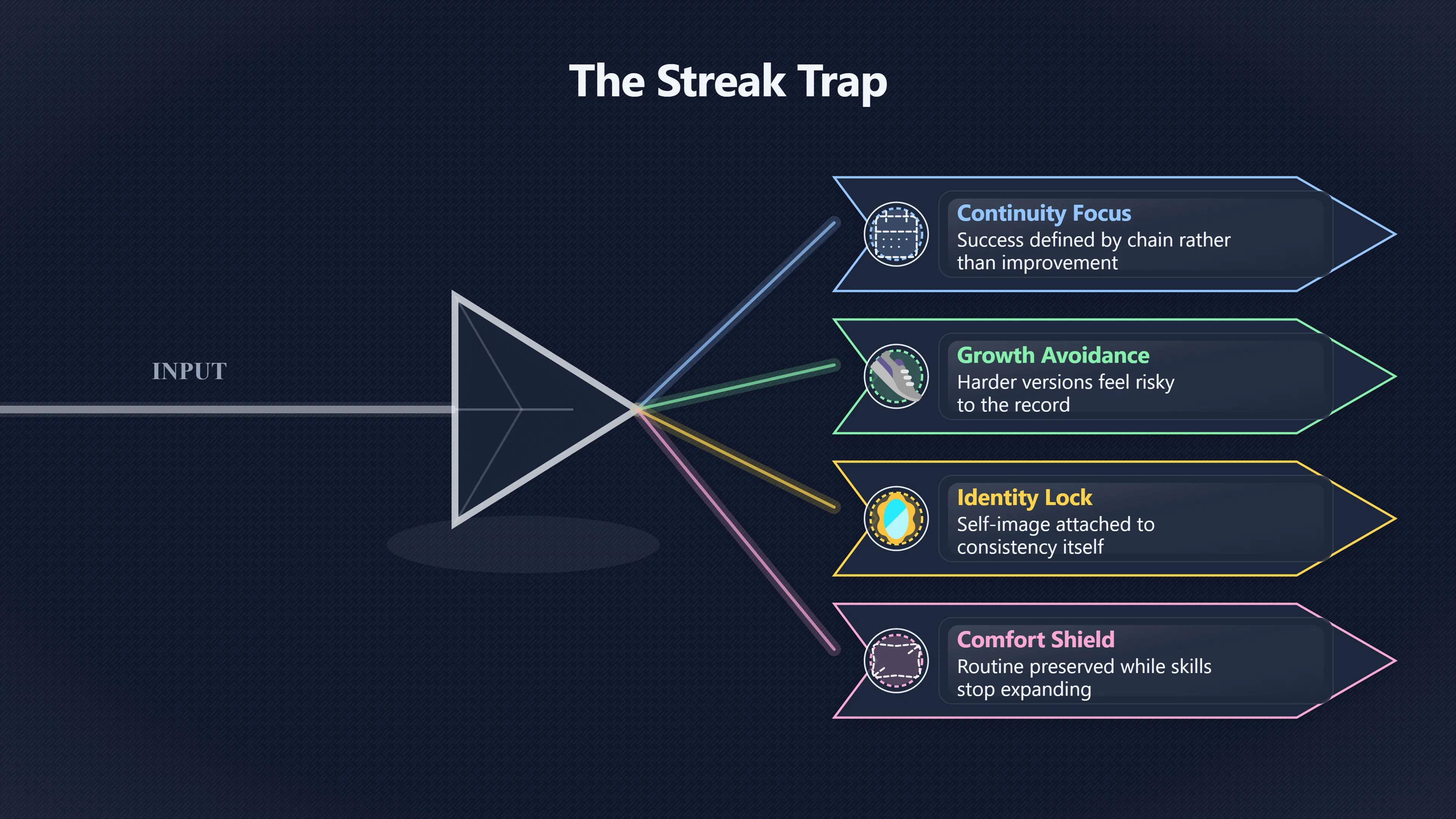
- Success becomes defined by continuity rather than improvement.
- Avoiding failure becomes more important than pursuing growth.
- The tracker’s number becomes more emotionally significant than the skill being developed.
- Experiments feel risky because they might interrupt the record.
A writer who once aimed to become better at writing may end up prioritising “writing something every day” over learning difficult techniques. A language learner may continue easy review sessions because they preserve a streak while avoiding more demanding speaking practice. A runner may protect a daily running streak by repeating comfortable distances instead of attempting training that requires recovery and variation.
In each case, the habit survives, but development slows.
Why Harder Habits Feel Threatening
This pattern is especially common when people move from beginner behaviours to intermediate ones.
Small habits are usually designed for reliability. Harder habits are designed for adaptation. They involve uncertainty, learning and occasional failure.
A streak rewards predictability. Improvement often requires disruption.
The certainty gap
A five-minute habit can usually be completed regardless of mood, weather or workload. A more ambitious version may depend on energy, preparation or skill.
Because the streak provides immediate psychological rewards, the guaranteed success of the easy habit can feel more attractive than the uncertain benefits of progression.
Identity protection
Long streaks often become part of a person’s self-image.
Someone may start thinking:
- “I’m the person who never misses.”
- “I’ve maintained this for 400 days.”
- “I don’t want to throw that away.”
The identity becomes attached to consistency itself rather than to the purpose behind the behaviour.
This is one reason why breaking a streak can feel disproportionately painful. Some people report losing motivation entirely after a broken streak because the symbolic loss overshadows the actual behaviour. Community discussions among habit-tracking users frequently describe this all-or-nothing reaction.[Reddit]reddit.comHas anyone else struggled with habit trackers because of…I've noticed that when the streak breaks, I often lose motivation and s…
Comfort disguised as discipline
Perhaps the most deceptive version of the streak trap is that it looks like discipline from the outside.
The person is still showing up.
The calendar is still full.
The habit still exists.
Yet the behaviour may no longer be stretching skills, expanding capacity or moving towards the larger goal.

Warning Signs That the Habit Is Protecting Comfort
A streak is probably becoming a constraint rather than a support when several of these signs appear:
- You feel anxious about changing the habit format.
- You repeatedly choose easier versions despite being capable of more.
- Missing one day feels catastrophic rather than inconvenient.
- You avoid training plans that include recovery days.
- You focus more on the streak count than on outcomes.
- The behaviour has stopped becoming more effective over time.
- You reject useful experiments because they might interrupt tracking.
The most revealing question is often simple:
If the streak disappeared tomorrow, would you still think your current version of the habit was the best way to improve?
If the answer is no, the streak may be preserving routine rather than supporting growth.
Better Ways to Track Resilient Progress
The solution is not to abandon tracking altogether. Self-monitoring remains one of the most consistently useful behaviour-change techniques. Tracking often helps people maintain awareness, accountability and momentum.[James Clear]jamesclear.comJames ClearThe Ultimate Habit Tracker Guide: Why and How to Track…A habit tracker is a simple way to log your behavior, and the mere a…
The challenge is to track in a way that rewards development rather than mere preservation.
Track levels, not just days
Instead of recording only whether the habit happened, record the level achieved.
For example:
DayExerciseMonday10-minute walkTuesday20-minute walkWednesdayWalk plus intervals
The focus shifts from maintaining a chain to expanding capability.
Reward recovery and adaptation
Many valuable habits require variation.
Strength training, endurance training and skill development often improve through cycles of effort and recovery rather than identical daily repetition.
A tracking system should recognise planned recovery as successful behaviour rather than failure.
Measure outputs occasionally
Consistency matters, but outcomes matter too.
A writer might track words produced, articles completed or feedback received.
A language learner might track conversations held.
A runner might track fitness improvements.
These measures remind the person why the habit exists.
Keep a “growth streak”
Instead of counting consecutive days, count consecutive weeks in which some form of progression occurred.
The question becomes:
“Did I improve something this week?”
That framing aligns the score with the purpose.
The Goal Is Not a Perfect Record
Research and practical habit-building experience both suggest that consistency is valuable because it helps behaviours become established. But the purpose of starting small is not to remain small forever. Tiny actions are training wheels, not the destination.[stanford]gsb.stanford.eduStanford Graduate School of BusinessBuilding Habits: The Key to Lasting Behavior ChangeApr 18, 2023 — In this episode, BJ Fogg reveals th… Graduate School of Business[Maria Shriver]mariashriver.comWhen you go tiny, when you set the bar really low, you are much more likely to succeed. You…Read more…
A streak is useful when it lowers resistance and helps a behaviour become normal. It becomes problematic when preserving the record matters more than increasing capability.
The healthiest relationship with a streak is to treat it as evidence that a habit exists, not proof that improvement is occurring. Once the behaviour is stable, the important question is no longer “Can I keep the chain alive?”
It is “What is the next challenge this habit now makes possible?”
Amazon book picks
Further Reading
Books and field guides related to When Streaks Stop You Getting Better. Use these as the next step if you want deeper reading beyond the article.
eBay marketplace picks
Marketplace Samples
Example marketplace items related to this page. Use the search link to explore similar finds on eBay.


Endnotes
1.
Source: ehm-tech.com
Title: habit streaks do they actually work
Link:https://www.ehm-tech.com/habit/blog/habit-streaks-do-they-actually-work/
Source snippet
EHM TechHabit Streaks: Why They Work and When They BackfireMar 10, 2026 — Habit streaks tap into loss aversion, dopamine loops, and ident...
2.
Source: arxiv.org
Link:https://arxiv.org/abs/2402.00121
Source snippet
Designing for Sustained Motivation: A Review of Self-Determination Theory in [Behaviour Change]({{ 'behaviour-change/' | relative_url }}) TechnologiesJanuary 31, 2024...
Published: January 31, 2024
3.
Source: reddit.com
Link:https://www.reddit.com/r/selfimprovement/comments/1s0utik/has_anyone_else_struggled_with_habit_trackers/
Source snippet
Has anyone else struggled with habit trackers because of...I've noticed that when the streak breaks, I often lose motivation and s...
4.
Source: gsb.stanford.edu
Link:https://www.gsb.stanford.edu/insights/building-habits-key-lasting-behavior-change
Source snippet
Stanford Graduate School of BusinessBuilding Habits: The Key to Lasting Behavior ChangeApr 18, 2023 — In this episode, BJ Fogg reveals th...
5.
Source: keelify.com
Title: case against gamified habits
Link:https://keelify.com/blog/case-against-gamified-habits
6.
Source: jamesclear.com
Link:https://jamesclear.com/habit-tracker
Source snippet
James ClearThe Ultimate Habit Tracker Guide: Why and How to Track...A habit tracker is a simple way to log your behavior, and the mere a...
7.
Source: mariashriver.com
Link:https://mariashriver.com/stanford-researcher-bj-fogg-on-the-tiny-habits-that-lead-to-big-breakthroughs/
Source snippet
When you go tiny, when you set the bar really low, you are much more likely to succeed. You...Read more...
8.
Source: play.google.com
Link:https://play.google.com/store/apps/details?hl=en_SG&id=com.adrienblc.habitstracker
Source snippet
Tracker - Habit Streak – Apps on Google Play11 Feb 2026 — Habit Streak is the most powerful habit tracker and daily planner app designed...
9.
Source: iheart.com
Title: stanford behaviour change expert bj fogg 57869504
Link:https://www.iheart.com/podcast/239-how-i-work-31072293/episode/stanford-behaviour-change-expert-bj-fogg-57869504/
Source snippet
Stanford behaviour change expert, BJ Fogg, on how he...Stanford behaviour change expert, BJ Fogg, on how he decides which habits to form...
Additional References
10.
Source: bjsrestaurants.com
Link:https://www.bjsrestaurants.com/
Source snippet
BJ's Restaurants and BrewhouseDiscover our brewhouse menu featuring deep dish pizza, handcrafted burgers, seasonal specials, popular favo...
11.
Source: medium.com
Link:https://medium.com/design-bootcamp/streaks-and-daily-rewards-as-habit-forming-systems-dab7f5a34539
Source snippet
Streaks and Daily Rewards as Habit-Forming SystemsThis text explores streaks and daily rewards not as features, but as habit-forming syst...
12.
Source: medium.com
Link:https://medium.com/nudge-notes/the-science-behind-habit-forming-products-b0be52dec61e
Source snippet
The Science Behind Habit-Forming ProductsAccording to BJ Fogg's Behavior Model, three elements must converge simultaneously for a behavio...
13.
Source: tinyhabits.com
Link:https://tinyhabits.com/
Source snippet
Tiny Habits: BJ FoggBJ Fogg, PhD, created the Tiny Habits method. He directs the Behavior Design Lab at Stanford University. Dr. Fogg's m...
14.
Source: medium.com
Link:https://medium.com/%40webbercookn/why-some-people-achieve-their-goals-while-others-quit-dd9d0297033a
Source snippet
Why Some People Achieve Their Goals While Others QuitThe people who reach long‑term goals typically turn important actions into habits so...
15.
Source: gc-bs.org
Link:https://gc-bs.org/articles/the-architecture-of-influence-a-comprehensive-analysis-of-gamification-in-behavioral-change-strategies/
Source snippet
The Architecture of Influence: A Comprehensive Analysis...10 Nov 2025 — Self-Determination Theory, a macro-theory of human motivation de...
16.
Source: discovery.ucl.ac.uk
Link:https://discovery.ucl.ac.uk/1477627/1/Chi%202016%20LBW%202.1%20camera%20ready.pdf
Source snippet
Role of Dependency in Habit Formation AppsStreaks motivated participants by providing a challenge to maintain a streak, a form of 'gamifi...
17.
Source: oneyoufeed.net
Link:https://www.oneyoufeed.net/why-[willpower
Source snippet
Why Willpower Isn't Enough: The Tiny Habits Method...23 Dec 2025 — Eric and Dr. BJ Fogg discuss why willpower isn't enough as they explo...
18.
Source: happily.ai
Link:https://happily.ai/blog/using-gamification-to-change-workplace-outcomes-how-play-transforms-anxiety-into-progress/
Source snippet
Why 'Play' is the Cure for Workplace Anxiety (According to...14 Nov 2025 — This approach satisfies all three psychological needs from Se...
19.
Source: yukaichou.com
Title: self determination theory guide to ryan and decis motivation framework
Link:https://yukaichou.com/gamification-analysis/self-determination-theory-guide-to-ryan-and-decis-motivation-framework/
Source snippet
Self-Determination Theory: All 6 Mini-Theories6 May 2026 — Self-Determination Theory is the most empirically validated motivation framewo...
Published: May 2026
Topic Tree