Within Better Change
How Repetition Becomes Automatic
Repeating a behaviour after the same cue helps it become less dependent on conscious effort.
On this page
- Cue stability
- Repetition and automaticity
- When routines break

Page outline Jump by section
Introduction
Stable contexts are one reason self improvement can become easier with time. A behaviour is more likely to become automatic when it is repeated after the same cue: the same time, place, preceding action, object, person, mood or routine step. Over time, the cue begins to do some of the work that motivation used to do. Instead of deciding afresh to stretch, read, walk, floss or prepare lunch, the situation itself starts to prompt the next action. Habit researchers commonly describe this as a learned cue-behaviour association: repeated action in a stable context makes behaviour faster, more efficient and less dependent on conscious deliberation.[PubMed]pubmed.ncbi.nlm.nih.govPsychology of Habitby W Wood · 2016 · Cited by 1909 — This review characterizes habits in terms of their cognitive, motivational, a…
This is not a promise that behaviour becomes effortless after a magic number of days. The better lesson is more practical: make the cue stable, repeat the action often enough, keep the behaviour simple enough to survive ordinary days, and protect the routine when life changes. Habit automaticity is useful because it shifts self improvement away from heroic willpower and towards everyday design.
Why stable cues matter more than good intentions
A stable context is any recurring situation that reliably appears before the behaviour. It can be obvious, such as “after breakfast”, “when I sit at my desk” or “when I arrive home”. It can also be part of a sequence: closing the laptop, putting the kettle on, taking medication, locking the front door, or placing running shoes beside the bed. The cue matters because habit is not merely frequent behaviour. It is behaviour that has become linked to a trigger.
This distinction is important for self improvement because many people try to build habits by repeating a slogan rather than repeating a cue-response pairing. “I want to exercise more” names a desire. “After I put my work bag down, I change into walking shoes” creates a repeated context. Habit theory predicts that repetition has its strongest automaticity-building effect when the behaviour is performed in response to stable cues rather than scattered across changing situations.[PMC]pmc.ncbi.nlm.nih.govMaking health habitual: the psychology of 'habit-formation' and…by B Gardner · 2012 · Cited by 896 — Psychological theory and evide…
The cue does not have to be dramatic. In the real world, the strongest cue is often a small piece of ordinary life. A person who reads for ten minutes after brushing their teeth is not relying on a deep philosophical commitment to literacy every night. They are using an existing daily action as the launch pad for a new one. The old routine supplies the reminder; the repeated pairing supplies the learning.
That is why stable contexts are especially useful for behaviours people value but do not always feel like doing. Motivation may start the process, but context helps carry it. Once the cue has become associated with the behaviour, the person may still be aware of choosing, but the choice feels less like pushing a boulder uphill and more like following the next step in a familiar sequence.
How repetition becomes automatic
Automaticity develops gradually. In a well-known everyday habit-formation study, participants chose a simple eating, drinking or activity behaviour and repeated it daily in the same context for 12 weeks. The researchers found that automaticity increased with repetition, but the pace varied widely: the average time to reach the automaticity plateau was 66 days, with a reported range from 18 to 254 days.[Wiley Online Library]onlinelibrary.wiley.comOnline Library Modelling habit formation in the real worldWiley Online LibraryModelling habit formation in the real world - Lally - 2010by P Lally · 2010 · Cited by 3681 — Abstract To investigate…
The useful lesson is not “it takes 66 days”. The useful lesson is that habit formation is a curve, not a switch. Early repetitions tend to matter because they begin linking the cue and behaviour. Later repetitions continue strengthening the association, but gains usually slow as the behaviour approaches a plateau. Missing one day is therefore not the same as destroying the habit; what matters more is whether the person returns to the cue-behaviour pattern consistently enough for the association to keep strengthening.[Cykelvæksthuset]cykelvaeksthuset.dkCykelvæksthuset Promoting habit formationCykelvæksthuset Promoting habit formation
The mechanism can be understood in three linked steps:
- The cue becomes noticeable. A time, place or preceding action repeatedly appears before the behaviour.
- The behaviour follows the cue. The person performs the same response often enough for the brain to learn the pairing.
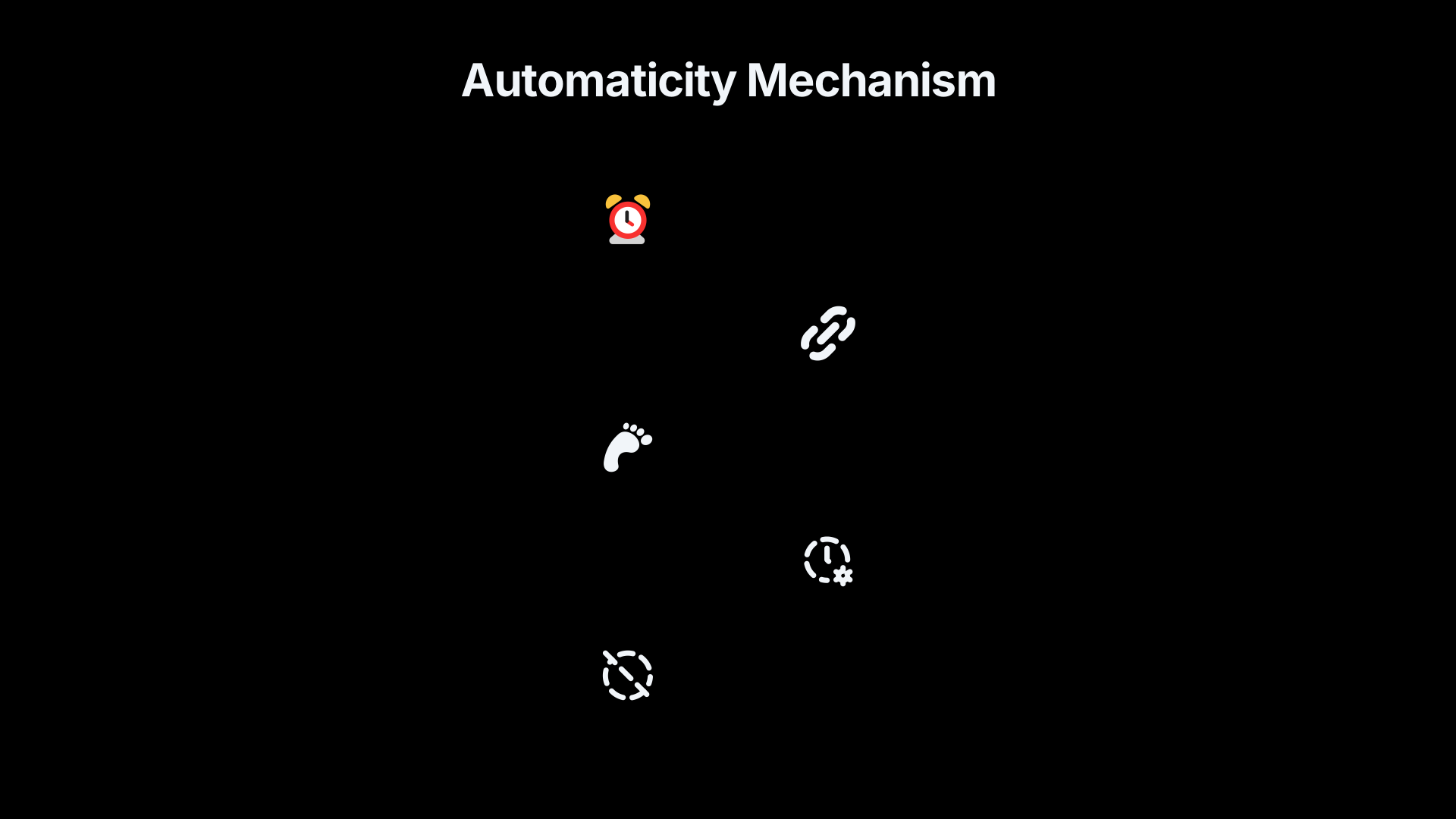
- The cue starts to prompt the behaviour. The action begins to feel more natural, immediate or “what I do here”, rather than a fresh decision each time.
This is why a tiny, repeatable behaviour often beats an ambitious, irregular one. “Do a full workout whenever I can” may be valuable, but it gives the mind a new scheduling problem every time. “Do ten press-ups after turning on the shower” is smaller, but it gives the brain a stable cue. For automaticity, the regularity of the cue-response pairing is often more important than the impressiveness of any single repetition.
Cue stability is not the same as a rigid life
A stable context does not require living like a machine. It means choosing an anchor that appears often enough to support learning. The most reliable anchors are usually existing routines, because they already happen without much debate. Breakfast, commuting, making coffee, plugging in a phone, opening a laptop, finishing dinner and brushing teeth are common habit anchors because they are already embedded in daily life.
The stronger design question is: “What will reliably happen immediately before this behaviour?” That question is more useful than “When will I feel motivated?” For example, a person trying to write more might test “after I open my laptop in the morning, I write one sentence before email”. A person trying to eat better might use “after dinner, I put tomorrow’s lunch container by the kettle”. A person trying to move more might use “after every meeting ends, I stand and stretch for one minute”.
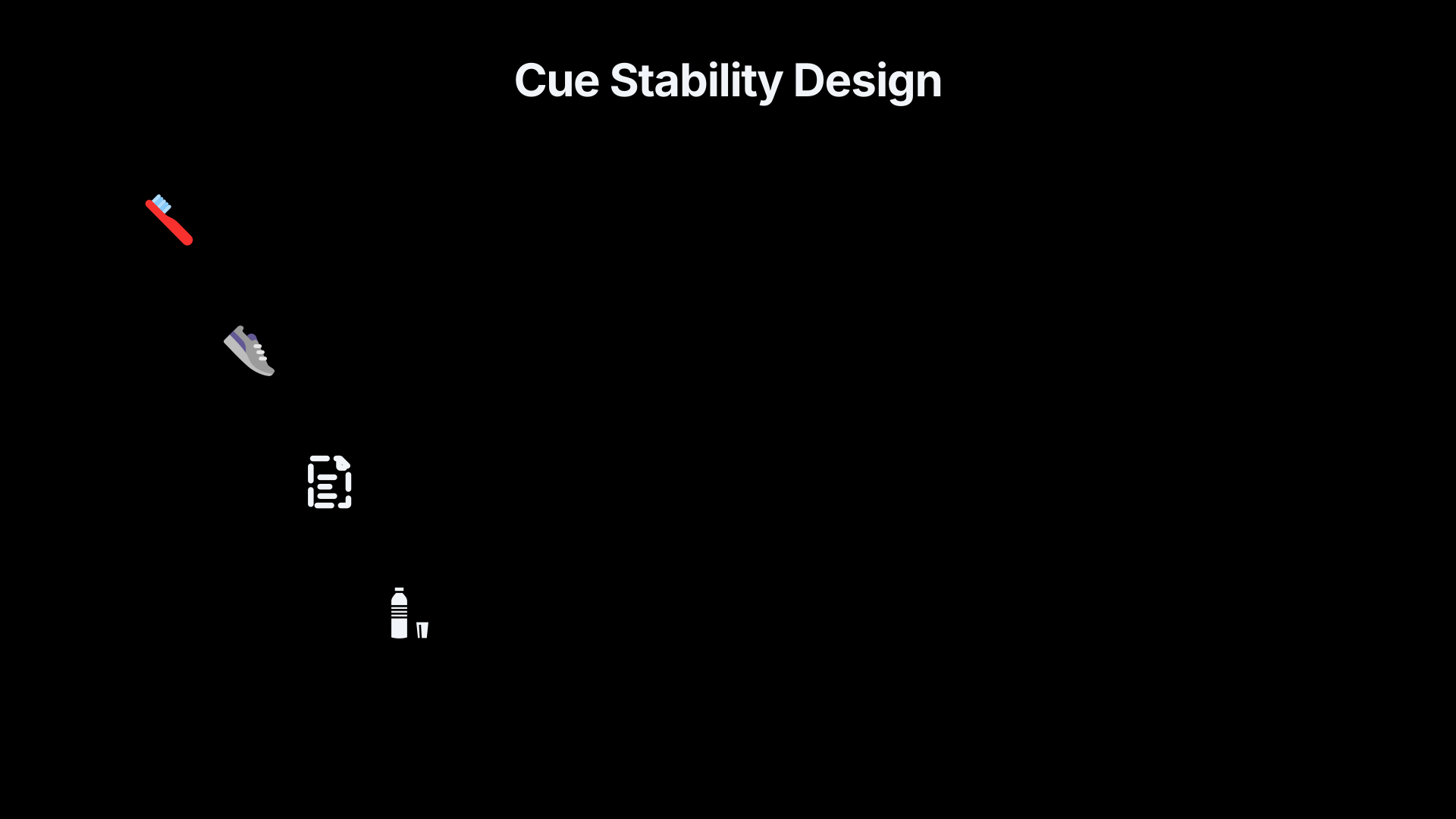
Stable cues also help because they reduce the need for memory. A calendar reminder can help, but a cue that is already part of the environment can be more durable. The toothbrush beside the sink, the book on the pillow, the gym bag in front of the door and the water bottle on the desk are not just props. They are attempts to make the desired behaviour easier to notice at the right moment.
The caution is that cue stability should not become perfectionism. A habit can survive some variation if the cue remains recognisable. “After breakfast” may work even when breakfast is at 7.30 on weekdays and 9.00 on weekends. “At exactly 7.00 in the same chair” may be helpful for some people, but too brittle for others. A good cue is stable enough to repeat and flexible enough to survive real life.
Simple behaviours become automatic more readily
Not all behaviours are equally habit-friendly. Drinking a glass of water after breakfast is easier to automate than completing a complicated workout, cooking a new recipe or writing for two hours. Research on behavioural complexity suggests that frequency, reward and contextual stability are all associated with automaticity, but complexity changes how easily those factors translate into habit strength. More complex behaviours may need clearer planning, simpler starting points or stronger environmental support.[Frontiers]frontiersin.orgFrontiers Habits, Quick and Easy: Perceived Complexity ModeratesFrontiers Habits, Quick and Easy: Perceived Complexity Moderates
This does not mean complex goals cannot become habitual. It means the automatic part may be the start of the routine rather than every detail inside it. Habit researchers distinguish between habitual instigation, where a cue automatically prompts the person to begin an action episode, and habitual execution, where the steps inside the behaviour also become automatic. This distinction helps explain why “going to the gym” can become a habit even if the exact workout still requires choices.[ScienceDirect]sciencedirect.comSource details in endnotes.
For self improvement, this distinction is powerful. The goal is often to automate the doorway, not the whole building. A person may not be able to make “write a brilliant chapter” automatic, but they can make “open the document after coffee” automatic. They may not make “eat perfectly” automatic, but they can make “put vegetables on the plate first” more automatic. They may not automate “be calm”, but they can automate “take three breaths before replying”.
This keeps habit design realistic. Automaticity is best used to reduce the number of decisions required to begin a valued behaviour. Once the behaviour has started, skill, judgement and attention may still matter. A stable cue does not replace competence; it helps the person show up often enough for competence to develop.
When routines break, habits lose their trigger
The same mechanism that makes stable contexts useful also explains why habits can collapse during travel, illness, holidays, moving house, job changes, exams, parenthood or disrupted sleep. If a habit depends on a cue, then removing the cue weakens the prompt. The person may still value the behaviour, but the environment no longer reminds them in the same way.
Research on habit discontinuity shows this clearly. Studies of context change have found that when usual performance contexts change, established habits can be disrupted because the recurring cues no longer appear in the same form. Work on students transferring to a new university, for example, examined behaviours such as exercising, newspaper reading and television watching, and found that habits were more likely to be disrupted when the old contextual cues changed.[PubMed]pubmed.ncbi.nlm.nih.govPsychology of Habitby W Wood · 2016 · Cited by 1909 — This review characterizes habits in terms of their cognitive, motivational, a…
This is frustrating when the habit is useful. Someone who exercises reliably at a gym near work may stop after changing jobs, not because their character changed, but because the cue-chain broke. The route, timing, bag, colleagues, building and post-work rhythm may all have been part of the habit architecture. Remove them, and the behaviour becomes a decision again.
But disruption can also create opportunity. The habit discontinuity hypothesis suggests that life changes can make people more attentive and deliberate because old routines are no longer cued so strongly. This is why moving home, starting a new job or changing commute can be a good moment to redesign routines, provided the person installs new cues quickly rather than waiting for motivation to settle everything.[ScienceDirect]sciencedirect.comSource details in endnotes.
How to design a stable context for a new habit
The practical question is not “How do I become disciplined?” but “What cue will reliably invite the next action?” A useful habit design starts small enough to repeat and specific enough to attach to a cue.
A strong cue-behaviour plan usually has four features:
- It follows an existing routine. “After brushing my teeth” is stronger than “sometime in the evening.”
- It names the first physical action. “Put on walking shoes” is clearer than “be healthier.”
- It keeps the first version small. “Read one page” is easier to repeat than “read for an hour.”
- It keeps the cue visible. A book on the pillow, a packed bag by the door or a water bottle on the desk makes the cue harder to miss.
The first version of a habit should often be deliberately underwhelming. That is not because small actions are morally superior, but because repetition is the raw material of automaticity. A behaviour that can be repeated after the same cue on tired days, busy days and low-motivation days has a better chance of becoming automatic than a grand behaviour that only happens when conditions are perfect.
The best test is: “Could this happen after the cue even on a normal bad day?” If the answer is no, the behaviour is probably too large, the cue too vague, or the environment too hostile. Shrinking the action is not failure; it is often the design move that makes repetition possible.
Why tracking should observe the cue, not just the outcome
Many habit trackers focus on streaks, but streaks can hide the mechanism that matters. For automaticity, the key question is not only “Did I do it?” but “Did I do it after the intended cue?” A person who meditates three times in a week at random moments may be practising a useful behaviour. A person who meditates after making morning coffee is also strengthening a specific cue-behaviour link.
This changes what should be observed. A simple tracker might include three columns: cue appeared, behaviour happened, and friction noticed. For example: “Finished dinner — packed lunch — no clean containers.” That record tells the person more than a bare tick or cross. It shows whether the cue is stable, whether the behaviour is realistic, and what environmental obstacle keeps interfering.
Researchers have also emphasised that habit should not be reduced to frequency alone. Measures such as the Self-Report Habit Index were developed because habit includes features of automaticity, not just a count of past behaviour. Later discussion in the field has sharpened this point: a behaviour can be frequent because it is planned, socially required or externally rewarded, while habit refers more specifically to automatic cue-triggered action.[Wiley Online Library]onlinelibrary.wiley.comOnline Library Modelling habit formation in the real worldWiley Online LibraryModelling habit formation in the real world - Lally - 2010by P Lally · 2010 · Cited by 3681 — Abstract To investigate…
For self improvement, this means a missed day should be interpreted carefully. Missing because the cue never appeared is different from missing because the cue appeared and the behaviour failed. The first suggests a context problem. The second suggests a friction, motivation, difficulty or competing-habit problem. Good tracking helps diagnose the routine rather than judge the person.
When automaticity helps, and when it is the wrong target
Habit automaticity is most useful for behaviours that benefit from regular repetition and low deliberation: taking medication, preparing the next day’s bag, walking after lunch, flossing, stretching, saving a small amount, reviewing a task list, reading before bed, or starting focused work. In these cases, thinking less can be an advantage. The behaviour is already endorsed; the problem is getting it to happen reliably.
Automaticity is less suitable when the behaviour requires careful judgement each time. Difficult conversations, creative strategy, medical decisions, financial commitments and emotionally loaded choices should not be reduced to mindless cue-response routines. Even there, however, a small preparatory habit can help: opening the budget, writing the first sentence, taking a pause before responding, or setting up the meeting notes.
There is also a risk that people use habit language to oversimplify change. Some behaviours are blocked by money, time, caring responsibilities, unsafe environments, mental health problems, pain, shift work or social pressure. A stable cue can help, but it cannot remove every constraint. Good self improvement does not pretend that all barriers are solved by personal routine design.
The strongest use of habit automaticity is therefore modest and practical. It does not say, “Automate your life.” It says, “Find the repeated moments where a better default would help, and make those moments easier to follow.” That is enough to matter. A stable cue, a small action and repeated practice can turn a valued behaviour from a daily negotiation into a familiar next step.

Amazon book picks
Further Reading
Books and field guides related to How Repetition Becomes Automatic. Use these as the next step if you want deeper reading beyond the article.
Atomic Habits
Rating: 3.5/5 from 7 Google Books ratings
Directly addresses cues, repetition and automaticity.
eBay marketplace picks
Marketplace Samples
Example marketplace items related to this page. Use the search link to explore similar finds on eBay.


Endnotes
1.
Source: pmc.ncbi.nlm.nih.gov
Link:https://pmc.ncbi.nlm.nih.gov/articles/PMC3505409/
Source snippet
Making health habitual: the psychology of 'habit-formation' and...by B Gardner · 2012 · Cited by 896 — Psychological theory and evide...
2.
Source: onlinelibrary.wiley.com
Title: Online Library Modelling habit formation in the real world
Link:https://onlinelibrary.wiley.com/doi/abs/10.1002/ejsp.674?page%3D1=
Source snippet
Wiley Online LibraryModelling habit formation in the real world - Lally - 2010by P Lally · 2010 · Cited by 3681 — Abstract To investigate...
3.
Source: pmc.ncbi.nlm.nih.gov
Link:https://pmc.ncbi.nlm.nih.gov/articles/PMC6667662/
4.
Source: sciencedirect.com
Link:https://www.sciencedirect.com/science/article/pii/S266651822200016X
5.
Source: sciencedirect.com
Link:https://www.sciencedirect.com/science/article/abs/pii/S0272494407000898
6.
Source: onlinelibrary.wiley.com
Title: j.1559 1816.2003.tb01951.x
Link:https://onlinelibrary.wiley.com/doi/10.1111/j.1559-1816.2003.tb01951.x
7.
Source: compass.onlinelibrary.wiley.com
Link:https://compass.onlinelibrary.wiley.com/doi/10.1111/spc3.12975
8.
Source: bpspsychub.onlinelibrary.wiley.com
Link:https://bpspsychub.onlinelibrary.wiley.com/doi/10.1111/bjhp.12504
9.
Source: sciencedirect.com
Link:https://www.sciencedirect.com/science/article/abs/pii/S002210311100254X
10.
Source: pubmed.ncbi.nlm.nih.gov
Link:https://pubmed.ncbi.nlm.nih.gov/26361052/
Source snippet
Psychology of Habitby W Wood · 2016 · Cited by 1909 — This review characterizes habits in terms of their cognitive, motivational, a...
11.
Source: cykelvaeksthuset.dk
Title: Cykelvæksthuset Promoting habit formation
Link:https://www.cykelvaeksthuset.dk/media/az3linp0/promoting-habit-formation.pdf
12.
Source: frontiersin.org
Title: Frontiers Habits, Quick and Easy: Perceived Complexity Moderates
Link:https://www.frontiersin.org/journals/psychology/articles/10.3389/fpsyg.2019.01556/full
13.
Source: pubmed.ncbi.nlm.nih.gov
Link:https://pubmed.ncbi.nlm.nih.gov/26991427/
14.
Source: pubmed.ncbi.nlm.nih.gov
Title: Pub Med Changing circumstances, disrupting habits
Link:https://pubmed.ncbi.nlm.nih.gov/15982113/
15.
Source: pubmed.ncbi.nlm.nih.gov
Link:https://pubmed.ncbi.nlm.nih.gov/17907866/
16.
Source: pubmed.ncbi.nlm.nih.gov
Link:https://pubmed.ncbi.nlm.nih.gov/42053513/
17.
Source: Wikipedia
Link:https://en.wikipedia.org/wiki/Habit
18.
Source: Wikipedia
Link:https://en.wikipedia.org/wiki/Wood
19.
Source: dictionary.cambridge.org
Link:https://dictionary.cambridge.org/dictionary/english/habit
20.
Source: frontiersin.org
Link:https://www.frontiersin.org/journals/psychology/articles/10.3389/fpsyg.2022.883795/full
21.
Source: apa.org
Link:https://www.apa.org/monitor/jun05/habits
22.
Source: coachpedropinto.com
Title: habit formation
Link:https://coachpedropinto.com/habit-formation/
23.
Source: oxford-review.com
Title: Habit Formation
Link:https://oxford-review.com/habit-formation-what-the-neuroscience-is-saying/
Additional References
24.
Source: ucl.ac.uk
Title: how long does it take form habit
Link:https://www.ucl.ac.uk/news/2009/aug/how-long-does-it-take-form-habit
Source snippet
University College LondonHow long does it take to form a habit?4 Aug 2009 — It takes an average 66 days to form a new habit, according to...
25.
Source: cambridge.org
Link:https://www.cambridge.org/core/books/handbook-of-behavior-change/changing-behavior-using-habit-theory/5F222BC3AF6ADD9A8307BBB726D43F5C
Source snippet
Cambridge University Press & AssessmentChanging Behavior Using Habit Theory (Chapter 13)Evidence shows that established habits are cue-co...
26.
Source: youtube.com
Title: Habit Stacking: The Science of Linking Habits for Automatic Behavior
Link:https://www.youtube.com/watch?v=PvU2oC7mfEQ
Source snippet
2 The secret habits that control your life | Wendy Wood...
27.
Source: youtube.com
Title: The Habit Loop Decoded: Why 43% of Your Daily Life Runs on Autopilot
Link:https://www.youtube.com/watch?v=7f5YpjXPdJw
Source snippet
4 Dr. Wendy Wood: Good Habits, Bad Habits (Hidden Gem)...
28.
Source: youtube.com
Title: The secret habits that control your life | Wendy Wood
Link:https://www.youtube.com/watch?v=FoAODalKhv8
Source snippet
3 The Habit Loop Decoded: Why 43% of Your Daily Life Runs on Autopilot...
29.
Source: academia.edu
Link:https://www.academia.edu/1237676/A_new_look_at_habits_and_the_habit_goal_interface
30.
Source: researchgate.net
Link:https://www.researchgate.net/publication/7762000_Changing_Circumstances_Disrupting_Habits
31.
Source: researchgate.net
Link:https://www.researchgate.net/publication/322222649_Habit_Formation_and_Change
32.
Source: researchgate.net
Link:https://www.researchgate.net/publication/342379317_Does_habit_weaken_the_relationship_between_intention_and_behaviour_Revisiting_the_habit-intention_interaction_hypothesis
33.
Source: researchgate.net
Link:https://www.researchgate.net/publication/362509175_Habit_and_behavioural_complexity_habitual_instigation_and_execution_as_predictors_of_simple_and_complex_behaviours
Topic Tree