Within Apologies
How to Catch Hurt Before It Hardens
Small shifts in tone, silence, or defensiveness can signal a rupture early enough for repair to stay simple.
On this page
- Common cues that a rupture has happened
- Why intention impact gaps need quick repair
- How defensiveness can become a useful prompt
Page outline Jump by section
Introduction
Most relationship damage does not begin with a major betrayal. It begins with a small moment of hurt that goes unnoticed, unacknowledged, or defended against. By the time someone explicitly asks for an apology, they may already have spent days or weeks building a story about what happened and what it means about the relationship.
 Spotting apology cues early is therefore less about mind-reading and more about noticing signals that a rupture may have occurred. Research on relationship repair suggests that successful relationships are not conflict-free; they are characterised by frequent, early repair attempts that prevent negative emotions from escalating. The earlier a repair begins, the less emotional weight an apology has to carry.[The Gottman Institute]gottman.comr is for repairThe Gottman InstituteR is for Repair3 Sept 2014 — Gottman describes a repair attempt as “any statement or action — silly or otherwise — t…[2YES! Magazine]yesmagazine.orgrepair relationships apologyThis Is Better Than an Apology31 Dec 2019 — John Gottman had newlywed couples enter into a 15-minute conflict discussion and coded their…
Within the broader practice of apologising before resentment hardens, the key skill is learning to recognise when hurt is present before it becomes a grievance.
Common Cues That a Rupture Has Happened
People rarely announce hurt in a clear and direct way. More often, it appears through subtle behavioural changes.
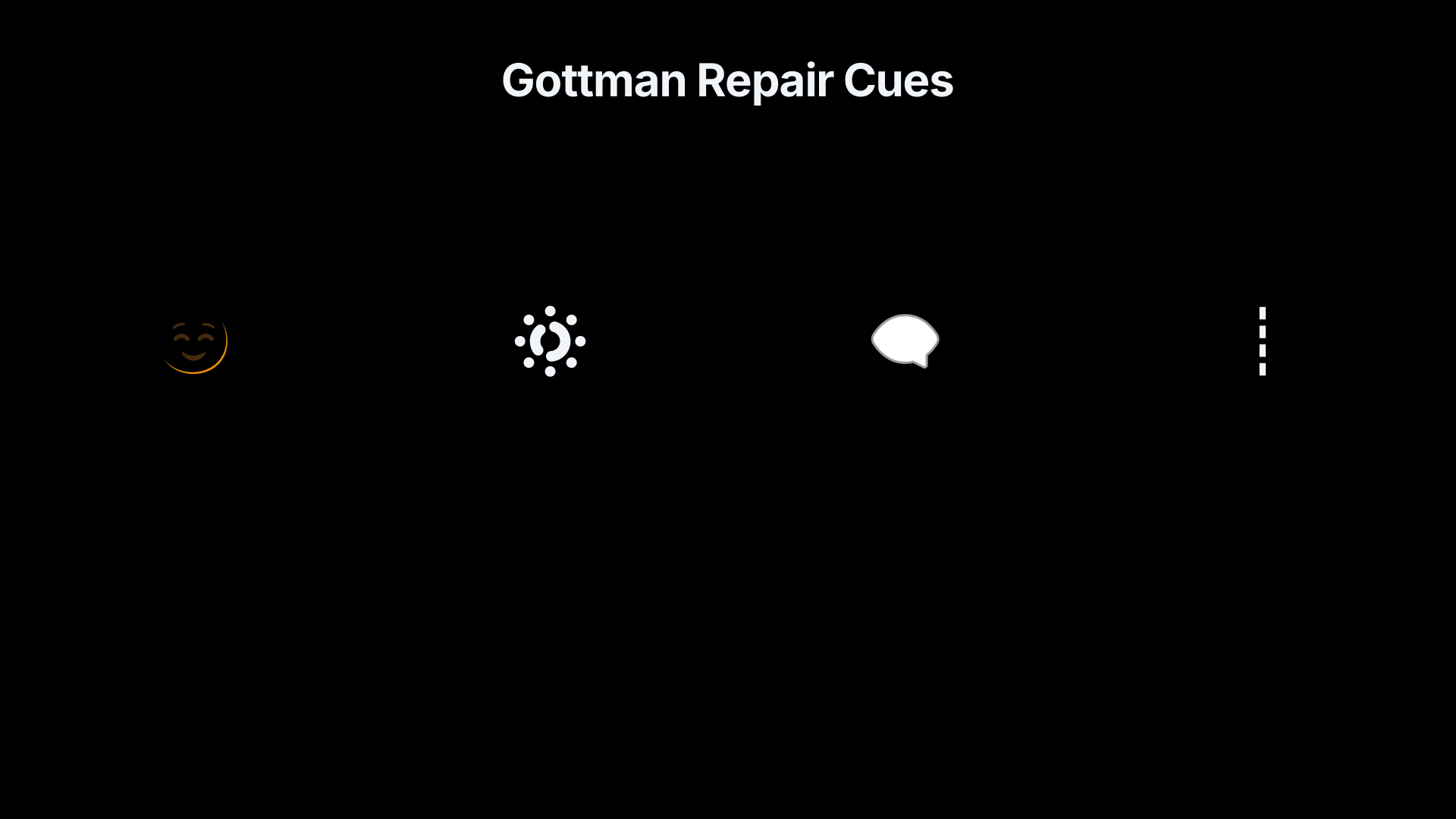
A sudden drop in warmth is one of the most reliable clues. A friend who normally responds enthusiastically may become brief. A colleague who usually collaborates openly may become unusually formal. A partner may stop elaborating, stop joking, or stop volunteering thoughts. These shifts do not automatically mean you caused harm, but they are signals worth investigating rather than dismissing.
Other common cues include:
- A conversation that abruptly loses energy after a comment.
- Repeated references to the same incident.
- Increased irritability around a particular topic.
- Sarcasm replacing straightforward communication.
- Withdrawal, silence, or emotional distance.
- Statements such as “Never mind” or “It doesn’t matter” that sound unresolved.
What makes these cues important is not that they prove wrongdoing. They indicate that the emotional meaning of an interaction may differ between the people involved. A repair attempt at this stage can be as simple as asking, “I feel like something landed badly. Did I miss something?” That small intervention often prevents assumptions from becoming settled conclusions.[The Gottman Institute]gottman.comr is for repairThe Gottman InstituteR is for Repair3 Sept 2014 — Gottman describes a repair attempt as “any statement or action — silly or otherwise — t…[The Gottman Institute]gottman.comr is for repairThe Gottman InstituteR is for Repair3 Sept 2014 — Gottman describes a repair attempt as “any statement or action — silly or otherwise — t…
Why Intention–Impact Gaps Need Quick Repair
Many conflicts are not disputes about facts. They are disputes about meaning.
One person focuses on intention: “I was joking.” The other focuses on impact: “I felt humiliated.” Both statements can be true simultaneously.
A common mistake is to treat good intentions as evidence that no apology is required. Yet hurt frequently emerges from mismatches between intended and actual effects. When the person who caused the impact immediately argues about intent, the injured person often experiences a second injury: the feeling that their reaction is being challenged or dismissed.
Research on effective apologies consistently finds that acknowledging responsibility and addressing harm matter more than elaborate explanations. People tend to respond better when they feel their experience has been recognised rather than debated.[Ohio State News]news.osu.eduOhio State NewsThe 6 elements of an effective apology, according to scienceExpression of regret · 2. Explanation of what went wrong · 3. Acknowledgment of responsibility · 4. Declaration of repentance · 5. Offer…[Association for Psychological Science]psychologicalscience.orgeffective apologies include six elementsAssociation for Psychological ScienceEffective Apologies Include Six Elements24 May 2016 — Expression of regret; Explanation of what went…
Consider the difference:
- “I didn’t mean it that way.”
- “I didn’t mean it that way, but I can see that it hurt you.”
The first statement centres the speaker’s intentions. The second creates room for both realities. Early repair is often nothing more complicated than recognising that impact deserves attention even when harm was unintended.
How Hurt Becomes a Grievance
A grievance is usually not a single emotional reaction. It is hurt that has acquired a narrative.
Initially, someone may think, “That comment upset me.” Later, if nothing addresses the rupture, the interpretation can expand:
- “They don’t listen.”
- “They always do this.”
- “My feelings do not matter to them.”
Once the story shifts from a specific incident to a judgement about character or commitment, repair becomes more difficult. The discussion is no longer about one event; it is about accumulated evidence.
Relationship researchers have long noted the importance of repair attempts because they interrupt this escalation process. Small acknowledgements, clarifications, expressions of concern, or apologies can stop negative interpretations from becoming entrenched.[The Gottman Institute]gottman.comr is for repairThe Gottman InstituteR is for Repair3 Sept 2014 — Gottman describes a repair attempt as “any statement or action — silly or otherwise — t…[2YES! Magazine]yesmagazine.orgrepair relationships apologyThis Is Better Than an Apology31 Dec 2019 — John Gottman had newlywed couples enter into a 15-minute conflict discussion and coded their…
This is why waiting for certainty can be costly. Many people delay apologising until they have fully analysed who was right. By then, the other person’s emotional experience may have moved far beyond the original issue.

How Defensiveness Can Become a Useful Prompt
One of the strongest apology cues often comes from within rather than from the other person.
Defensiveness tends to appear when a person’s self-image feels threatened. The internal dialogue may sound familiar:
- “That’s unfair.”
- “They’re overreacting.”
- “Now I’m being blamed for everything.”
- “But that’s not what I meant.”
These reactions are normal. The problem is not feeling defensive; the problem is treating defensiveness as proof that no repair is needed.
Research from the Gottman Institute identifies defensiveness as one of the communication patterns that commonly escalates conflict because it shifts attention away from the other person’s experience and towards self-protection.[The Gottman Institute]gottman.comr is for repairThe Gottman InstituteR is for Repair3 Sept 2014 — Gottman describes a repair attempt as “any statement or action — silly or otherwise — t…
A more productive approach is to use defensiveness as a cue rather than a conclusion.
Instead of asking, “How do I prove I wasn’t wrong?” ask:
- “What part of this interaction might have hurt them?”
- “What are they reacting to that I may not be seeing?”
- “Can I acknowledge the impact before explaining myself?”
This mental shift often creates enough space for a genuine apology to emerge.
The Fastest Repair Questions
When early signs of hurt appear, lengthy analysis is usually unnecessary. A few simple questions can reveal whether repair is needed:
- “Did something I said come across differently than I intended?”
- “You seem quieter than usual. Are you okay with what happened?”
- “I think I may have missed the impact of that conversation.”
- “Is there something you wish I had done differently?”
These questions matter because they signal openness before resentment forms. They communicate that preserving the relationship is more important than protecting pride.
Importantly, they are not admissions of guilt. They are invitations to understanding. If no hurt occurred, little is lost. If hurt did occur, the door to repair opens while the problem is still small.
Catching the Moment Before It Hardens
The most effective apologies are often the least dramatic. They happen before someone has rehearsed their disappointment, before silence becomes distance, and before a single incident becomes evidence of a pattern.
The practical skill is learning to notice deviations: the pause after a joke, the unexpected withdrawal, the repeated mention of a comment, or the surge of your own defensiveness. These are not proofs that you have done something wrong. They are cues that a relationship may need attention.
People who repair early are not necessarily more virtuous than everyone else. They are simply quicker to recognise that relationships are shaped by countless small moments of adjustment. A brief acknowledgement today can prevent a much larger apology tomorrow.[The Gottman Institute]gottman.comr is for repairThe Gottman InstituteR is for Repair3 Sept 2014 — Gottman describes a repair attempt as “any statement or action — silly or otherwise — t…[2verilymag.com]verilymag.comrepair attempts apologiesHere's Why 'Repair Attempts' Are Even More Powerful Than…31 Mar 2017 — These “repair attempts,” as Gottman puts it, could mean saying…
Amazon book picks
Further Reading
Books and field guides related to How to Catch Hurt Before It Hardens. Use these as the next step if you want deeper reading beyond the article.
The Seven Principles For Making Marriage Work
Emphasises repair attempts before conflicts harden.
eBay marketplace picks
Marketplace Samples
Example marketplace items related to this page. Use the search link to explore similar finds on eBay.






Endnotes
1.
Source: gottman.com
Title: r is for repair
Link:https://www.gottman.com/blog/r-is-for-repair/
Source snippet
The Gottman InstituteR is for Repair3 Sept 2014 — Gottman describes a repair attempt as “any statement or action — silly or otherwise — t...
2.
Source: gottman.com
Title: The Gottman Institute Manage Conflict: Repair and De-Escalate Dr
Link:https://www.gottman.com/blog/manage-conflict-repair-and-de-escalate/
Source snippet
John Gottman's scientific studies involving thousands of couples have revealed the usefulness of several constructive steps to making and...
3.
Source: gottman.com
Link:https://www.gottman.com/blog/the-four-horsemen-recognizing-criticism-contempt-defensiveness-and-stonewalling/
Source snippet
The Gottman InstituteThe Four Horsemen: Criticism, Contempt, Defensiveness...31 Mar 2026 — Defensiveness will only escalate the conflict...
4.
Source: gottman.com
Title: its not my fault why defensiveness is damaging
Link:https://www.gottman.com/blog/its-not-my-fault-why-defensiveness-is-damaging/
Source snippet
'It's Not My Fault!': Why Defensiveness is Damaging31 Mar 2022 — Defensiveness is the "horsemen" that escalates conflict. See why it hurt...
5.
Source: verilymag.com
Title: repair attempts apologies
Link:https://verilymag.com/relationships/repair-attempts-apologies/
Source snippet
Here's Why 'Repair Attempts' Are Even More Powerful Than...31 Mar 2017 — These “repair attempts,” as Gottman puts it, could mean saying...
6.
Source: gottman.com
Title: the art of the mindful apology why sorry is not enough
Link:https://www.gottman.com/blog/the-art-of-the-mindful-apology-why-sorry-is-not-enough/
Source snippet
This is a process of compassionate communication that takes two of you, not just the one who messed up.Read more...
7.
Source: gottman.com
Title: how we used the aftermath of a fight to repair our relationship
Link:https://www.gottman.com/blog/how-we-used-the-aftermath-of-a-fight-to-repair-our-relationship/
Source snippet
How We Used the Aftermath of a Fight to Repair Our...9 Jan 2019 — As John Gottman's research has shown, it's not you fight about that ma...
8.
Source: gottman.com
Link:https://www.gottman.com/about/research/
Source snippet
ResearchGottman and Levenson discovered that couples interaction had enormous stability over time (about 80% stability in conflict discus...
9.
Source: complicated.life
Title: how to apologise rupture and repair in relationships
Link:https://complicated.life/blog/how-to-apologise-rupture-and-repair-in-relationships/
Source snippet
How to Apologise: Rupture and Repair in Relationships25 Jun 2025 — Repair in relationships is about recognising when there's been a ruptu...
10.
Source: yesmagazine.org
Title: repair relationships apology
Link:https://www.yesmagazine.org/health-happiness/2019/12/31/repair-relationships-apology
Source snippet
This Is Better Than an Apology31 Dec 2019 — John Gottman had newlywed couples enter into a 15-minute conflict discussion and coded their...
11.
Source: news.osu.edu
Title: Ohio State NewsThe 6 elements of an effective apology, according to science
Link:https://news.osu.edu/the-6-elements-of-an-effective-apology-according-to-science/
Source snippet
Expression of regret · 2. Explanation of what went wrong · 3. Acknowledgment of responsibility · 4. Declaration of repentance · 5. Offer...
12.
Source: psychologicalscience.org
Title: effective apologies include six elements
Link:https://www.psychologicalscience.org/news/minds-business/effective-apologies-include-six-elements.html
Source snippet
Association for Psychological ScienceEffective Apologies Include Six Elements24 May 2016 — Expression of regret; Explanation of what went...
Published: May 2016
13.
Source: facebook.com
Link:https://www.facebook.com/GottmanInstitute/posts/how-many-times-do-we-try-to-repair-after-a-fight-before-we-admit-its-not-working/1279613770880288/
14.
Source: facebook.com
Link:https://www.facebook.com/GottmanInstitute/posts/its-tough-to-find-the-right-words-after-a-stressful-period-of-time-or-after-an-a/315972080577800/
Source snippet
The Gottman InstituteIt’s tough to find the right words after a stressful period of time or after an argument, but repair attempts are ke...
15.
Source: facebook.com
Link:https://www.facebook.com/GottmanInstitute/posts/making-amends-takes-more-than-an-apology-it-takes-deep-listening-emotional-attun/1141655488009451/
Source snippet
The Gottman InstituteMaking amends takes more than an apology, it takes deep listening, emotional attunement, and a commitment to rebuild...
Additional References
16.
Source: couplestherapyinc.com
Link:https://couplestherapyinc.com/gottman-repair-attempts/
Source snippet
Gottman Repair AttemptsLearning to fight well and repair relationship conflicts before they spiral out of control is a skill. It's one of...
17.
Source: medium.com
Link:https://medium.com/p-s-i-love-you/how-to-make-repair-attempts-so-your-partner-feels-loved-3f62d9e2a473
Source snippet
How to Make Repair Attempts So Your Partner Feels LovedA repair attempt is any statement or action — verbal, physical, or otherwise — mea...
18.
Source: mylifepsychologists.com.au
Link:https://mylifepsychologists.com.au/relationship-conflict-the-art-of-repair/
Source snippet
Relationship Conflict: The Art of RepairAccording to Dr John Gottman, a renowned relationships researcher, repair attempts are the “happy...
19.
Source: researchgate.net
Link:https://www.researchgate.net/publication/387412229_Development_of_the_Repair_Attempts_Scale_A_Validity_and_Reliability_Study
Source snippet
Development of the Repair Attempts Scale: A Validity and...1 May 2026 — This study aimed to develop and test a Repair Attempts Scale to...
Published: May 2026
20.
Source: facebook.com
Title: couples who make repair attempts are both willing to admit responsibility for th
Link:https://www.facebook.com/GottmanInstitute/posts/couples-who-make-repair-attempts-are-both-willing-to-admit-responsibility-for-th/679488920892779/
Source snippet
Couples who make repair attempts are both willing to admit...Couples who make repair attempts are both willing to admit responsibility f...
21.
Source: youtube.com
Link:https://www.youtube.com/watch?v=SqPvgDYmJnY
Source snippet
Relationship Repair that Works | Dr. John GottmanDr. Gottman describes how the "masters" of relationships make repairing their relationsh...
22.
Source: facebook.com
Link:https://www.facebook.com/GottmanInstitute/posts/every-couple-faces-conflict-but-what-matters-most-is-how-they-repairdr-john-gott/1043357967839204/
Source snippet
Dr. John Gottman found that the success or failure of repair attempts is a key predictor...
23.
Source: howcommunicationworks.com
Title: relationship communication john gottmans repair attempts
Link:https://www.howcommunicationworks.com/blog/2021/1/4/relationship-communication-john-gottmans-repair-attempts
Source snippet
Relationship Communication: John Gottman's Repair...4 Jan 2021 — I'm going to give you a list of exact phrases you can use to repair the...
24.
Source: lakemichigandates.com
Link:https://www.lakemichigandates.com/blog/gottman-repair-4-steps-to-apology
Source snippet
The Gottman Apology for Travel: 4 Steps to Repair After Conflict22 Oct 2025 — The Gottman apology is a structured way of repairing after...
25.
Source: bristolcbt.co.uk
Link:https://www.bristolcbt.co.uk/publications/the-cycle-of-rupture-and-repair-in-close-relationships/
Source snippet
He describes repair attempts as “any statement or action —...Read more...
Topic Tree